PuniCodex

Extended Lore

Whiro

Etymology · Orthography · Cult · Iconography · Reception · Sources

Tier 2 Whiro
Whiro — Darkness, Evil
01

Quick Facts

Essential information about Whiro, Darkness, Evil

Scholarly TransliterationWhiro
Unicode RestorationWhiro
Reconstructed Pronunciation/ˈfi.ɾo/
PantheonPolynesian
DomainDarkness, Evil
MeaningThe lizard of death
ClassificationTier 2
Primary DomainWhiro
Sacred SymbolsThe Lizard (Moko/Ngarara), The Night (Pō), The War-Party of Spirits, Sickness (Mate), The Underworld Path
02

Etymology & Word Family

From original script to Unicode restoration

Scholarly Transliteration Whiro Whiro — "The lizard of death"
Unicode Restoration Whiro Canonical scholarly spelling — ASCII-identical
Modern ASCII whiro Plain-ASCII fallback

The name Whiro reaches the modern world through scholarly transliteration of the polynesian tradition. Because the conventional spelling uses only Latin letters, its Unicode and ASCII forms coincide — the tradition it carries is in the name itself, not in diacritics.

03

Unicode Character Breakdown

Character-by-character philological analysis

CharacterUnicodeNameBlockPhonetic Role
WU+0057Latin Capital Letter WBasic LatinSame, capitalized
hU+0068Latin Small Letter HBasic LatinSame
iU+0069Latin Small Letter IBasic LatinSame
rU+0072Latin Small Letter RBasic LatinSame
oU+006FLatin Small Letter OBasic LatinSame

The Tier 2 classification here reflects fidelity to the attested tradition, not recovered diacritics: every character of Whiro already survives in ASCII. What the restoration preserves is the canonical spelling itself — the form scholarship standardised.

04

Cult & Worship

How the sacred was kept — rites, sanctuaries, remains

The Cult

Whiro was never worshipped, and honesty requires beginning there: no marae was dedicated to him, no priesthood served him, no offering was ever laid in his name. He is the rare figure in this catalog whose 'cult' is a system of defenses against him. What the nineteenth-century sources document is the apparatus of avoidance and exorcism that his existence mandated. The dying were never left alone: kin kept vigil through the last hours, Best records, so that the soul's journey began rightly — a misstep on the path meant falling among the powers that answered to Whiro rather than to one's own people. The sickbed was his battleground, and the tohunga's curing rites — their interrogation of which atua sent this, their incantations driving the intruder out — were the working liturgy of the war against him. A lizard in the house was an omen to be countered; night errands were hedged with caution. His worship is everything done to make him unnecessary.

In the Earth

As with most Māori atua, there is no material representation of Whiro: Māori religion was aniconic, and no carving, amulet, or structure is identified with him — the dread of his likeness would itself have been a contradiction. The relevant archaeology is contextual: the carved meeting houses whose pou (posts) embody ancestors of light, set against the prohibitions and ritual zones around burial caves and urupā, where his jurisdiction was strongest. Traditional Māori rock art and tattoo (tā moko) employ curvilinear forms sometimes read as reptilian, but attributing them to Whiro exceeds the evidence. The 'sites' of Whiro are instead the documented places of night practice — the sickbed, the burial ground, the lizard-haunted gully — mapped for us by Best's ethnography rather than by excavation.

05

Iconography

How Whiro was imaged across the ages

The Image

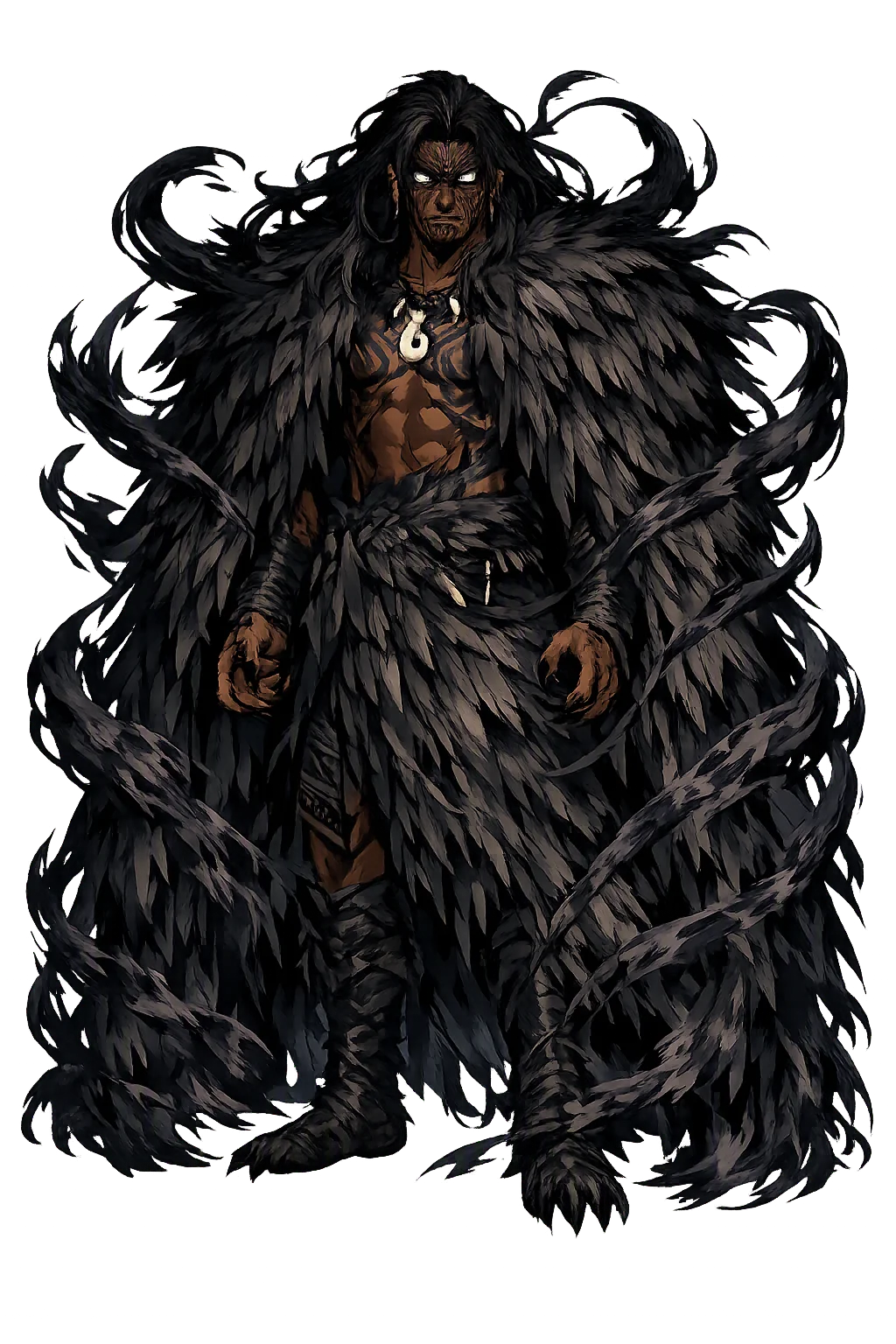
No image of Whiro survives, and Māori religion seems to have forbidden one by logic rather than by rule: the personification of darkness had no business taking shape in a carving. The great tradition of whakairo — the carved meeting houses whose posts embody named ancestors of light and lineage — allocated its art to the other side of the cosmos; the night-side god entered neither post nor lintel legend. What stands for him in the material record are the guarded places of his jurisdiction: the burial caves and urupā hedged with tapu, the sickbed, the gully where lizards basked — sites ethnography mapped rather than excavation revealed. Curvilinear reptilian forms do wind through Māori rock art and surface design, and the ngarara of his kinship gave artists a natural emblem; but not one carving, tattoo pattern, or ornament can be assigned to him by name. His iconography is therefore negative space — the figure missing from every meeting house, which is itself a precise theological statement about which powers get faces.

06

Reception & Transformation

The name after its own age — transmission, translation, survival

Afterlives

Whiro's entire transmission is a single century of salvage. He exists in writing because the nineteenth century wrote him down: George Grey's Polynesian Mythology (1855), translated from Māori texts dictated by Te Rangikāheke and other experts, carried the war over the baskets of knowledge to London and the world; John White's Ancient History of the Maori (1887–90) stacked variant traditions volume on volume; and Elsdon Best's Tūhoe (1925), the fruit of decades among the Tūhoe people, preserved their battle-lines and the dread office in Rarohenga. The comparative philologists joined in — Tregear's Maori-Polynesian Comparative Dictionary (1891) set his name beside Tahitian Hiro — and the dictionary tradition, from Williams through Biggs, kept the word itself on the scholarly record. The written corpus then passed into the keeping of modern Māori studies, which reads it against the living language and the renaissance of carving and oratory — checking the Victorian framing against the cosmology's own balance rather than Christianity's. Outside Polynesian studies his footprint is deliberately small: a culture that refused him images also refused him a mythology of praise, so his afterlife rides entirely on the ethnographers' notebooks. Which is fitting. The god of night survives, like night, only by being accurately described.

Identifications Across Traditions

The missionaries who translated Māori cosmology reached immediately for their own devil — and George Grey's English Polynesian Mythology (1855) already frames Whiro as a 'personification of evil' in Victorian moral vocabulary, a reading modern scholarship (Orbell; Craig) treats as an over-Christianization of a more ambivalent figure. Whiro is darkness and death, but Māori tradition also treats night as generative — the Pō is where spirits dwell and from which thought ascends — so his 'evil' is an office in a balanced cosmos, not a fallen angel's rebellion. In the modern renaissance, Whiro has been reclaimed as exactly that: a necessary power, appearing as an antagonist in Māori-language fiction, film, and graphic narrative where a culture works out its relationship to sickness, night, and fear on its own terms rather than Christianity's.

Modern Legacy

Whiro was never worshiped — he had no marae, no priesthood, no offering; his 'cult' is a vocabulary of avoidance and exorcism. His legacy runs through language and practice instead: the fear of lizards as omens, the ritual cautions of the night, and the entire therapeutic tradition of the tohunga, whose first question — which atua did this? — assumes his world. In the twentieth and twenty-first centuries Whiro has become a figure of the Māori cultural renaissance: a dignified, fully Māori face for the dark side of existence, used in health frameworks that treat illness within a Māori cosmology (te ao Māori models of wellbeing explicitly name and counter the atua of affliction). A god nobody prayed to thus shapes how a people still prays for health — his lasting temple is the rite that casts him out.

07

The Meditation

What Whiro means — beyond the dictionary

Whiro is a lesson in how a culture personifies what it fears without worshiping it. The Greeks had Éris; the Māori have Whiro — a being defined entirely by opposition, known through the myths of his defeats. Yet the Māori construction is subtler than a devil: Whiro is not fallen but resident — darkness is part of the building, the Pō beneath the Ao, and a cosmos without him would be a day without night, unthinkable and infertile. His myths are therefore really about the other side: Tāne's knowledge matters because Whiro contested it; the tohunga's cure works because Whiro sent the sickness. To study Whiro is to study a people's map of dread — lizards, wasting illness, the path of the dead — drawn with such precision that the map became the means of rescue. Fear, given a genealogy, can be argued with.

08

Frequently Asked Questions

Common questions about Whiro, Darkness, Evil, and Unicode restoration

01How do you pronounce Whiro?

In reconstructed pronunciation, Whiro is /ˈfi.ɾo/ — approximately 'FEE-roh' — the wh is an f-sound in most modern Māori, and the r is trilled.

02What does Whiro mean?

Whiro means The lizard of death in the polynesian tradition.

03What are the symbols of Whiro?

Whiro is associated with The Lizard (Moko/Ngarara) (His embodied kin — reptiles were feared as carriers of his malign influence (hence 'the lizard of death')), The Night (Pō) (His domain — the darkness that preceded light and that receives the dead), The War-Party of Spirits (The host of atua he leads against the worlds of light, named in accounts of Tāne's battles), Sickness (Mate) (The weapon he hurls — illness conceived as an invading atua to be fought and expelled), The Underworld Path (The descent to Rarohenga over which, in some traditions, he holds final power).

04Why restore Whiro in Unicode?

Whiro is written entirely in ASCII letters, so its restoration is about canonical fidelity rather than recovered diacritics: the temple fixes the name in its scholarly standard spelling, attested in the source tradition, instead of leaving it to drift.

05What is the most important myth about Whiro?

“The War Over the Baskets of Knowledge” — the The Rival of Tāne story that anchors the mythology of Whiro, told in full on the lore page.

09

Scholarly Sources

The philological foundations of this restoration

Every claim on this page is grounded in established scholarship. The orthographic restorations follow disciplinary convention. The etymological chain follows the best available reference works. This is not invention — it is resurrection through scholarship.

◈

Lexicography & Philology

  • Grey
  • Best
◎

Primary Texts

  • Primary sources in the polynesian tradition for Whiro.
◉

Archaeology & Art History

  • Material evidence — iconography, inscriptions, and temple archaeology — for Whiro and related cults.
✦

Religious Studies

  • Grey, Polynesian Mythology / Nga Mahi a nga Tupuna (1855)
  • Best, Tūhoe: The Children of the Mist (1925)
  • White, The Ancient History of the Maori (1887–90)
  • Orbell, A Concise Encyclopedia of Māori Myth and Legend (1998)
  • Craig, Dictionary of Polynesian Mythology (1989)
Return

The Surface Awaits

You have traced the name from its earliest attestation to its Unicode restoration. Now return to the myth. The story is where the name lives.

Back to Lore
Whiro mascot