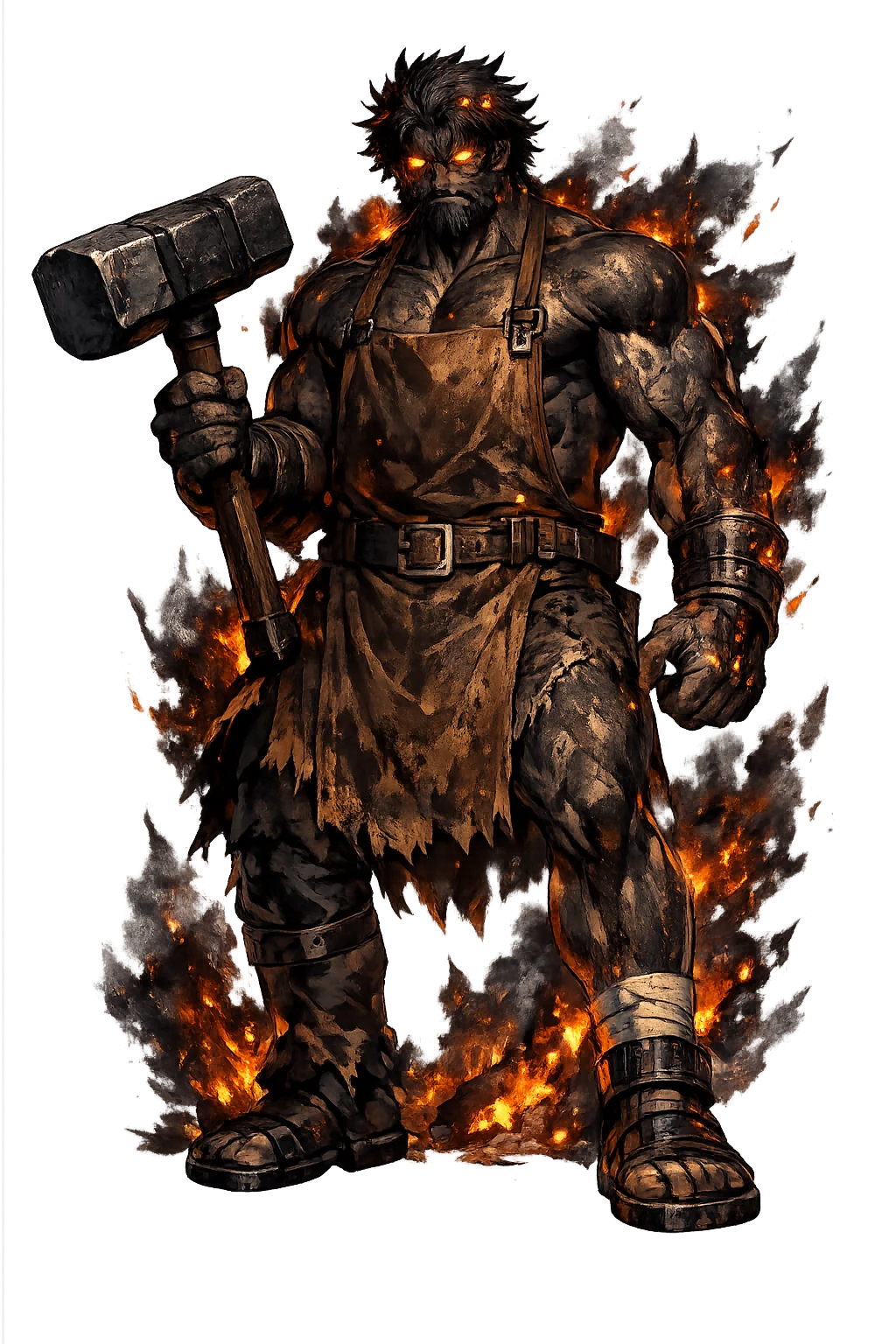
Stories of Vulcānus
Roman myth borrowed Hēphaistos' stories for him, but his cult is older and darker than the smith of Olympos: Vulcānus is first the fire that must be averted. The myths Rome gave him are the comedies and commissions of the forge — the net that caught Venus and Mars, the chair that bound Iūnō, the shield that carried Rome's future — played against a festival that treated him, above all, as a danger to be bought off.
At the Volcanalia of August 23, when the stored grain stood at its driest and the city's risk of fire peaked, the Romans kindled bonfires for Vulcānus and threw live fish into the flames. Plutarch, puzzling over the rite in his Roman Questions (47), records the substitution plainly: the fish — creatures of the opposite element — were consumed in place of living things, so that the fire's hunger was answered without paying it a human debt. The calendars fixed the day; the antiquarians explained it as aversion — not celebration of the flame but insurance against it, Rome's premium paid in water-creatures at the hottest point of the year.
It is propitiation, not praise — the rite of a people who had decided that their god of fire was mostly dangerous, and who worshipped him accordingly: at arm's length, with a substitute ready.
The finest comedy in the mythic stock became Roman property. Vulcānus, told by the Sun of his wife Venus' affair with Mars, forged a net of bronze links finer than spider-silk and spread it unseen over the marriage bed; the lovers were caught and exhibited, and the gods — Ovid tells it in the Metamorphoses (4.171–189) — crowded to see the war-god shamed and laughed until they wept. In the Odyssey the story belongs to Hēphaistos and Ares; Rome received it wholesale but kept its own moral: craft, not force, is the smith's justice, and the net that humiliates Mars is the same ingenuity that arms Aeneas.
The myth stayed funny for two thousand years precisely because the humiliation is just: the god of war, disarmed by a cuckold's patience, is force submitting to art.
The Roman cycle kept the revenge of the lame smith on the mother who had thrown him from heaven. Vulcānus, scorned at birth and hurled from Olympos, answered with a gift: a golden throne for Iūnō, which seized her fast the moment she sat — springs, bands and hidden fetters closing on the queen of the gods. No one could free her; only the smith could, and the smith would not. In the Greek original the wine-god Bacchus, sent to fetch the exile, got him drunk and led him home laughing; Roman retellings kept the chair, the wine and the limping return. The scholia to Homer's Iliad (1.590) and the mythographers preserve the Greek frame, and the scene of the trapped queen passed into medieval and Renaissance art as the emblem of ingenuity's revenge.
Even the queen of heaven learns that the forge holds the stronger magic: what is made patiently in secret can bind in an instant what force cannot move.
The Aeneid gives Vulcānus his noblest commission. Venus begs arms for her son Aeneas, and the god leaves his forge beneath the Aeolian islands to work the request himself: shield, sword and corslet — and on the shield, at the center of the poem's eighth book, the whole future of Rome wrought in gold and silver, from the she-wolf to Actium, 'the fame and fate of his descendants' (Virgil, Aeneid 8.626–731). The smith-god becomes the secret author of Roman destiny, beating history itself into armor — and Aeneas lifts the shield he cannot read: the future as a craft object, beautiful and illegible to the man who carries it.
It is the myth's deepest image of technology: the tool made by the despised god that carries the nation's story — forge-work as historiography, the anvil as archive.
Forge, Volcano, and the Bonfire of Aversion
Vulcānus is Rome's ambivalent fire: the destructive flame that must be kept outside the walls and the tamed forge-fire that arms the state. His festival burns fish alive in midsummer — not for food, but to buy the city's safety from the god who burns cities.
"The Softener" — his title as the smith who coaxes iron, taming fire into craft.
August 23: live fish thrown into bonfires, a substitute-offering against the fire's hunger for the city (Plutarch, Roman Questions 47).
His open-air altar in the Forum — above the Lapis Niger, at the city's oldest sacred ground (Varro, De lingua Latina 5.70).
The island Vulcano, where his hammerings were heard beneath the smoking mountain — the forge that gave every volcano its name.
From the original script to the living URL
VVLCANVS
The name in its original Roman form. Vulcānus (VVLCANVS) is attested in the source tradition — “Possibly from fulgere (to flash) or a pre-Roman fire root”. Its macron-length vowels carry the full phonetic and orthographic weight of the source tradition.
vulcanus
Reduced to plain vulcanus, the name loses everything that made it specific: macron-length vowels. What remains is an ASCII string that machines can parse but that no longer speaks with its original voice.
Vulcānus
The Unicode restoration recovers what ASCII flattened. Vulcānus restores macron-length vowels, returning the name to its original written dignity. The domain encodes to Punycode, but the browser displays the truth.
Vulcānus.com → xn--vulcnus-v3a.com
The non-ASCII characters in Vulcānus are encoded while the ASCII remains visible. To the DNS, it is Punycode. To humanity, it is Vulcānus.
Owned, ideal, and ASCII forms of Vulcānus
Vulcānus
Restores VVLCANVS. The live temple domain — vulcānus.com.
vulcanus
Flattens VVLCANVS. The plain ASCII fallback — what DNS and legacy systems see.
How Vulcānus was spoken
How Vulcānus travels from ancient script to the modern URL
The lore you have read is the living myth. Extended Lore opens the scholarly vault beneath it: the cult and its material remains, a history of the image, the name after antiquity, a meditation on what the name still means, and the full scholarly apparatus — etymology, orthography, sources.
Enter Extended Lore