PuniCodex

Extended Lore

वाच् Vāc

Etymology · Orthography · Cult · Iconography · Reception · Sources

Tier 1 Vāc.com
Vāc — Speech, Voice, Sacred Word
01

Quick Facts

Essential information about Vāc, Speech, Voice, Sacred Word

Original Scriptवाच्
Unicode RestorationVāc
Reconstructed Pronunciation/ʋaːtʃ/
PantheonSanskrit
DomainSpeech, Voice, Sacred Word
MeaningSpeech personified — the Vedic goddess of sacred utterance (Vāc)
ClassificationTier 1
Primary DomainVāc.com
Sacred SymbolsThe tongue, Flowing water, The veena, The lotus book
02

Etymology & Word Family

From original script to Unicode restoration

Proto-indo-european *u̯ēkʷ-s speech, voice
Original Script वाच् Vāc — "Speech personified — the Vedic goddess of sacred utterance (Vāc)"
Unicode Restoration Vāc Restored stress, length, and script
Modern ASCII vac Plain-ASCII fallback

From Vedic vāc- 'speech, voice', continuing Proto-Indo-European *u̯ēkʷ-s 'speech, voice', reflected in Latin vōx and Greek ἔπος.

03

Unicode Character Breakdown

Character-by-character philological analysis

CharacterUnicodeNameBlockPhonetic Role
VU+0056Latin Capital Letter VBasic LatinSame
āU+0101Latin Small Letter A with MacronLatin Extended-AMacron: long a
cU+0063Latin Small Letter CBasic LatinSame

The Tier 1 classification reflects how much of the original phonology this restoration preserves — stress and vowel length for Greek names, distinctive letters and diacritics for every other tradition.

04

Cult & Worship

How the sacred was kept — rites, sanctuaries, remains

The Cult

Vāc was honored above all through Vedic sacrifice, where the precise recitation of hymns by Brahmin priests was itself the cult act. The Ṛgveda hymns to Vāc (10.125, 10.71) were transmitted orally within hereditary śākhā lineages long before they were written down, and their correct pronunciation was guarded as a sacred technology. Offerings of clarified butter, soma, and praise accompanied her identification with Sarasvatī, the river and goddess who gradually absorbed her functions. Later Hindu ritual continued this veneration through vāk-oriented rites, Sarasvatī Pūjā, and the ongoing recitation of Vedic saṃhitās in traditional schools from Kerala to Varanasi.

In the Earth

Vāc's material record lies in manuscripts and recitation traditions that preserve the Ṛgveda. The Bhandarkar Oriental Research Institute in Pune holds paper and palm-leaf manuscripts copied in Gujarat, Rajasthan, and Maharashtra from the 15th to 19th centuries. The oldest birch-bark and paper Vedic manuscripts from Kashmir and Nepal reach back to the 14th century CE. The dried Ghaggar-Hakra paleochannel at Kalibangan, Bhirrana, and Rakhigarhi links Vāc's later identification with the Sarasvatī river.

05

Iconography

How Vāc was imaged across the ages

The Image

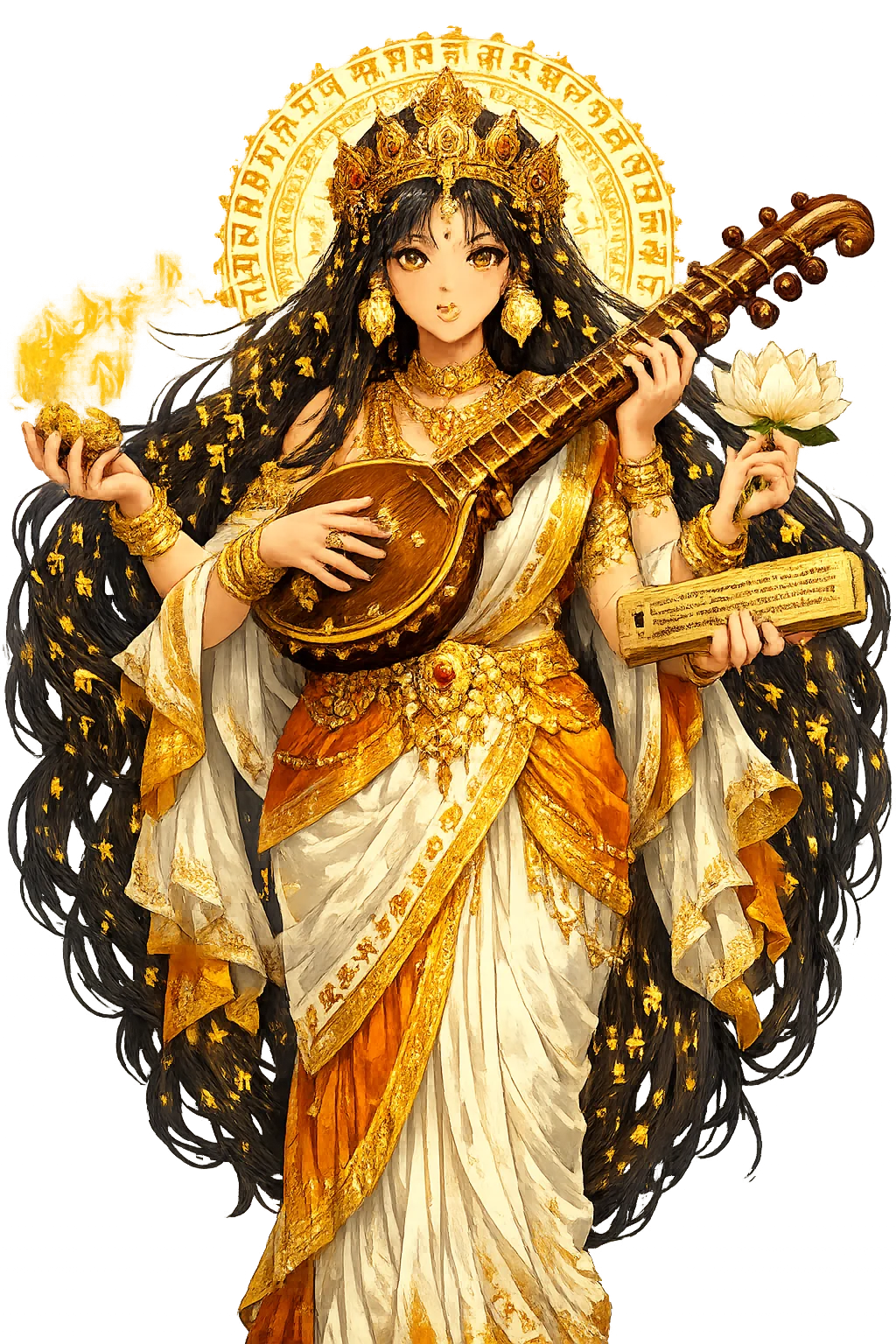
Vāc has no independent sculptural tradition in ancient India. In the Devi Sukta she is a speaking presence rather than a visible form, and early Vedic religion generally avoided cult images. As Vāc merged with Sarasvatī, she inherited the later iconography of the goddess of learning: a white-robed figure seated on a lotus or swan, holding a vīṇā, book, and prayer beads. Manuscript paintings from Rajasthan, Gujarat, and Nepal sometimes illustrate the Devi Sukta with a crowned female figure, but these are medieval and early-modern visualizations of a deity who was originally apprehended only through sound.

06

Reception & Transformation

The name after its own age — transmission, translation, survival

Afterlives

Vāc moved from the personified voice of the Ṛgveda into the Upaniṣadic doctrine of śabda-brahman, the creative word identical with ultimate reality. This trajectory fed classical Sanskrit grammar, where Pāṇini's Aṣṭādhyāyī treats language as an eternal, perfect system, and it resurfaced in Tantric and Bhakti traditions that continued to sanctify speech. In modern scholarship, Vāc became a central exhibit in the study of Indo-European poetics and the theology of the word, while her name survives in Sanskrit-derived words for voice across South Asia. The oral transmission that preserved her hymns is itself one of the longest continuous reception histories in world religion.

Identifications Across Traditions

Vāc is the Vedic counterpart of a pan-Indo-European reverence for the spoken word. Her root *wekʷ- connects her to Latin vōx, English voice, and the whole family of 'vocal' words across the West. Within India, she is absorbed into Sarasvatī, just as Sarasvatī herself absorbs the river goddess of the same name. In tantric and later Hindu traditions, the power of speech becomes vāc-śakti, the creative energy that manifests thought into form — mapped onto four levels from the transcendent parā to the spoken vaikharī. Buddhist philosophy debates the status of vāc — is speech ultimately real, or a conventional designation? — and the term survives in Pali and Sanskrit grammatical literature. Vāc is thus both a specific Vedic goddess and a persistent theory: that the world is, in some sense, made of words.

Modern Legacy

Vāc's legacy is the sanctity of speech in Indian civilization. The Vedas are not merely old poems; they are believed to be the very breath of Vāc, eternal and unauthored. Grammar (vyākaraṇa), phonetics (śikṣā), and ritual science (kalpa) all developed to preserve her purity. The idea that a correctly pronounced mantra has real power — that sound can protect, heal, or create — flows from Vāc into Hindu, Buddhist, and Jain practice. In modern India, Sarasvatī is worshipped by students and artists on Vasant Panchami, but the Vedic hymn to Vāc remains the theological foundation: 'I move with the Rudras, with the Vasus, with the Ādityas...' (ṚV 10.125). The concept also echoes in Western thought: the opening of John's Gospel, 'In the beginning was the Word,' has often been compared to Vedic Vāc. Speech, in both traditions, is not an afterthought but the first creative act.

07

The Meditation

What Vāc means — beyond the dictionary

Vāc teaches that words are not cheap. In a culture saturated with noise, the Vedic idea that speech is a goddess feels almost impossible. But that is precisely the point: every word either participates in order or adds to the lie. Vāc is not freedom of speech in the modern sense; she is responsibility of speech — the demand that what we say correspond to what is real, that our utterances build rather than damage.

The poet who composed Ṛgveda 10.125 heard speech as a presence larger than himself. He was not the owner of his words; he was their vehicle. That is why the Vedic tradition insists on exact recitation: the word must be passed on unchanged, because the word is alive. To speak with care, to listen with attention, to refuse the easy lie — these are small acts, but in the theology of Vāc they are cosmic acts. Every true sentence is a sacrifice; every honest conversation feeds the fire of the world.

08

Frequently Asked Questions

Common questions about Vāc, Speech, Voice, Sacred Word, and Unicode restoration

01How do you pronounce Vāc?

In reconstructed pronunciation, Vāc is /ʋaːtʃ/ — approximately "VAHCH" — one long syllable, like "watch" but with the vowel drawn out and a crisper final "ch.".

02What does Vāc mean?

Vāc means Speech personified — the Vedic goddess of sacred utterance (Vāc) in the sanskrit tradition.

03What are the symbols of Vāc?

Vāc is associated with The tongue (The organ of speech, the physical seat of Vāc in the human body.), Flowing water (Speech as a river; Vāc moves, cleanses, and connects heaven and earth.), The veena (Borrowed from her later form Sarasvatī — music as structured, beautiful speech.), The lotus book (The Vedas as the revealed text of which Vāc is the source.).

04Why restore Vāc in Unicode?

Plain ASCII vac strips the stress, length, and script that make the name specific. Unicode restoration returns the name to its original written dignity.

05What is the most important myth about Vāc?

“The Devi Sukta: I Am the Queen of the Universe” — the Ṛgveda story that anchors the mythology of Vāc, told in full on the lore page.

09

Scholarly Sources

The philological foundations of this restoration

Every claim on this page is grounded in established scholarship. The orthographic restorations follow disciplinary convention. The etymological chain follows the best available reference works. This is not invention — it is resurrection through scholarship.

◈

Lexicography & Philology

  • Monier-Williams
  • Macdonell
◎

Primary Texts

  • Ṛgveda
  • Ṛgveda Saṃhitā 10.125 (Devi Sukta); 10.71 (birth of speech); 1.164 (Vāc and Sarasvatī)
  • Śatapatha Brāhmaṇa, the Prajāpati creation cycle (creation by utterance)
  • Bṛhadāraṇyaka Upaniṣad 4.1.2 (Vāc as queen of the senses)
◉

Archaeology & Art History

  • Material evidence — iconography, inscriptions, and temple archaeology — for Vāc and related cults.
✦

Religious Studies

  • Macdonell, A. A., Vedic Mythology (1897)
  • Gonda, J., The Vision of the Vedic Poets (1963)
  • Monier-Williams, Sanskrit-English Dictionary, s.v. vāc
Return

The Surface Awaits

You have traced the name from its earliest attestation to its Unicode restoration. Now return to the myth. The story is where the name lives.

Back to Lore
Vāc mascot