PuniCodex

Extended Lore

Θέμις Thémis

Etymology · Orthography · Cultural Legacy · Reception · Primary Sources

Tier 2 Thémis
Thémis — Divine Law, Order, Custom
01

Quick Facts

Essential information about Thémis, Divine Law, Order, Custom

Original ScriptΘέμις
Unicode RestorationThémis
Reconstructed Pronunciation/tʰé.mis/
PantheonGreek
DomainDivine Law, Order, Custom
MeaningA Titaness, the personification of divine order, law, and established custom; a consort of Zeus and mother of the Seasons (Horae) and the Fates (Moirai).
ClassificationTier 2
Primary DomainThémis
Sacred SymbolsThe scales, The tripod, The Horae, The Moirai, The seat of assembly
02

Etymology & Word Family

From original script to Unicode restoration

Original Script Θέμις Thémis — "A Titaness, the personification of divine order, law, and established custom; a consort of Zeus and mother of the Seasons (Horae) and the Fates (Moirai)."
Unicode Restoration Thémis Restored stress, length, and script
Modern ASCII themis Plain-ASCII fallback

Law, right (from τίθημι)

03

Unicode Character Breakdown

Character-by-character philological analysis

CharacterUnicodeNameBlockPhonetic Role
TU+0054Latin Capital Letter TBasic LatinTau
hU+0068Latin Small Letter HBasic LatinTheta
éU+00E9Latin Small Letter E with AcuteLatin-1 SupplementShort epsilon
mU+006DLatin Small Letter MBasic LatinMu
iU+0069Latin Small Letter IBasic LatinShort iota
sU+0073Latin Small Letter SBasic LatinSigma

The Tier 2 classification reflects how much of the original phonology this restoration preserves — stress and vowel length for Greek names, distinctive letters and diacritics for every other tradition.

04

Cultural Significance

From ancient cult to modern memory

Thémis in Later Traditions

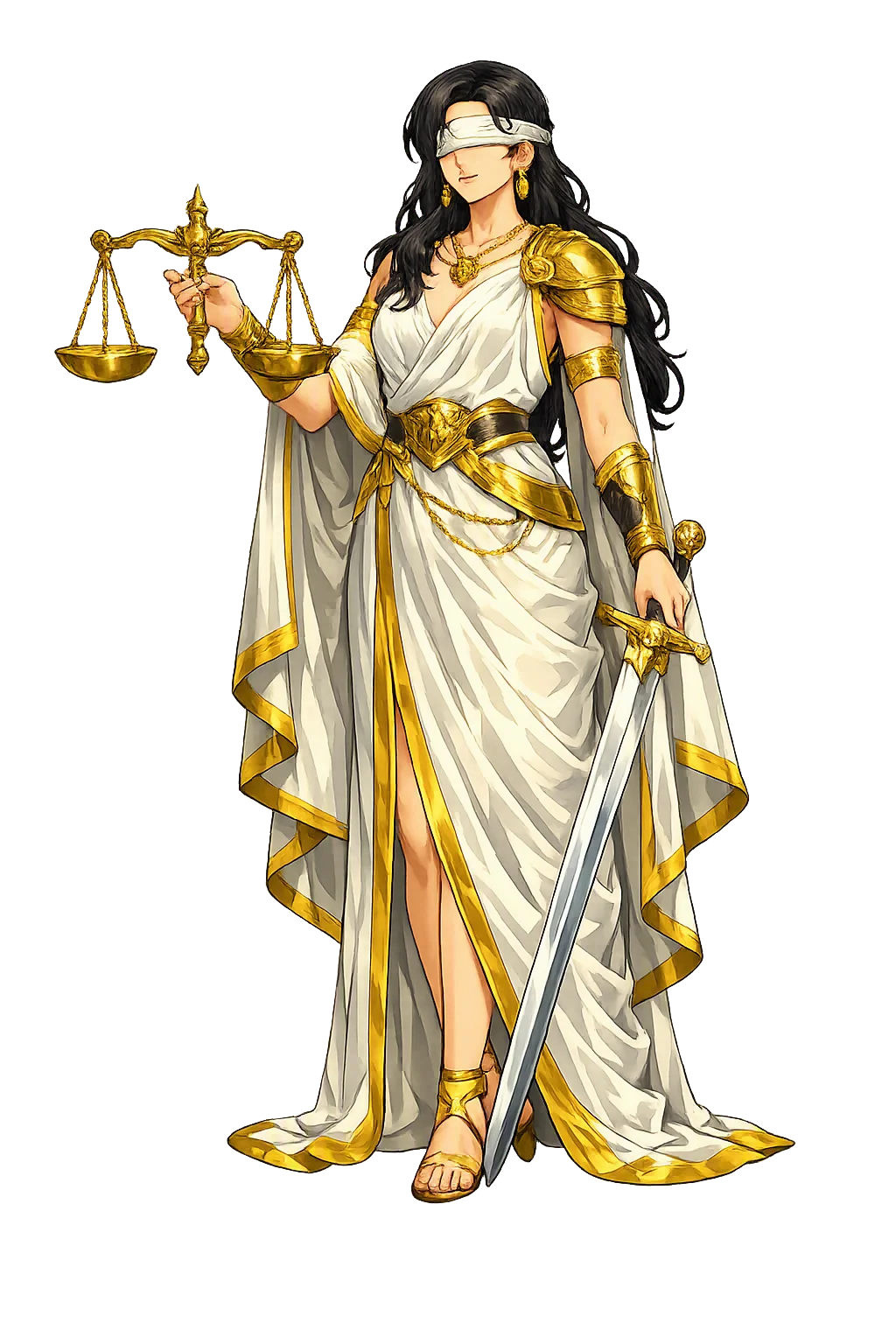
Rome made no translation of Thémis — her name crossed into Latin unchanged, a rarity among the Titans, which tells us how abstractly the Romans took her: not a foreign goddess to be matched but a concept to be quoted. Cicero treats her as personified divine law, and late antique, medieval, and Renaissance art gradually fused her with Justitia, the Roman Justice whose scales and sword became the standard attributes of Lady Justice from the sixteenth century onward. The courthouse allegory of modernity — the robed figure with balanced scales — descends from this merger rather than from any classical cult image of Themis alone. In the Latin West her second life was thus juridical: she became the face the law chose for itself.

Modern Legacy

Every courthouse statue of a robed woman with scales descends from Thémis — filtered through Justitia and the Renaissance, but unmistakably the Titaness who made order divine. Her name passed directly into modern institutions: asteroid 24 Themis (1853), NASA's THEMIS mission (2007), and countless law reviews and legal institutes. In the Greek world her name lived on as a word for lawful right — Homer has mortals and gods act 'by thémis' — and in the modern imagination she stands for the principle that law is not invented but recognized: what is right is discovered, not made. Restoring Thémis restores the name of the oldest idea in law.

In the Earth

Pausanias records an altar of Themis among the Elean altars in the Altis at Olympia (5.14), one of the few fixed points of her cult; she was worshipped chiefly in company — with the Horae, at the assembly-seat — rather than alone. Her true monument is theatrical: the opening speech of Aeschylus' Eumenides (458 BCE), performed before the very rock of the Areopagus, makes her the first keeper of Delphi. Vase painters show her occasionally among the assembled gods — at the wedding of Peleus and Thetis, in divine councils — recognizable by her modest bearing among the more flamboyant figures. The cult of 'the way things are done' leaves modest remains; which is, perhaps, exactly right.

05

The Meditation

What Thémis means — beyond the dictionary

Thémis is the most important figure in this lexicon that almost no one remembers. She has no epic adventures, no metamorphoses, no loves. She is simply what is established — the way things are rightly done, before anyone wrote it down. The Greeks could see that custom preceded law, that the unwritten order held where decrees failed, and they gave that order a mother: a Titaness, born before Zeus, honored after him.

There is something quietly radical in making order a goddess rather than a king. Kings die; Thémis remains. When Aeschylus traces the Delphi oracle through her hands, he is tracing legitimacy itself — the idea that authority is valid only when held rightly. In an age that writes new constitutions every decade, Thémis asks a harder question: what do you already know is right, before you vote on it?

06

Frequently Asked Questions

Common questions about Thémis, Divine Law, Order, Custom, and Unicode restoration

01How do you pronounce Thémis?

In reconstructed pronunciation, Thémis is /tʰé.mis/ — approximately 'THAY-miss' — the first syllable rises in pitch like a gavel; both vowels are short and quick.

02What does Thémis mean?

Thémis means A Titaness, the personification of divine order, law, and established custom; a consort of Zeus and mother of the Seasons (Horae) and the Fates (Moirai). in the greek tradition.

03What are the symbols of Thémis?

Thémis is associated with The scales (The balance of what is ordained; in later Greco-Roman art her figure merges with Justitia's, scales in hand.), The tripod (Her office at Delphi before Apollo took the oracle — the seat she held between Gaia and Phoebe.), The Horae (Her three daughters as her emblem: Order, Justice, and Peace — the visible seasons of a rightly governed life.), The Moirai (The Fates, her daughters by Zeus — spinners of the destiny even gods must accept; even Zeus 'gave them the greatest honor'.), The seat of assembly (Gods and mortals alike gather 'by Thémis' when they convene lawfully — her name is the Greek word for the lawful convocation itself.).

04Why restore Thémis in Unicode?

Plain ASCII themis strips the stress, length, and script that make the name specific. Unicode restoration returns the name to its original written dignity.

05What is the most important myth about Thémis?

“The Titaness Who Married Order to Power” — Thémis's myths are myths of legitimacy — who may hold an oracle, who may marry whom, and what order survives a flood. A Titaness of the first generation, she appears wherever the question is not 'what is powerful?' but 'what is right?' Homer swears by her; Aeschylus seats her at Delphi; Pindar makes her save the cosmos with a single prophecy. The full telling lives on the lore page.

07

Scholarly Sources

The philological foundations of this restoration

Every claim on this page is grounded in established scholarship. The orthographic restorations follow disciplinary convention. The etymological chain follows the best available reference works. This is not invention — it is resurrection through scholarship.

Lexicography & Philology

  • Liddell, H. G., Scott, R., & Jones, H. S. A Greek-English Lexicon. Oxford: Clarendon Press, 9th ed. 1996.
  • Pape, W., & Benseler, G. E. Wörterbuch der griechischen Eigennamen. Braunschweig: Vieweg, 1884.
  • Beekes, R. S. P. Etymological Dictionary of Greek. Leiden: Brill, 2010.

Primary Texts

  • Hesiod, Theogony 132–136, 901–906
  • Aeschylus, Eumenides 1–8
  • Pindar, Isthmian 8.26–47
  • Aeschylus, Prometheus Bound 873–900
  • Apollodorus, Bibliotheca 1.7.2, 3.13.5
  • Ovid, Metamorphoses 1.381–415

Archaeology & Art History

  • Material evidence — iconography, inscriptions, and temple archaeology — for Thémis and related cults.

Religious Studies

  • Beekes, Etymological Dictionary of Greek
Return

The Surface Awaits

You have traced the name from its earliest attestation to its Unicode restoration. Now return to the myth. The story is where the name lives.

Back to Lore
Thémis mascot