PuniCodex

Extended Lore

Tēzcatlīpōca

Etymology · Orthography · Cult · Iconography · Reception · Sources

Tier 1 Tēzcatlīpōca.com · Tēzcatlīpohca.com · tezcatlipōca.com
Tēzcatlīpōca — Night, Sorcery, Fate
01

Quick Facts

Essential information about Tēzcatlīpōca, Night, Sorcery, Fate

Scholarly TransliterationTēzcatlīpōca
Unicode RestorationTēzcatlīpōca
Reconstructed Pronunciation/teːs.kat.liː.ˈpoː.ka/
PantheonNahuatl
DomainNight, Sorcery, Fate
MeaningSmoking mirror
ClassificationTier 1
Primary DomainTēzcatlīpōca.com
Sacred SymbolsThe smoking mirror, The jaguar, The missing foot, The black stripe
02

Etymology & Word Family

From original script to Unicode restoration

Scholarly Transliteration Tēzcatlīpōca Tēzcatlīpōca — "Smoking mirror"
Unicode Restoration Tēzcatlīpōca Restored stress, length, and script
Modern ASCII tezcatlipoca Plain-ASCII fallback

The name Tēzcatlīpōca carries the orthographic signature of the nahuatl tradition. Unicode restoration recovers what ASCII flattens.

03

Unicode Character Breakdown

Character-by-character philological analysis

CharacterUnicodeNameBlockPhonetic Role
TU+0054Latin Capital Letter TBasic LatinSame, capitalized
ēU+0113Latin Small Letter E with MacronLatin Extended-AMacron: long /eː/
zU+007ALatin Small Letter ZBasic LatinSame
cU+0063Latin Small Letter CBasic LatinSame
aU+0061Latin Small Letter ABasic LatinSame
tU+0074Latin Small Letter TBasic LatinSame
lU+006CLatin Small Letter LBasic LatinSame
īU+012BLatin Small Letter I with MacronLatin Extended-AMacron: long /iː/
pU+0070Latin Small Letter PBasic LatinSame
ōU+014DLatin Small Letter O with MacronLatin Extended-AMacron: long /oː/
cU+0063Latin Small Letter CBasic LatinSame
aU+0061Latin Small Letter ABasic LatinSame

The Tier 1 classification reflects how much of the original phonology this restoration preserves — stress and vowel length for Greek names, distinctive letters and diacritics for every other tradition.

04

Cult & Worship

How the sacred was kept — rites, sanctuaries, remains

The Cult

Tezcatlipoca's cult was the most demanding in Mexico: it asked a city to adore the power whose purpose was to test and break it. Its engine was the ixiptla institution — a flawless captive chosen to live one full year as the god made flesh, robed, attended, married, and then cut down on the pyramid when Toxcatl, the fifth twenty-day month, came to its close. Around that rite the whole apparatus gathered: warriors and kings claimed him as patron and divine examiner, sorcerers and diviners kept his black arts, his shrines stood in the great temple precincts, and human hearts fed him as they fed the sun. The friars who watched Toxcatl understood they were seeing the empire's most perfect ceremony, and recorded it page after page.

In the Earth

His obsidian mirrors survive across collections — the British Museum's Dee mirror foremost — ground from the volcanic glass that Pachuca and Otumba supplied by the ton. The Florentine Codex's account of Toxcatl, illustrated by Nahua artists under Sahagún, is the fullest ritual description from the pre-Columbian world. Templo Mayor excavations found his cult's material traces among the offerings, and the Calendar Stone's jaguar-sun glyph keeps his first age on the empire's central monument. The ixiptla's flutes themselves survive in museum cases — small clay instruments, some broken exactly as the rite demanded.

05

Iconography

How Tēzcatlīpōca was imaged across the ages

The Image

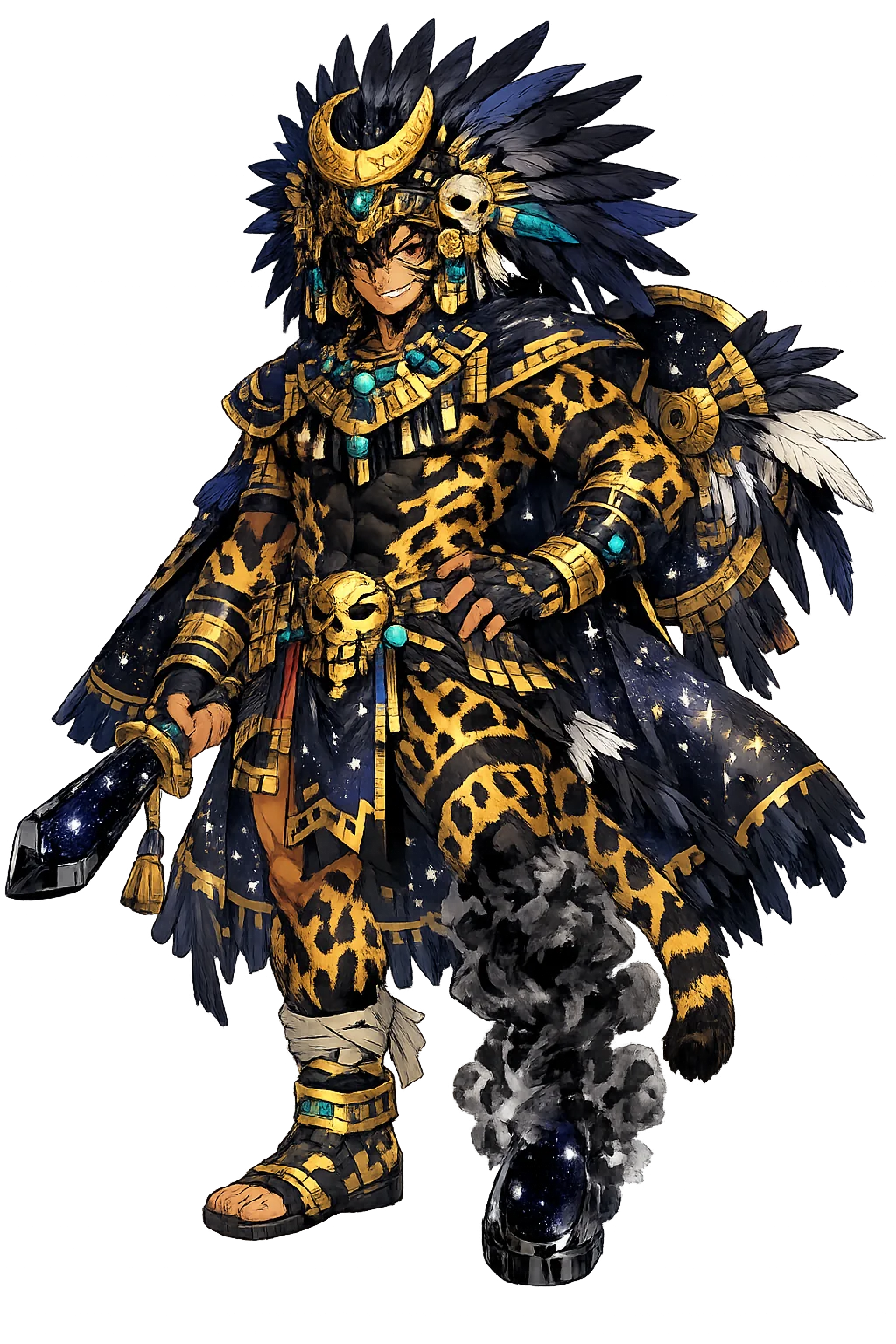
Tezcatlipoca is the easiest Aztec god to know and the hardest to see past: a warrior with a black stripe painted across his face — the night sky worn as war-color — a smoking obsidian mirror set at his temple or replacing the foot the earth-monster tore away, the jaguar always close, for the jaguar is his animal shape. The Mixteca-Puebla picture-books, above all the Codex Borgia around 1500, fixed this canonical form, and the Nahua artists of the Florentine Codex drew him again and again for the friars. Stone images are rarer than painted ones; the most haunting is a human skull sheathed in turquoise mosaic, usually identified as the god, in the British Museum. The type froze fast after the conquest and never thawed: the black-striped face remains the universal shorthand for an Aztec deity.

06

Reception & Transformation

The name after its own age — transmission, translation, survival

Afterlives

Tezcatlipoca's afterlife ran along a manuscript road. The friars' own books carried him: Sahagún's Florentine Codex, finished in the 1570s and shelved in Florence's Laurentian Library; Durán's illustrated chronicles; the Aztec histories copied into alphabetic Nahuatl within a generation of the fall. Europe met him first through spectacle — the Calendar Stone dug up in Mexico City's zócalo in 1790 and circulated in engravings — then through Lord Kingsborough's Antiquities of Mexico (1830–48), whose lithographs put the codices into scholarly hands, and Eduard Seler's turn-of-the-century commentaries, which taught modern scholarship to actually read them. The twentieth century re-anchored him in stone with the Templo Mayor excavations and made him a field of study in his own right — the first full monograph on the god appeared only at the century's end. Every modern account of him is still, at bottom, a reading of Sahagún.

Identifications Across Traditions

The friars made him the devil — Sahagún's own informants struggle with the comparison — but the colonial fusion was subtler: he survived in Nahua sorcery as lord of the night and the crossroads, and in the dark side of the Day of the Dead. Scholars compare him with the disruptive, sovereignty-testing trickster found from Loki to Eshu: the power that governs by breaking. Modern Mexican letters reclaimed him as the national shadow — Octavio Paz's 'other Mexico,' the inward, night-facing double of every official sun. Guilhem Olivier's monograph made the point academically: to study Tēzcatlīpōca is to study how the Aztec state understood the necessity of its own negation.

Modern Legacy

'Smoking mirror' entered the world's vocabulary as the emblem of deceptive appearances. His obsidian mirror in the British Museum — Aztec-made, later owned by the Elizabethan magus John Dee as his scrying glass — is among the most storied objects on earth, linking Tenochtitlan to the court of Elizabeth I. Every account of Aztec civilization, from the earliest friars to the present, must reckon with his Toxcatl: the rite that made beauty, divinity, and death one ceremony. In Mexico his name still brands nightclubs, football chants, and political cartoons — the god of the untouchable shadow, as serviceable to the modern state as to the empire that fed him hearts.

07

The Meditation

What Tēzcatlīpōca means — beyond the dictionary

Tēzcatlīpōca is the god of the honest mirror. He flatters no one: he shows the king his age, the golden age its end, the world its price. Every tradition needs a power that tests rather than comforts; the Aztecs gave him their most beautiful ceremonies, understanding that what breaks you falsely was never yours — and what survives the mirror is. He is the night's argument that the state carries with it always: legitimacy is not a possession but an examination, renewed every age, and the examiner has one black eye of volcanic glass and no mercy in it.

08

Screen & Culture

Where Tēzcatlīpōca echoes through film, television, and games — and how

09

Frequently Asked Questions

Common questions about Tēzcatlīpōca, Night, Sorcery, Fate, and Unicode restoration

01How do you pronounce Tēzcatlīpōca?

In reconstructed pronunciation, Tēzcatlīpōca is /teːs.kat.liː.ˈpoː.ka/ — approximately 'tehs-kaht-lee-POH-kah' — hold the first e and the lee long, with long ō on the stressed penult.

02What does Tēzcatlīpōca mean?

Tēzcatlīpōca means Smoking mirror in the nahuatl tradition.

03What are the symbols of Tēzcatlīpōca?

Tēzcatlīpōca is associated with The smoking mirror (Knowledge of the hidden; the self seen without mercy), The jaguar (His nahual — the night's power and the first sun's ferocity), The missing foot (The price of creation: what the earth-monster took, and where the obsidian mirror now sits), The black stripe (The paint across his face — the night sky worn as war-color).

04Why are there different spellings of Tēzcatlīpōca?

Each form is a historically attested restoration rather than a mistake: Tēzcatlīpohca is the alt form (Widespread Wikipedia rendering with short o; Karttunen and Andrews give the long ō of īpōca (to smoke), so Tēzcatlīpōca is primary). PUNICODEX registers the full set so the tradition is preserved under every defensible spelling.

05Why restore Tēzcatlīpōca in Unicode?

Plain ASCII tezcatlipoca strips the stress, length, and script that make the name specific. Unicode restoration returns the name to its original written dignity.

06What is the most important myth about Tēzcatlīpōca?

“The Foot in the Jaws” — the The Creation story that anchors the mythology of Tēzcatlīpōca, told in full on the lore page.

10

Scholarly Sources

The philological foundations of this restoration

Every claim on this page is grounded in established scholarship. The orthographic restorations follow disciplinary convention. The etymological chain follows the best available reference works. This is not invention — it is resurrection through scholarship.

◈

Lexicography & Philology

  • Karttunen
◎

Primary Texts

  • Olivier, Guilhem, Mockeries and Metamorphoses of an Aztec God (2003)
◉

Archaeology & Art History

  • Material evidence — iconography, inscriptions, and temple archaeology — for Tēzcatlīpōca and related cults.
✦

Religious Studies

  • Sahagún, Florentine Codex, Bks. 1–2 (the god; the Toxcatl festival)
  • Leyenda de los Soles (Codex Chimalpopoca; the suns and the creation)
  • Histoyre du Mechique; Anales de Cuauhtitlan (the fall of Tollan)
  • Durán, Book of the Gods and Rites, Bk. 1 (Toxcatl)
  • Karttunen, An Analytical Dictionary of Nahuatl, s.v. tēzcatl, pōca
Return

The Surface Awaits

You have traced the name from its earliest attestation to its Unicode restoration. Now return to the myth. The story is where the name lives.

Back to Lore
Tēzcatlīpōca mascot