The Living Myth
Heat, Austerity, Spiritual Power · Heat, the Generative Austerity · 'Heat' — the generative austerity that burns away impurity and powers creation
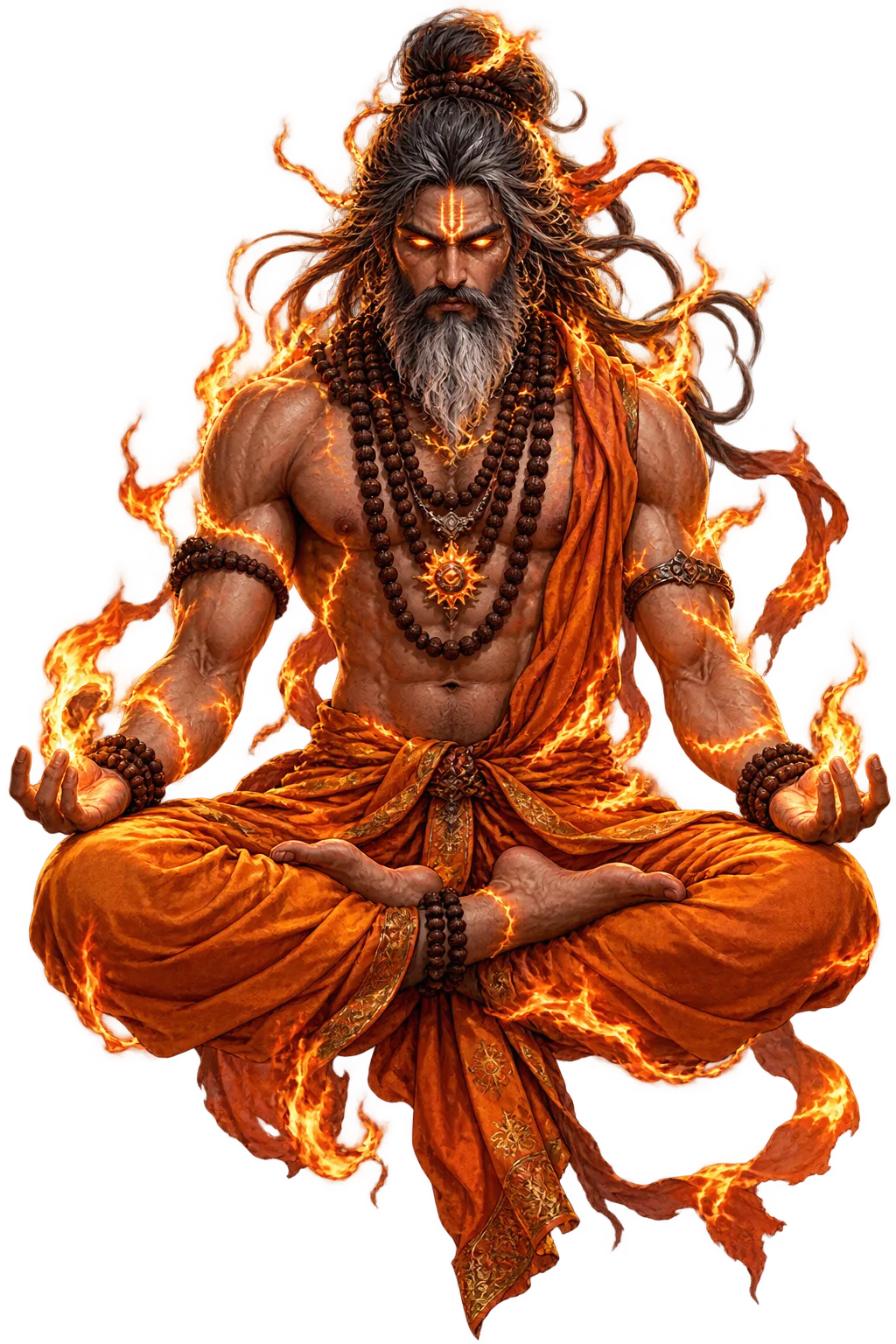
Stories of Tapas
Tapas’s mythology is the mythology of creative heat: the One’s self-heating before the world, Prajāpati’s austerity that populates creation, and the sages’ banked fires that bend gods and kings. The epics count a sage’s power in years of tapas the way bankers count capital — and spend it the same way.
The creation hymn’s second verse: ‘desire came upon the One in the beginning, that was the first seed of mind’ — and the One, the tradition glosses, heated itself by tapas until it multiplied into the world. The cosmogony is thermal: creation as the overflow of accumulated inner fire.
Prajāpati, having made the world, lay exhausted and dismembered; the gods reassembled him by offering, and his recovered heat (tapas) became the sun. The rite rekindles the creator daily — every sacrifice is a stoking of the first fire, the sun its visible remainder.
The Mahābhārata runs on tapas-economics: Paraśurāma’s austerity wins his axe; Viśvāmitra’s stands rival the gods’ own; and Śakuntalā’s ring is lost through a sage’s angry tapas-spell. Kings court sages as they court armies — a century of austerity, the epics know, outweighs a century of elephants.
Patañjali makes tapas one of kriyā-yoga’s three members — austerity, self-study, and devotion to the lord. The commentaries define it as bearing the pairs of opposites, heat and cold, honour and insult: the discipline of not flinching, by which the body becomes fit for stillness.
The Fire That Burns Away and the Fire That Makes
Tapas is heat as the engine of creation and purification: the fire that burned before the gods were born, the austerity by which sages bend the cosmos, the glow of concentration in which the mind’s dross is burned off. Every Indian cosmogony begins in tapas; every ascetic’s power is accounted for by it — the universe’s original and renewable energy.
Before creation, the One heated itself by itself — tapas is the first act of every cosmogony.
The ascetic’s heat: fasting, silence, and posture banked like coals until power accrues.
In yoga, tapas is one of the three disciplines (kriyā-yoga) — the heat that ripens meditation.
The creator god heated himself to the world’s making — and his creatures’ tapas still feeds creation.
From the original script to the living URL
तपस्
The name in its original Sanskrit form. Tapas (तपस्) is attested in the source tradition — “'Heat' — the generative austerity that burns away impurity and powers creation”. Its original diacritics and script distinctions carry the full phonetic and orthographic weight of the source tradition.
tapas
The plain tapas form is identical to the Unicode restoration. Because this name is already written in Latin letters, no diacritics, stress, or script information were lost — only capitalization differs.
Tapas
The Unicode restoration does not need to recover lost marks for Tapas. Its value is canonical spelling and consistent cataloguing, not the reconstruction of erased orthography. The domain is readable as-is to both DNS and humanity.
Tapas.com
This restoration is written entirely in ASCII letters — no Punycode encoding stands between Tapas and the DNS. The domain reads identically to machines and to human eyes.
The attested spelling family of Tapas
Tapas
Restores तपस्. The full Unicode restoration. tapas.com is not in the PuniCodex collection — it is watched for release; if it drops, this temple upgrades to an owned flagship. Attested by MW, Upanishads.
How Tapas was spoken
How Tapas travels from ancient script to the modern URL
The lore you have read is the living myth. Extended Lore opens the scholarly vault beneath it: the cult and its material remains, a history of the image, the name after antiquity, a meditation on what the name still means, and the full scholarly apparatus — etymology, orthography, sources.
Enter Extended Lore