PuniCodex

Extended Lore

手力男神 Tajikarao

Etymology · Orthography · Cult · Iconography · Reception · Sources

Tier 2 Tajikarao
Tajikarao — Strength, Caves
01

Quick Facts

Essential information about Tajikarao, Strength, Caves

Original Script手力男神
Unicode RestorationTajikarao
Reconstructed Pronunciation/ta.dʑi.ka.ɾa.o/
PantheonJapanese
DomainStrength, Caves
MeaningStrong hand man
ClassificationTier 2
Primary DomainTajikarao
Sacred SymbolsStrong hands, The rock-door, Sunlight, Mountains
02

Etymology & Word Family

From original script to Unicode restoration

Original Script 手力男神 Tajikarao — "Strong hand man"
Unicode Restoration Tajikarao Canonical scholarly spelling — ASCII-identical
Modern ASCII tajikarao Plain-ASCII fallback

The name Tajikarao reaches the modern world through scholarly transliteration of the japanese tradition. Because the conventional spelling uses only Latin letters, its Unicode and ASCII forms coincide — the tradition it carries is in the name itself, not in diacritics.

03

Unicode Character Breakdown

Character-by-character philological analysis

CharacterUnicodeNameBlockPhonetic Role
TU+0054Latin Capital Letter TBasic LatinSame, capitalized
aU+0061Latin Small Letter ABasic LatinSame
jU+006ALatin Small Letter JBasic LatinSame
iU+0069Latin Small Letter IBasic LatinSame
kU+006BLatin Small Letter KBasic LatinSame
aU+0061Latin Small Letter ABasic LatinSame
rU+0072Latin Small Letter RBasic LatinSame
aU+0061Latin Small Letter ABasic LatinSame
oU+006FLatin Small Letter OBasic LatinSame

The Tier 2 classification here reflects fidelity to the attested tradition, not recovered diacritics: every character of Tajikarao already survives in ASCII. What the restoration preserves is the canonical spelling itself — the form scholarship standardised.

04

Cult & Worship

How the sacred was kept — rites, sanctuaries, remains

The Cult

Tajikarao's cult is tied to the geography of the Ama-no-Iwato cave myth. Amanoiwato-jinja above the Takachiho Gorge in Miyazaki faces the cliff where Amaterasu was said to have hidden, and the Middle Shrine (Chū-sha) of Togakushi in Nagano stands as his principal sanctuary within a complex of mountain shrines. Rites at both sites commemorate the violent reopening of the cave and the restoration of cosmic light. Mountain ascetics and pilgrims have long associated him with physical strength and the power to break through obstacles. There is no evidence of an independent priesthood in the earliest periods, but the medieval and early modern Shinto landscape made his cave-shrine cult durable.

In the Earth

No excavated site attests Tajikarao himself from the Kofun period or earlier; his evidence is cultic and textual. The clearest material anchor is Amanoiwato-jinja above the Takachiho Gorge in Miyazaki Prefecture, where the cave of the myth is identified and a worship-hall faces the cliff across the gorge. His principal shrine, the Middle Shrine (Chū-sha) of Togakushi in Nagano, stands within a complex whose documented history runs from the mid-ninth century, when the Tendai temple Togakushi-san was founded on the mountain; the present shrine buildings are early modern, and the famous cryptomeria avenue to the Oku-sha was planted in the medieval period. Kagura masks and votive tablets depicting the cave scene, from the early modern period onward, are held in shrine collections across western Japan.

05

Iconography

How Tajikarao was imaged across the ages

The Image

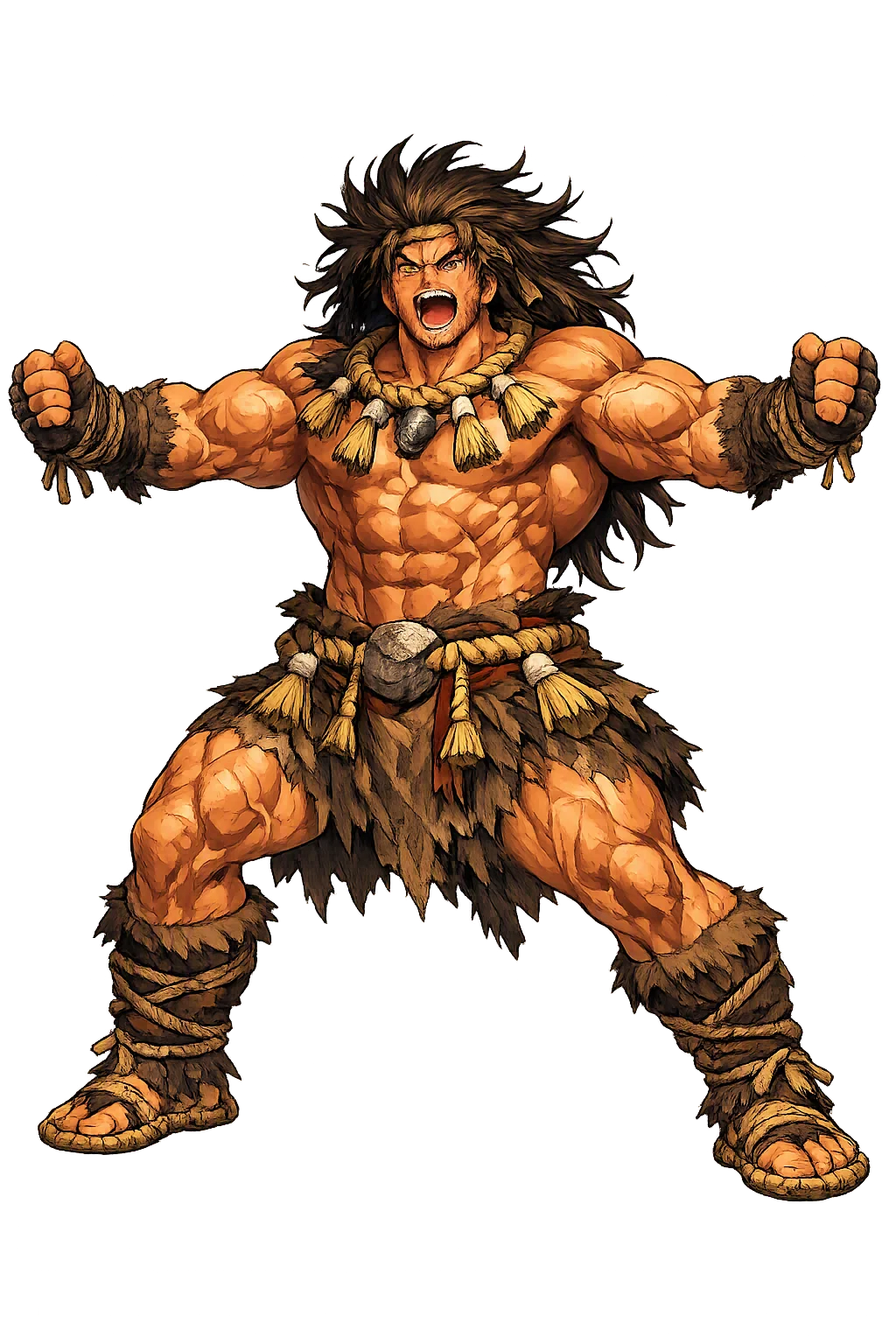
Tajikarao is imagined above all as a powerfully muscled figure seizing the rock door of the heavenly cave with both hands. Narrative picture-scrolls and shrine mandala show him from behind or in profile, straining to roll aside the boulder, while Amaterasu's light bursts from within. The Togakushi shrine tradition emphasizes strength and mountain austerity, and modern ema and festival imagery portray him as a determined, broad-shouldered kami. No classical cult statue dominated his worship; like other myth-of-origin kami, his image was produced primarily to illustrate narrative episodes rather than to serve as a focus of devotional gaze.

06

Reception & Transformation

The name after its own age — transmission, translation, survival

Afterlives

Tajikarao's reception is inseparable from the Ama-no-Iwato narrative, one of the most retold myths in Japanese culture. The Kojiki and Nihon Shoki made him the agent of cosmic revelation, and medieval Shinto mapped the cave onto the Takachiho landscape, creating a pilgrimage destination that still draws visitors. Togakushi Shrine in Nagano developed a vigorous mountain cult around him, linking him to strength, swordsmanship, and esoteric practice. In modern times he appears in school textbooks, animated retellings of the Kojiki, and regional tourism, where the rolling-away of the cave door is staged as a foundational moment of Japanese identity. His name remains a byword for decisive, forceful intervention.

Identifications Across Traditions

Tajikarao resists syncretism precisely because his role is so pure: he is the strong arm inside a theology of coordinated function. In the Ama-no-Iwato assembly every kami performs one office — Uzume the dance, Futotama the rope, Koyane the words, Tajikarao the hand — a picture of the kami as functionaries in a cosmic administration that Shinto reflection has read ever since as a model of communal harmony (wa). Buddhism, which absorbed so many kami as guardians and avatars, found little to work with in a god of one deed; he has no avatar and no second career. The cave scene, however, travelled without him: it is re-enacted in kagura across the country, painted on shrine votive panels, and taught to every Japanese schoolchild, so that his five seconds of action are among the most-watched moments in the national mythology. Comparativists set the disappearing-sun motif beside eclipse and solstice myths worldwide; the Japanese version is distinctive in that the sun hides from wounded pride, not from a cosmic enemy, and is recovered by theatre plus muscle.

Modern Legacy

Tajikarao's living monument is Togakushi. The shrine complex above Nagano, approached by an avenue of centuries-old cedars, draws pilgrims and hikers to the Oku-sha and worshippers seeking strength and favorable outcomes to its Middle Shrine; the mountains acquired a second, separate fame in the medieval period as the legendary home of the Togakure-ryū ninja tradition — the 'hidden door' serving concealment as well as revelation. Beyond the shrine, he survives wherever the cave myth is told: in classical kagura repertoires, in school textbooks, and in a steady stream of anime, manga, and games that borrow the Ama-no-Iwato scene and, with it, the strong hand that ends it. Athletes and competitors occasionally invoke him as a kami of chikara, raw power. His name remains what it was in the Kojiki: a byword for the moment deliberation ends and someone finally pulls.

07

The Meditation

What Tajikarao means — beyond the dictionary

Tajikarao is the theology of the decisive gesture. In the most famous deliberation in Japanese myth — eight hundred myriad kami conferring in the dark — he is the one who stops conferring. Nothing in the sources grants him eloquence, cunning, or lineage; the Kojiki gives him no genealogy, no prior deed, and not a single word. He appears at the cave mouth, closes his hand, and changes the state of the universe from night to day. Then he largely vanishes from the record.

There is a quiet profundity in a kami who does exactly one thing. Every tradition keeps such figures — the strongman, the opener, the one who pulls when everyone else has talked — and usually ranks them below subtler minds. But the Ama-no-Iwato myth refuses that hierarchy: the dance fails without the hand, and the mirror is useless unless someone opens the door. Tajikarao asks each of us to locate our own cave-mouth — the one situation in our lives where analysis has done all it can, and what remains is to take hold, and pull.

08

Frequently Asked Questions

Common questions about Tajikarao, Strength, Caves, and Unicode restoration

01How do you pronounce Tajikarao?

In reconstructed pronunciation, Tajikarao is /ta.dʑi.ka.ɾa.o/ — approximately 'TAH-jee-kah-rah-oh' — the 'j' is soft, and the 'r' is a light tap.

02What does Tajikarao mean?

Tajikarao means Strong hand man in the japanese tradition.

03What are the symbols of Tajikarao?

Tajikarao is associated with Strong hands (The attribute his name encodes and the instrument of every deed attributed to him), The rock-door (The stone slab he tore from the cave mouth; tradition places its landing at Togakushi, 'the hidden door'), Sunlight (What returned to the world the instant his grip closed on the sun goddess's wrist), Mountains (The cave-country of the kami, where strength and silence meet).

04Why restore Tajikarao in Unicode?

Tajikarao is written entirely in ASCII letters, so its restoration is about canonical fidelity rather than recovered diacritics: the temple fixes the name in its scholarly standard spelling, attested in the source tradition, instead of leaving it to drift.

05What is the most important myth about Tajikarao?

“The Sun Withdraws into the Rock” — the Kojiki story that anchors the mythology of Tajikarao, told in full on the lore page.

09

Scholarly Sources

The philological foundations of this restoration

Every claim on this page is grounded in established scholarship. The orthographic restorations follow disciplinary convention. The etymological chain follows the best available reference works. This is not invention — it is resurrection through scholarship.

◈

Lexicography & Philology

  • Lexical and philological sources for Tajikarao.
◎

Primary Texts

  • Kojiki
  • Nihon Shoki
  • Kojiki, Ama-no-Iwato narrative (Kamitsumaki)
  • Nihon Shoki, Age of the Gods, Scroll I
  • Philippi, Kojiki (Princeton, 1968)
◉

Archaeology & Art History

  • Material evidence — iconography, inscriptions, and temple archaeology — for Tajikarao and related cults.
✦

Religious Studies

  • Aston, Nihongi (1896)
  • Togakushi shrine tradition (Nagano)
Return

The Surface Awaits

You have traced the name from its earliest attestation to its Unicode restoration. Now return to the myth. The story is where the name lives.

Back to Lore
Tajikarao mascot