PuniCodex

Extended Lore

太極 Tàijí

Etymology · Orthography · Cult · Iconography · Reception · Sources

Tier 1 Tàijí.com
Tàijí — Supreme Ultimate, Origin
01

Quick Facts

Essential information about Tàijí, Supreme Ultimate, Origin

Original Script太極
Unicode RestorationTàijí
Reconstructed Pronunciation/tʰaɪ̯˥˩ tɕi˧˥/
PantheonChinese
DomainSupreme Ultimate, Origin
MeaningGreat extreme
ClassificationTier 1
Primary DomainTàijí.com
Sacred SymbolsThe taijitu circle, The empty circle of wuji, Solid and broken lines, Water, The center
02

Etymology & Word Family

From original script to Unicode restoration

Original Script 太極 Tàijí — "Great extreme"
Unicode Restoration Tàijí Restored stress, length, and script
Modern ASCII taichi Plain-ASCII fallback

The name Tàijí carries the orthographic signature of the chinese tradition: 太極. Unicode restoration recovers what ASCII flattens.

03

Unicode Character Breakdown

Character-by-character philological analysis

CharacterUnicodeNameBlockPhonetic Role
TU+0054Latin Capital Letter TBasic LatinSame, capitalized
àU+00E0Latin Small Letter A with GraveLatin-1 SupplementStress on a
iU+0069Latin Small Letter IBasic LatinSame
jU+006ALatin Small Letter JBasic LatinSpecial character
íU+00EDLatin Small Letter I with AcuteLatin-1 SupplementSpecial character
—N/ADropped characterChinese orthographyDropped

The Tier 1 classification reflects how much of the original phonology this restoration preserves — stress and vowel length for Greek names, distinctive letters and diacritics for every other tradition.

04

Cult & Worship

How the sacred was kept — rites, sanctuaries, remains

The Cult

Tàijí was never a god and had no cult in the ancient sense — no temple, calendar, or sacrifice ever addressed it. Its veneration was the Chinese kind: study and practice. Song Neo-Confucian academies pondered Zhou Dunyi's brief Explanation of the Diagram as a spiritual discipline; Daoist lineages contemplated the diagram on temple walls and internal-alchemical charts; from the Ming, the taijitu hung in monasteries and academies as an object of meditation rather than worship. From the nineteenth century, the Chen family of Chenjiagou in Henan turned the principle into taijiquan, and the slow forms practiced at dawn by millions across the world today are the nearest thing the supreme ultimate has ever had to a congregation — modern, health-oriented, and far from ritual religion, but reverent in its way.

In the Earth

Tàijí as a named cosmological term is textual rather than archaeological. Its locus classicus is Zhou Dunyi's Taijitu shuo, preserved in Song dynasty editions and woodblock prints. Earlier antecedents appear in Han commentaries on the Yijing and in the Mawangdui silk manuscripts, which transmit variant versions of the Daodejing and Yijing. The distinctive two-tone taijitu diagram itself becomes common only in Song and Ming visual culture, though the yin-yang pairing it encodes is far older.

05

Iconography

How Tàijí was imaged across the ages

The Image

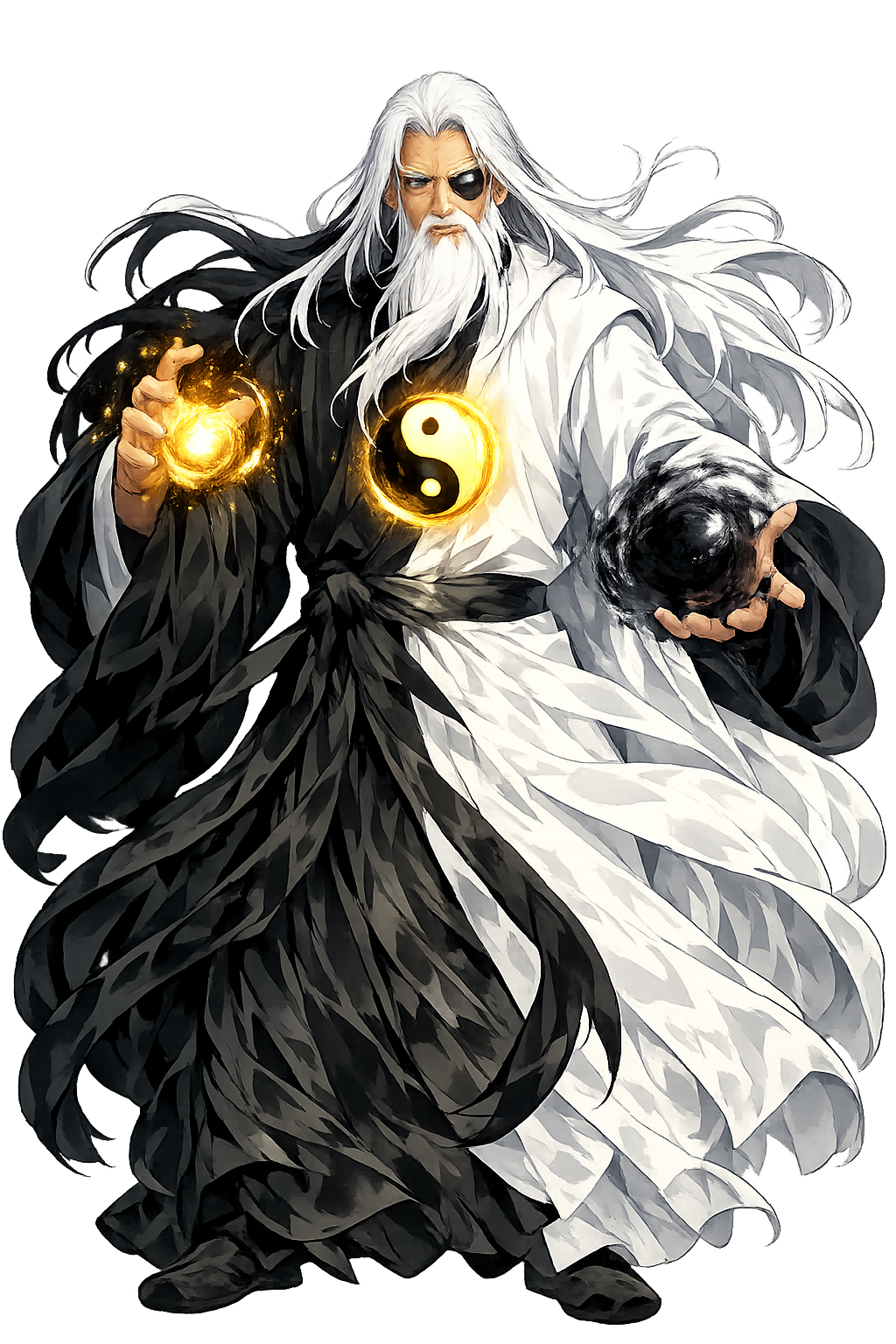
The image and the idea are younger than people think. Zhou Dunyi's original 'supreme ultimate diagram,' as transmitted through Zhu Xi's twelfth-century commentary, is not the familiar swirl but a sober cosmogram: an empty circle above ranked circles and rectangles representing water, fire, and the hexagrams. The two-tone emblem — interlocking black-and-white teardrops, each carrying the other's seed — becomes common only in the Ming: Lai Zhide drew the taiji as interpenetrating halves, and Zhang Huang's encyclopedia Tushu bian (1613) printed the classic version. Its medium was the woodblock, then temple wall and stele; its grammar is rotation and reversal, each half swallowing its opposite. Choson Korea adopted the diagram for royal pedagogy — Yi Hwang's Ten Diagrams on Sage Learning (1568) opens with it — and in 1882 it rose onto the Taegeukgi, the Korean flag.

06

Reception & Transformation

The name after its own age — transmission, translation, survival

Afterlives

Tàijí began as a sentence, not a symbol. The term is old — the Xici appendix of the Yijing declares that in change there is Tàijí, which generates the two modes — but the figure we mean was assembled in the Song dynasty. Later tradition attributed the diagram to the Daoist master Chen Tuan and traced it through Mu Xiu to Zhou Dunyi (1017–1073), whose five characters wújí ér tàijí launched six centuries of commentary. Zhu Xi made the diagram the head of orthodox metaphysics, and the Yuan state's 1313 examination decree, enshrining his commentaries, put it into the mind of every degree candidate for the rest of the imperial era. Korea received it through Yi Hwang's pedagogy, Japan with its Yijing studies, and Zhang Huang's Ming encyclopedia fixed the visual form readers know today. The modern chapter belongs to taijiquan — Yang Luchan's Beijing teaching in the mid-nineteenth century, the standardized short forms of the 1950s — which carried Tàijí around the world as a name most newcomers meet first on a gym schedule.

Identifications Across Traditions

Tàijí sits at the intersection of three Chinese traditions. For Daoists it is the cosmological stage just after the Dao; for Neo-Confucians it is the metaphysical foundation of ethics and natural order; for martial artists it is the physical principle of softness overcoming hardness. The symbol of the taijitu migrated into Korean Taoism, Japanese martial arts, and Vietnamese folk religion, often detached from Zhou Dunyi's text. In the modern West, Tai Chi is usually known as a health exercise, while the taijitu has become a generic emblem of balance and Eastern wisdom — sometimes stripped of its specific philosophical grammar but instantly recognizable.

Modern Legacy

Taijiquan is now practiced by millions worldwide and was added to UNESCO's Representative List of the Intangible Cultural Heritage of Humanity in 2020. Hospitals prescribe it for balance, hypertension, and stress; parks from Beijing to San Francisco fill with slow, synchronized movement at dawn. The taijitu symbol appears on flags, album covers, tattoos, and corporate logos — a visual shorthand for equilibrium. Yet the most lasting legacy may be conceptual: Tàijí gave Chinese thought a vocabulary for describing how a single dynamic source can generate an ordered cosmos without recourse to a creator god.

07

The Meditation

What Tàijí means — beyond the dictionary

Tàijí is the stillness inside motion and the motion inside stillness. It is the held breath before the word, the pause before the decision, the center of the storm. In a culture obsessed with productivity and opposition, Tàijí reminds us that the most powerful position may be the one that does not push back but redirects.

To meditate on Tàijí is to stop asking whether something is yin or yang and to start noticing how it is becoming its opposite. Day becomes night, tension becomes release, victory becomes defeat if pushed too far. The supreme ultimate is not a place to arrive but a way of keeping one's balance while everything turns.

08

Frequently Asked Questions

Common questions about Tàijí, Supreme Ultimate, Origin, and Unicode restoration

01How do you pronounce Tàijí?

In reconstructed pronunciation, Tàijí is /tʰaɪ̯˥˩ tɕi˧˥/ — approximately TIE-JEE — 'tai' like 'tie' with a sharp falling tone (high to low), and 'ji' like 'gee' with a rising tone.

02What does Tàijí mean?

Tàijí means Great extreme in the chinese tradition.

03What are the symbols of Tàijí?

Tàijí is associated with The taijitu circle (The whole that contains both yin and yang in dynamic interdependence), The empty circle of wuji (The limitless void from which Tàijí emerges), Solid and broken lines (Yang and yin as the two building blocks of all subsequent forms), Water (The softest thing that overcomes the hardest — the practical image of Tàijí's yielding power), The center (The still point around which all motion turns).

04Why restore Tàijí in Unicode?

Plain ASCII taichi strips the stress, length, and script that make the name specific. Unicode restoration returns the name to its original written dignity.

05What is the most important myth about Tàijí?

“Wújí ér Tàijí” — the Zhou Dunyi, Taijitu shuo story that anchors the mythology of Tàijí, told in full on the lore page.

09

Scholarly Sources

The philological foundations of this restoration

Every claim on this page is grounded in established scholarship. The orthographic restorations follow disciplinary convention. The etymological chain follows the best available reference works. This is not invention — it is resurrection through scholarship.

◈

Lexicography & Philology

  • I Ching
  • Zhou Dunyi
◎

Primary Texts

  • Primary sources in the chinese tradition for Tàijí.
◉

Archaeology & Art History

  • Material evidence — iconography, inscriptions, and temple archaeology — for Tàijí and related cults.
✦

Religious Studies

  • Zhou Dunyi, Taijitu shuo
  • Laozi, Daodejing
  • Yijing (Book of Changes)
  • Adler, 'The Discovery of the Tao' / Zhou Dunyi studies
  • Baxter & Sagart, Old Chinese Reconstruction
  • Graham, Disputers of the Tao
  • Unihan Database (Unicode Consortium)
Return

The Surface Awaits

You have traced the name from its earliest attestation to its Unicode restoration. Now return to the myth. The story is where the name lives.

Back to Lore
Tàijí mascot