
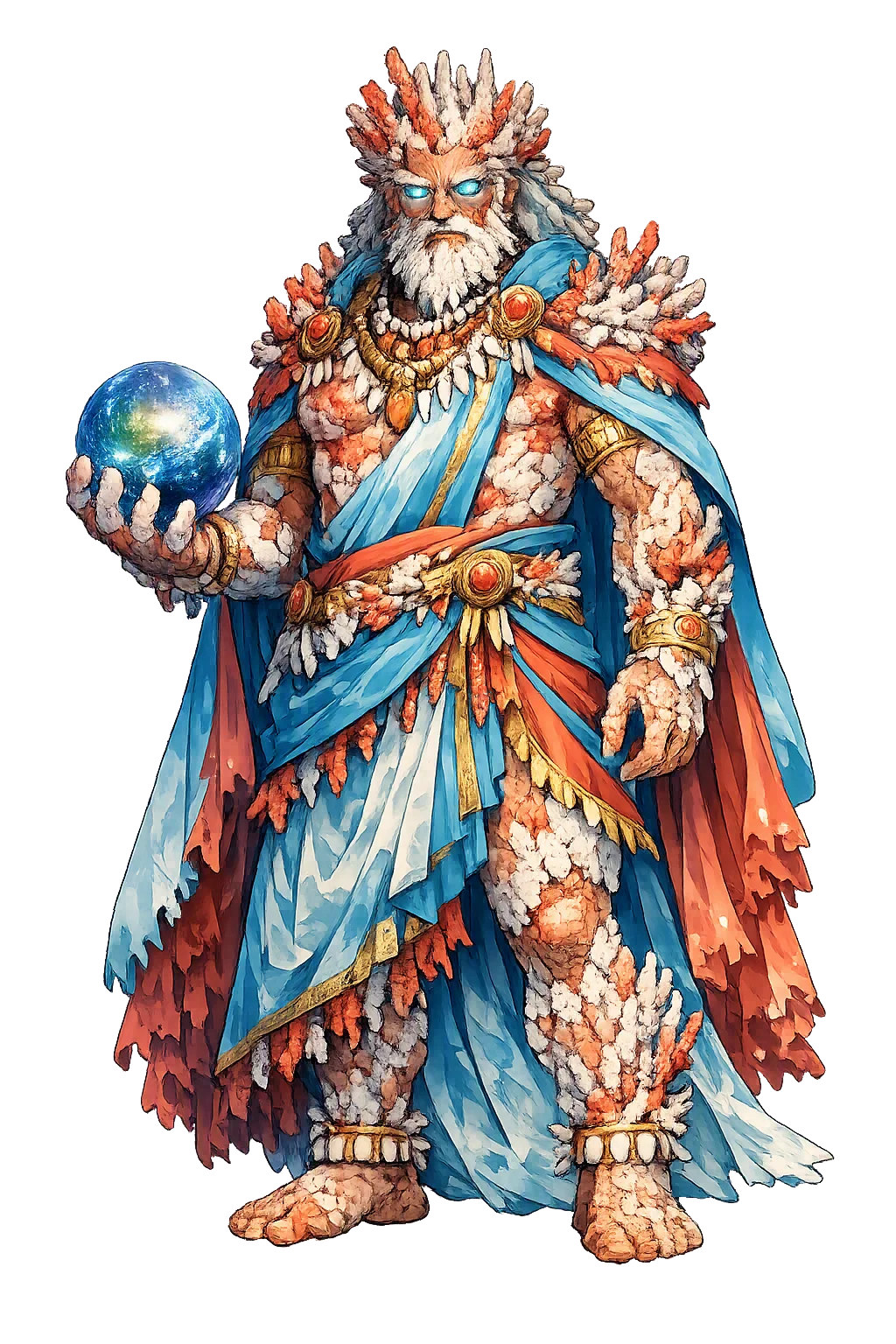
How Tagaloa was rebuilt, mark by mark
Bench notes, Tagaloa: what we found, what we rejected, and what we finally set down. Kept in the open, because a restoration you cannot audit is just a spelling with confidence.
What We Found
The attestation runs through the tradition's own sources: —. Meaning: "The lord".
The figure behind the name: Tagaloa's mythology is cosmogony in the strict sense — stories of how land, people, and rank came to be.
What the Name Carried In
The Vine Let Down into the Sea. In the beginning Tagaloa dwelt alone in Lani-uli, the highest heaven, and beneath him lay only the boundless sea. He let down into the waters a vine from the sky; where its parts touched the surface, the islands of Samoa rose.
Sina and the Eel. Tagaloa's daughter Sina came down to the pool of Mata o le Alelo to bathe, where a great eel, Tuna, confessed its love. When the eel was killed at Sina's command, she buried its head, and from it grew the first coconut palm — its two eyes, mouth, and body still showing on the nut.
A spelling that has to carry stories like these is not a label. It is equipment.
Where It Stood Before Us
No cult image of Tagaloa is known — Samoan religion, like Polynesian religion generally, was essentially aniconic, and its temples were open-air malae and stone platforms rather than statue houses. The material landscape nevertheless preserves his world: Pulemelei mound on Savai'i, the largest prehistoric monument in Polynesia (roughly 60 × 50 m, dated by some researchers to the first millennium CE), served as a ceremonial platform, though which god it served is beyond proof. Scattered stone platforms, star mounds for pigeon-snaring (tia seu lupe), and chiefly burial sites across 'Upolu and Savai'i map the sacred geography the myths describe. The 'archaeology' of Tagaloa himself is documentary: the creation accounts recorded by Turner (1861), Stair (1897), Krämer (1902), and in the Journal of the Polynesian Society remain the primary evidence. The bench inherits all of it — the web temple is the newest site, not the first.
What We Rejected
Any form invented for availability. The rule on the bench: if the evidence does not carry it, the domain does not get it — whatever the registrar has in stock.
What We Set Down
Tagaloa — One decisive feature survives — a single, honest mark — which places the restoration in Tier-2: exact, and exactly labeled.
For the voice: 'tah-ngah-LO-ah' — stress falls on the third syllable, and the g is a soft 'ng,' never a hard English g.
The temple stands at /tagaloa/ — the notes above are public in its Scholarly Edition, sources and all.
At a Glance
- Restored name: Tagaloa
- ASCII form: tagaloa
- Meaning: "The lord"
- Domain of influence: Creator, Ocean
- Pantheon: Polynesian
- Classification: Tier 2
- Original script: —
- Series: The Restoration Files, No. 470 of 548
The File Continues
The temple's founding dispatch tells the name's story; its Resonance File reads the myths into the industries; the blog index holds the whole archive.
Continue the series — previous file: Taaroa (read it here) · next file: Tàijí (read it here).
The Restoration Files are written from the same canonical record as the temples themselves: the lexicon, the lore catalog, the pattern atlas, and the cited scholarly sources. If a file ever disagrees with its temple, the temple is right — tell us, and the file will be corrected.