PuniCodex

Extended Lore

Svarog

Etymology · Orthography · Cult · Iconography · Reception · Sources

Tier 2 Svarog
Svarog — Sky, Fire, Smithing
01

Quick Facts

Essential information about Svarog, Sky, Fire, Smithing

Scholarly TransliterationSvarog
Unicode RestorationSvarog
Reconstructed Pronunciation/sva.ˈroɡ/
PantheonSlavic
DomainSky, Fire, Smithing
MeaningBright, clear
ClassificationTier 2
Primary DomainSvarog
Sacred SymbolsThe Forge, The Tongs, The Sun-Disk, The Anvil-Stone, Sacred Fire
02

Etymology & Word Family

From original script to Unicode restoration

Scholarly Transliteration Svarog Svarog — "Bright, clear"
Unicode Restoration Svarog Canonical scholarly spelling — ASCII-identical
Modern ASCII svarog Plain-ASCII fallback

The name Svarog reaches the modern world through scholarly transliteration of the slavic tradition. Because the conventional spelling uses only Latin letters, its Unicode and ASCII forms coincide — the tradition it carries is in the name itself, not in diacritics.

03

Unicode Character Breakdown

Character-by-character philological analysis

CharacterUnicodeNameBlockPhonetic Role
SU+0053Latin Capital Letter SBasic LatinSame, capitalized
vU+0076Latin Small Letter VBasic LatinSame
aU+0061Latin Small Letter ABasic LatinSame
rU+0072Latin Small Letter RBasic LatinSame
oU+006FLatin Small Letter OBasic LatinSame
gU+0067Latin Small Letter GBasic LatinSame

The Tier 2 classification here reflects fidelity to the attested tradition, not recovered diacritics: every character of Svarog already survives in ASCII. What the restoration preserves is the canonical spelling itself — the form scholarship standardised.

04

Cult & Worship

How the sacred was kept — rites, sanctuaries, remains

The Cult

No rite of Svarog is recorded — his entire dossier is textual, three notices and a gloss, and no chronicle, charter, or saint's life describes his altar, his festival, or his votaries. The nearest thing to a cult is indirect: South Slavic folklore collected in the nineteenth century preserves honorific treatment of the hearth fire — doused rather than desecrated, fed, addressed with formula — which Russian and Serbian scholarship has long connected to the name Svarožič, 'Little Svarog,' the domestic form of the sky-smith. Whether that fire-etiquette descends from actual worship of Svarožič or from a general sanctity of flame cannot be proved. Rodnover communities keep his feast today; that is revival, not attestation, and the temple says so.

In the Earth

There is, strictly speaking, no archaeology of Svarog — no image, temple, amulet, or inscription bearing his name has ever been found, and the famous monumental idols of the Slavs (the Zbruch idol, the Svetovid of Arkona, the Prillwitz figures) belong to other gods. The Slavic smith-god is a documentary phenomenon: three medieval texts and their later copies. This absence is itself instructive. Baltic and Scandinavian pagans left cult objects; the early Slavs, converting earlier and building in wood, left almost none — so the chronicles, compiled by their enemies and converts, are the sole excavation. Every claim about Svarog's worship should be weighed against that silence.

05

Iconography

How Svarog was imaged across the ages

The Image

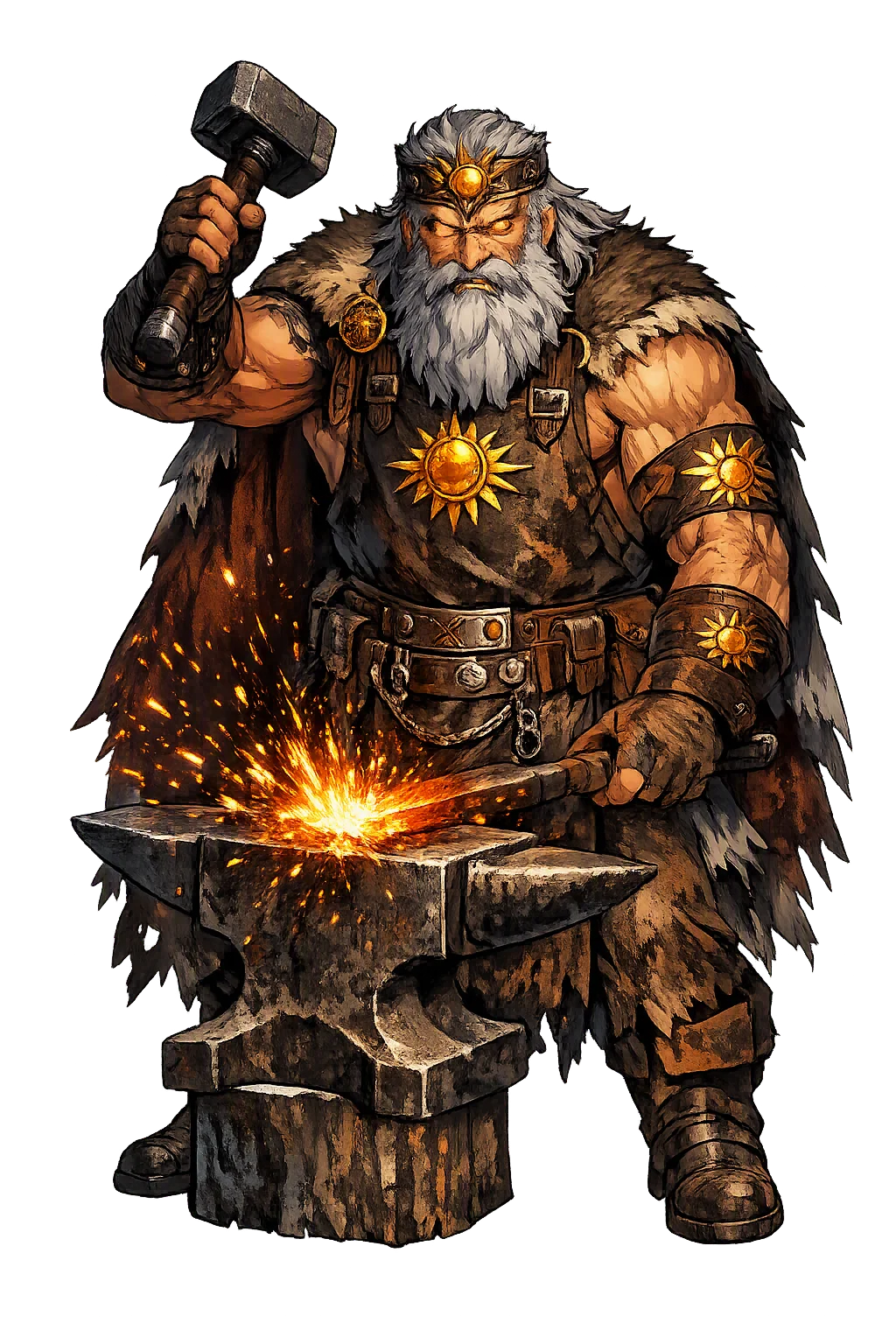
There is no iconography of Svarog — none. No image, amulet, relief, or carving bearing his name or securely depicting him exists, and the famous Slavic idols (the Zbruch figure, the Svetovid of Arkona) belong to other gods or to no one. A smith-god would presumably have carried hammer and tongs, and the Izbornik of 1073 compares him to Hephaestus; but no medieval Slavic artist, so far as the record shows, ever gave him a body. His iconography is therefore accidental and borrowed: the forge that later painters and modern illustrators draw for him is Vulcan's workshop, lent out.

06

Reception & Transformation

The name after its own age — transmission, translation, survival

Afterlives

Svarog's transmission is the strangest of any Slavic god: a three-word notice that slept for seven centuries and woke as a national symbol. The Svyatoslav Izbornik of 1073 copied his name beside the Hephaestus comparison; the Primary Chronicle made him father of the sun; Helmold heard him among the western Slavs as Zuarasici — and then silence. The Romantic nineteenth century reforged him: Polish verse reached for the sky-smith, with Słowacki's Beniowski the locus classicus, and the comparative mythologists of the era, reading forge and sun together, set him beside Hephaestus and Vulcan as a matter of course. Russia's antiquarian tradition kept the chronicle notices in circulation, but it was the age of national awakenings that turned the smith of heaven into an emblem of the Slavic cosmos conversion had not erased. Twentieth-century scholarship tightened the record — Gieysztor and Ivanits separating attestation from reconstruction with care — while the schoolbooks loosened it again, until Svarog became the first Slavic god a child meets. The twenty-first century added the last layer: Rodnover communities re-erecting his altars, so that a god known from three sentences is once more prayed to.

Identifications Across Traditions

Svarog's afterlife is a study in resurrection. After the chronicle notices fell silent, he slept for seven centuries — until the Slavic national revivals of the nineteenth century reforged him. Juliusz Słowacki reached for him in Polish Romantic verse (most famously in Beniowski), and comparative mythologists of the era, seeing the forge-and-sun logic, set him beside Hephaestus and Vulcan. In the twentieth century the identification hardened in schoolbook mythology; in the twenty-first, Rodnovery — the Slavic neopagan movement — restored him to actual worship, with Svarog as smith of heaven and patron of crafts. Every layer must be labeled: attested god in the eleventh century, literary construction in the nineteenth, living deity today. Modern scholarship (Gieysztor; Ivanits) keeps the layers distinct — and notes that a god can be reconstructed honestly, provided the reconstruction admits what it is.

Modern Legacy

Svarog's modern presence is out of all proportion to his ancient evidence. He is the Slavic god schoolchildren meet first — the smith of the sky in every compendium of Slavic mythology — and his name has become a byword for the lost pre-Christian heritage of Eastern Europe. Rodnover communities keep his festivals; blacksmiths and metalworkers claim his patronage; and in literature from Słowacki onward he stands as the emblem of a Slavic cosmos that conversion only partially erased. The Primary Chronicle line about Dažbog ensured his survival in another way: every retelling of Russian origins must reckon with him. A god of whom three medieval sentences survive now carries a civilization's memory of its own forge — perhaps a fitting tribute to the smith of lights.

07

The Meditation

What Svarog means — beyond the dictionary

Svarog asks what can be known of a god who left almost nothing. The honest answer is: a name, a son, a forge, and a fire. Yet these fragments sketch a complete theology of making. The Slavs looked at daylight and did not call it a lamp or a face — they called it work: something hammered out on an anvil by a craftsman whose son delivers it. In that intuition lies a whole philosophy — that order is manufactured, that radiance is skilled labor, that the sky is a workshop and the sun its product. The hearth-name Svarožič extends the philosophy downward: if the sun is a forge's output, every kitchen fire is a franchise of heaven. A civilization that imagined the cosmos this way honored the smith as its most theologically precise citizen. Svarog survives because the intuition survives: we still speak of 'forging' the future, still feel that making is the most godlike of acts.

08

Frequently Asked Questions

Common questions about Svarog, Sky, Fire, Smithing, and Unicode restoration

01How do you pronounce Svarog?

In reconstructed pronunciation, Svarog is /sva.ˈroɡ/ — approximately 'svah-ROHG' — stress on the second syllable, hard g as in English 'god.'.

02What does Svarog mean?

Svarog means Bright, clear in the slavic tradition.

03What are the symbols of Svarog?

Svarog is associated with The Forge (Heaven as smithy — the place where light and daylight were hammered out), The Tongs (The smith's tool, emblem of his craft and of handled, controllable fire), The Sun-Disk (His finished work — the Primary Chronicle makes Dažbog, the sun, his son), The Anvil-Stone (The fixed point of the sky on which the world-shaping blows fall), Sacred Fire (The hearth flame addressed as Svarožič — the god scaled to every home).

04Why restore Svarog in Unicode?

Svarog is written entirely in ASCII letters, so its restoration is about canonical fidelity rather than recovered diacritics: the temple fixes the name in its scholarly standard spelling, attested in the source tradition, instead of leaving it to drift.

05What is the most important myth about Svarog?

“Named in the Izbornik of 1073” — the The Book God story that anchors the mythology of Svarog, told in full on the lore page.

09

Scholarly Sources

The philological foundations of this restoration

Every claim on this page is grounded in established scholarship. The orthographic restorations follow disciplinary convention. The etymological chain follows the best available reference works. This is not invention — it is resurrection through scholarship.

◈

Lexicography & Philology

  • Primary Chronicle
  • Ivanov-Toporov
◎

Primary Texts

  • The Primary Chronicle (Povest’ vremennykh let); the Hypatian Codex; East Slavic chronicle tradition and South Slavic folk invocations.
◉

Archaeology & Art History

  • Material evidence — iconography, inscriptions, and temple archaeology — for Svarog and related cults.
✦

Religious Studies

  • The Svyatoslav Izbornik (1073), Old Russian miscellany
  • Primary Chronicle (Povest' vremennykh let), anti-pagan sermon
  • Helmold of Bosau, Chronica Slavorum I.52 (c. 1172)
  • Ivanits, Russian Folk Belief (1989)
  • Gieysztor, Mitologia Słowian (1982)
  • Cross & Sherbowitz-Wetzor, trans., The Russian Primary Chronicle (1953)
Return

The Surface Awaits

You have traced the name from its earliest attestation to its Unicode restoration. Now return to the myth. The story is where the name lives.

Back to Lore
Svarog mascot