
The name Svarog and the world it opens
A name is a door. Svarog opens onto a world of celestial fire, divine smithcraft, and the bright sky that arches over the Slavic lands. He is the heavenly smith, the father of the sun god Dazhbog, and one of the most enigmatic figures in the Slavic pantheon. His name appears in the Primary Chronicle as one of the gods of Kievan Rus', yet his functions and origins have been debated for generations. Some scholars see him as a Slavic sky-father; others emphasize his connection to fire and metalworking; still others trace his name to Iranian or other non-Slavic sources. This post walks through the world that Svarog opens: his etymology, his mythology, his cultural legacy, and the Unicode restoration that returns his name to the address bar.
Svarog is a figure who seems to contain multitudes. In him, the sky, the sun, the forge, and the fatherhood of gods come together in a single radiant image. He is both transcendent and practical, both celestial and artisanal. This combination makes him one of the most philosophically interesting deities in the Slavic pantheon and one of the most rewarding to study.
For the modern maker and thinker, Svarog offers a compelling symbol. He is the god who shapes raw matter into order, who transforms chaos through fire and skill. In an age of technology and craft, his image resonates with anyone who has ever stood before a forge, a kiln, a compiler, or a laboratory and tried to make something new.
At a Glance
- Restored name: Svarog
- ASCII form: svarog
- Meaning: "Bright, clear"
- Domain of influence: Sky, Fire, Smithing
- Pantheon: Slavic
- Classification: Tier 2
Overview
Svarog belongs to the Slavic tradition, where he is catalogued under the domains of sky, fire, and smithing. In the Primary Chronicle, he is listed among the gods whose statues were erected by Prince Vladimir in 980 CE, but the chronicle says little about his specific functions. Scholars have had to reconstruct his nature from comparative evidence, etymology, and later folklore. The result is a figure of remarkable depth and complexity.
At the center of Svarog's identity is fire — not the destructive fire of the battlefield but the creative fire of the forge and the heavenly fire of the sun. He is the divine smith who shapes the world and the heavenly father who sends light and warmth to the earth. In some interpretations, he is the Slavic equivalent of the Greek Hephaestus and the Roman Vulcan, but with a cosmic scope that extends beyond mere craftsmanship.
The PuniCodex restoration presents Svarog in its standard scholarly form. The ASCII form svarog is a DNS fallback; the restored form returns the name to its status as a proper noun and divine name. Because the name does not require diacritics or special characters, it is classified as Tier 2. As a flagship entry, Svarog receives the full scholarly and creative treatment.
Svarog's position as the father of Dazhbog is one of his most important mythological features. This genealogy links the celestial fire of the father to the solar light of the son, creating a coherent divine family that spans the sky. It also gives Svarog a role in the cosmic order that is both active and generative: he does not merely exist in heaven; he produces the sun that warms the world.
Etymology and Meaning
The etymology of Svarog is one of the most debated questions in Slavic religious studies. One influential proposal connects the name to a root meaning "bright, clear, or radiant," reflected in words like Old Church Slavonic světъ ("light") and the related forms across Slavic languages. In this reading, Svarog is the "Bright God" or "Clear God," a solar or celestial deity whose name describes his luminous nature.
Another proposal connects Svarog to the Indo-Aryan svar ("sun, heaven, light") and the related Sanskrit svar- ("sunlight, radiance"). This would make Svarog a member of the ancient Indo-European family of sky and sun gods, cognate with names like the Greek Hēlios and the Vedic Sūrya. The connection is attractive because it places Svarog in a deep historical context, but it remains a matter of scholarly debate.
A third possibility sees the name as a borrowing from Iranian or other neighboring traditions. The ancient Iranians had a fire cult and a class of smith-magicians, and elements of this culture may have influenced the Slavs on the steppe frontier. If Svarog's name or function was borrowed, it would not diminish his importance; it would simply make him another example of the cosmopolitan nature of early Slavic religion.
The meaning "Bright, clear" captures the most widely accepted semantic core of the name. Svarog is the god of bright fire, clear sky, and shining metal. He is associated with the upper world, the celestial realm, and the transformative power of fire. The pronunciation is approximately "SVAH-rog," with stress on the first syllable and a hard final -g. The standard form requires no diacritics, placing it in Tier 2.
The debate over Svarog's etymology reflects the broader challenge of understanding the Kievan pantheon. The gods listed in the Primary Chronicle include figures of diverse origins, and their names do not always yield easy meanings. Svarog's name is a focal point for these debates because it is both important and obscure.
Mythology and Domain
Svarog's mythology is reconstructed from scattered references and comparative analysis. He is primarily associated with three domains: sky, fire, and smithing. These domains are not separate but interconnected, forming a coherent picture of a celestial craftsman.
The domain of sky places Svarog in the upper reaches of the cosmos. He is the bright sky, the celestial realm, the source of light and order. In some interpretations, he is the Slavic sky-father, the highest god who presides over the other deities. This reading aligns him with the Indo-European Dyēus type, the father-god of the sky whose name survives in Zeus and Jupiter. However, the evidence for Svarog as a supreme deity is weaker than the evidence for Perun in that role.
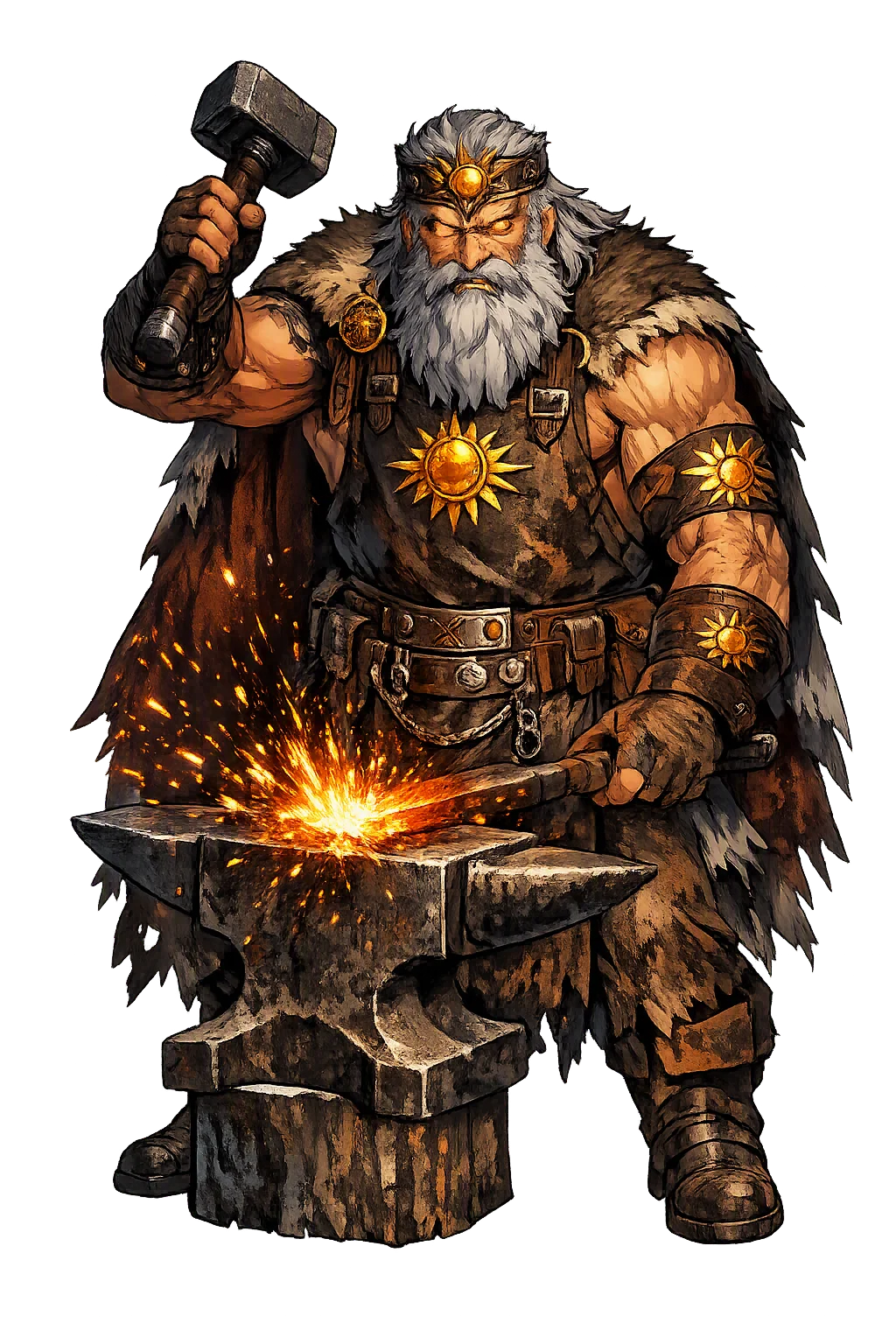
The domain of fire is more securely attested. Svarog is the divine smith, the one who works with fire to shape metal and create order from raw matter. His forge is in heaven, and his sparks are the stars. This imagery connects him to the widespread mythological figure of the celestial smith, found in Greek Hephaestus, Roman Vulcan, and Germanic Wayland. The smith is a liminal figure who masters dangerous fire and produces the tools of civilization.
The domain of smithing follows from the domain of fire. Svarog is the patron of blacksmiths and metalworkers, the one who teaches humans the art of forging. In traditional societies, the blacksmith was a figure of special status, often credited with magical powers. By placing a god at the head of this craft, the Slavs acknowledged the importance of metalwork for agriculture, warfare, and ritual.
One of the most important mythological connections is Svarog's fatherhood of Dazhbog, the sun god. In the Primary Chronicle, Dazhbog is the son of Svarog. This genealogy makes sense if Svarog is the celestial fire and Dazhbog is the sun, the visible manifestation of that fire. The father-son pair thus represent different aspects of solar and celestial power.
The forge of Svarog is sometimes identified with the sky itself, where the stars are the sparks of his hammer. This cosmic smithing connects Svarog to the creation and maintenance of the world. He is not just a craftsman of tools but a shaper of the heavens, a creator whose work is visible every clear night.
Cultural Legacy
Svarog's cultural legacy is rich but diffuse. Because his functions overlap with those of other deities and because his documentation is sparse, he has been claimed by many different interpretations. In the Romantic period, he was often depicted as a supreme Slavic sky-god, a kind of Slavic Zeus or Jupiter. This image served nationalist purposes but went beyond the evidence. In more recent scholarship, he has been understood primarily as a fire and smith deity, with possible Iranian or Indo-European connections.
In Slavic folk belief, traces of Svarog may survive in customs surrounding fire, smithing, and the hearth. The blacksmith's forge was traditionally a place of magic and taboo, and the smith himself was sometimes seen as a mediator between the human and supernatural worlds. Fire rituals, including the lighting of ceremonial fires at midwinter and midsummer, may preserve ancient gestures of honor toward a fire god.
Contemporary Slavic Native Faith and related movements honor Svarog as a god of fire, smithcraft, and celestial light. Rituals in his honor may include bonfires, metalwork, and offerings of forged objects or fire-related materials. He is also invoked as a patron of craftspeople and artists, those who transform raw matter into meaningful form. His connection to Dazhbog makes him a fitting figure for celebrations of the sun and the summer solstice.
Svarog has also inspired modern fantasy, games, and literature. He appears as a fire god, a sky father, or a divine smith in works that draw on Slavic mythology. These representations vary widely in accuracy, but they keep the name in circulation and introduce it to audiences who might never encounter it in academic sources.
The image of Svarog as a celestial smith has proven especially powerful in visual art. Artists depict him with a hammer and tongs, surrounded by stars and sparks, forging the sun or shaping the world. This imagery connects ancient myth to modern craftsmanship, suggesting that creativity and transformation are sacred activities.
Unicode Restoration and Conclusion
The PuniCodex restoration of Svarog returns the name to its proper scholarly form. The ASCII form svarog is a technical fallback that strips the name of its status as a proper noun and divine name. The restored form, with its capital S, marks Svarog as a figure of myth and religion, the celestial smith of the Slavs.
The restoration is fitting for a god whose domain is brightness and clarity. Just as Svarog brings light and order to the cosmos, the restoration brings order to the digital representation of his name. The Unicode domain ensures that the name is typed, displayed, and shared in its correct form, preserving the connection between the ancient deity and the modern world.
The restoration also honors the creative and artisanal dimensions of the divine. In a culture that often celebrates warriors and rulers, Svarog reminds us that making things — forging metal, kindling fire, shaping the world — is also a sacred activity. His restored name is a tribute to the dignity of craft.
The restoration of Svarog also affirms the value of cosmic craftsmanship in a technological age. As humans increasingly shape their environment through tools and industry, the ancient image of a divine smith takes on new meaning. Svarog is not merely a mythic blacksmith; he is a symbol of the transformative power that humans share with the gods. The restored name invites us to consider whether our own making can be approached with the reverence once accorded to his forge.
In the end, Svarog opens a door to some of the deepest themes of Slavic religion: fire and sky, craft and creation, fatherhood and light. His name may be obscure to many, but its resonances are profound. The restoration does not solve the scholarly debates about his origins and functions, but it does ensure that those debates take place under the right name.
Svarog and the Dignity of Labor
One of the most distinctive features of Svarog is his association with labor. As the divine smith, he embodies the transformative work of making things. This sets him apart from gods whose power is purely destructive or purely ruling. Svarog does not merely command; he crafts. He does not merely judge; he shapes. In this respect, he is a deity who sanctifies the dignity of skilled labor.
In traditional societies, the blacksmith occupied a special position. He worked with fire, the most dangerous and transformative of elements, and produced the tools essential for agriculture, warfare, and ritual. His forge was a place of power and taboo, and he himself was often thought to possess magical knowledge. By placing Svarog at the head of this craft, the Slavs acknowledged that making things is not a base activity but a sacred one.
The connection between Svarog and labor extends beyond metalworking. Any craft that transforms raw material into something useful or beautiful can be seen as participating in his domain. Potters, weavers, carpenters, and farmers all engage in forms of making. Artists and musicians, too, shape raw experience into meaning. In this broad sense, Svarog is the patron of all who labor to bring order and beauty into the world.
The modern world has complicated the idea of dignified labor. Industrialization, automation, and global capitalism have often separated workers from the products of their labor and from the sense of craft that once made work meaningful. Svarog's image offers a counterpoint: the smith who sees his work through from raw ore to finished tool, who understands the material and the process, and who takes pride in the result. This ideal of integrated, skillful labor remains powerful even in a post-industrial economy.
Svarog's labor is also cosmic in scope. He does not merely make tools; he shapes the heavens. The stars are the sparks of his forge, and the sun is born from his celestial fire. This cosmic dimension elevates labor from a mundane necessity to a participation in divine creativity. To work well is to imitate the gods, to bring a small piece of cosmic order into the human world.
Contemporary pagan and spiritual movements have drawn on this aspect of Svarog to honor manual skills and craftsmanship. Rituals may include the forging or dedication of tools, the lighting of fires, and offerings of handmade objects. These practices connect modern makers to the ancient image of the divine smith and affirm the value of creative labor in a culture that often devalues it.
The Unicode restoration of Svarog thus has more than philological significance. It preserves the name of a god who stands for the dignity and creativity of work. In an age when many people feel alienated from their labor, Svarog offers a mythic model of meaningful making. The restored name invites us to approach our own work — whether with metal, wood, words, or code — with the reverence once accorded to his forge.
In the end, Svarog reminds us that the gods are not only warriors and rulers but also makers. His name preserves the ancient insight that creation is a form of divinity, and that those who create participate in the sacred. The restoration ensures that this name, and the dignity it represents, continues to be honored.
Sources and Further Exploration
Svarog appears in the Primary Chronicle as the father of Dazhbog, but his broader significance must be reconstructed from comparative and etymological evidence. Studies of Indo-European sky and sun gods shed light on his possible cosmic role, while research on smith deities across cultures illuminates his association with fire and craft. The Iranian connection, though debated, adds a layer of cross-cultural complexity to his study.
Contemporary practitioners honor Svarog through fire rituals, craftwork, and celebrations of the summer sun. The PuniCodex temple for Svarog brings together these scholarly and devotional threads under the restored name, offering visitors a comprehensive introduction to the celestial smith of the Slavs.
The restoration of Svarog ultimately affirms the sacredness of making. In a world that often separates art, labor, and religion, Svarog reunites them. To forge, to build, to create is to participate in the divine work of shaping reality. The restored name invites makers of all kinds to see their labor as a continuation of the celestial smith's ancient craft.
Related Names
- Baba Jagá — Forest Witch, Death
- Černobog — Darkness, Chaos, Evil
- Dažbog — Sun, Wealth, Giving
- Domovój — Household Spirit
- Kikimóra — House Spirit, Swamp Hag
Sources
- N. I. Tolstoi et al., Slavic Antiquities: Ethnolinguistic Dictionary (1995–2012).
- Vyacheslav Ivanov & Vladimir Toporov, comparative Slavic mythology studies.
- L. Niderle, The Slavic Antiquities (1902–1924).