PuniCodex

Extended Lore

सूर्य Sūrya

Etymology · Orthography · Cult · Iconography · Reception · Sources

Tier 1 Sūrya.com
Sūrya — Sun, Light, Health
01

Quick Facts

Essential information about Sūrya, Sun, Light, Health

Original Scriptसूर्य
Unicode RestorationSūrya
Reconstructed Pronunciation/ˈsuːr.jə/
PantheonSanskrit
DomainSun, Light, Health
MeaningThe Sun — the Vedic solar deity who rides the one-wheeled chariot of seven mares
ClassificationTier 1
Primary DomainSūrya.com
Sacred SymbolsSeven horses, The one wheel, Lotus, Ruby and gold, The lotus of the heart (hṛdaya padma)
02

Etymology & Word Family

From original script to Unicode restoration

Original Script सूर्य Sūrya — "The Sun — the Vedic solar deity who rides the one-wheeled chariot of seven mares"
Unicode Restoration Sūrya Restored stress, length, and script
Modern ASCII surya Plain-ASCII fallback

The name Sūrya carries the orthographic signature of the sanskrit tradition: सूर्य. Unicode restoration recovers what ASCII flattens.

03

Unicode Character Breakdown

Character-by-character philological analysis

CharacterUnicodeNameBlockPhonetic Role
SU+0053Latin Capital Letter SBasic LatinSame
ūU+016BLatin Small Letter U with MacronLatin Extended-AMacron: long /uː/
rU+0072Latin Small Letter RBasic LatinSame
yU+0079Latin Small Letter YBasic LatinSame
aU+0061Latin Small Letter ABasic LatinShort /a/

The Tier 1 classification reflects how much of the original phonology this restoration preserves — stress and vowel length for Greek names, distinctive letters and diacritics for every other tradition.

04

Cult & Worship

How the sacred was kept — rites, sanctuaries, remains

The Cult

Sūrya's cult began in the dawn hymns of the Ṛgveda and never ended. Its daily liturgy is the sandhyā prayer at sunrise and sunset; its calendrical peaks are Makara Saṅkrānti, when the sun turns north, and the festival of Chhath in Bihar, when devotees stand in rivers to offer the setting and rising sun. Great sun temples anchored regional cults: Modhera in Gujarat (eleventh century), Konark in Odisha (thirteenth, its colossal stone chariot still facing the sea), and the Martand temple in Kashmir (eighth); the Samba Purāṇa remembers the famous solar shrine of Multan. A hereditary solar priesthood grew up around such sanctuaries — the Purāṇic etiology says Sāmba brought the Maga priests from Śākadvīpa — and Saura became a recognized religious stream. Copperplate royal grants invoke the sun, and the epics' solar lineages knit him to kingship itself.

In the Earth

Images of Sūrya are among the most widespread in Indian art, from Kushan-period statuary showing Greco-Roman influence to the colossal chariot temple at Konark (13th century CE). The sun temple at Modhera (Gujarat) and the Martand temple in Kashmir preserve elaborate sculptural programs of solar mythology. Copperplate inscriptions and land grants frequently invoke Sūrya, and his cult was particularly strong in Odisha, Gujarat, Rajasthan, and Kashmir. The Jantar Mantar observatories in Jaipur and Delhi, built by Jai Singh II in the eighteenth century, are late but spectacular expressions of the royal interest in solar measurement.

05

Iconography

How Sūrya was imaged across the ages

The Image

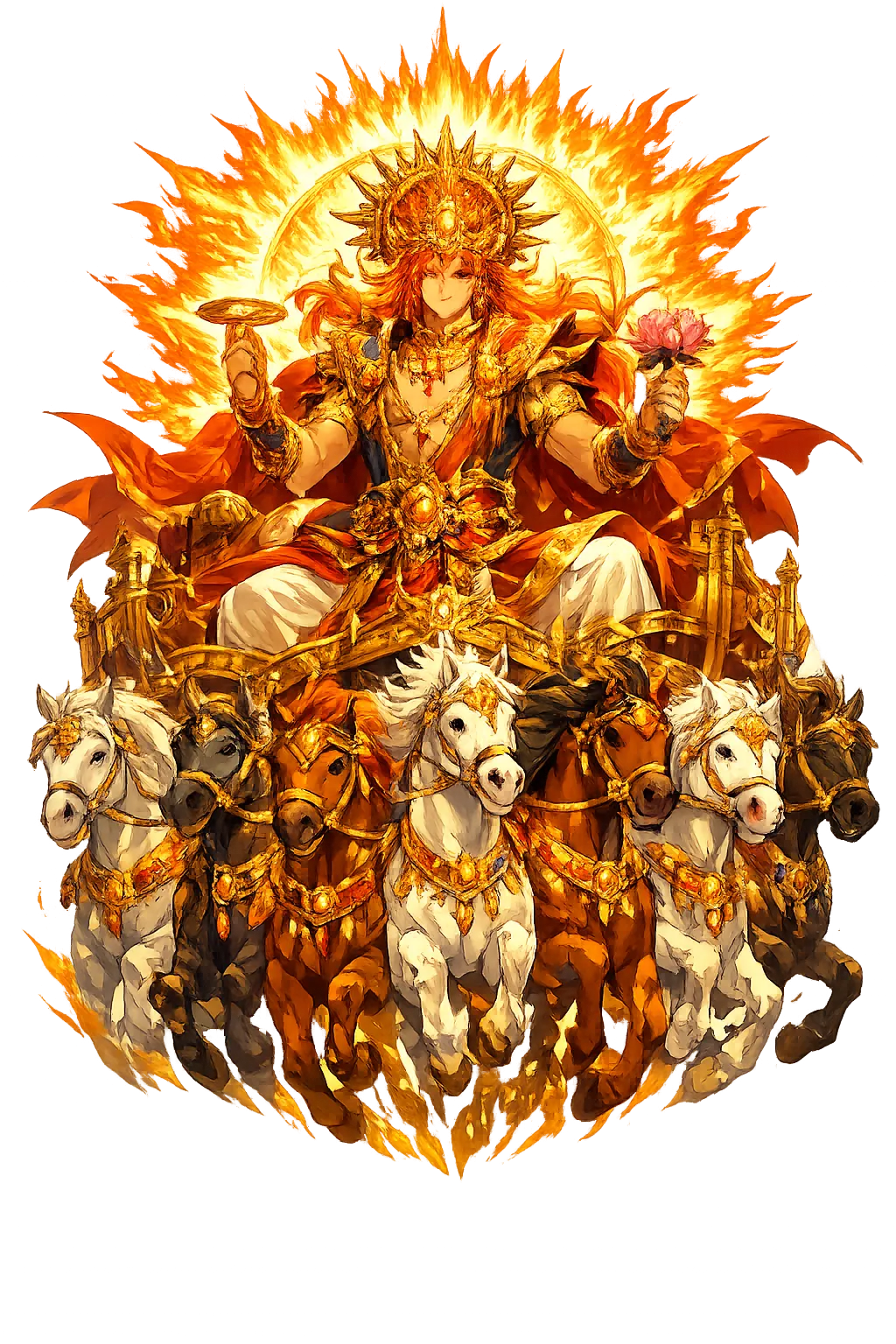
To recognize Sūrya, look for the chariot. His canonical image is a standing, crowned god holding a lotus in each hand, riding a one-wheeled chariot drawn by seven horses — the rays — driven by the legless dawn-charioteer Aruṇa; early medieval art adds the attendant archers Uṣā and Pratyūṣā shooting away the darkness. His dress betrays his long journey: tunic and boots, foreign garments in Indian iconography, reflecting the northern dress already visible in Kuṣāṇa-period images. Some of the earliest witnesses survive in stone: the second-century Sūrya relief from the Mahābodhi railing at Bodh Gayā, now in the Indian Museum, Kolkata, shows the full program — chariot, horses, the god with twin lotuses — and Kuṣāṇa gold coins carry his Iranian cousin Miiro. The image then froze for a millennium: from Modhera to Konark the seven horses and twin lotuses never change, though Konark monumentalizes the whole vehicle in stone.

06

Reception & Transformation

The name after its own age — transmission, translation, survival

Afterlives

Sūrya rode out of the Veda on a chariot of scholarship. The epics made solar blood the currency of legitimacy, the Purāṇas multiplied his mythology, and the Saura stream carried him to the great sun temples of the medieval millennium. Astronomy then wrote him into science: the Sūrya Siddhānta, fixed in its surviving form in the early centuries CE, became the founding text of Indian mathematical astronomy — the sun worshipped with sines. European scholarship made him a battleground: nineteenth-century solar mythology — Max Müller's school, which read myths as sun and weather allegory — provoked Andrew Lang's famous rebuttal, and Sūrya became the textbook case of a nature-god over-interpreted. The twentieth century repatriated him through yoga: the Raja of Aundh popularized Sūrya Namaskāra as a daily physical discipline in the 1920s, while the dawn Gāyatrī and Makara Saṅkrānti kept the solar rhythm beating in national life and, with the diaspora, far beyond it.

Identifications Across Traditions

Sūrya was one of the few Vedic gods to retain and expand his worship into the medieval and modern periods, perhaps because the sun itself is impossible to demote. He absorbed Persian and Hellenistic solar imagery after the Indo-Greek and Kushan periods, and his classical iconography — boots, tunic, royal attributes — shows clear Greco-Roman influence. In Southeast Asia the sun god appears in Cambodian and Javanese temple art, while in India the Saura tradition became one of the major religious streams. The Japanese Amaterasu, the Egyptian Rꜥ, and the Iranian Mithra are distant cousins in the broad Eurasian family of solar cults, though Sūrya's Vedic roots — chariot, lotus, the Gāyatrī mantra — are distinctively his own.

Modern Legacy

Sūrya remains central to Hindu daily life. The Gāyatrī mantra, addressed to Savitṛ, is recited by millions at dawn; sūrya namaskāra, the sun salutation, is practiced in yoga classes worldwide. Sun temples such as Konark in Odisha and Modhera in Gujarat stand as architectural masterpieces of solar worship, while the Jantar Mantar observatories in Jaipur and Delhi translate his movement into monumental geometry. In Ayurveda and traditional medicine, sunlight is a healing force, and the sun's position determines auspicious moments (muhūrta) for every important undertaking. The name Sūrya is common across South Asia, and the sun continues to symbolize clarity, justice, and vital energy in popular culture — the one god who never needed a priest to make his daily appearance.

07

The Meditation

What Sūrya means — beyond the dictionary

Sūrya teaches that witnessing is a form of love. The sun does not judge; it simply sees, and in seeing, it makes life possible. Every secret act is held in its light, every shadow defined by its presence.

To worship Sūrya is to consent to be seen — not with shame but with the recognition that visibility is the condition of growth. The sun asks nothing in return but disciplined attention: the sandhya prayers at dawn and dusk, the alignment of breath with his rising and setting. In that attention, the cosmos becomes a ritual and the day itself a sacrament.

08

Frequently Asked Questions

Common questions about Sūrya, Sun, Light, Health, and Unicode restoration

01How do you pronounce Sūrya?

In reconstructed pronunciation, Sūrya is /ˈsuːr.jə/ — approximately 'SOO-ryuh' — hold the first syllable long and bright, as in 'sue' stretched out; the final 'yuh' is quick.

02What does Sūrya mean?

Sūrya means The Sun — the Vedic solar deity who rides the one-wheeled chariot of seven mares in the sanskrit tradition.

03What are the symbols of Sūrya?

Sūrya is associated with Seven horses (The steeds of Sūrya's chariot, identified in the Ṛgveda itself with the seven meters of Sanskrit verse — cosmic order yoked to language), The one wheel (The chariot's single never-wearing wheel is the year itself (Ṛgveda 1.164) — time as the sun's axle and orbit in one), Lotus (The sun rising from the lotus, a symbol of emergence, purity, and renewal; images of Sūrya hold lotuses in both hands), Ruby and gold (The colors and materials of solar radiance and kingship — the gem offered to him in the weekly Sunday rites), The lotus of the heart (hṛdaya padma) (In yoga, the inner sun is visualized within the heart lotus, the source of vital energy).

04Why restore Sūrya in Unicode?

Plain ASCII surya strips the stress, length, and script that make the name specific. Unicode restoration returns the name to its original written dignity.

05What is the most important myth about Sūrya?

“The One-Wheeled Chariot” — the Ṛgveda story that anchors the mythology of Sūrya, told in full on the lore page.

09

Scholarly Sources

The philological foundations of this restoration

Every claim on this page is grounded in established scholarship. The orthographic restorations follow disciplinary convention. The etymological chain follows the best available reference works. This is not invention — it is resurrection through scholarship.

◈

Lexicography & Philology

  • MW
  • KEWA
◎

Primary Texts

  • Ṛgveda Saṃhitā 1.50, 1.115, 1.164, 7.63 (Sūrya hymns)
  • Viṣṇu Purāṇa 3.2 (Sañjñā and Chāyā)
◉

Archaeology & Art History

  • Material evidence — iconography, inscriptions, and temple archaeology — for Sūrya and related cults.
✦

Religious Studies

  • Mahābhārata, Ādi Parvan (birth of Karṇa) and Karṇa Parvan (his death)
  • Rāmāyaṇa, Kiṣkindhākāṇḍa (Sugrīva's alliance with Rāma)
  • Samba Purāṇa and Bhaviṣya Purāṇa (Samba's penance and the Multan temple)
  • Gonda, Jan, The Vedic God Mitra-Varuṇa and Sūrya
Return

The Surface Awaits

You have traced the name from its earliest attestation to its Unicode restoration. Now return to the myth. The story is where the name lives.

Back to Lore
Sūrya mascot