The Living Myth
Fire, Ragnarök, Muspelheim · The Black One, the Fire at the End · Black, the swarthy one
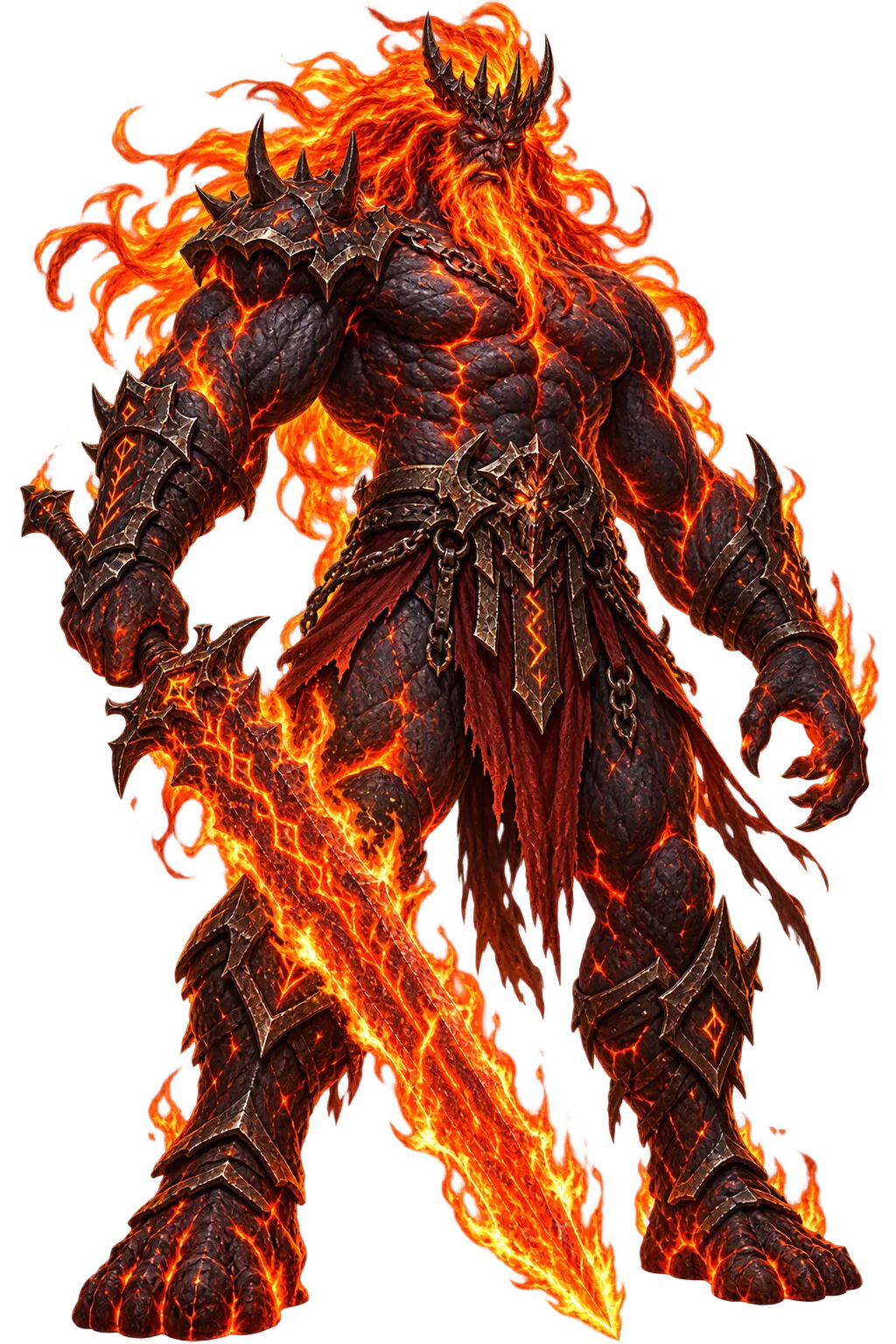
Stories of Surtr
Surtr’s mythology is the eschaton itself: he barely acts in the world’s story because his role is to end it. The Eddic poems give him Múspellsheimr, the sword of the sun’s brightness, the march at Ragnarök, the killing of Freyr, and the fire that consumes and renews. He is the Norse pantheon’s only fire-god — the flames of the end, kept outside the world until the world’s last hour.
The seeress’ prophecy reserves its starkest stanzas for him: ‘Surtr comes from the south with the bane of branches, the sun of the battle-gods shone from his sword.’ He rides first of the doom-forces; his arrival is the sign that the last battle has begun, and the sky itself catches fire from his blade.
Odin’s wisdom-contest with the giant Vafþrúðnir fixes the cosmography: Surtr and the Æsir’s gods will meet at the field of Vígríðr, and ‘he will return home victorious’ from the encounter with Freyr. The poem’s calm arithmetic of doom — the lists of who kills whom — gives Surtr the war’s decisive duel.
Snorri’s prose Edda places him as Múspellsheimr’s guardian from the beginning — the fire that predates the world and will outlast it. His sons, the ‘sons of Múspell’, ride with him; their host waits at the world’s rim through every age, kept out by the world’s green and the gods’ vigil.
The Norse end is not the Christian end: after Surtr’s fire the earth rises green from the sea, the gods’ survivors meet, and the world begins again. The fire-giant’s destruction is the renewal’s price — the black one’s blaze is the last act of the old world and the first condition of the new.
The Fire-Giant of Múspellsheimr
Surtr is the fire that ends the world: the black giant of Múspellsheimr, the realm of flame beyond the world’s rim, who will ride forth at Ragnarök with his burning sword brighter than the sun, defeat Freyr, and set the nine worlds ablaze — from whose surge the renewed earth rises. The Völuspá gives him the last word of the old world and the first light of the new.
His sword shines brighter than the sun; with it he splits the world-tree’s shelter and sets the sky afire.
His realm of fire, the southernmost of the nine worlds — hot and radiant, guarded for the last battle.
At Ragnarök he kills Freyr, who lacks his own sword — the gods’ summer falls to the world’s fire.
From his fire the new earth rises green — the destroyer as the price of the world’s rebirth.
From the original script to the living URL
ᛋᚢᚱᛏᚱ
The name in its original Norse form. Surtr (ᛋᚢᚱᛏᚱ) is attested in the source tradition — “Black, the swarthy one”. Its original diacritics and script distinctions carry the full phonetic and orthographic weight of the source tradition.
surtr
The plain surtr form is identical to the Unicode restoration. Because this name is already written in Latin letters, no diacritics, stress, or script information were lost — only capitalization differs.
Surtr
The Unicode restoration does not need to recover lost marks for Surtr. Its value is canonical spelling and consistent cataloguing, not the reconstruction of erased orthography. The domain is readable as-is to both DNS and humanity.
Surtr.com
This restoration is written entirely in ASCII letters — no Punycode encoding stands between Surtr and the DNS. The domain reads identically to machines and to human eyes.
The attested spelling family of Surtr
Surtr
Restores ᛋᚢᚱᛏᚱ. The full Unicode restoration. surtr.com is not in the PuniCodex collection — it is watched for release; if it drops, this temple upgrades to an owned flagship. Attested by Cleasby-Vigfusson, Zoëga.
How Surtr was spoken
How Surtr travels from ancient script to the modern URL
The lore you have read is the living myth. Extended Lore opens the scholarly vault beneath it: the cult and its material remains, a history of the image, the name after antiquity, a meditation on what the name still means, and the full scholarly apparatus — etymology, orthography, sources.
Enter Extended Lore