PuniCodex

Extended Lore

Stribog

Etymology · Orthography · Cult · Iconography · Reception · Sources

Tier 2 Stribog
Stribog — Winds, Storms
01

Quick Facts

Essential information about Stribog, Winds, Storms

Scholarly TransliterationStribog
Unicode RestorationStribog
Reconstructed Pronunciation/stribog/
PantheonSlavic
DomainWinds, Storms
MeaningFather of winds
ClassificationTier 2
Primary DomainStribog
Sacred SymbolsWind and weather, Storm cloud and squall, The steppe horizon, The moving air of thaw
02

Etymology & Word Family

From original script to Unicode restoration

Scholarly Transliteration Stribog Stribog — "Father of winds"
Unicode Restoration Stribog Canonical scholarly spelling — ASCII-identical
Modern ASCII stribog Plain-ASCII fallback

The name Stribog reaches the modern world through scholarly transliteration of the slavic tradition. Because the conventional spelling uses only Latin letters, its Unicode and ASCII forms coincide — the tradition it carries is in the name itself, not in diacritics.

03

Unicode Character Breakdown

Character-by-character philological analysis

CharacterUnicodeNameBlockPhonetic Role
SU+0053Latin Capital Letter SBasic LatinSame, capitalized
tU+0074Latin Small Letter TBasic LatinSame
rU+0072Latin Small Letter RBasic LatinSame
iU+0069Latin Small Letter IBasic LatinSame
bU+0062Latin Small Letter BBasic LatinSame
oU+006FLatin Small Letter OBasic LatinSame
gU+0067Latin Small Letter GBasic LatinSame

The Tier 2 classification here reflects fidelity to the attested tradition, not recovered diacritics: every character of Stribog already survives in ASCII. What the restoration preserves is the canonical spelling itself — the form scholarship standardised.

04

Cult & Worship

How the sacred was kept — rites, sanctuaries, remains

The Cult

For Stribog's cult the honest record is two data points: a place in the pantheon of Kyiv, and a share in the great sacrifice of 980, when Vladimir fed the hill's idols before the Dnieper baptism of 988. No festival, temple, priesthood, or votive object is ever named for him; the Kyiv hill has yielded no shrine deposit, and no chronicle anecdote visits his altar. His rank implies a cult of real standing — the sixth place of six is not given to nobodies — but everything beyond the two lines is modern inference, and the temple treats it as such.

In the Earth

No artifact, building, image, or inscription can be tied to Stribog. Unlike Perun's Peryn' enclosure or Veles's Novgorod street, the wind-god left no footprint in the ground, and the destruction of 988 swept away whatever shrine the Kyiv hill may have held. Wind and storm imagery on medieval jewelry and amulets — whirlwind stamps, storm-bird pendants — is sometimes laid at his door, but the attributions are decorative rather than demonstrated, and nothing bears his name. The Slovo's 'grandsons of Stribog' remains his only monument: a line of verse that has outlasted every temple in the pantheon, copied in more than a hundred manuscripts of the national epic and read aloud in classrooms eight centuries after the last wind was officially his.

05

Iconography

How Stribog was imaged across the ages

The Image

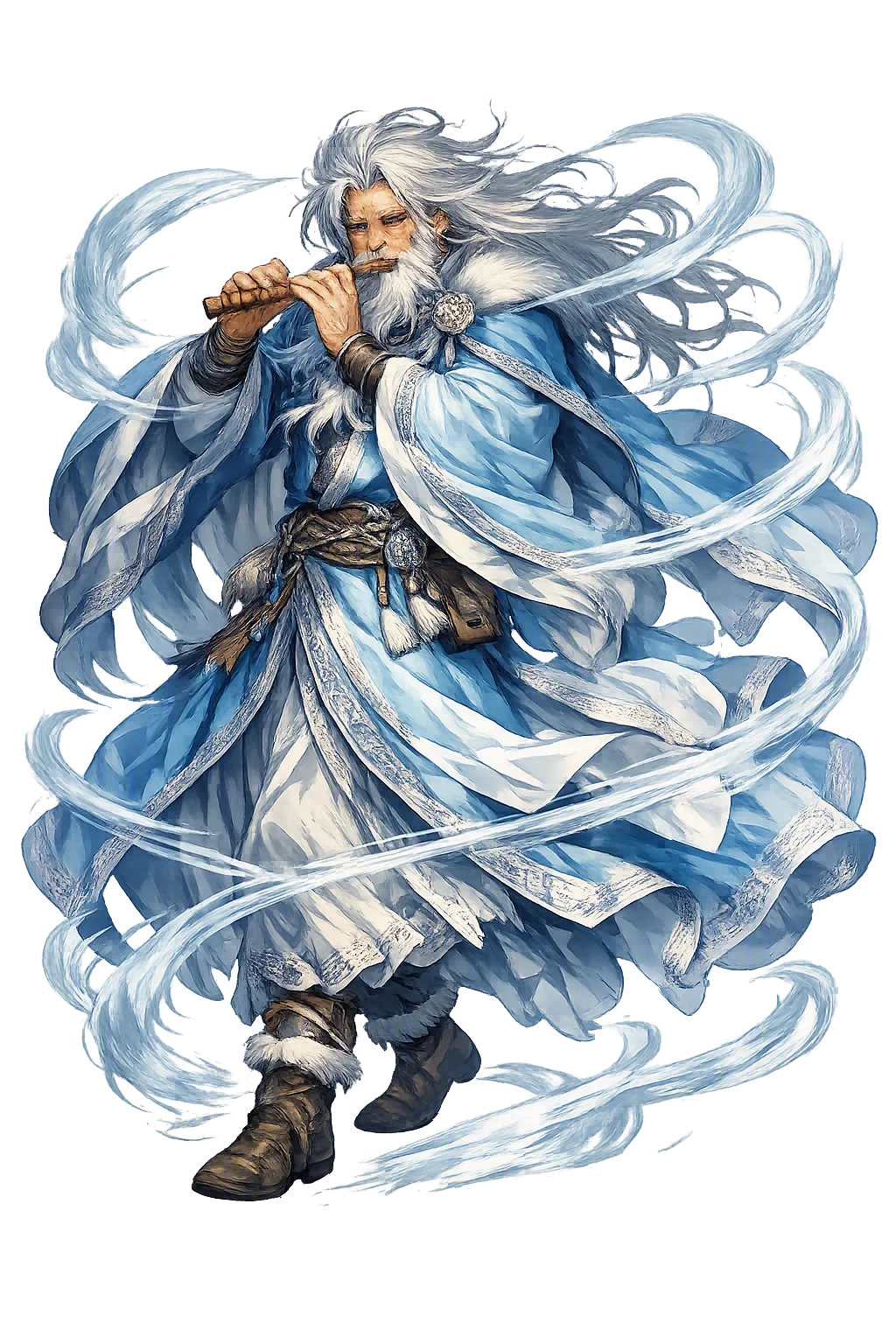
No depiction of Stribog survives, and none is likely to have existed: the early Slavs built in wood and carved little, and no medieval image of a wind-god has ever been assigned to him. What the tradition supplies instead is a natural iconography — the rising dust, the sea-born squall — fixed forever in the Slovo's image of the winds blowing from the sea. Whirlwind stamps on medieval jewelry and storm-bird pendants are sometimes laid at his door, but the attributions are decorative guesses, and nothing bears his name. His true portrait is verbal: a family of winds with a grandfather.

06

Reception & Transformation

The name after its own age — transmission, translation, survival

Afterlives

Stribog's afterlife was decided by manuscript accidents. His two attestations — the Primary Chronicle's list and the Slovo o polku Igoreve's 'grandsons of Stribog' — survived in a handful of medieval codices, and the Slovo itself was rediscovered only in 1795, in the collection of Count Aleksei Musin-Pushkin; published in 1800 to national sensation, it burned with Moscow in 1812 and survives solely through the copies and editions made in those seventeen years. That rediscovery made Stribog a Romantic possession: the wind-god entered every anthology of Old Rus' literature and every schoolroom, quoted more widely than gods with far richer cults. Nineteenth- and twentieth-century philology then made his name its problem child — Brückner, Łowmiański, and Vasmer each weighed the opaque first element — so that his modern fame rests on one epic line and an unsolved etymology. No church ever replaced him; the winds kept their grandfather.

Identifications Across Traditions

Stribog attracted no Christian successor — no saint took the winds from him the way Elijah took Perun's storm — and Byzantine writers had no classical slot for a wind-god, so no interpretatio rescued him either. His afterlife is purely literary and comparative. Comparative mythology seats him beside the Vedic Vāyu, master of the winds, and beside the Greek winds as a brood rather than a person — Aeolus managing his bag of quarrelsome grandchildren. In the twentieth century Rodnover calendars promoted him as a god of winds and weather, roles extrapolated from the Slovo formula; fantasy fiction and games drift him as a stock 'old Slavic' name. The most honest syncretism is the one the poet performed unwittingly: naming the winds a family. That is how a polytheist sky is actually experienced — every gust somebody's relative, every storm a household arriving.

Modern Legacy

Stribog's legacy is almost entirely onomastic and literary. The Slovo's phrase 'Stribog's grandsons' entered every anthology of Old Rus' literature and every schoolroom, so that his name survives more widely read than those of gods with far richer cults. Modern paganism adopted him enthusiastically but thinly: he appears in Rodnover calendars and in fantasy fiction, games, and brand names, usually as a generic wind or storm patron — attributes supplied by authors, not sources. For linguists he remains a standing exhibit in seminars on Slavic theonymy, a name whose opaque first element defeats each new generation of etymologists. If Perun is the god who would not die and Veles the god who would not stay hidden, Stribog is the god who never quite existed in the record — a place kept for the wind in the pantheon's seating plan, honored now mostly by being quoted correctly.

07

The Meditation

What Stribog means — beyond the dictionary

Stribog is the god of what passes through. Wind cannot be sworn by, cannot be fed, cannot even be consistently blamed — and so the tradition left him almost nothing to hold. What the epic gives him instead is better than a cult: a family. The winds are his grandsons — not his subjects, not his weapons, his grandsons, the way weather actually behaves, arriving uninvited, full of intentions, unmistakably related. The phrase is a miniature of how polytheism worked before it learned to be systematic: the world is not governed, it is inhabited, by beings with kin. Stribog matters to the modern imagination precisely because he is so nearly empty — a vessel into which every age pours its theory of the wind, from philology's unsolved root to fantasy's storm lord. Perhaps a god who is only a name and a family of winds is the truest wind-god of all: felt everywhere, pinned down nowhere, and quoted — 'the winds, Stribog's grandsons' — whenever the air itself needs a lineage.

08

Frequently Asked Questions

Common questions about Stribog, Winds, Storms, and Unicode restoration

01How do you pronounce Stribog?

In reconstructed pronunciation, Stribog is /stribog/ — approximately 'STREE-bog', rolled r, stress forward; the second half of the name literally means 'god'.

02What does Stribog mean?

Stribog means Father of winds in the slavic tradition.

03What are the symbols of Stribog?

Stribog is associated with Wind and weather (The element itself, which the epic makes his family: the winds do what grandsons do), Storm cloud and squall (The war-weather of the Slovo — the black sky under which Igor's campaign marched), The steppe horizon (Kyiv's winds came off the open steppe; his one vivid scene is a steppe wind rising from the sea), The moving air of thaw (The spring winds that break the river ice — function inferred from his wind-kin, not attested).

04Why restore Stribog in Unicode?

Stribog is written entirely in ASCII letters, so its restoration is about canonical fidelity rather than recovered diacritics: the temple fixes the name in its scholarly standard spelling, attested in the source tradition, instead of leaving it to drift.

05What is the most important myth about Stribog?

“The Idols in the Dnieper” — the Kyiv, 988 story that anchors the mythology of Stribog, told in full on the lore page.

09

Scholarly Sources

The philological foundations of this restoration

Every claim on this page is grounded in established scholarship. The orthographic restorations follow disciplinary convention. The etymological chain follows the best available reference works. This is not invention — it is resurrection through scholarship.

◈

Lexicography & Philology

  • Primary Chronicle
  • Ivanov-Toporov
◎

Primary Texts

  • The Primary Chronicle (Povest’ vremennykh let); the Hypatian Codex; East Slavic chronicle tradition and South Slavic folk invocations.
◉

Archaeology & Art History

  • Material evidence — iconography, inscriptions, and temple archaeology — for Stribog and related cults.
✦

Religious Studies

  • Primary Chronicle / Povest' vremennykh let, s.a. 988
  • Slovo o polku Igoreve (The Tale of Igor's Campaign)
  • Gieysztor, Aleksander, Mitologia Słowian (1982)
  • Brückner, Aleksander, Mitologia słowiańska i polska (1924)
  • Łowmiański, Henryk, Religia Słowian i jej upadek (1979)
  • Vasmer, Max, Russisches etymologisches Wörterbuch
Return

The Surface Awaits

You have traced the name from its earliest attestation to its Unicode restoration. Now return to the myth. The story is where the name lives.

Back to Lore
Stribog mascot