PuniCodex

Extended Lore

Sosin

Etymology · Orthography · Cult · Iconography · Reception · Sources

Tier 2 Sosin
Sosin — Messenger, Revealer
01

Quick Facts

Essential information about Sosin, Messenger, Revealer

Scholarly TransliterationSosin
Unicode RestorationSosin
Reconstructed Pronunciation/so.ɕin/
PantheonKorean
DomainMessenger, Revealer
MeaningRevealer of things
ClassificationTier 2
Primary DomainSosin
Sacred SymbolsPath or road, Mirror, Feather or wing, Scroll or petition
02

Etymology & Word Family

From original script to Unicode restoration

Scholarly Transliteration Sosin Sosin — "Revealer of things"
Unicode Restoration Sosin Canonical scholarly spelling — ASCII-identical
Modern ASCII sosin Plain-ASCII fallback

The name Sosin reaches the modern world through scholarly transliteration of the korean tradition. Because the conventional spelling uses only Latin letters, its Unicode and ASCII forms coincide — the tradition it carries is in the name itself, not in diacritics.

03

Unicode Character Breakdown

Character-by-character philological analysis

CharacterUnicodeNameBlockPhonetic Role
SU+0053Latin Capital Letter SBasic LatinSame, capitalized
oU+006FLatin Small Letter OBasic LatinSame
sU+0073Latin Small Letter SBasic LatinSame
iU+0069Latin Small Letter IBasic LatinSame
nU+006ELatin Small Letter NBasic LatinSame

The Tier 2 classification here reflects fidelity to the attested tradition, not recovered diacritics: every character of Sosin already survives in ASCII. What the restoration preserves is the canonical spelling itself — the form scholarship standardised.

04

Cult & Worship

How the sacred was kept — rites, sanctuaries, remains

The Cult

Sosin was not worshipped in a building but invoked in a performance. The figure's cult is the gut itself: at the opening of the shamanic rite the mudang drums the road-opening spirits toward the house, invokes the courier spirits to carry the household's petitions upward, and interrogates them in the divination passages that disclose the cause of misfortune. Lee Jung Young's Korean Shamanistic Rituals (1981) and Walraven's Songs of the Shaman (1994) — the latter built from recorded performances — document exactly this postal structure, and Kendall's Seoul ethnography (1985) shows the diagnosis being negotiated in real time. Per-figure evidence naming Sosin is thin and regional; what stands firm is the office, still performed across the peninsula.

In the Earth

No inscription, stele, or excavated shrine names Sosin; the figure's 'archaeology' is the archaeology of the gut itself. The material witnesses are the ritual paraphernalia preserved in Korean collections — the National Folk Museum of Korea in Seoul holds shamanic costumes, divination flags, bells, blades, and mirrors from twentieth-century performances — and the documented regional cycles of gut performance: the Jeju yeongdeunggut (inscribed by UNESCO in 2009), the chilseong-gut and jeseok-gut traditions recorded across the peninsula. Film and audio recordings of mudang made by scholars from the 1970s through the 1990s now function as the primary 'texts' for spirits of this class. Older strata are indirect: the Confucian and Buddhist polemics against 'exorcists and spirit-mediums,' reaching back well over a millennium, attest the tradition's antiquity even as they condemn it.

05

Iconography

How Sosin was imaged across the ages

The Image

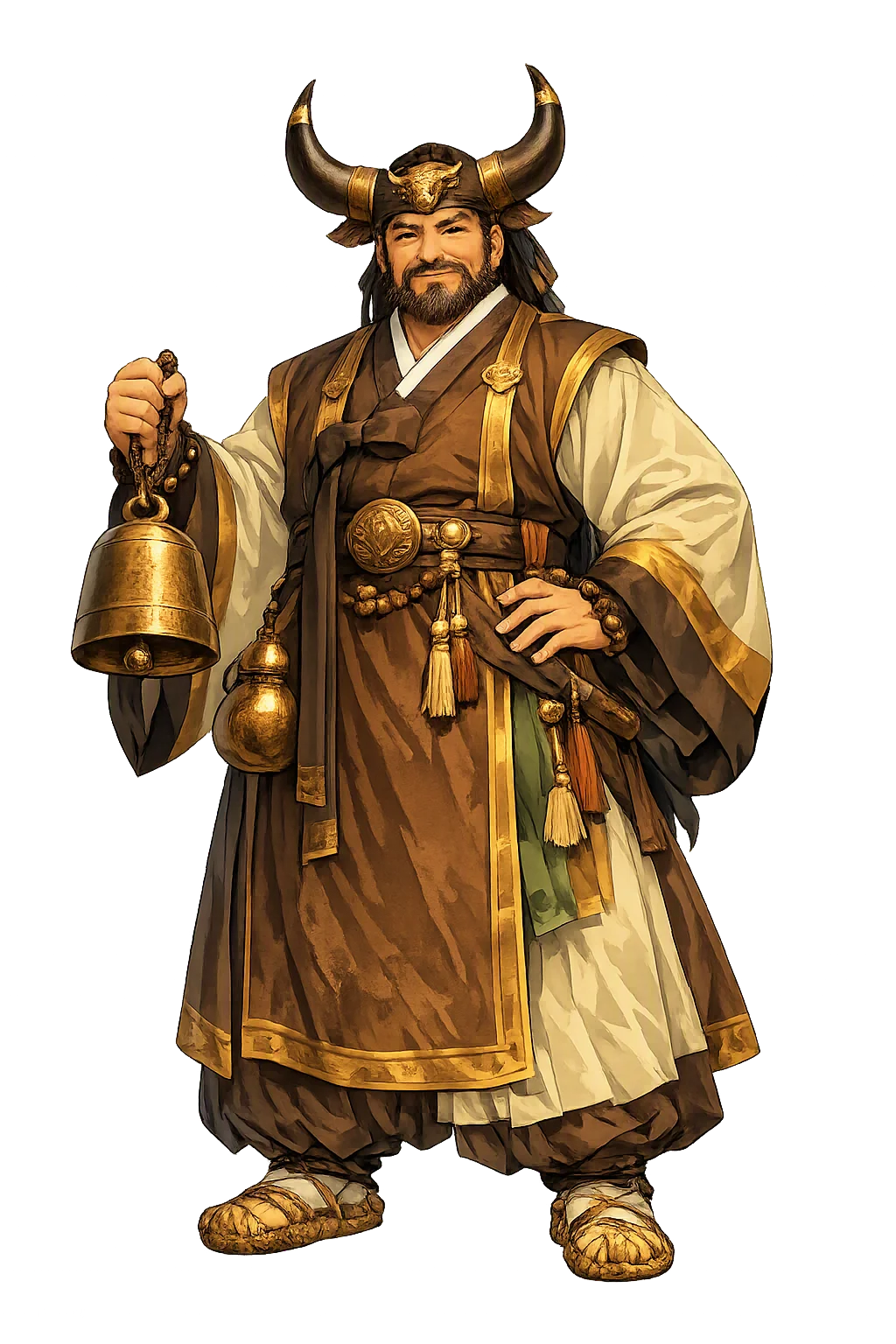
Sosin has no canonical image; the gut tradition of Korean shamanism is effectively aniconic, its gods present in song, movement, and paraphernalia rather than in statuary or painting. The figure's visual vocabulary is the mudang's equipment: the divination flags announcing the spirits' arrival, the bronze mirror that catches and returns the unseen, the bells and blades that mark the courier's road. Twentieth-century photographs of mudang at work — preserved in museum archives and folklore publications — show the messenger spirits dressed in the shaman's own body: the possessed mudang speaks with the spirit's voice, so the image of Sosin in performance is a human face mid-trance. The spirit paintings sold to clients today depict heavenly bureaucrats in official robes — a convention of the celestial-court cosmology, not a portrait of this courier.

06

Reception & Transformation

The name after its own age — transmission, translation, survival

Afterlives

Sosin's transmission runs entirely through the twentieth century's documentation of a condemned tradition. Colonial authorities moved against shamanic practice in the 1930s, post-war governments stigmatized the mudang as superstition, and the tradition survived because its practitioners kept performing — and because scholars finally recorded them. The foundational texts are Lee Jung Young's Korean Shamanistic Rituals (1981), Kendall's Shamans, Housewives, and Other Restless Spirits (1985), and Walraven's Songs of the Shaman (1994), all built on fieldwork with working mudang; the National Folk Museum's Encyclopedia of Korean Folk Beliefs (2015) then fixed the figure in reference form. Kim Keum-hwa's staged guts carried the rite to national and international audiences from the 1970s onward, and UNESCO's 2009 inscription of Jeju's Chilmeoridang gut gave the tradition official standing. The scholarly afterlife now outruns the living one: for many young Koreans, figures like Sosin exist first as ethnography, only secondly as religion.

Identifications Across Traditions

Sosin sits at the meeting point of several centuries of Korean religious politics. Confucian literati classed the mudang's messengers among the 'heterodox spirits' their order condemned; Buddhist establishments, more accommodating, absorbed the spirit hierarchy as mundane deities below the Buddha; and the Protestant churches that loom large in modern Korea inherited much of the old Confucian distrust of the rite. Japanese colonial authorities moved against shamanic practice in the 1930s and 1940s, and post-war governments stigmatised it as superstition before folklorists rebuilt its scholarly standing. Related rites have since received formal honour — the Jeju Chilmeoridang gut was inscribed on UNESCO's Representative List in 2009. Comparatively, the messenger-revealer type is regional rather than uniquely Korean: Chinese spirit-medium traditions and the courier spirits of Siberian shamanism present the same courier of a celestial bureaucracy, and Sosin is best read as the Korean member of that type (Walraven 1994; Lee 1981).

Modern Legacy

Sosin is not a household name in the way that Yongwang or Samshin are, but it remains important within shamanic practice and the academic study of Korean religion. The figure appears in ritual manuals, recordings of gut performances, and ethnographic studies of mudang; the famous twentieth-century shaman Kim Keum-hwa and others carried the gut to national and international stages, turning village ritual into recognised performance art. Sosin also stands in the background of Korea's enormous contemporary fortune-telling culture of saju and jeom — the commercial grandchildren of the village mudang's diagnosis. And it interests modern readers concerned with divination, intuition, and the hidden dimensions of experience. As Korean shamanism gains international scholarly attention, figures like Sosin help illustrate the complexity and sophistication of the tradition: a religion whose postal service is also its theology.

07

The Meditation

What Sosin means — beyond the dictionary

Sosin is the patron of an unfashionable idea: that truth needs a courier. The modern world imagines that information travels by itself, weightless and instant; the Korean gut remembers that it never does. Between the village's grief and heaven's answer stands a being whose whole office is the passage — someone who opens the road, states the petition plainly, and brings the reply back in terms a household can act on. Every translator, every advocate, every doctor who reframes a frightening diagnosis is doing Sosin's old work. There is also a quiet lesson in the figure's obscurity: the tradition gave no epic to its messengers because their perfection is invisibility. They are judged, as postal workers are, by whether anything arrives. To restore the capital S is to grant that office a name, and to admit that some of the most consequential figures in any cosmology are the ones who only carry.

08

Frequently Asked Questions

Common questions about Sosin, Messenger, Revealer, and Unicode restoration

01How do you pronounce Sosin?

In reconstructed pronunciation, Sosin is /so.ɕin/ — approximately 'SOH-sheen' — two syllables with a light stress forward; the sh-sound is the crisp Korean 시, slightly sharper than English 'sh'. In shamanic usage the name denotes a spirit who reveals hidden matters and carries messages between realms.

02What does Sosin mean?

Sosin means Revealer of things in the korean tradition.

03What are the symbols of Sosin?

Sosin is associated with Path or road (The channel through which messages travel between worlds.), Mirror (An instrument of revelation that reflects hidden truth.), Feather or wing (A messenger emblem signifying swift movement between realms.), Scroll or petition (The written or spoken prayer entrusted to Sosin for delivery.).

04Why restore Sosin in Unicode?

Sosin is written entirely in ASCII letters, so its restoration is about canonical fidelity rather than recovered diacritics: the temple fixes the name in its scholarly standard spelling, attested in the source tradition, instead of leaving it to drift.

05What is the most important myth about Sosin?

“The Government of Heaven” — the Cosmology story that anchors the mythology of Sosin, told in full on the lore page.

09

Scholarly Sources

The philological foundations of this restoration

Every claim on this page is grounded in established scholarship. The orthographic restorations follow disciplinary convention. The etymological chain follows the best available reference works. This is not invention — it is resurrection through scholarship.

◈

Lexicography & Philology

  • Korean folklore
  • Shamanic texts
◎

Primary Texts

  • Primary sources in the korean tradition for Sosin.
◉

Archaeology & Art History

  • Material evidence — iconography, inscriptions, and temple archaeology — for Sosin and related cults.
✦

Religious Studies

  • Walraven, Boudewijn, Songs of the Shaman: The Ritual Chants of the Korean Mudang (Kegan Paul International, 1994).
  • Lee, Jung Young, Korean Shamanistic Rituals (Mouton, 1981).
  • Kendall, Laurel, Shamans, Housewives, and Other Restless Spirits: Women in Korean Ritual Life (University of Hawaii Press, 1985).
  • National Folk Museum of Korea, Encyclopedia of Korean Folk Beliefs (2015).
Return

The Surface Awaits

You have traced the name from its earliest attestation to its Unicode restoration. Now return to the myth. The story is where the name lives.

Back to Lore
Sosin mascot