PuniCodex

Extended Lore

ᛋᛚᛅᛁᛒᚾᛁᛦ Sleipnir

Etymology · Orthography · Cult · Iconography · Reception · Sources

Tier 2 Sleipnir
Sleipnir — Eight-Legged Steed, Journey, Offspring of Loki
01

Quick Facts

Essential information about Sleipnir, Eight-Legged Steed, Journey, Offspring of Loki

Original Scriptᛋᛚᛅᛁᛒᚾᛁᛦ
Unicode RestorationSleipnir
Reconstructed Pronunciation/ˈslɛip.nir/
PantheonNorse
DomainEight-Legged Steed, Journey, Offspring of Loki
MeaningGliding one (from sleipr, slippery)
ClassificationTier 2
Primary DomainSleipnir
Sacred SymbolsThe eight legs, The grey coat, Svaðilfari, The leap over Helgrindr, The rune-carved teeth
02

Etymology & Word Family

From original script to Unicode restoration

Original Script ᛋᛚᛅᛁᛒᚾᛁᛦ Sleipnir — "Gliding one (from sleipr, slippery)"
Unicode Restoration Sleipnir Canonical scholarly spelling — ASCII-identical
Modern ASCII sleipnir Plain-ASCII fallback

The name Sleipnir reaches the modern world through scholarly transliteration of the norse tradition. Because the conventional spelling uses only Latin letters, its Unicode and ASCII forms coincide — the tradition it carries is in the name itself, not in diacritics.

03

Unicode Character Breakdown

Character-by-character philological analysis

CharacterUnicodeNameBlockPhonetic Role
SU+0053Latin Capital Letter SBasic LatinSame, capitalized
lU+006CLatin Small Letter LBasic LatinSame
eU+0065Latin Small Letter EBasic LatinSame
iU+0069Latin Small Letter IBasic LatinSame
pU+0070Latin Small Letter PBasic LatinSame
nU+006ELatin Small Letter NBasic LatinSame
iU+0069Latin Small Letter IBasic LatinSame
rU+0072Latin Small Letter RBasic LatinSame

The Tier 2 classification here reflects fidelity to the attested tradition, not recovered diacritics: every character of Sleipnir already survives in ASCII. What the restoration preserves is the canonical spelling itself — the form scholarship standardised.

04

Cult & Worship

How the sacred was kept — rites, sanctuaries, remains

The Cult

Sleipnir himself received no cult, but he stands at the centre of the best-attested ritual horizon of the Viking-Age North: the horse. The Gokstad ship burial (c. 900) went to the grave with twelve horses and six dogs; saga tradition preserves the Yule horse-meat of the great heathen sacrifices and Völsa þáttr's household cult of a horse relic passed from hand to hand at the banquet; and the laws and penitentials of the Christian centuries kept forbidding what men had done — eating horseflesh in honour of the powers. None of this names Sleipnir, and no source dedicates a rite to him: his cultic reality is that of his kind, elevated to the god's own saddle. Modern Heathen and Ásatrú practice remembers him in Óðinn-rites as the mount of the road between worlds — a modern honouring, sincere and explicitly revivalist, for the eight-legged one the skalds praised but never, so far as the evidence runs, propitiated.

In the Earth

Sleipnir has the strongest material attestation of any horse in the corpus: the Gotland picture stones. The Tjängvide stone (Alskog parish) and Ardre VIII, carved in the eighth and ninth centuries, show an eight-legged horse bearing a rider toward a welcoming figure — an image the standard scholarship (Lindqvist; Simek s.v. Sleipnir) identifies as Óðinn carried by Sleipnir, centuries older than any written telling. No runic inscription names the horse, and no votive deposit can be tied to him — his cult, if any, was his master's. The textual witnesses are the Codex Regius and related codices of the Prose Edda for Gylfaginning 42 and 49, and the Codex Regius of the Poetic Edda for Grímnismál and Sigrdrífumál.

05

Iconography

How Sleipnir was imaged across the ages

The Image

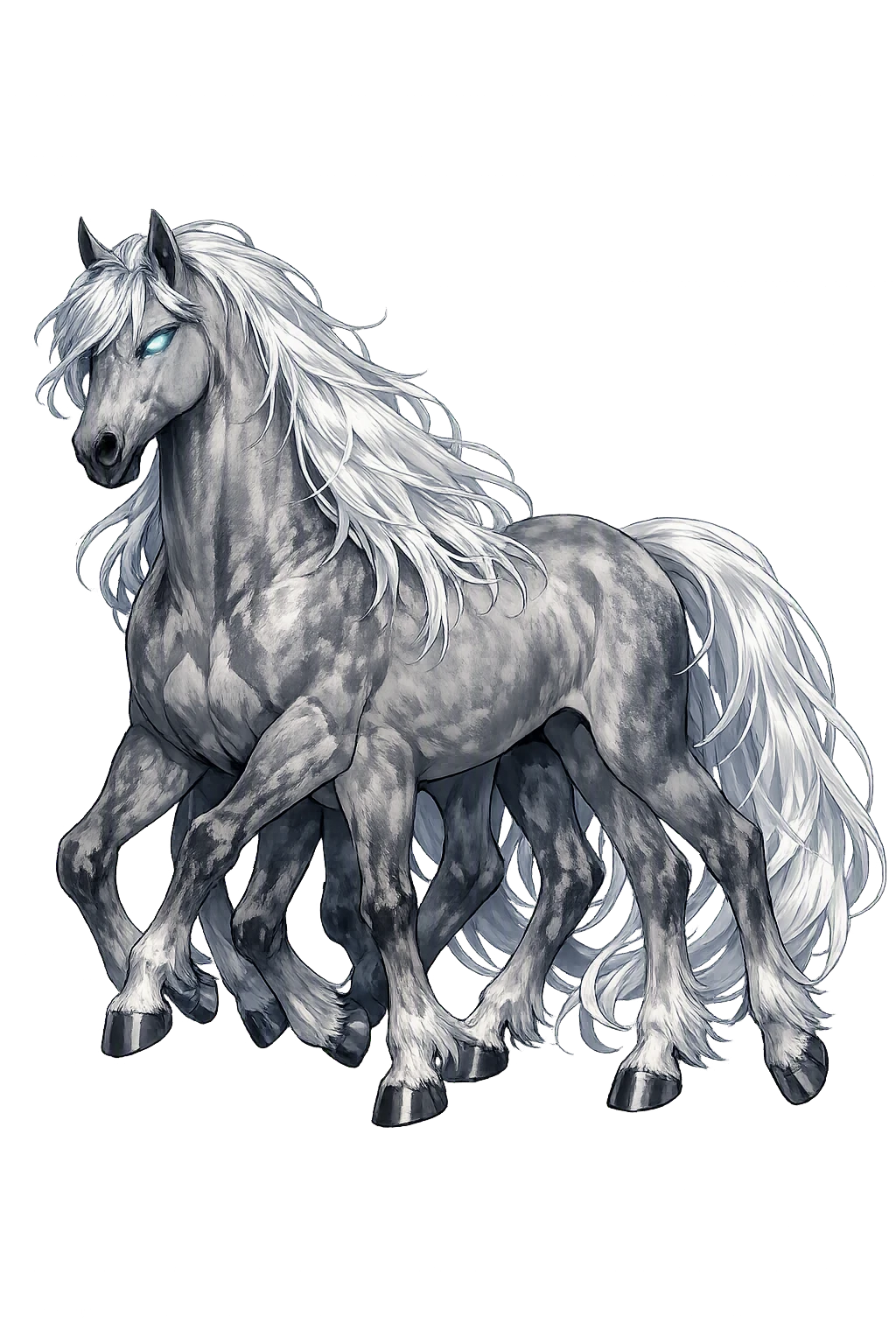
Sleipnir's image is carved in stone three centuries before Snorri wrote a word of him. On the Gotland picture stones of the eighth and ninth centuries — the Tjängvide stone from Alskog parish and Ardre VIII above all, both now in the Gotland Museum in Visby — an eight-legged horse bears a rider toward a woman with a drinking-horn who waits before a hall: Óðinn carried by his steed, received at the gate of the otherworld, in the standard reading that Lindqvist's corpus (1941–42) fixed. The attribute needs no caption: eight legs where nature and every other carved horse keep four, the visual signature no other northern beast was ever given. The textual attributes gather around the same body — the grey coat, the runes cut on his teeth, the leap over Hel's gate 'with so much to spare' — but the medieval manuscripts add no image, and later art follows the stones. From the antiquarian plates of the nineteenth century to every modern handbook, the eight-legged rider of Tjängvide has been the frontispiece of the Norse otherworld.

06

Reception & Transformation

The name after its own age — transmission, translation, survival

Afterlives

Sleipnir's afterlife begins on Gotland, with the stones. The picture stones were drawn and debated by Swedish antiquaries from Johan Hadorph's seventeenth-century expeditions onward, recorded in county descriptions and runic thesauri; Oscar Montelius and then Sune Lindqvist's Gotlands Bildsteine (1941–42) established their chronology and made the eight-legged horse a fixed exhibit of Norse studies — the rare case where a mythic creature's image is older than every written account of it, and scholarship has always known it. The written line descends from Grímnismál's superlative through Snorri's two chapters into the heroic cycle, where Reginsmál's prose and the Völsunga saga make Grani 'of Sleipnir's lineage', carrying the god's stable down into Sigurðr's world; the manuscripts rode the general rediscovery of the Edda — the 1643 Codex Regius, Resen's bilingual printing of 1665, the editions and translations of the nineteenth century. Saxo Grammaticus, who euhemerizes every god he touches, passes the eight-legged horse over in silence — a useful reminder of how odd the creature seemed even to a medieval Dane. The stones keep the last word: whatever the philologists decide, the rider of Tjängvide has been galloping for twelve centuries.

Identifications Across Traditions

Sleipnir's closest kin is inside the corpus: Grani, Sigurðr's grey, whom Reginsmál's prose calls 'of Sleipnir's lineage' — the mythic superlative breeding the heroic one, as if the gods' stable stocked the sagas. Beyond the North, scholars have ranged widely and cautiously. The eight-legged world-crosser has been read as the ritual mount of shamanic journey — the animal that carries its rider through the levels of the cosmos — an interpretation Simek registers as one modern reading among others, not an attestation. The old folkloric fancy that eight legs picture four pallbearers carrying a corpse has no medieval warrant at all and the handbooks give it no house-room. What the sources support is narrower and stronger: a horse that belongs to no stable but Óðinn's, born of the one god who crosses every boundary himself, and used for the one ride — down to Hel and back — that no other mount could survive. Within the corpus his story binds Loki, Óðinn, Hermóðr, and the house of Baldr; he is the only one of Loki's children — beside the wolf, the serpent, and Hel — whose existence is a gift and not a threat.

Modern Legacy

Sleipnir's afterlife is the afterlife of the image: the eight-legged rider of the Gotland stones has become one of the most reproduced figures of Norse art, carried from nineteenth-century antiquarian plates into every modern handbook of the mythology. In the North itself the name never quite left the stables — Swedish and Norwegian kept Sleipner for engines and hulls, from locomotives to naval vessels, and Norway gave the name to the Sleipner gas field in the North Sea, the undersea treasure-house named for the underworld runner. Modern Heathen and Ásatrú communities remember Sleipnir in Óðinn rites as the mount of the road between worlds, and retellings of the Baldr cycle keep his two great moments: the leap over Hel's gate, and the grey foal standing in the wreckage of the gods' broken bargain.

07

The Meditation

What Sleipnir means — beyond the dictionary

Sleipnir is the Edda's quiet answer to the question of what Loki costs the gods. His other children are the wolf that eats the sun's lord, the serpent that girdles the world, and the daughter who keeps the dead — every one a debt that comes due at Ragnarǫk. Sleipnir alone runs the other way: the same transgression, the same mare-shape shame, and the foal is given to Óðinn and spends his strength on errands of rescue. He is the proof that in this mythology nothing is only what it cost — not the broken oath, not the trickster's punishment, not the giant's death. The wall was never finished; the horse was. And the name says what he is for: the gliding one, the creature on whose back a wall, a river, a gate of the dead are all one thing — ground. When the Æsir needed a road to the one place that has no road, they did not build one. They mounted the child of their own worst bargain, and he leapt.

08

Frequently Asked Questions

Common questions about Sleipnir, Eight-Legged Steed, Journey, Offspring of Loki, and Unicode restoration

01How do you pronounce Sleipnir?

In reconstructed pronunciation, Sleipnir is /ˈslɛip.nir/ — approximately 'SLAYP-nir' — stress on the first syllable as in every Old Norse word, the ei a true two-part glide, the final r rolled and audible.

02What does Sleipnir mean?

Sleipnir means Gliding one (from sleipr, slippery) in the norse tradition.

03What are the symbols of Sleipnir?

Sleipnir is associated with The eight legs (Speed beyond nature's allowance — the mount that outruns every horse in the nine worlds), The grey coat (The foal's colour at birth, noted by Snorri — grey, the working colour of northern horses), Svaðilfari (The giant builder's stallion, the sire — the bargain's price become a gift), The leap over Helgrindr (The gate of the dead cleared with room to spare — no boundary holds the gliding one), The rune-carved teeth (Sigrdrífumál's image of runes lodged in the horse's mouth — the steed as a carrier of signs as well as riders).

04Why restore Sleipnir in Unicode?

Sleipnir is written entirely in ASCII letters, so its restoration is about canonical fidelity rather than recovered diacritics: the temple fixes the name in its scholarly standard spelling, attested in the source tradition, instead of leaving it to drift.

05What is the most important myth about Sleipnir?

“The Master Builder's Wage” — the Gylfaginning 42 story that anchors the mythology of Sleipnir, told in full on the lore page.

09

Scholarly Sources

The philological foundations of this restoration

Every claim on this page is grounded in established scholarship. The orthographic restorations follow disciplinary convention. The etymological chain follows the best available reference works. This is not invention — it is resurrection through scholarship.

◈

Lexicography & Philology

  • Cleasby-Vigfusson
◎

Primary Texts

  • Poetic Edda
  • Prose Edda
  • Snorri Sturluson, Prose Edda: Gylfaginning 42 (the master builder, Svaðilfari, and the birth of the grey eight-legged foal) and 49 (Hermóðr's ride on Sleipnir down the Hel-road and the leap over Hel's gate); Skáldskaparmál þulur (jóa heiti)
  • Poetic Edda: Grímnismál 44 (Sleipnir the best of horses); Sigrdrífumál 15 (runes carved on Sleipnir's teeth); Reginsmál prose (Grani of Sleipnir's lineage), trans. Carolyne Larrington
◉

Archaeology & Art History

  • Material evidence — iconography, inscriptions, and temple archaeology — for Sleipnir and related cults.
✦

Religious Studies

  • Völsunga saga (Grani's descent from Sleipnir's line), trans. Jesse L. Byock
  • Cleasby–Vigfusson, An Icelandic-English Dictionary, s.v. sleipr, Sleipnir; Zoëga, A Concise Dictionary of Old Icelandic, s.v. Sleipnir
  • de Vries, Altnordisches etymologisches Wörterbuch, s.v. Sleipnir, sleipr ('the gliding one', from sleipr 'slippery, smooth')
  • Simek, Dictionary of Northern Mythology; Orchard, Dictionary of Norse Myth and Legend; Lindow, Norse Mythology: A Guide — s.v. Sleipnir (attestation, the shamanic-journey interpretation, and the picture-stone evidence); Lindqvist, Gotlands Bildsteine (Tjängvide, Ardre VIII)
Return

The Surface Awaits

You have traced the name from its earliest attestation to its Unicode restoration. Now return to the myth. The story is where the name lives.

Back to Lore
Sleipnir mascot