
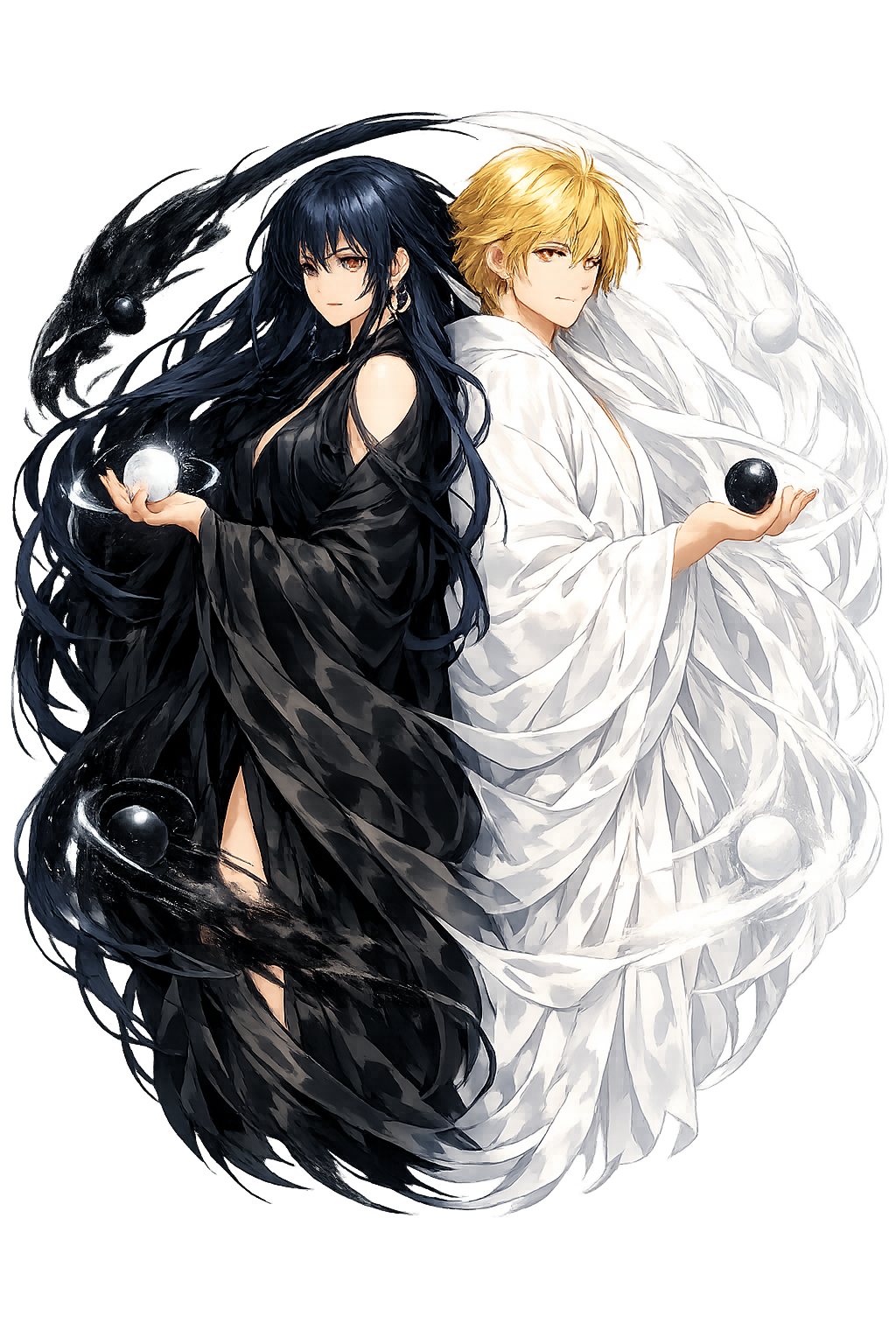
From Chinese characters to Unicode: the journey of Yīnyáng
Long before it was a domain, this name traveled through scripts. Yīnyáng begins in Chinese characters, passes through scholarly transliteration, and ends — for now — inside the punycode machinery of the global DNS. Each stage of that journey preserves some information and loses some, and the craft of restoration is knowing exactly which marks matter. This post follows the name stage by stage: the original script, the reconstructed pronunciation, the mythological record, the material evidence, and finally the Unicode form that carries all of it into the address bar. Think of it as a biography of a name, told through its spelling.
At a Glance
- Restored name: Yīnyáng
- ASCII form: yinyang
- Meaning: "Interdependence of opposites"
- Domain of influence: Cosmic Duality
- Pantheon: Taoist
- Classification: Tier 2
- Original script: 陰陽 (Chinese characters)
- Live domain: yīnyáng.com
Overview
Yīnyáng (yinyang) is the paired principle of complementary opposition at the center of classical Chinese cosmology — the interdependence of dark and bright, receptive and active, earth and heaven. In the Yijing's Great Treatise the alternation of the two modes is named as the Dao itself, and in the PuniCodex corpus the name anchors the Daoist domain of 'Cosmic Duality.'
Yīnyáng is not a battle between good and evil. It is the Chinese understanding that every phenomenon is shaped by the pull of two complementary tendencies: dark and bright, still and active, receptive and assertive, earth and heaven. The earliest meanings of the words were topographical — yīn the shady side of a hill, yáng its sunny side — and the Shuowen jiezi, the Han lexicon, still glosses both characters through landscape. From that concrete root grew a cosmology that, already in the Zuo Zhuan, is used to explain disease and celestial order, and that still underlies medicine, statecraft, martial arts, and divination.
What makes yin and yang powerful is not their opposition but their interdependence. Each contains a seed of the other, and each turns into the other at its extreme.
PuniCodex restores the name as Yīnyáng and serves its temple at yīnyáng.com. Mandarin marks prosody by tone rather than by stress or vowel length, so the restoration preserves the citation tones of the two syllables — the high level tone of yīn and the rising tone of yáng — and a tone-preserving restoration of this kind is classified Tier 2 in the project's scheme. The plain ASCII form yinyang survives as a modern convenience imposed by the early domain-name system; the tone-marked restoration, not the fallback, is the name's primary scholarly form.
The Name
The name is written in Chinese characters as 陰陽 (simplified 阴阳), a binome of 陰 yīn 'shady, dark' and 陽 yáng 'bright, sunny': the interdependence of complementary cosmic forces. Joined as a pair, the two characters name the complementary modes whose alternation the Yijing's Great Treatise identifies with the Dao itself: 'one yin and one yang, this is called the Dao.'
The ASCII form yinyang survives only because the early domain-name system could not carry diacritics; it is a technological compromise, not an ancient spelling. The Unicode restoration Yīnyáng restores the Hanyu Pinyin tone marks directly in the address bar — the macron of the first (high level) tone on ī and the acute accent of the second (rising) tone on á. Mandarin preserves no vowel-length or stress distinctions in this word, so a tone-marked restoration of this kind is classified Tier 2 in the project's scheme.
The letter-by-letter transformation runs:
- y → Y — Same, capitalized
- i → ī — Macron: first (high level) tone
- n → n — Same
- y → y — Same
- a → á — Acute accent: second (rising) tone
- n → n — Same
- g → g — Same
Attested and derived spellings of the name:
- Yīn-yáng — owned form: Owned domain form with hyphen
The project holds the domain yīnyáng.com (xn--ynyng-zqa92c.com) as the canonical home of this name; the hyphen in the owned variant marks the syllable boundary for readability and registrability and does not alter the Pinyin.
The Original Script
The name is preserved in Chinese characters as 陰陽 — Hanzi (Sino-Tibetan), attested Oracle-bone – present, c. 1200 BCE –, in China. The script is written left-to-right; traditional top-to-bottom.
The scholarly transliteration is Yīnyáng (Hanyu Pinyin with tone mark), giving the normalized reading /ín.jǎŋ/.
The rendering proceeds step by step:
- The name is written with the Chinese characters 陰陽.
- Each character is a logogram that encodes meaning and historical pronunciation.
- Hanyu Pinyin with tone marks preserves Mandarin pronunciation; the ASCII form loses tone.
- The Unicode restoration Yīnyáng is the registrable form because hanzi are outside the .com IDN table.
The original script is 陰陽 in traditional Chinese and 阴阳 in simplified, and the binome is attested across the early corpus — in the Xici commentary of the Yijing, in the Daodejing, and repeatedly in the Zhuangzi. The Modern Standard Mandarin reading is Yīnyáng (Tone 1 + Tone 2). The domain label yīn-yáng.com inserts an ASCII hyphen between the syllables for readability and registrability; this is a DNS convention and does not alter the Pinyin. The tone marks are preserved so the restoration remains phonetically accurate. Baxter & Sagart reconstruct 陰 as q(r)um and 陽 as laŋ, working in the Old Chinese reconstruction tradition founded on Karlgren's Grammata Serica and refined by Pulleyblank and Schuessler.
Pronunciation
The reconstructed pronunciation of the name is /in˥ jaŋ˧˥/ — Modern Standard Mandarin (Pinyin).
Phoneme by phoneme:
- yīn — Syllable with high front glide [j] (written 'y' in Pinyin), high front vowel [i], alveolar nasal [n], and Tone 1 (high level, ˥).
- yáng — Syllable with glide [j], open vowel [a], velar nasal [ŋ], and Tone 2 (rising, ˧˥). The final '-ng' is a single velar nasal, not a cluster.
For the modern speaker, the closest approximation is: YIN-YAHNG — first syllable high and level, second syllable rising from mid to high.
Kindred and historical forms of the name:
- Traditional — 陰陽
- Simplified — 阴阳
- Wade-Giles — yin¹-yang²
- Related terms — 兩儀 liǎngyí (the two modes); 太極 tàijí (supreme ultimate)
陰陽 (Yīnyáng) denotes the complementary cosmic dualities—dark/passive/female and bright/active/male—central to Daoist cosmology, traditional Chinese medicine, and the Yijing. The Modern Standard Mandarin reading is yīn (Tone 1) + yáng (Tone 2), as given in the Unihan Database (kMandarin). For historical context, Baxter & Sagart (2014) reconstruct 陰 as q(r)um (GSR 0651y, 'dark') and 陽 as laŋ (GSR 0720e, 'bright'). The tone-marked Pinyin restoration Yīnyáng accurately preserves the citation tones.
Mythology
Yīnyáng has no origin myth in the usual sense. It is a lens through which Chinese thinkers read the origin of everything. Its stories are therefore cosmological and medical rather than biographical.
One Yin, One Yang (Yijing)
The Xici appendices of the Yijing state: 'One yin and one yang, this is called the Dao.' The cosmos is not governed by a personal deity but by the alternation of these two modes. Divination is the art of reading where one stands in that alternation.
All Things Carry Yin and Embrace Yang (Daodejing)
Daodejing 42 says that the ten thousand things 'carry yin on their backs and embrace yang in their arms,' achieving harmony through the blending of chongqi — the empty or vital breath. Yin and yang are not external forces but the internal structure of every existing thing.
Yin-Yang as Natural Philosophy (Zuo Zhuan)
By the fourth century BCE, court physicians and astronomers were explaining disease and celestial anomalies in terms of yin-yang imbalance. The Zuo Zhuan records the physician Yi He, sent from Qin to the ailing Duke of Jin in 541 BCE, deriving illness from excess among the six qi — yin, yang, wind, rain, darkness, and light: an excess of yin breeds cold disorders, an excess of yang hot ones.
The Han Synthesis (Dong Zhongshu)
In the second century BCE, Dong Zhongshu integrated yin-yang cosmology with imperial Confucianism. He argued that natural disasters were heaven's response to human misconduct — a theory that made yin-yang balance into a political as well as a metaphysical concern.
Symbols & Iconography
The iconography of Yīnyáng concentrates in a small set of recurring attributes, each a compressed statement about the pair rather than a picture of a thing:
- The taijitu — The black-and-white emblem of interpenetrating yin and yang, each half carrying a dot of the other. The familiar two-tone spiral circulated widely only from the Song period onward, when cosmograms became a scholarly genre of their own, though the pairing it diagrams is Warring States cosmology.
- Broken and solid lines — A broken line for yin and a solid line for yang form the alphabet of the Yijing: stacked in threes they make the eight trigrams, in sixes the sixty-four hexagrams, so that every oracular situation is formally a shading of the pair.
- Sun and moon — The brightest yang luminary and its dark counterpart, the standard celestial pair; the character 明 'bright' is itself their graphic compound.
- Tiger and dragon — Two paired energies whose contest and coupling figure the interplay of yin and yang in martial and internal-alchemical symbolism.
- Water and fire — The canonical yin and yang agents in body and cosmos, figured by the trigrams kan 坎 (water) and li 離 (fire).
Across all five emblems the grammar is constant: nothing stands for yin or yang in isolation, and each image encodes relation rather than substance.
Archaeology & Evidence
The oldest layer of yin-yang thought is embedded in the Yijing tradition itself. The earliest extant Yijing manuscript is a Chu bamboo-slip copy in the Shanghai Museum corpus (c. 300 BCE), and the library of Mawangdui tomb three (sealed 168 BCE) preserves the classic on silk together with early versions of its Xici commentary — the stratum in which the doctrine 'one yin and one yang, this is called the Dao' is first articulated. The roughly contemporary Guodian slips (c. 300 BCE) contain no Yijing, but their cosmogony Taiyi sheng shui ('The Great One Gives Birth to Water') shows the intellectual milieu in which paired cosmic forces were being theorized. The Zuo Zhuan preserves early medical and astrological uses of yin-yang terminology, including the physician Yi He's six-qi pathology delivered at the Jin court in 541 BCE. Han tomb furnishing and pictorial art pair the two principles with the Four Spirits and the five phases, while the iconic two-tone taijitu diagram is a Song-era visual innovation, though the conceptual pairing it depicts is ancient.
Realm & Domain
Yīnyáng is not a battle between good and evil. It is the Chinese understanding that every phenomenon is shaped by the pull of two complementary tendencies: dark and bright, still and active, receptive and assertive, earth and heaven. The earliest meanings of the words were topographical — yīn the shady north side of a hill, yáng the sunny south side — and from that concrete root grew a cosmology that underlies medicine, statecraft, martial arts, and divination.
What makes yin and yang powerful is not their opposition but their interdependence. Each contains a seed of the other, and each turns into the other at its extreme.
Darkness and Light
Yin is not merely dark; it is the capacity to receive, to hold, to rest. Yang is not merely bright; it is the capacity to act, to extend, to warm.
Cyclic Transformation
At its height, yang becomes yin; at its depth, yin becomes yang. This is the engine of seasons, days, and human fortunes.
Cosmic Balance
Health, harmony, and good government all depend on keeping yin and yang in dynamic equilibrium rather than crushing one side.
Medical Diagnosis
Traditional Chinese medicine reads illness as yin-yang imbalance: too much heat, too little moisture, excess above, deficiency below.
Across Cultures
Yīnyáng traveled with Chinese civilization into Korea (eum-yang), Japan (in'yō), and Vietnam (âm-dương), where it shaped local medicine, martial arts, and geomancy. In the early modern West, Leibniz saw in the Yijing's broken and solid lines a precursor to binary arithmetic, while Hegel read yin and yang as an early dialectic. Contemporary New Age culture has turned yin-yang into a universal emblem of balance, often severed from its technical roles in medicine and divination. The symbol also appears in Unicode as ☯ (U+262F), one of the most widely recognized non-Western glyphs in digital culture.
Within the Daoist tradition, closely related names in the corpus include [[laozi|Lǎozǐ]] and [[wuji|Wújí]].
Cultural Legacy
Every acupuncture needle, feng shui compass, and tai chi form is a working application of yin-yang theory. In Traditional Chinese Medicine, diagnosis begins by asking whether a symptom is hot or cold, deficient or excess, interior or exterior, yin or yang. Martial artists use yin to absorb and yang to strike. Architects orient buildings to capture yang light and yin shade. The concept has also entered global popular culture as a shorthand for balance, duality, and counterculture — surfacing in music, fashion, tattoo art, and even psychology, where 'shadow' work loosely parallels the yin within yang. Yet the most rigorous legacy remains clinical: yin-yang is still the organizing axis of a living medical tradition.
The Scholarly Record
The account of Yīnyáng given in this edition rests on the witnesses and reference works listed below. Lexica and etymological dictionaries secure the form and meaning of the name; the literary and religious texts supply the narrative evidence.
- Yijing (Book of Changes). Full text
- Laozi, Daodejing. Full text
- Zuo Zhuan.
- Dong Zhongshu, Chunqiu fanlu.
- Graham, Disputers of the Tao.
- Unschuld, Medicine in China.
- Baxter & Sagart, Old Chinese Reconstruction. Full text
- Unihan Database (Unicode Consortium). Full text
A Meditation
Yīnyáng is an invitation to stop choosing sides. It says that what looks like opposition is really relationship: day has no meaning without night, speaking has no meaning without silence, strength has no meaning without vulnerability. The small dot in each half of the taijitu is the most radical part of the symbol: nothing is pure; everything carries the seed of its seeming opposite.
This is not relativism. Yin and yang are real, measurable, and consequential — but they are not moral categories. To call something yin is not to demean it; to call something yang is not to praise it. The question is always one of balance: too much yang burns, too much yin stagnates. The wise move, in medicine as in life, is to notice which way the scales are tipping and to restore the dynamic exchange.
The Unicode Restoration
Yīnyáng is classified as Tier 2: the original preserves at least one philological feature that ASCII cannot encode. The ASCII fallback yinyang still resolves everywhere, but it is the restored form that carries the name's full information. Across the 7 characters of the name, the restoration adjusts 2: 1 mark of stress (á); 1 mark of length (ī). That is the whole thesis of this temple: the marks are the message.
The Domain Name
The restored name is live as a working domain: yīnyáng.com, which the DNS carries in punycode form as xn--ynyng-zqa92c.com — an ASCII-compatible encoding that lets a non-ASCII name travel the global network without breaking older infrastructure. The visitor sees Yīnyáng; the machines see the encoding. That duality is the engineering compromise on which the entire restoration rests, and it is why a name written the way its own tradition wrote it in Chinese characters can now be typed into any browser on earth.
Why This Restoration Matters
Every stage of the journey from Chinese characters to Unicode was an act of care: the scribe who first wrote the name, the lexicographer who glossed it, the engineer who taught the DNS to carry it. The PuniCodex restoration is the latest stage, not the last word — the Scholarly Edition is revised as the evidence improves. What does not change is the principle: a name deserves to be written the way its own tradition wrote it. Yīnyáng in the address bar is that principle, made routable.
Explore Further
This post is one doorway into the temple. The home page carries the full character breakdown and the ambient canvas; the lore page tells the myths in long form; the Scholarly Edition preserves the sources, pronunciation data, and revision history; and the patron wall supports the restoration directly. For the wider map, browse the Lexicon, explore the Pantheon, or return to the PuniCodex blog.
Related Names
Sources
The full scholarly apparatus — every citation, revision, and review — lives in the Scholarly Edition. Key references for this post:
- Yijing (Book of Changes), Xici zhuan (Great Treatise appendix): 'One yin and one yang, this is called the Dao.'
- Zuo Zhuan, Duke Zhao year 1 (physician Yi He on the six qi).
- Laozi, Daodejing, chapters 2, 40, and 42.
- Unihan Database (Unicode Consortium), readings and definitions of U+9670 陰 and U+967D 陽.
- Baxter & Sagart, Old Chinese: A New Reconstruction (Oxford University Press, 2014).
- Chinese classical texts, Chinese Text Project, 500 BCE.
- Xu Shen, Shuowen jiezi (c. 100 CE), entries for 陰 and 陽.
- Zhou Dunyi, Taijitu shuo (Explanation of the Diagram of the Supreme Ultimate), 11th century.
- Dong Zhongshu, Chunqiu fanlu (Luxuriant Dew of the Spring and Autumn Annals).
- Zuo Zhuan.
- Lexicon authorities for this entry: I Ching, Chinese classics.