The Authentic Orthography
Fire, Time, Hearth · Fire, Time, Hearth · "Fire Lord" — the Aztec fire god, lord of the hearth and of the year
Unicode restoration and ASCII comparison
Xiuhtēcuhtli
The name survives only in scholarly transliteration. Xiuhtēcuhtli is the standard Nahuatl romanisation, documented in academic sources — “"Fire Lord" — the Aztec fire god, lord of the hearth and of the year”. Its macron-length vowels preserve distinctions lost in plain ASCII.
No indigenous writing system is securely attested for individual nahuatl names. The form shown is a modern scholarly transliteration.
xiuhtecuhtli
Reduced to plain xiuhtecuhtli, the name loses everything that made it specific: macron-length vowels. What remains is an ASCII string that machines can parse but that no longer speaks with its original voice.
Xiuhtēcuhtli
The Unicode restoration recovers what ASCII flattened. Xiuhtēcuhtli restores macron-length vowels, returning the name to its original written dignity. The domain encodes to Punycode, but the browser displays the truth.
Xiuhtēcuhtli.com → xn--xiuhtcuhtli-tpb.com
The non-ASCII characters in Xiuhtēcuhtli are encoded while the ASCII remains visible. To the DNS, it is Punycode. To humanity, it is Xiuhtēcuhtli.
How Xiuhtēcuhtli is preserved in writing
No indigenous writing system is securely attested for individual nahuatl names. The form shown is a modern scholarly transliteration.
Contribute scholarly provenance →How Xiuhtēcuhtli was spoken
Hearth, Year, and the New Fire Ceremony
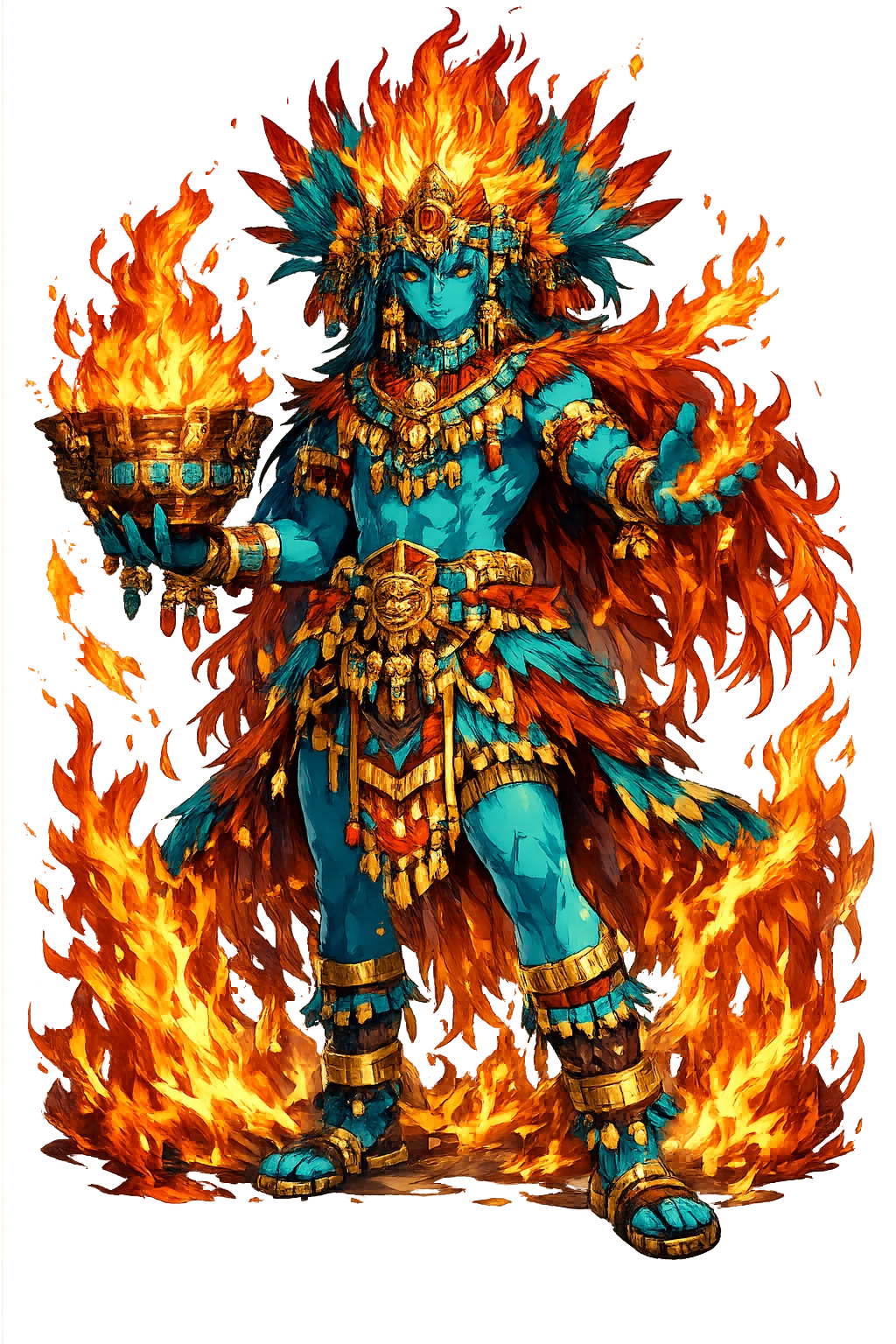
Xiuhtēcuhtli is the Aztec fire itself: first and last of the gods, the hearth at the center of every home and of the universe, and the god whose great ceremony — the drilling of the New Fire — restarted time itself every fifty-two years.
The three stones of every Aztec kitchen — his throne in every house.
Every 52 years, all fires died and one was drilled anew — the cosmos restarted.
"The Old God" — his other name: the ancient of days, wrinkled with a brazier on his back.
The axis mundi: fire as the pillar between the levels of the world.
Stories of Xiuhtēcuhtli
Xiuhtēcuhtli's myths are the calendar's: the fire that must be renewed, and the darkness that waits if it is not.
At the close of each 52-year cycle (xiuhmolpilli), the Aztec world extinguished every flame: households went dark, debts were settled, and the priests climbed Huixachtlan — Hill of the Star — to watch for the Pleiades' midnight passage. On a captive's chest the fire-priest drilled the new flame; if it caught, the runner carried it to the Templo Mayor, and every hearth in the empire was relit from it. If it failed, the stars said, the sun would not rise — and the world would end in the dark.
Under his other name he is the oldest thing in the cosmos: Huehueteotl, the wrinkled god who carries the brazier on his bent back, present before the suns. The Aztecs put him at the center of the universe's four directions — the fire-pillar of the world — and every domestic hearth was his shrine: the smallest and the greatest cult at once, the god of the kitchen who is also the god of the calendar.
The codices show his contract: fire feeds the world and feeds on it. Offerings of copal, of the first fruits, and — in the empire's hard logic — of the heart, were given to the flame that gives light, heat, and the year. Xiuhtēcuhtli's priests performed the fire-walking and the self-sacrifice by fire: the god who is the gift and the cost of the gift, the oldest bargain in the Americas.
Xiuhtēcuhtli is the god of the tending. Civilizations, households, and marriages are all the same fire: it is not the lighting that matters but the keeping, and the empire knew it — 52 years of warmth, one night of terror, and the drill again. He asks the hearth's question, which is the oldest one there is: what, in your house, are you keeping alight — and what would you do on the night it goes out?
Enter Extended Lore