
Why Wújí belongs in your address bar
Every address bar is a choice. When you type Wújí, you are not typing a novelty; you are restoring a name that the early DNS, built for English typewriters, could not carry. The plain ASCII form wuji is a leftover of that constraint, not the name itself. This post is the long version of the restoration: where the name comes from, how the Chinese characters tradition wrote it, how it is pronounced, what the myths and the material record preserve, and why its Unicode form now lives as a working domain. The claim throughout is simple — the original spelling is not decoration. It is the name.
At a Glance
- Restored name: Wújí
- ASCII form: wuji
- Meaning: "The primordial state of emptiness"
- Domain of influence: Limitless, Ultimate Nothing
- Pantheon: Taoist
- Classification: Tier 2
- Original script: 無極 (Chinese characters)
- Live domain: wújí.com
Overview
Wújí (wuji) — 'the Limitless,' the primordial state of undifferentiated emptiness — names the boundless condition before distinction itself, and anchors the Daoist corpus of PuniCodex under the domain 'Limitless, Ultimate Nothing.' The compound is as old as the Daodejing, whose twenty-eighth chapter makes 'returning to the limitless' the destination of one who holds fast to constant virtue.
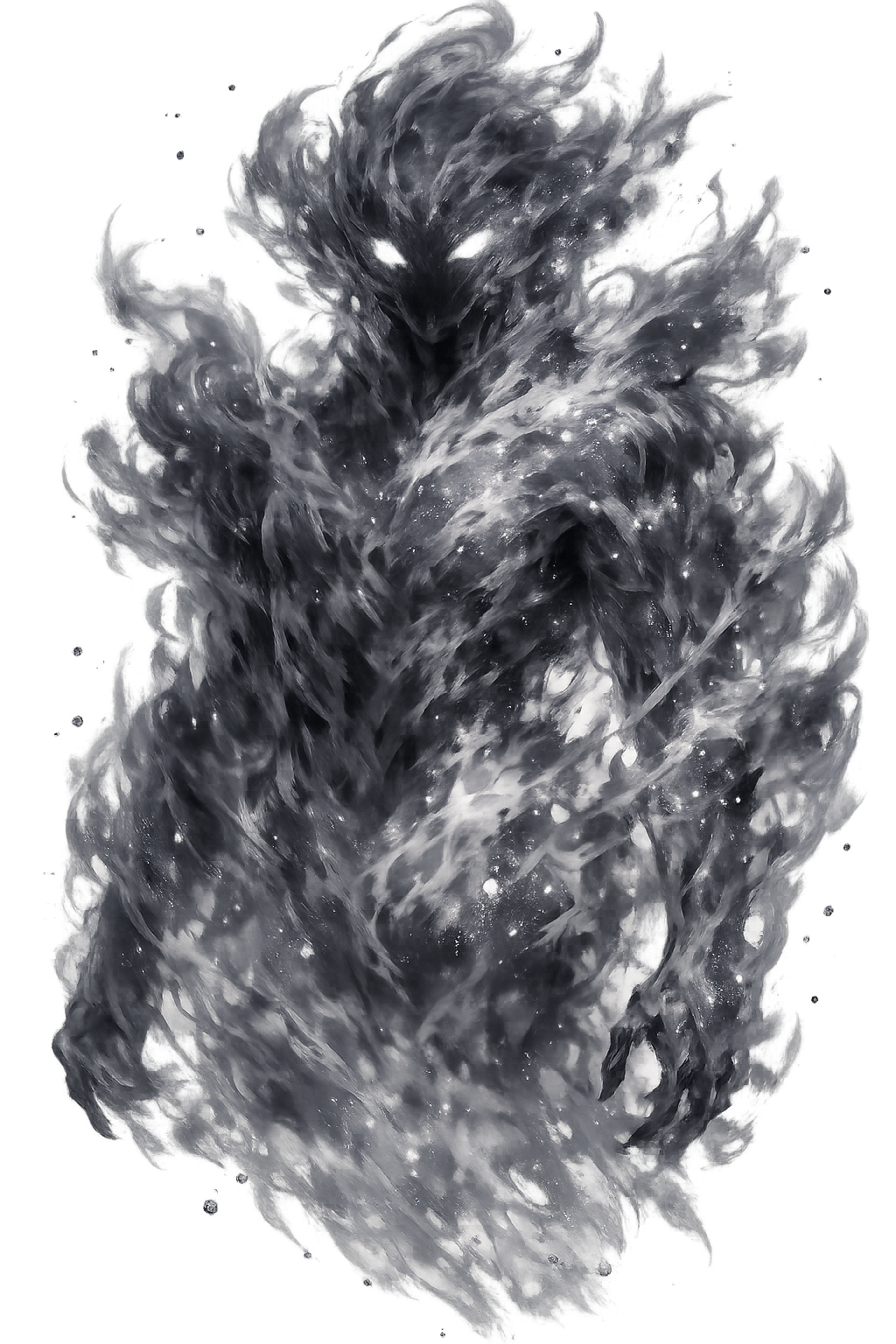
Wújí is the boundless before the bounded, the empty circle before the diagram is drawn. In Zhou Dunyi's cosmology it precedes Tàijí; in Daoist meditation it names the state of no-limit, no-position, no-preference from which the ten thousand things arise. It is not nihilistic emptiness but a plenum of undifferentiated potential — the silence that contains every possible note.
To think about Wújí is to practice standing at the edge of language, where names have not yet been attached to things.
PuniCodex restores the name as Wújí and serves its temple at wújí.com. Mandarin marks prosody by tone rather than by stress or vowel length, so the restoration preserves the citation tones of both syllables — the parallel rising (second) tones of wú and jí — and a tone-preserving restoration of this kind is classified Tier 2 in the project's scheme. The plain ASCII form wuji survives as a modern convenience imposed by the early domain-name system; the tone-marked restoration, not the fallback, is the name's primary scholarly form.
The Name
The name is written in Chinese characters as 無極 (simplified 无极), a compound of 無 wú 'without, not have' and 極 jí 'limit, utmost point': the limitless, the primordial state of undifferentiated emptiness before Tàijí. The compound is attested as early as the Daodejing, whose twenty-eighth chapter weaves 'return to the limitless' into its triad of returns — to the infant, to the limitless, to the uncarved block.
The ASCII form wuji survives only because the early domain-name system could not carry diacritics; it is a technological compromise, not an ancient spelling. The Unicode restoration Wújí restores the Hanyu Pinyin tone marks directly in the address bar — the acute accent of the second (rising) tone on both ú and í. Mandarin preserves no vowel-length or stress distinctions in this word, so a tone-marked restoration of this kind is classified Tier 2 in the project's scheme.
The letter-by-letter transformation runs:
- w → W — Same, capitalized
- u → ú — Acute accent: second (rising) tone
- j → j — Same
- i → í — Acute accent: second (rising) tone
The project holds the domain wújí.com (xn--wj-oja4c.com) as the canonical home of this name.
The Original Script
The name is preserved in Chinese characters as 無極 — Hanzi (Sino-Tibetan), attested Oracle-bone – present, c. 1200 BCE –, in China. The script is written left-to-right; traditional top-to-bottom.
The scholarly transliteration is Wújí (Hanyu Pinyin with tone mark), giving the normalized reading /u˧˥ tɕi˧˥/.
The rendering proceeds step by step:
- The name is written with the Chinese characters 無極.
- Each character is a logogram that encodes meaning and historical pronunciation.
- Hanyu Pinyin with tone marks preserves Mandarin pronunciation; the ASCII form loses tone.
- The Unicode restoration Wújí is the registrable form because hanzi are outside the .com IDN table.
The original script is 無極 in traditional Chinese and 无极 in simplified; the compound is first attested in the Daodejing (chapter 28) and recurs throughout the canon transmitted in the Ming Zhengtong Daozang. The Modern Standard Mandarin reading is Wújí (Tone 2 + Tone 2), per Hanyu Pinyin and the Unihan Database. The registrable form uses tone-marked Pinyin; the hanzi are displayed in the Original Script card. Baxter & Sagart reconstruct 無 as ma and 極 as [g](r)ək, working in the Old Chinese reconstruction tradition founded on Karlgren's Grammata Serica and refined by Pulleyblank and Schuessler.
Pronunciation
The reconstructed pronunciation of the name is /u˧˥ tɕi˧˥/ — Modern Standard Mandarin (Pinyin).
Phoneme by phoneme:
- wú — Syllable beginning with labio-velar glide [w] (written 'w' in Pinyin), high back rounded vowel [u], and Tone 2 (rising, ˧˥).
- jí — Syllable with unaspirated alveolo-palatal affricate [tɕ], high front vowel [i], and Tone 2 (rising, ˧˥). Pinyin 'j' is always [tɕ] before front vowels.
For the modern speaker, the closest approximation is: WOO-JEE — both syllables carry a rising tone (mid to high), like a gentle question on each half.
Kindred and historical forms of the name:
- Traditional — 無極
- Simplified — 无极
- Wade-Giles — wu²-chi²
- Related terms — 太極 tàijí (supreme ultimate); 道 dào (the Way); 無極而太極 wújí ér tàijí
無極 (Wújí) means 'Limitless' or 'Ultimate Nothing', the undifferentiated state before the emergence of Tàijí in Zhou Dunyi's Taijitu shuo. The Modern Standard Mandarin reading is wú (Tone 2) + jí (Tone 2), per the Hanyu Pinyin scheme and the Unihan Database (kMandarin). Baxter & Sagart (2014) reconstruct 無 as ma (GSR 0103a, 'not have') and 極 as [g](r)ək (GSR 0910e, 'extreme'). The Unicode restoration Wújí preserves the parallel rising tones of both syllables.
Mythology
Wújí belongs to cosmogony rather than narrative. Its myths are stories about the origin of differentiation, told by philosophers, alchemists, and meditators across two millennia.
Wújí ér Tàijí (Zhou Dunyi, Taijitu shuo)
Zhou Dunyi's famous line, 'Wújí ér Tàijí,' can be translated as 'The Limitless, and yet the Supreme Ultimate.' The phrase caused centuries of debate: does Wújí come before Tàijí, or are they two names for the same reality? Zhu Xi, the great synthesizer, argued that Wújí is simply the name for Tàijí's lack of form.
The Valley Spirit (Daodejing)
Laozi praises emptiness as the source of usefulness: 'Thirty spokes share one hub; it is the empty center that makes the wheel useful.' Wújí is the great empty center of the cosmos, the valley spirit that never runs dry.
The Grand Beginning (Zhuangzi, 'Heaven and Earth')
The Zhuangzi delights in undermining fixed categories. The chapter 'Heaven and Earth' opens its cosmogony at the Grand Beginning: 'In the Grand Beginning there was nothing, and nothing that could be named. From it arose the One; the One existed but had no form, and things obtained it and were produced.' Wújí is that 'nothing' which is paradoxically generative.
Refining the Elixir in Stillness (Neidan)
Daoist internal alchemists sit in Wújí before beginning their practice. The posture is not laziness but a deliberate return to the pre-differentiated state, the better to let jing, qi, and shen reorganize themselves without the meddling of the discriminating mind.
The North Sea and the Great Beginning (Zhuangzi)
The Zhuangzi delights in undermining fixed categories. In one passage it asks about the Great Beginning: 'In the beginning there was nothing; from nothing came the one; from the one came form; from form came things.' Wújí is that 'nothing' which is paradoxically generative.
Symbols & Iconography
The iconography associated with Wújí concentrates in a small set of recurring attributes, each a compressed statement about the name:
- The empty circle — The standard visual representation of Wújí — a boundary with nothing inside it
- Primordial mist — The undifferentiated hundun or chaos that precedes cosmic order
- The uncarved block — Pu, the uncarved wood that is still capable of becoming any implement
- The number one — The pre-dual unity from which yin and yang are differentiated
- The meditation stance — The Wújí posture in internal arts: standing without agenda
Archaeology & Evidence
The word wuji is attested early, though as a cosmological technical term it is late. The received Daodejing uses it once, in the triad of returns of chapter 28, and the phrase stands in both silk manuscripts of the text from Mawangdui tomb three (sealed 168 BCE). The Zhuangzi applies wuji to the limitless reach of the Milky Way, evidence that the word circulated in Warring States cosmological speculation well before it named a doctrine. The classic formulation, however, is Song: Zhou Dunyi's Taijitu shuo and the commentaries of Zhu Xi were transmitted through Song and Ming woodblock editions, and Qing critics such as Huang Zongxi and Mao Qiling argued that Zhou's diagram itself descended from Daoist 'wuji diagrams' (wuji tu) of the Chen Tuan tradition — a pedigree modern scholarship largely accepts. Daoist internal-alchemical texts from the Tang through Qing return to wuji as a meditative stage, and the empty circle appears on steles, talismans, and altar cloths, though the concept is tied to no single excavation site.
Realm & Domain
Wújí is the boundless before the bounded, the empty circle before the diagram is drawn. In Zhou Dunyi's cosmology it precedes Tàijí; in Daoist meditation it names the state of no-limit, no-position, no-preference from which the ten thousand things arise. It is not nihilistic emptiness but a plenum of undifferentiated potential — the silence that contains every possible note.
To think about Wújí is to practice standing at the edge of language, where names have not yet been attached to things.
Boundless Void
No center, no edge, no direction: Wújí is the canvas on which all distinctions are later painted.
Pre-Cosmic Stillness
Before movement and stillness differentiate, there is a quiet so complete that even 'silence' is too noisy a word.
Source of Tàijí
Wújí is not a rival to Tàijí but its ground; the limitless opens naturally into the supreme ultimate, and the supreme ultimate never leaves the limitless.
Daoist Meditation
Meditative and martial traditions use Wújí as a posture of total neutrality — empty, alert, and ready to become any response.
Across Cultures
Wújí overlaps with the Buddhist concept of śūnyatā (emptiness), and the two were often fused in later Chinese Buddhism, especially in Chan. Neo-Confucians borrowed Wújí from Daoist diagrams and reinterpreted it as the formless aspect of moral principle. In Western thought, Wújí has been compared to the Neoplatonic One beyond being, to Spinoza's substance, and to the quantum vacuum — though these analogies are loose and should not be pressed too hard. The common thread is the intuition that fullness and emptiness are not opposites but phases of a single reality.
Within the Daoist tradition, closely related names in the corpus include [[laozi|Lǎozǐ]] and [[yinyang|Yīnyáng]].
Cultural Legacy
Wújí survives in names and practices. Wujiquan and Wuji standing meditation open many internal-arts sessions. The empty-circle motif appears in minimalist art, architecture, and graphic design as an emblem of potential. In popular culture, Wújí is the name of games, albums, martial-arts schools, and wellness brands — often used more for atmosphere than precision. Yet the underlying idea remains potent: before the first move, before the first word, there is a spaciousness that contains everything. Modern contemplative traditions, from mindfulness to certain psychotherapies, independently rediscover what Wújí named two thousand years ago.
The Scholarly Record
The account of Wújí given in this edition rests on the witnesses and reference works listed below. Lexica and etymological dictionaries secure the form and meaning of the name; the literary and religious texts supply the narrative evidence.
- Zhou Dunyi, Taijitu shuo.
- Laozi, Daodejing. Full text
- Zhuangzi, Zhuangzi; Chinese Text Project, 300 BCE. Full text
- Zhu Xi, Zhouyi benyi / commentary tradition.
- Needham, Science and Civilisation in China.
- Graham, Disputers of the Tao.
- Baxter & Sagart, Old Chinese Reconstruction. Full text
- Unihan Database (Unicode Consortium). Full text
A Meditation
Wújí is the permission slip to not yet be anything. In a world that rewards definition — what do you do, where do you stand, what do you believe — Wújí is the value of the unmarked state. It is the silence before the opinion, the blank page before the sketch, the open hand before it grasps.
This is not a denial of form. The Daoist sage does not stay in Wújí; she lets forms arise and pass through it. Wújí is the home base to which one returns after every action, the awareness that no label ever exhausts what a thing is. To name a domain Wújí is almost a joke: the moment you name it, it is no longer Wújí. But it is also a serious gesture — a reminder that every web page, every brand, every word is born from the unnameable ground that precedes it.
The Unicode Restoration
Wújí is classified as Tier 2: the original preserves at least one philological feature that ASCII cannot encode. The ASCII fallback wuji still resolves everywhere, but it is the restored form that carries the name's full information. Across the 4 characters of the name, the restoration adjusts 2: 2 marks of stress (ú, í). That is the whole thesis of this temple: the marks are the message.
Character by Character
The journey from wuji to Wújí, one character at a time:
- w → W — Same, capitalized
- u → ú — Second tone
- j → j — Same
- i → í — Second tone
The Domain Name
The restored name is live as a working domain: wújí.com, which the DNS carries in punycode form as xn--wj-oja4c.com — an ASCII-compatible encoding that lets a non-ASCII name travel the global network without breaking older infrastructure. The visitor sees Wújí; the machines see the encoding. That duality is the engineering compromise on which the entire restoration rests, and it is why a name written the way its own tradition wrote it in Chinese characters can now be typed into any browser on earth.
The Taoist Pantheon
Wújí is one of 12 entries the PuniCodex lexicon catalogues under the Taoist pantheon. The Pantheon page gathers the tradition's major figures in one place, and the Lexicon lets you filter all 895 restorations by tradition, tier, or script — the fastest way to see where this name sits among its kin.
Frequently Asked Questions
What does Wújí mean? The traditional gloss is "The primordial state of emptiness."
Which tradition does Wújí belong to? Wújí is catalogued in the Taoist pantheon of the PuniCodex lexicon.
Why is Wújí classified as Tier 2? Because the original preserves at least one philological feature that ASCII cannot encode — and the marks in the restored spelling preserve exactly that evidence.
Is Wújí a working domain? Yes — wújí.com resolves today and routes to this temple.
What is the punycode for wújí.com? The DNS encoding is xn--wj-oja4c.com; browsers perform the translation automatically, so visitors only ever see the restored name.
Why This Restoration Matters
Restoring Wújí is part of a larger effort to make the web multilingual by default. The PuniCodex project does not ask users to learn a new alphabet; it asks the infrastructure to respect the alphabets that already exist. Every section of this post — the script, the sound, the myths, the evidence — converges on the same point: the marks in Wújí are information, and information deserves an address of its own. A single Unicode domain is a small proof, but it is a proof that scales: every name restored makes the next one easier, and every visit to wújí.com is a vote for the restored form.
Explore Further
This post is one doorway into the temple. The home page carries the full character breakdown and the ambient canvas; the lore page tells the myths in long form; the Scholarly Edition preserves the sources, pronunciation data, and revision history; and the patron wall supports the restoration directly. For the wider map, browse the Lexicon, explore the Pantheon, or return to the PuniCodex blog.
Related Names
Sources
The full scholarly apparatus — every citation, revision, and review — lives in the Scholarly Edition. Key references for this post:
- Laozi, Daodejing, chapter 28: 'return to the limitless (wuji).'
- Unihan Database (Unicode Consortium), readings and definitions of U+7121 無 and U+6975 極.
- Baxter & Sagart, Old Chinese: A New Reconstruction (Oxford University Press, 2014).
- Zhuangzi, chapter 12 'Heaven and Earth' (the Grand Beginning passage).
- Zhuangzi, chapter 1 'Enjoyment in Untroubled Ease' ('like the Milky Way, without limit').
- Zhuangzi, Zhuangzi; Chinese Text Project, 300 BCE.
- Zhou Dunyi, Taijitu shuo (Explanation of the Diagram of the Supreme Ultimate), 11th century.
- Zhou Dunyi, Taijitu shuo.
- Pregadio (ed.), The Encyclopedia of Taoism (Routledge, 2008), entries on neidan and wuji.
- Needham, Science and Civilisation in China, vol. 2 (History of Scientific Thought).
- Lexicon authorities for this entry: Dao De Jing, Daoist Canon.