
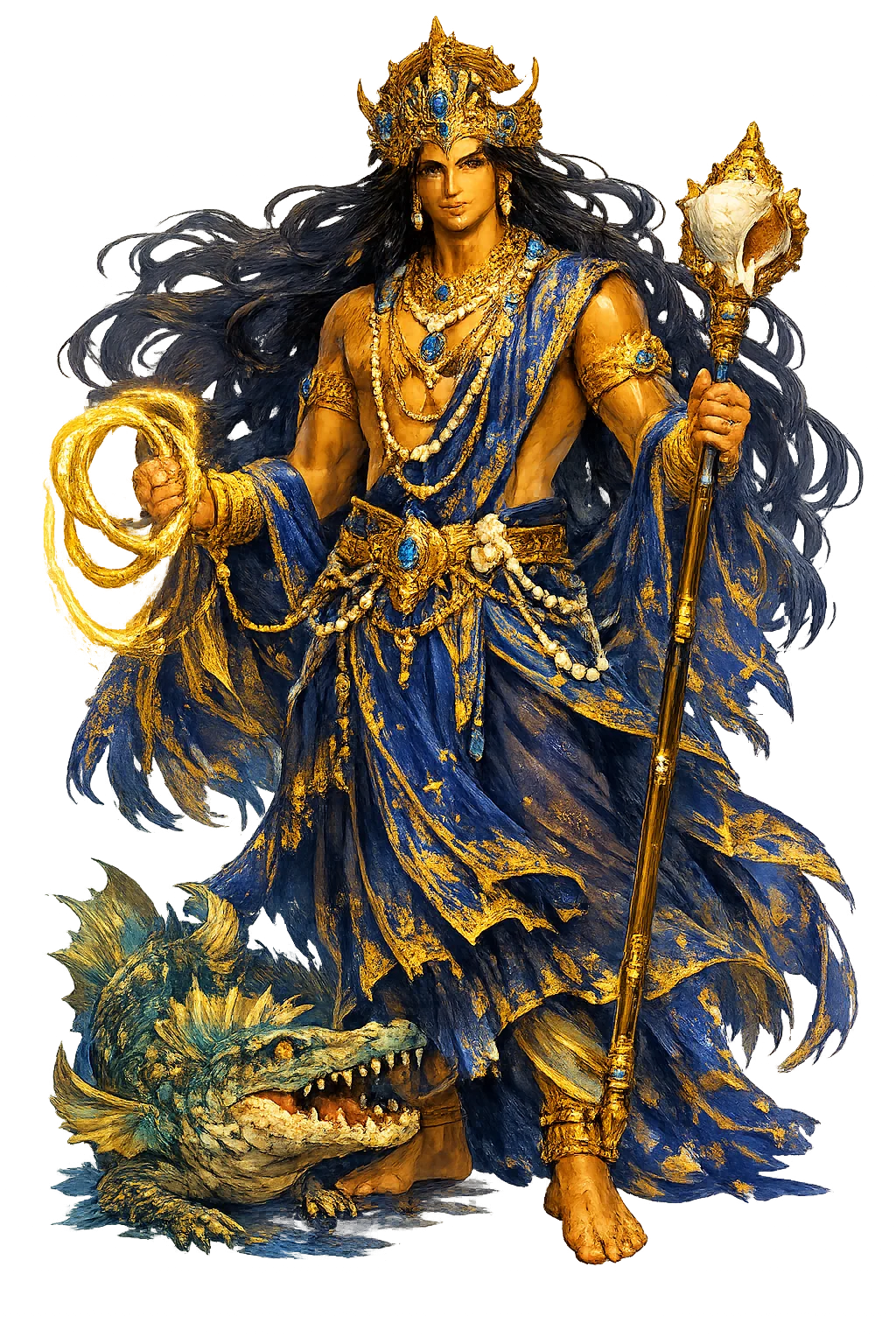
How Varuṇa got its accent back
The ASCII form varuna is missing something. Varuṇa restores the marks the source language used to distinguish this name from a thousand others — and those marks change how the name is read, pronounced, and understood. This post explains, with the full scholarly record behind it, what each restored mark preserves: the Devanagari evidence, the reconstructed sound, the myths the name carries, and the classification logic that separates Tier 1 restorations from Tier 2. By the end, the marks in Varuṇa will look less like ornaments and more like what they are — recovered evidence, pinned back in its proper place.
At a Glance
- Restored name: Varuṇa
- ASCII form: varuna
- Meaning: "‘Allenveloping Sky’, N. of an Āditya (in the Veda commonly associated with Mitra [q.v.] and presiding over the night as Mitra over the day, but often celebrated separately"
- Domain of influence: Cosmic Order, Oceans, Law
- Pantheon: Sanskrit
- Classification: Tier 2
- Original script: वरुण (Devanagari)
- Live domain: varuṇa.com
Overview
Varuṇa (varuna) — He who covers — belongs to the Sanskrit tradition, where it is catalogued under the domain "Cosmic Order, Oceans, Law". Monier-Williams glosses the name "All-enveloping Sky" and identifies its bearer as an Āditya who in the Veda is commonly associated with Mitra, presiding over the night as Mitra over the day, but is often celebrated separately.
Varuṇa is the Vedic sovereign of ṛta, the cosmic order that binds gods and mortals alike. He is the lord of all waters — rivers, seas, rain, and the underworld streams — and the guardian of truth who sends a thousand spies to watch the world. To swear falsely before Varuṇa is to invite disease, disaster, and the loosening of the bonds that hold existence together.
PuniCodex restores the name as Varuṇa and serves its temple at varuṇa.com. The original preserves one prosodic feature — stress or vowel length — rather than both, which places the name in Tier 2. The plain ASCII form varuna survives as a modern convenience imposed by the early domain-name system; the restoration, not the fallback, is the form the project defends as philologically complete.
The Name
The name is attested in Devanagari as वरुण. Monier-Williams glosses it "All-enveloping Sky", the name of an Āditya who in the Veda is commonly associated with Mitra, presiding over the night as Mitra over the day, but is often celebrated separately.
The reconstructed proto-form is u̯er- (proto-indo-european, "to cover, bind, enclose"). Usually derived from Sanskrit vṛ- 'to cover, encompass', with a proposed Proto-Indo-European root *u̯er- 'to cover, bind'; the exact formation and prehistory remain disputed.
Cognate forms across related languages:
- Vourunaša / Vouruna (avestan) — Iranian counterpart linked to waters and oaths (Avesta)
The ASCII form varuna survives only because the early domain-name system could not carry diacritics; it is a technological compromise, not an ancient spelling. The Unicode restoration Varuṇa recovers the full diacritic detail of the scholarly transliteration directly in the address bar. The original preserves one prosodic feature — stress or vowel length — rather than both, which places the name in Tier 2.
The letter-by-letter transformation runs:
- v → V — Same
- a → a — Same
- r → r — Same
- u → u — Same
- n → ṇ — N with dot below
- a → a — Same
The project holds the domain varuṇa.com (xn--varua-6l1b.com) as the canonical home of this name.
Etymology & Roots
The recorded derivation reads: Usually derived from Sanskrit vṛ- 'to cover, encompass', with a proposed Proto-Indo-European root *u̯er- 'to cover, bind'; the exact formation and prehistory remain disputed.
The reconstructed proto-form is *u̯er- (proto-indo-european), glossed as "to cover, bind, enclose".
The reconstruction is classed as disputed.
Kindred forms recorded in the lexicon:
- Vourunaša / Vouruna (avestan) — Iranian counterpart linked to waters and oaths (Avesta)
The Original Script
The name is preserved in Devanagari as वरुण — Brahmic abugida, attested Vedic – present, c. 1500 BCE –, in South Asia. The script is written left-to-right.
The scholarly transliteration is Varuṇa (IAST), giving the normalized reading /ˈʋɐ.ru.ɳə/.
The rendering proceeds step by step:
- Sanskrit Varuṇa is written वरुण in Devanagari.
- Each aksara combines a consonant with an inherent or explicit vowel.
- IAST diacritics preserve length, retroflexion, and aspiration lost in plain ASCII.
- The Devanagari form is not used as the primary domain because Indic scripts are not in the .com IDN table.
Pronunciation
The reconstructed pronunciation of the name is /ˈʋɐ.ru.ɳɐ/ — Sanskrit/Vedic Reconstruction.
Phoneme by phoneme:
- V- — Labiodental approximant [ʋ], softer than English v, followed by short open [ɐ].
- -ru- — Alveolar tap or trill [r] plus short [u] — the syllable that names the rolling waters.
- -ṇa — Retroflex nasal [ɳ] plus short [ɐ]; the dot beneath the n marks the tongue-tip curl distinctive to Sanskrit.
For the modern speaker, the closest approximation is: 'VUH-roo-nah' — start with a soft 'v', keep the middle syllable light, and end with a tongue-tip-curled 'n' like an American 'r' pressed against the roof of the mouth.
Kindred and historical forms of the name:
- Sanskrit — वरुण (Varuṇa), the Vedic lord of waters, oaths, and cosmic order
- Avestan — Vourunaša / Vouruna, the Iranian counterpart associated with waters and binding oaths
- PIE — *u̯er- ('to cover, bind, enclose') — the root behind Varuṇa's name and his noose
Varuṇa is Tier 2 because the registrable form Varuṇa preserves the retroflex ṇ (a phonemic distinction central to Sanskrit) but carries no stress or length mark. The name is traditionally derived from the root vṛ- 'to cover, encompass,' fitting a god who covers the waters, the night sky, and the hidden deeds of humankind.
Mythology
Varuṇa is the Vedic sovereign of the cosmic order (ṛta), the lord of waters, and the guardian of truth. He binds offenders with his noose (pāśa), sends a thousand spies to watch the world, and holds the night sky in his sway. To swear falsely before Varuṇa is to invite disease, disaster, and cosmic rupture.
The Thousand-Eyed Watcher (Omniscience)
Varuṇa is praised in the Ṛgveda as the god who sees all and knows all. His spies — the thousand-eyed — move through the world observing every act, every lie, every hidden crime. Unlike a distant judge, Varuṇa is intimately present: he knows the wandering of birds, the path of ships, and the secret thoughts of human beings. Nothing done in darkness escapes him.
Varuṇa's Noose (Justice)
The pāśa, Varuṇa's noose, is both punishment and release. He binds those who break ṛta, the cosmic law, and he loosens the bonds of those who confess and atone. Disease, misfortune, and drought are understood as the tightening of the noose; sacrifice, truth, and repentance loosen it. Varuṇa is therefore a god of both terror and mercy, the enforcer of a law that can be repaired.
Lord of Ṛta and the Waters (Cosmology)
Varuṇa dwells in the waters — rivers, seas, rain, and the cosmic ocean — and through them he sustains ṛta. The regular fall of rain, the flow of rivers, and the cycle of seasons are all expressions of his order. In later tradition he becomes a sea-god, but in the Vedas he is something larger: the divine principle that keeps truth liquid, moving, and inescapable.
Varuṇa and Indra (Mythic Friendship)
Varuṇa is often paired with Indra, the warrior-storm god. Where Indra acts with thunderbolt and force, Varuṇa governs by law and vigilance. Together they represent the two faces of sovereignty: power and justice. Some hymns call them kings side by side, and in ritual they receive offerings together. The pairing expresses the Vedic ideal that might must be answerable to ṛta.
Symbols & Iconography
Varuṇa's attributes compress his theology into a handful of objects, each attested at a different stratum of the tradition:
- Noose (pāśa) — His Vedic signature: the bond with which he seizes oath-breakers and from which he releases the penitent, already his emblem in the Ṛgveda (1.24–25).
- Thousand eyes — His spies, identified with the stars of the night sky over which he rules; the Atharvaveda celebrates the king whose watchers miss no hidden deed (4.16).
- Conch (śaṅkha) — The ocean's own product and voice: in the Khāṇḍava episode of the Mahābhārata the sea is his treasury, from which he arms Arjuna with the Gāṇḍīva bow, the inexhaustible quivers, and the conch Devadatta.
- Makara (crocodile) vehicle — A post-Vedic addition from his career as lord of the western direction: the aquatic monster that carries him in Gupta and medieval dikpāla images.
The list itself records the god's history — a Vedic judge with a noose and a thousand watchers becoming, by the early centuries CE, the marine sovereign of temple iconography.
- Conch and waters — All freshwater and salt water are his body; the conch announces his presence.
Archaeology & Evidence
No image of Varuṇa survives from the Vedic period — the hymns themselves are his earliest monument. His antiquity is confirmed instead from abroad: the Mitanni treaty from Boğazköy (c. 1380 BCE) invokes the divine witnesses Mi-it-ra and U-ru-wa-na — Mitra and Varuṇa — in Hittite cuneiform, the oldest written attestation of his name.
Within India the earliest proposed images are Maurya-Śuṅga railing medallions at Bharhut and Sanchi, where a water-guardian bearing a noose has been identified with him — a plausible reading, though not secured by inscription. His iconography becomes standard only with the dikpāla scheme, the eight guardians of the directions: from the Gupta age onward temples from Deogarh to Khajuraho set Varuṇa in the western niche, mounted on the makara with the noose in hand. Coastal shrines and the stepwells (vāv) of Gujarat and Maharashtra preserve his lordship of waters in living use.
Realm & Domain
Varuṇa is the Vedic sovereign of ṛta, the cosmic order that binds gods and mortals alike. He is the lord of all waters — rivers, seas, rain, and the underworld streams — and the guardian of truth who sends a thousand spies to watch the world. To swear falsely before Varuṇa is to invite disease, disaster, and the loosening of the bonds that hold existence together.
Cosmic Order
As guardian of ṛta, Varuṇa keeps sun, moon, seasons, and sacrifice moving in their proper courses.
Waters
Rivers, rain, oceans, and the hidden springs all flow by his authority; drought is his noose tightened.
Oaths and Justice
He binds oath-breakers with the pāśa noose and loosens it for those who confess and speak truth.
The Night Sky
His thousand eyes are the stars; he sees the path of ships, the flight of birds, and the secrets of hearts.
Across Cultures
Varuṇa's sovereignty over waters and oaths has ancient Indo-Iranian roots. The Avestan Vourunaša and the Mitanni treaties' Mitravaruna pair show his name and function reached from Anatolia to the Indian subcontinent before the Ṛgveda was fixed in writing. In later Hinduism he becomes the sea-god Samudra and the guardian of the western quarter among the dikpālas. His judicial functions partly pass to Yama, while his waters are absorbed into the mythology of Gaṅgā and the cosmic ocean. Buddhist and Jain texts remember him as a great king of the devas, and Southeast Asian cosmology places him among the guardian deities of the quarters.
Kindred figures in the PuniCodex cross-tradition index include [[poseidon|Poseidôn]] (sea / cosmic water), [[aseratu|Ašeratu]] (sea / water), [[babaluaye|Ọbalúayé]] (sea / water), [[ea|Ēa]] (sea / water), [[manannan|Manannán]] (sea / water), and [[njordr|Njǫrðr]] (sea / water).
Cultural Legacy
Varuṇa's deepest afterlife is liturgical. The śānti-mantra śaṃ no mitraḥ śaṃ varuṇaḥ — "may Mitra be gracious to us, may Varuṇa be gracious" — opens the Taittirīya Upaniṣad (1.1) and is still intoned at the head of its recitation; from it the Indian Navy drew its motto śaṃ no varuṇaḥ, "may the ocean-god be auspicious unto us". His name survives likewise in the modern Indian languages, where varuṇ still evokes rain and the monsoon, and coastal ritual along the Arabian Sea and Bay of Bengal still carries echoes of the old water-god, even where his cult has been absorbed into the worship of Viṣṇu, Śiva, and local guardian deities.
Beyond India his line runs into Buddhism: the Pāli canon remembers Varuṇa as a king of the devas and a companion of Sakka, and in East Asian Buddhism he survives as Suiten, the Japanese "water-deva" of the Twelve Devas, preserved in the Tō-ji temple paintings in Kyoto. In the Hindu diaspora of Southeast Asia, Balinese tradition worships him as Baruna, lord of the sea, honored in the melasti purifications that carry temple emblems to the shore.
The Scholarly Record
The account of Varuṇa given in this edition rests on the witnesses and reference works listed below. Lexica and etymological dictionaries secure the form and meaning of the name; the literary and religious texts supply the narrative evidence.
- Ṛgveda Saṃhitā, Translated by Ralph T. H. Griffith, 1500 BCE. Full text
- Atharvaveda.
- Monier-Williams Sanskrit-English Dictionary.
- Aitareya Brāhmaṇa.
- Mahābhārata.
- Ṛgveda Saṃhitā 7.86–89 (Varuṇa hymns and the confession of the sinner).
- Ṛgveda Saṃhitā 7.33 (birth of Vasiṣṭha from Mitra-Varuṇa).
- Taittirīya Saṃhitā 2.1.11 (Varuṇa and the waters).
- Śatapatha Brāhmaṇa 5.4.4 (Śunaḥśepa narrative and royal vow).
A Meditation
To contemplate Varuṇa is to stand under inspection. His confessional hymns do not let the worshipper hide: the poet of Ṛgveda 1.25 speaks as one who knows that every breach of law is already seen, and asks not for acquittal but for mercy. The noose is the tradition's image for consequence itself — the way an act, once done, binds its doer until the truth is spoken and the knot is named.
Yet the god who binds is also the god of waters, and water in the Veda is what flows, cleanses, and cannot be held. Varuṇa's meditation is therefore double: the rigor of being watched and the mercy of being washed. Vasiṣṭha's cycle of hymns (Ṛgveda 7.86–89) ends not in punishment but in the plea for loosened bonds, because the order this god guards is not vengeance but ṛta — the world running true again. To speak honestly, in this theology, is to rejoin the flow.
The Unicode Restoration
Varuṇa is classified as Tier 2: the original preserves at least one philological feature that ASCII cannot encode. The ASCII fallback varuna still resolves everywhere, but it is the restored form that carries the name's full information. Across the 6 characters of the name, the restoration adjusts 1: 1 further adjustment (ṇ). That is the whole thesis of this temple: the marks are the message.
Character by Character
The journey from varuna to Varuṇa, one character at a time:
- v → V — Same
- a → a — Same
- r → r — Same
- u → u — Same
- n → ṇ — N with dot below
- a → a — Same
The Domain Name
The restored name is live as a working domain: varuṇa.com, which the DNS carries in punycode form as xn--varua-6l1b.com — an ASCII-compatible encoding that lets a non-ASCII name travel the global network without breaking older infrastructure. The visitor sees Varuṇa; the machines see the encoding. That duality is the engineering compromise on which the entire restoration rests, and it is why a name written the way its own tradition wrote it in Devanagari can now be typed into any browser on earth.
The Sanskrit Pantheon
Varuṇa is one of 88 entries the PuniCodex lexicon catalogues under the Sanskrit pantheon. The Pantheon page gathers the tradition's major figures in one place, and the Lexicon lets you filter all 895 restorations by tradition, tier, or script — the fastest way to see where this name sits among its kin.
Why This Restoration Matters
The marks in Varuṇa were never lost; they were only waiting for a carrier that could hold them. Now that the carrier exists, the burden flips: every use of varuna is a choice to leave evidence on the table. The PuniCodex temple keeps the restored form in circulation — as a domain, a dataset entry, and a scholarly argument — so that the choice to use it stays easy. Accent by accent, macron by macron, that is how the original names come back: not with a single grand gesture, but with a spelling that finally works everywhere.
Explore Further
This post is one doorway into the temple. The home page carries the full character breakdown and the ambient canvas; the lore page tells the myths in long form; the Scholarly Edition preserves the sources, pronunciation data, and revision history; and the patron wall supports the restoration directly. For the wider map, browse the Lexicon, explore the Pantheon, or return to the PuniCodex blog.
Related Names
Sources
The full scholarly apparatus — every citation, revision, and review — lives in the Scholarly Edition. Key references for this post:
- Ṛgveda Saṃhitā, Translated by Ralph T. H. Griffith, 1500 BCE.
- Atharvaveda.
- Monier-Williams Sanskrit-English Dictionary.
- Monier-Williams Sanskrit-English Dictionary (varuṇa).
- Atharvaveda 4.16 (Varuṇa's thousand spies).
- Lexicon authorities for this entry: MW, KEWA.