
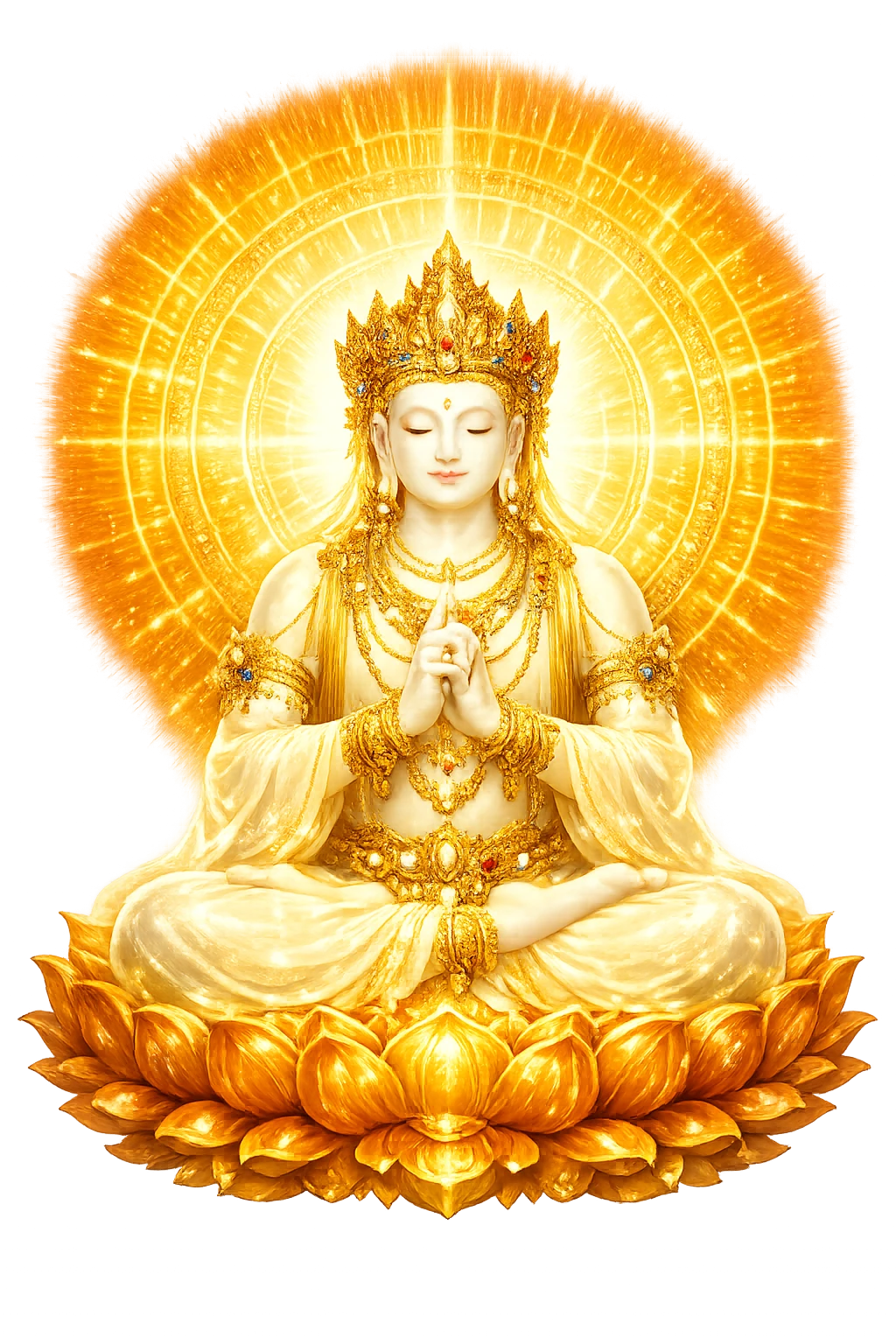
The name Mahāvairocana and the world it opens
Some names describe a god; this one describes a cosmos. Mahāvairocana — 'the Great Illuminator' — is the Buddha who, in the boldest reading of the Avataṃsaka Sūtra, does not merely dwell in the universe but is the universe: every atom containing every world, every world reflecting every other. The ASCII form mahavairocana keeps the letters and drops the one mark that carries the name's first claim — the long ā of mahā, 'great'. What follows is the full picture — script, sound, myth, bronze, and the Unicode restoration that lets the complete name live at a real address.
At a Glance
- Restored name: Mahāvairocana
- ASCII form: mahavairocana
- Meaning: "the Great Illuminator"
- Domain of influence: Universal Illumination, Cosmic Buddha
- Pantheon: Buddhist
- Classification: Tier 1
- Original script: महावैरोचन (Devanagari)
- Live domain: mahāvairocana.com
Overview
Mahāvairocana (mahavairocana) — Universal Illumination, Cosmic Buddha · the Great Illuminator — belongs to the Buddhist tradition, one of 23 entries the PuniCodex lexicon catalogues under that pantheon.
Mahāvairocana is the cosmic Buddha of the Avataṃsaka Sūtra: not one teacher among many but the dharma-body of reality itself, the sun in whose light every being and every world stands revealed.
PuniCodex restores the name as Mahāvairocana and serves its temple at mahāvairocana.com. The restoration preserves the long ā of mahā that plain ASCII cannot carry — a distinctive philological feature, which places the name in Tier 1.
The Name
The name is attested in Sanskrit as महावैरोचन (IAST mahāvairocana). It is a transparent compound: mahā, 'great', joined to vairocana, 'shining forth, illuminating' — a derivative of the root vi-√ruc, 'to shine'. The name thus means 'the Great Illuminator': greatness of scope married to the act of shining.
The shorter form Vairocana is the scholarly commonplace; the lexicon records it as the standard variant. The full form prevails in the esoteric transmission, where the Mahāvairocana Sūtra gives the name its own scripture.
The ASCII form mahavairocana survives only because the early domain-name system could not carry diacritics; it is a technological compromise, not an attested ancient spelling. The Unicode restoration Mahāvairocana recovers the long ā of mahā directly in the address bar.
The letter-by-letter transformation runs:
- m → M — Same, capitalized
- a → a — Same
- h → h — Same
- a → ā — Macron: long /aː/
- v → v — Same
- a → a — Same
- i → i — Same
- r → r — Same
- o → o — Same
- c → c — Same
- a → a — Same
- n → n — Same
- a → a — Same
The Original Script
The name is written in Devanagari as महावैरोचन — the Brahmic abugida in which the Sanskrit Buddhist canon has been transmitted in India, read left to right. The scholarly transliteration is mahāvairocana (IAST).
The spelling decomposes visibly: महा (mahā), 'great', plus वैरोचन (vairocana), 'shining forth'. In Devanagari the long ā of the first member is written with the vowel sign ा; in IAST transliteration it becomes the macron — the single mark the ASCII form mahavairocana discards. The restoration Mahāvairocana keeps exactly that mark: the name written with its full vowel length, as the Sanskrit tradition wrote it.
Pronunciation
The reconstructed pronunciation of the name is /mə.ɦaː.ʋəi̯.ɾoː.tʃə.nə/ — Reconstructed Sanskrit.
For the modern speaker, the closest approximation is: 'muh-hah-VAI-roh-chuh-nuh' — 'vai' rhymes with 'eye'; the Sanskrit c is always 'ch' as in 'church'; the ro is long.
Kindred and historical forms of the name:
- Devanagari — महावैरोचन (mahāvairocana), 'the Great Illuminator'
- Short form — Vairocana, the scholarly commonplace
- Japanese — Dainichi, 'Great Sun', the Shingon rendering of the name's sense
- Owned form — Mahāvairocana
The v is the labiodental approximant [ʋ], softer than the English v, and the long ā sets the first syllables ringing — the sound the macron preserves.
Mythology
Mahāvairocana's mythology is not a cycle of adventures but a single vast claim, told four ways: that the universe itself is the Buddha, and that light is what that fact looks like.
The Universe as Buddha (Avataṃsaka Sūtra)
The Avataṃsaka Sūtra — the Flower Garland scripture — presents Vairocana not as a teacher who appears in the world but as the world itself awakened. Its vision is of a cosmos infinitely interpenetrated: every atom of dust contains entire worlds, and every world contains every atom. Its own image is the jeweled net of Indra, each jewel reflecting every other, each reflection carrying all the rest. Vairocana is the name the sūtra gives to that totality seen as a Buddha: the net taken as one luminous body.
The Dharma-Body
Mahāyāna doctrine gave the vision a technical frame: the three bodies of a Buddha. The dharmakāya, the 'dharma-body', is the formless ultimate of which all manifested, historical bodies are expressions. Vairocana is the name the esoteric tradition assigns to that ultimate body: not a being who possesses the truth but the truth of things, personified so that it can be approached and venerated. Every other Buddha, in this reading, is a localized shining of the one Great Illuminator.
The Great Sun of Shingon
The teaching crossed to Japan with the monk Kūkai (774–835), who studied esoteric Buddhism in Tang China and returned to found the Shingon school. In Shingon the cosmic Buddha is Dainichi Nyorai, 'Great Sun Thus-Come-One': the Japanese name translates the Sanskrit name's own sense. The school's root scripture is the Mahāvairocana Sūtra, and its contemplative map is the paired mandalas of the Womb Realm and the Diamond Realm — the cosmos as compassionate matrix and indestructible wisdom, Dainichi enthroned at the center of both. Kūkai taught that the dharma-body preaches: the universe is the sermon, and mantra and mudrā are how beings learn to hear it.
The Colossus of Nara
The vision was once cast in metal. In 743 the emperor Shōmu, facing epidemic and unrest, vowed a Great Buddha for his capital at Nara: a Vairocana as protector of the realm. The Tōdai-ji Daibutsu, dedicated in 752 CE in an eye-opening ceremony attended by thousands of monks and envoys, stands some sixteen meters tall: the largest bronze Buddha of its age, housed in what remains one of the largest wooden buildings on earth. The statue preached without words: the empire's center was a Buddha, and the Buddha was the cosmos, and both were made of light.
Symbols & Iconography
The iconography of Mahāvairocana concentrates in a small set of recurring attributes, each a compressed statement about the name:
- The sun disc — Dainichi's halo reads as the rising sun: light that reaches everywhere at once, the name's meaning made visible.
- The wisdom-fist mudrā — The esoteric gesture of the Diamond Realm: the right fist enclosing the raised left index finger, the practitioner grasped by the wisdom of the Buddha.
- White and golden radiance — A white body in the Womb Realm mandala, golden in the Diamond: compassion and indestructibility as two colors of one light.
- The cosmic mandala — Dainichi at the center of an ordered universe of Buddhas, bodhisattvas, and worlds — the map is the message.
Other Buddhas carry mounts or weapons; Mahāvairocana's attribute is geometry itself: greatness as totality, illumination as the order totality takes when it is drawn.
Archaeology & Evidence
The most massive physical witness is the Tōdai-ji Daibutsu: the eighth-century colossus, raised by imperial vow and dedicated in 752, anchors the cult of Vairocana in bronze and guild-craft, not just in text. The textual trail is equally concrete. The Avataṃsaka Sūtra circulated in Sanskrit before its great Chinese translations — Buddhabhadra's around 420 CE and Śikṣānanda's around 699 — and the Mahāvairocana Sūtra was translated into Chinese in 725 by Śubhakarasiṃha and the monk Yixing, the lineage Kūkai would carry to Japan.
Realm & Domain
Mahāvairocana's realm is not a place within the cosmos but the cosmos itself, known three ways.
The Great Sun
A sun that never sets because it shines in every direction at once, its light the fact of things appearing at all. Beings do not travel to it; they wake up inside it.
The Dharma-Body
The formless body of ultimate reality, of which every form — every Buddha, every world, every atom — is an expression. The realm is truth itself, available wherever anything is.
The Center
In the paired mandalas Dainichi sits at the center of the assembly: the still point from which the Womb Realm's compassion and the Diamond Realm's wisdom unfold, and to which both return.
Across Cultures
Solar-cosmic supreme figures recur wherever traditions look up for an image of totality. Egyptian Rꜥ is the sun as king and creator; Greek Hēlios is the all-seeing sun whose chariot measures the day. Mahāvairocana joins that company as a parallel, not a borrowing: no transmission links the esoteric Buddha to the Mediterranean sun cults. What they share is the intuition that light touches everything — and so the sun becomes the natural body for a principle that contains the world.
Cultural Legacy
In Japan the legacy never became antiquarian: Shingon remains a living school, its monks still performing the goma fire ritual before Dainichi on Mount Kōya, Kūkai's monastic complex. The Tōdai-ji Daibutsu is among the most visited sacred objects in Japan. Shingon's paired mandalas shaped a millennium of Japanese religious art, and the mandala form passed from altar painting into the broader visual culture. The Great Sun needs no Sanskrit to be recognized.
The Scholarly Record
The account of Mahāvairocana given in this post rests on the witnesses and reference works listed below. The lexicon secures the form and meaning of the name — Monier-Williams records vairocana from vi-√ruc, 'to shine' — while the sūtra literature supplies the theology: the Avataṃsaka for the cosmic vision, the Mahāvairocana Sūtra for the esoteric cult, and Kūkai's writings for the Japanese transmission. Tōdai-ji's material record survives in the temple chronicles and Nara-period court annals.
A Meditation
A Buddha who is the universe asks a strange question of anyone who looks for him: where would you stand to see what contains you? The tradition's answer is that you look from inside — that illumination is not a beam sent from elsewhere but the medium you already move in. Mahāvairocana's light does not compete with lamps; it is why lamps are visible. To say the name with its long ā intact is to hold the thought a moment longer: greatness, then shining — the sun's own grammar.
The Unicode Restoration
Mahāvairocana is classified as Tier 1: the restoration preserves a distinctive feature the ASCII form loses — the long ā of mahā, 'great'. Sanskrit vowel length is phonemic: mahā and maha are different words, and only the macron tells the reader which one is named. The ASCII fallback mahavairocana still resolves everywhere, but it is the restored form that carries the name's full information. Across 13 characters the restoration adjusts exactly 1: one mark of length (ā). The short form Vairocana, already fully spelled, needs no such rescue; the full form does. That is the whole thesis of this temple: the marks are the message.
Character by Character
The journey from mahavairocana to Mahāvairocana, one character at a time:
- m → M — Same, capitalized
- a → a — Same
- h → h — Same
- a → ā — Macron: long /aː/
- v → v — Same
- a → a — Same
- i → i — Same
- r → r — Same
- o → o — Same
- c → c — Same
- a → a — Same
- n → n — Same
- a → a — Same
The Domain Name
The restored name is live as a working domain: mahāvairocana.com, which the DNS carries in punycode form as xn--mahvairocana-9mb.com — an ASCII-compatible encoding that lets a non-ASCII name travel the global network without breaking older infrastructure. The visitor sees Mahāvairocana; the machines see the encoding. That duality is the engineering compromise on which the entire restoration rests, and it is why a name written the way its own tradition wrote it in Devanagari can now be typed into any browser on earth.
The Buddhist Pantheon
Mahāvairocana is one of 23 entries the PuniCodex lexicon catalogues under the Buddhist pantheon. The Pantheon page gathers the tradition's major figures in one place, and the Lexicon lets you filter all 925 restorations by tradition, tier, or script — the fastest way to see where this name sits among its kin.
Frequently Asked Questions
What does Mahāvairocana mean? The traditional gloss is "the Great Illuminator" — mahā, 'great', plus vairocana, 'shining forth'.
Which tradition does Mahāvairocana belong to? Mahāvairocana is catalogued in the Buddhist pantheon of the PuniCodex lexicon.
Why is Mahāvairocana classified as Tier 1? Because the restored spelling preserves a distinctive feature ASCII loses — the long ā of mahā.
Is mahāvairocana.com a working domain? Yes — mahāvairocana.com resolves today and routes to this temple.
What is the punycode for mahāvairocana.com? The DNS encoding is xn--mahvairocana-9mb.com; browsers translate automatically, so visitors only see the restored name.
Typing Mahāvairocana
You do not need a special keyboard to use this restoration. The PuniCodex Type Tool converts the ASCII form mahavairocana into Mahāvairocana as you type, and the browser extension offers the same conversion inside any text field. Copy the restored form, paste it into the address bar, and the DNS does the rest.
Sister Temples
Other temples in the Buddhist pantheon include Akṣobhya, Amitābha, and Mañjuśrī — each with its own restoration story, its own scholarly record, and its own place in the lexicon.
Why This Restoration Matters
A name this long tests the whole premise of the project. If mahavairocana were enough, thirteen ASCII characters would do; but the tradition said more — it said mahā, with the length that marks greatness as part of the word itself. Search indexes and language models inherit whatever spelling the web normalizes, which makes every Unicode domain a training signal. Mahāvairocana teaches the machinery that the restored form exists, that it is used, and that it points to a real place — the Great Sun, made routable.
Explore Further
This post is one doorway into the temple. The home page carries the full character breakdown and the ambient canvas; the lore page tells the myths in long form; the Scholarly Edition preserves the sources, pronunciation data, and revision history; and the patron wall supports the restoration directly. For the wider map, browse the Lexicon, explore the Pantheon, or return to the PuniCodex blog.
Related Names
Sources
The full scholarly apparatus — every citation, revision, and review — lives in the Scholarly Edition. Key references for this post:
- Avataṃsaka Sūtra (Flower Garland Sutra), trans. Thomas Cleary, 400.
- Monier-Williams Sanskrit-English Dictionary, Oxford, 1899.
- Buddhist canonical and commentarial literature (Pāli, Sanskrit, Chinese, and Tibetan recensions).
- The Mahāvairocana Sūtra; Kūkai and the Shingon transmission.
- Lexicon authorities for this entry: Avatamsaka Sutra, Buddhist texts.