
Ancient Domain
In the norse tradition, Þórr governed thunder, storms, oak. The name encodes a sphere of power that shaped ritual, narrative, and social order.
Extended Lore
Etymology · Phonology · Orthography · Cultural Legacy · Primary Sources
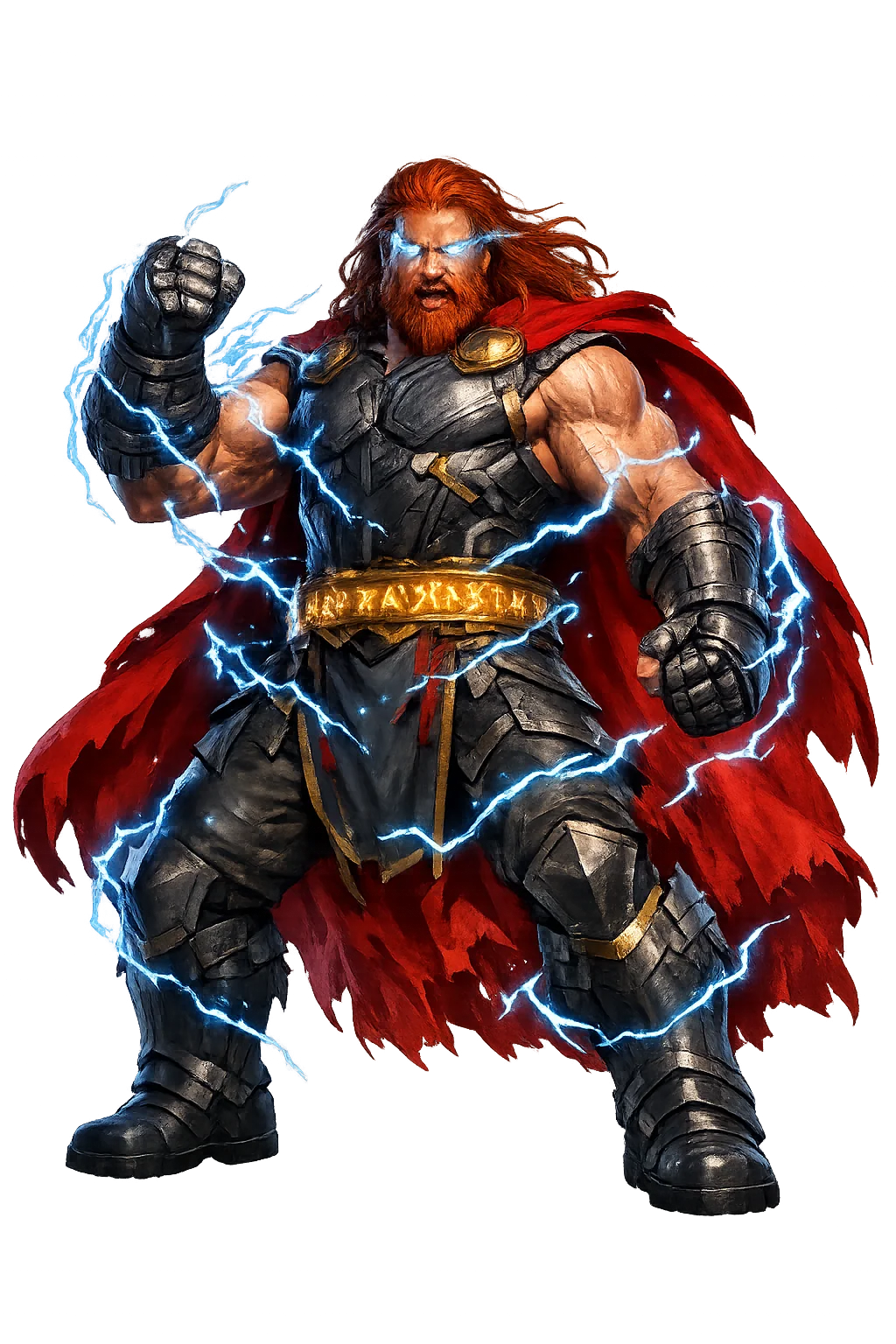
Essential information about Þórr, Thunder, Storms, Oak
From original script to Unicode restoration
Þórr is accent-preserving Tier 2: the acute on ó marks stress and length on the first syllable, while the geminate rr preserves the Old Norse long consonant. The English name Thor has lost both the thorn sound and the long rolled r.
Character-by-character philological analysis
| Character | Unicode | Name | Block | Phonetic Role |
|---|---|---|---|---|
| Þ | U+00DE | Latin Capital Letter Thorn | Latin-1 Supplement | Thorn: voiceless dental fricative |
| — | N/A | Dropped character | Norse orthography | Dropped: merged with t into thorn |
| ó | U+00F3 | Latin Small Letter O with Acute | Latin-1 Supplement | Acute on o |
| rr | U+0072 | Character U+0072 | Basic Latin | Geminate: double r in Old Norse |
The Tier 2 classification reflects which ancient features stress, length, or script are preserved in this restoration.
From ancient cult to modern Unicode
In the norse tradition, Þórr governed thunder, storms, oak. The name encodes a sphere of power that shaped ritual, narrative, and social order.
Norse tradition absorbed and reworked Germanic, Celtic, and Christian influences; medieval Icelandic compilers preserved the myths while Christian frameworks shaped their presentation.
The name lives on in modern fantasy, Neopagan practice, Scandinavian heritage, and the global reception of Viking-Age literature. Restoring Þórr in Unicode preserves the name's cultural specificity against the flattening force of plain ASCII. Þórr has become a global pop-culture icon, yet his medieval cult was rooted in the daily protection of farmers, sailors, and households. The thorn character and acute accent in Þórr restore the name's Old Norse specificity. The transition from Þórr of the Viking Age to Thor of modern media illustrates how medieval deities become global archetypes.
Restoring Þórr in a domain name is more than orthographic accuracy. It is a statement that the internet should recognize the full range of human writing — not only the ASCII keyboard.
Common questions about Þórr, Thunder, Storms, Oak, and Unicode restoration
In reconstructed pronunciation, Þórr is /ˈθɔːrː/ — approximately 'THORR' — begin with the breathy 'th' of 'thin', hold the 'o' long like 'awe', and trill the final r slightly longer than usual..
Þórr means Thunder (from *þunraz) in the norse tradition.
Þórr is associated with Mjöllnir (The short-handled hammer that returns to his hand and strikes down giants), Járngreipr (iron gloves) (The gloves that allow Thor to grasp the hammer's searing haft), Megingjörð (strength belt) (The belt that doubles Thor's already formidable strength), Goat-drawn chariot (Tanngrisnir and Tanngnjóstr, the goats who pull his thundering cart), Oak tree (The tree sacred to Thor in Germanic folk practice, struck by lightning).
Each is a historically defensible restoration. Thorr.com is the alt-stress form: Alternate: Thorr (length on o).
Plain ASCII thor strips the stress, length, and script that make the name specific. Unicode restoration returns the name to its original written dignity.
When the giant Þrymr steals Mjölnir and demands Freyja as ransom, the gods cannot pay. Instead, they dress Þórr as the bride, veil his beard, and send him to Jötunheimr with Loki as his maidservant. At the wedding feast, Þrymr places the hammer in the bride's lap to hallow her, and Þórr seizes it, slays every giant in the hall, and returns to Ásgarðr.The myth is comic, but its premise is serious: without Mjölnir, the gods cannot defend the order of the world. Þórr's willingness to wear women's clothing underscores that his masculinity is secure enough to be performed as disguise, and the hammer's return restores cosmic equilibrium.
The philological foundations of this restoration
Every claim on this page is grounded in established scholarship. The orthographic restorations follow disciplinary convention. The etymological chain follows the best available reference works. This is not invention — it is resurrection through scholarship.
You have traced the name from its earliest attestation to its Unicode restoration. Now return to the myth. The story is where the name lives.
Back to Lore