
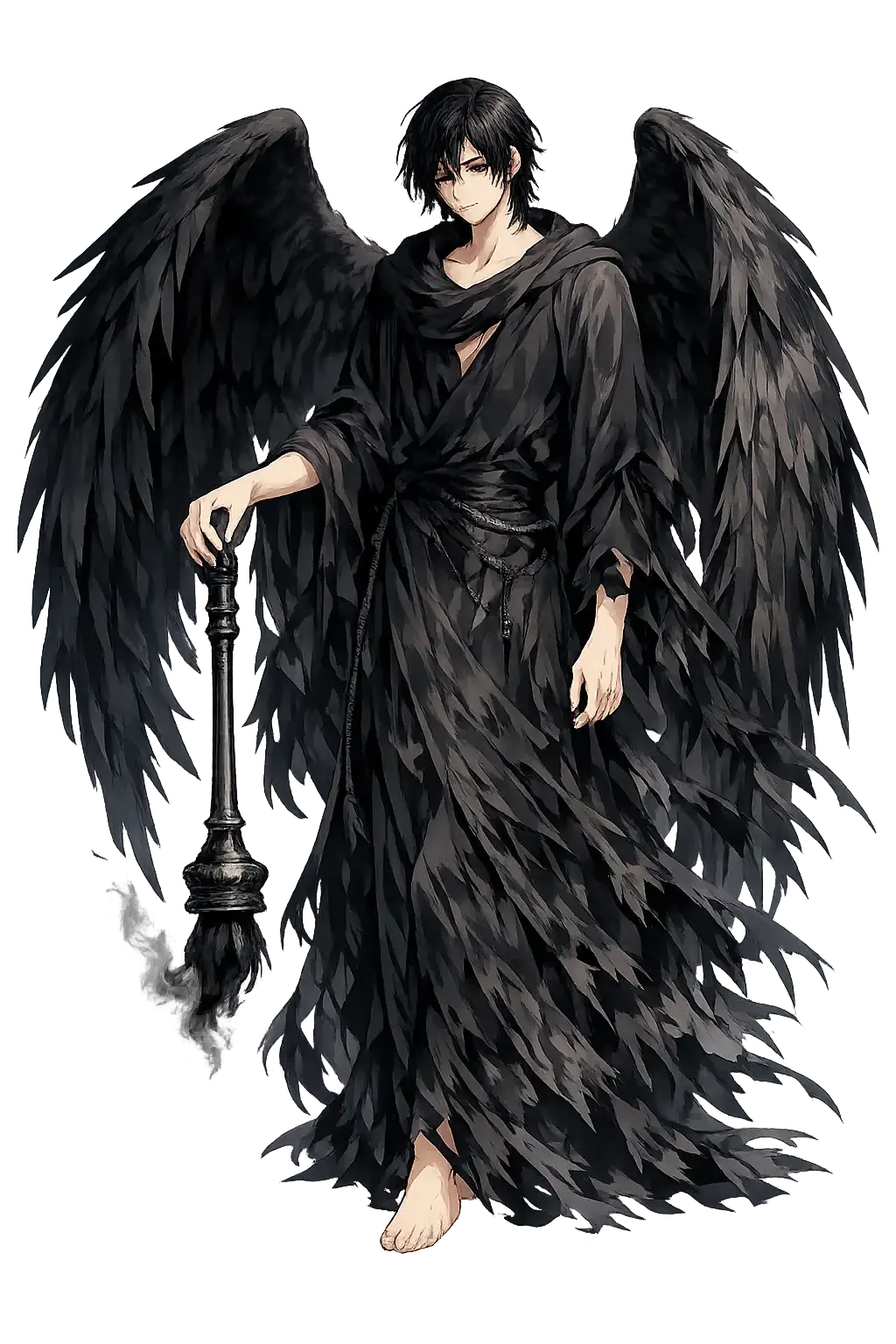
The hidden history behind Thánatos
Behind the modern ASCII form thanatos hides a much longer story. Thánatos reaches back through manuscripts, inscriptions, and oral tradition long before it ever touched a keyboard, and every mark in the restored spelling is a receipt from that journey. In what follows we trace the name from its Greek attestations through its mythology, its cult, its symbols, and its afterlife in other cultures — and we show how the PuniCodex project turned that philological record into a Unicode domain that resolves today. The history was never lost. It was only waiting for the infrastructure to catch up.
At a Glance
- Restored name: Thánatos
- ASCII form: thanatos
- Meaning: "Death"
- Domain of influence: Death
- Pantheon: Greek
- Classification: Tier 2
- Original script: Θάνατος (Greek)
- Live domain: thánatos.com
Overview
Thánatos (Greek Θάνατος; ASCII thanatos) is the personification of death in Greek tradition — specifically of non-violent death, since violent death belonged to his sisters, the blood-craving Kēres. Hesiod makes him a son of Nyx, Night, born without a father, and the twin brother of Hýpnos, Sleep; the brothers dwell in a sunless house in the underworld, and of the two only Sleep is kind to mortals — Death's heart is iron, his spirit pitiless as bronze. Homer gives him his most famous errand: at Zeus's command the twins lift the body of Sarpedon from the battlefield and carry it home to Lycia, an image of death as gentle conveyance that the Attic vase painters made canonical. On the tragic stage he walks on in person: robed in black and armed with a consecrating sword, he comes for Alcestis in Euripides' play — and is out-wrestled by Heracles. Aeschylus's lost Niobe gave the clearest statement of his nature: alone of the gods, Death loves not gifts, has no altar and no hymn of praise.
PuniCodex restores the name as Thánatos and serves this temple at thánatos.com. The Greek original preserves one prosodic feature — the acute accent on the first syllable — but no long vowel, which places the name in Tier 2. The plain ASCII form thanatos is a convenience of the domain-name system, not an ancient spelling.
The Name
The name is attested in Greek as Θάνατος, the ordinary Greek noun for 'death' raised to a person. It is a verbal noun built on the root θαν- of θνῄσκω, 'to die', the same root that yields θνητός, 'mortal' — literally 'one who may die' — so that the god's name and the human condition share a single stem. The accent is fixed on the first syllable (Θάνατος), and all three vowels are short.
The ASCII form thanatos survives only because the early domain-name system could not carry diacritics; it is a technological compromise, not an ancient spelling. The Unicode restoration Thánatos recovers the stress accent of the original directly in the address bar. The original preserves one prosodic feature — stress or vowel length — rather than both, which places the name in Tier 2.
The letter-by-letter transformation runs:
- t → T — T uppercase
- h → h — h same
- a → á — Acute on a
- n → n — n same
- a → a — a same
- t → t — t same
- o → o — o same
- s → s — s same
Attested and derived spellings of the name:
- Thanatos — ASCII form: Plain ASCII form
The project holds the domain thánatos.com (xn--thnatos-iwa.com) as the canonical home of this name.
The Original Script
The name is written in Greek as Θάνατος. This original script is the form against which the ASCII fallback thanatos and the PuniCodex restoration Thánatos are measured: the restoration preserves its pitch accent of the written form, so that a reader typing the modern address still speaks the ancient name.
The Greek is Θάνατος, a noun meaning 'death', personified as a deity. The initial θ (theta) was an aspirated [tʰ] in Classical Greek, not the fricative [θ] of modern Greek. The acute accent falls on the first syllable. PUNICODEX writes Thánatos with the stress mark, since the spiritus asper and the full Greek letters are not registrable.
Pronunciation
The reconstructed pronunciation of the name is /tʰá.na.tos/ — Classical Attic values: an aspirated stop [tʰ] for theta (not the English fricative 'th'), short open [a] twice, and short final [os]; the accent rests on the first syllable.
Phoneme by phoneme:
- Th- — Aspirated voiceless dental stop [tʰ], not the English fricative 'th'.
- -á- — Open [a] with acute stress on the first syllable.
- -na- — Voiced alveolar nasal [n] followed by open [a].
- -tos — Voiceless alveolar stop [t] plus short [os], the neuter noun ending.
For the modern speaker, the closest approximation is: 'THAH-nah-tos' — aspirate the first 'th' as in 'top-hat', stress the first syllable, and keep the final 'os' short.
Kindred and historical forms of the name:
- Greek — Θάνατος (Thánatos), personification of death; Hesiod makes him Night's son and Sleep's twin.
- Roman — Mors, the Roman counterpart, less mythologically developed.
- Twin — Hýpnos (Sleep), his twin brother in Hesiod's Theogony.
Thánatos is Tier 2: the Greek original carries acute stress but no long vowel. The restoration preserves the stress mark, distinguishing it from the flattened English 'Thanatos'.
Mythology
Thánatos appears in Greek myth most often as a function rather than a character, but three narratives make him a player.
Son of Night
Hesiod lists him among the fatherless children of Nyx — 'hateful Moros and black Ker and Thanatos, and she bare Hypnos and the tribe of Dreams' — and later gives the twins their sunless house in the underworld, where Sleep is kind to mortals but Death has a heart of iron and a spirit pitiless as bronze, hated even by the gods. Homer already knows the kinship: Sleep is 'the brother of Death'.
The body of Sarpedon
When the Lycian prince fell to Patroclus, Zeus commanded Apollo to cleanse the body and give it 'to Sleep and Death, the twins', who bore it through the air to Lycia, where his kin gave him funeral rites — one of the most moving images of death in Homer, not grim but almost filial; Bacchylides retells the sending.
Bound by Sisyphus
The Corinthian trickster 'supposed that he was master of Death': when Thánatos was sent against him, Sisyphus bound the god fast, so that no one could die, until Ares came to the rescue, released Death, and delivered Sisyphus into his power — the plot of Aeschylus' lost satyr play, told by Pherecydes and already known to Alcaeus and Theognis.
Wrestled by Heracles
In Euripides' Alcestis he comes on time and on stage to collect the queen who volunteered to die for Admetus; Apollo's bargaining fails, but Heracles ambushes him beside the tomb, crushes him in a wrestler's grip, and forces him to give the woman up — death beaten once by strength and friendship.
Symbols & Iconography
Thánatos's attributes divide cleanly between the Greek literary and vase-painting tradition and the later Roman funerary vocabulary:
- Wings — his constant Greek mark: Alcestis in her dying vision sees that 'he has wings', and the Attic painters give the twins great dark wings as they lift the dead.
- Sword — the consecrating blade of Euripides' Alcestis, with which he cuts the lock that devotes the dying to the gods below.
- Black robes — Heracles lies in wait for 'Thanatos of the black robes (melampeplos), master of dead men', drinking the blood-offerings by the grave.
- Inverted torch, wreath, and butterfly — the Roman funerary vocabulary: on imperial reliefs Death appears as a youth with a down-turned torch, sometimes holding a wreath or a butterfly, the image of the departing soul.
Thánatos has one of the most distinctive iconographies of any Greek personification: a winged male, youthful or bearded, almost always paired with his twin Hýpnos. The type is fixed by the Euphronios krater (c. 515 BCE), where the brothers lift the armored corpse of Sarpedon at Troy, and by generations of Attic white-ground lekythoi — one painter is even named the Thanatos Painter — in which the twins bear the dead to the grave. Euripides supplies the stage version: black robes and a sword to cut the consecrated lock of hair. In Roman funerary art he dissolves into generic genii of death with inverted torches, far from the grave dignity of the Greek twins.
Epithets & Cult Titles
Thánatos had no cult titles — a god without altars collects no liturgical names — but poetry gave him a precise vocabulary:
- νηλής (nēlḗs) — 'pitiless' — Hesiod: his spirit within him is 'pitiless as bronze'.
- χάλκεον ἦτορ (chálkeon êtor) — 'brazen heart' — the Theogony's image for the brother in the sunless house.
- διδυμάων (didymáōn) — 'twin' — 'Sleep and Death, the twins' in Iliad 16.
- ἱερεὺς τῶν νεκρῶν (hiereùs tôn nekrôn) — 'priest of the dead' — Apollo's title for him in Euripides' Alcestis, as he comes to consecrate the dying queen with his sword.
- μελάμπεπλος (melámpeplos) — 'of the black robes' — Heracles' name for him as he plans the ambush by the tomb.
- ἄναξ νεκρῶν (ánax nekrôn) — 'master of dead men' — the same scene: the lord Heracles expects to find drinking the blood-offerings.
- παιάν (paián) — 'the healer' — Aeschylus' Philoctetes prays to 'Death the healer' as the only mediciner of incurable ills.
- 'he who loves not gifts' — Aeschylus again: alone of gods he takes neither sacrifice nor libation.
The Homeric Hymns
No Homeric Hymn addresses Thánatos, and Aeschylus explains why: Death 'hath no altar nor hath he hymn of praise; from him, alone of gods, Persuasion stands aloof'. His earliest hexameter appearances are Hesiodic and Homeric. In the Theogony he is born to Night without a father, twin of Hýpnos, Sleep, and Hesiod later sets the brothers in a dark house the sun never sees, giving Death a heart of iron and a spirit pitiless as bronze. Homer grants him his most famous scene: in Iliad 16 Zeus commands that Sarpedon's body be given 'to Sleep and Death, the twins' (Ὕπνῳ καὶ Θανάτῳ διδυμάοσι), who carry the fallen prince home to Lycia. On the tragic stage he walks on in person at the opening of Euripides' Alcestis — robed, armed, and out-wrestled by Heracles. The later Orphic corpus does what archaic hymnody would not: the hymn to Thanatos (no. 87 in the standard numbering) addresses 'Death, whose empire unconfined extends to mortal tribes of every kind', and begs him to spare human life to abundant old age; Philostratus reports that the people of Gadeira, at the edge of the world, likewise sang hymns in his honor.
Oracle Sites & Sanctuaries
The Greeks built Thánatos no temples and consulted him at no oracle: Aeschylus' verdict that Death 'has no altar' holds across the record, and no sanctuary inscription names him. What the record offers is representation within others' sacred spaces. At Sparta, beside the temple of Athena of the Bronze House, Pausanias saw images of Hypnos and Thanatos, whom the Spartans 'think brothers, in accordance with the verses in the Iliad'; and on the chest of Cypselus dedicated at Olympia, Night was shown nursing two children, one white and one black, identified by inscriptions as Sleep and Death. Late notices preserve traces of actual sacrifice to Death, and Philostratus claims the Gadeirans sang him hymns, but these are exceptions that prove the rule. His real domain was the funerary sphere: the white-ground lekythoi deposited in Attic graves, where he and his twin lift the dead, are his closest approach to ritual presence. Everywhere else he is kept at the distance the Theogony marks — a minister of the realm of Hádēs, feared, unhymned, and unbribed.
Archaeology & Evidence
The archaeological record for Thánatos confirms what the texts say: he had no temples and no cult statues, and the material evidence for him is funerary and decorative, never hieratic. Aeschylus' line that Death 'has no altar' is matched by the absence of any excavated sanctuary in his name. Two public monuments carried his image: at Sparta, beside the temple of Athena of the Bronze House, Pausanias saw images of Hypnos and Thanatos, 'brothers, in accordance with the verses in the Iliad', and on the archaic chest of Cypselus dedicated at Olympia, Night appeared nursing two children, one white and one black, labelled Sleep and Death. His true archive is the Attic cemetery: red-figure vases from the Euphronios krater onward show the winged twins lifting Sarpedon, and the white-ground lekythoi deposited in graves made the scene a funerary commonplace — one of their painters is conventionally named the Thanatos Painter. Roman funerary reliefs then recast him as a torch-inverting youth, the type that passed into later European art.
Realm & Domain
Thánatos's single province is the end of life, but the sources give that province four distinct operations.
Gentle close
His is the touch of non-violent death, likened to his twin Sleep's: Hesiod contrasts the kindly brother who ranges earth and sea with the iron-hearted Death the gods themselves hate, and the dying Alcestis sees him coming winged and frowning beneath dark brows.
Twin of Sleep
The pairing is Homeric before it is Hesiodic: the Iliad calls Sleep 'the brother of Death', and the twins act together at the deaths of heroes.
Bearer of the honored dead
When Sarpedon fell, Zeus sent 'Death to carry him away, and Sleep, who is painless', to lay him in broad Lycia for burial — the errand that fixed his image in art.
Priest of consecration
In Euripides he enters armed with a sword to cut a lock of the dying queen's hair, 'for all whose hair is cut in consecration by this blade's edge are devoted to the gods below'; Aeschylus adds that he alone of gods accepts no gifts, no sacrifice, no libation.
Across Cultures
Rome translated him as Mors — with the less common Letum sometimes reserved for the destructive Keres — but never built him the visual and literary personality the Greeks gave Thánatos: Virgil sets Letum and his brother Sopor before the very jaws of Orcus, and Seneca calls Sleep 'sluggish brother of cruel Mors'. Horace's 'pale Death' who kicks with equal foot at paupers' huts and kings' towers fixed the Roman mood of somber inevitability rather than myth. Late antique and Roman religion shows faint cultic traces — Servius, Statius, and Lucan preserve notices of sacrifice to Death, and Philostratus reports that the people of Gadeira at the edge of the world 'sing hymns in honour of Thanatos' — but no temple to him is recorded anywhere. Modern psychology gave him a second life: Freud's 'death drive' (Todestrieb), developed in Beyond the Pleasure Principle (1920), was soon christened Thanatos in the psychoanalytic literature and set opposite Eros.
Kindred figures in the corpus include Hádēs, Kānāloa, Kēr, Mōt, and Persephonē, each linked through the realm of death and the underworld.
Cultural Legacy
Thánatos remains one of the most resonant names for death in Western culture, because Greek tradition made death a person with a character rather than a mere event. Psychoanalysis canonized the pairing 'Eros and Thanatos' for the two drives, and the coinage 'thanatology' now names the academic study of death and dying. The ancients themselves used him to think with: the dying sophist Gorgias, asked how he was, answered that 'Hypnos is now beginning to hand me over to his brother' — the twinship turned into a way of picturing the approach of death without terror. Aesop even made him a figure of black humor, the god who arrives when the despairing woodcutter summons him and is asked only to help lift the load. And in the quiet image of the winged twins carrying a fallen soldier — fixed by the Euphronios krater and the white-ground lekythoi, one painter of which is still known as the Thanatos Painter — he preserves a dignity that later, more skeletal personifications often lose.
The Scholarly Record
The account of Thánatos given in this edition rests on the witnesses and reference works listed below. Epic and tragedy supply the narratives; Pausanias and the art-historical literature the images; the lexica secure the name.
- Hesiod, Theogony 211–212, 756–766. Full text
- Homer, Iliad 14.231, 16.453–457, 16.666–683.
- Euripides, Alcestis 19–76, 259–266, 843–861, 1140–1146.
- Aeschylus, fragments 82 (Niobe) and 141 (Philoctetes); Alcaeus fr. 38a; Theognis 1.703; Pherecydes, FGrH 3 F 78; Bacchylides fr. 20e.
- Pausanias, Description of Greece 3.18.1, 5.18.1; Philostratus, Life of Apollonius of Tyana 5.4.
- Hyginus, Fabulae, Preface; Virgil, Aeneid 6.273–281; Horace, Odes 1.4.13; Seneca, Hercules Furens 1063–1068.
- LSJ (Liddell–Scott–Jones), s.vv. θάνατος, θνῄσκω; LIMC, s.v. 'Thanatos'.
A Meditation
Thánatos is the god we do not wish to meet, yet whose presence gives life its shape. Without him, every day would be endlessly postponable; no choice would be final, no love precious because it is brief. The Greeks understood this: death is not the enemy of meaning but its frame. They even made the thought bearable — the dying Gorgias could say, without terror, that Sleep was beginning to hand him over to his brother.
His twinship with Sleep is the deeper teaching. Every night we practice death; every morning we rehearse resurrection. Thánatos is the brother who, one day, does not let us wake. To name him is to admit that the condition of being alive is being temporary—and that this is not cruelty but definition.
The Unicode Restoration
Thánatos is classified as Tier 2: the original preserves at least one philological feature that ASCII cannot encode. The ASCII fallback thanatos still resolves everywhere, but it is the restored form that carries the name's full information. Across the 8 characters of the name, the restoration adjusts 1: 1 mark of stress (á). That is the whole thesis of this temple: the marks are the message.
The Domain Name
The restored name is live as a working domain: thánatos.com, which the DNS carries in punycode form as xn--thnatos-iwa.com — an ASCII-compatible encoding that lets a non-ASCII name travel the global network without breaking older infrastructure. The visitor sees Thánatos; the machines see the encoding. That duality is the engineering compromise on which the entire restoration rests, and it is why a name written the way its own tradition wrote it in Greek can now be typed into any browser on earth.
Why This Restoration Matters
The story of Thánatos did not end in antiquity; it changed medium. Names that survive for millennia do so because each generation finds a new carrier for them — clay, papyrus, print, and now DNS. The PuniCodex restoration simply makes the carrier honest: the spelling that resolves is the spelling the evidence supports. If this post showed anything, it is that thanatos and Thánatos are not the same name with different styling. They are a summary and the text it summarizes. The web can now serve the text.
Explore Further
This post is one doorway into the temple. The home page carries the full character breakdown and the ambient canvas; the lore page tells the myths in long form; the Scholarly Edition preserves the sources, pronunciation data, and revision history; and the patron wall supports the restoration directly. For the wider map, browse the Lexicon, explore the Pantheon, or return to the PuniCodex blog.
Related Names
Sources
The full scholarly apparatus — every citation, revision, and review — lives in the Scholarly Edition. Key references for this post:
- Hesiod, Theogony 211–212, 756–766.
- Orphic Hymn 87, To Thanatos (no. 86 in Taylor's numbering); Philostratus, Life of Apollonius of Tyana 5.4.
- Homer, Iliad 16.453–457, 16.681–683.
- Euripides, Alcestis 19–76, 843–861.
- Aeschylus, fragment 82 (from the lost Niobe, preserved by Stobaeus).
- LSJ (Liddell–Scott–Jones), Greek-English Lexicon, s.vv. θάνατος, θνῄσκω, θνητός; Chantraine, Dictionnaire étymologique, s.v. θνῄσκω.
- Lexicon authorities for this entry: Hesiod, LSJ.