The Authentic Orthography
Moon, Night Light · Moon, light (from σέλας)
Unicode restoration and ASCII comparison
Σελήνη
The name in its original Greek form. Selēnē (Σελήνη) is attested in the source tradition — “Moon, light (from σέλας)”. Its long vowels and acute accents carry the full phonetic and orthographic weight of the source tradition.
selene
Reduced to plain selene, the name loses everything that made it specific: long vowels and acute accents. What remains is an ASCII string that machines can parse but that no longer speaks with its original voice.
Selēnē
The Unicode restoration recovers what ASCII flattened. Selēnē restores long vowels and acute accents, returning the name to its original written dignity. The domain encodes to Punycode, but the browser displays the truth.
Selēnē.com → xn--seln-dvab.com
The non-ASCII characters in Selēnē are encoded while the ASCII remains visible. To the DNS, it is Punycode. To humanity, it is Selēnē.
How Selēnē travels from ancient script to the modern URL
Greek Σελήνη; from σέλας “light, brightness"; the moon-goddess.
Moon, Night Light
The Unicode restoration Selēnē preserves Greek stress and length; the ASCII form selene loses these features.
How Selēnē was spoken
Night, Cycles, Magic, and Sleep
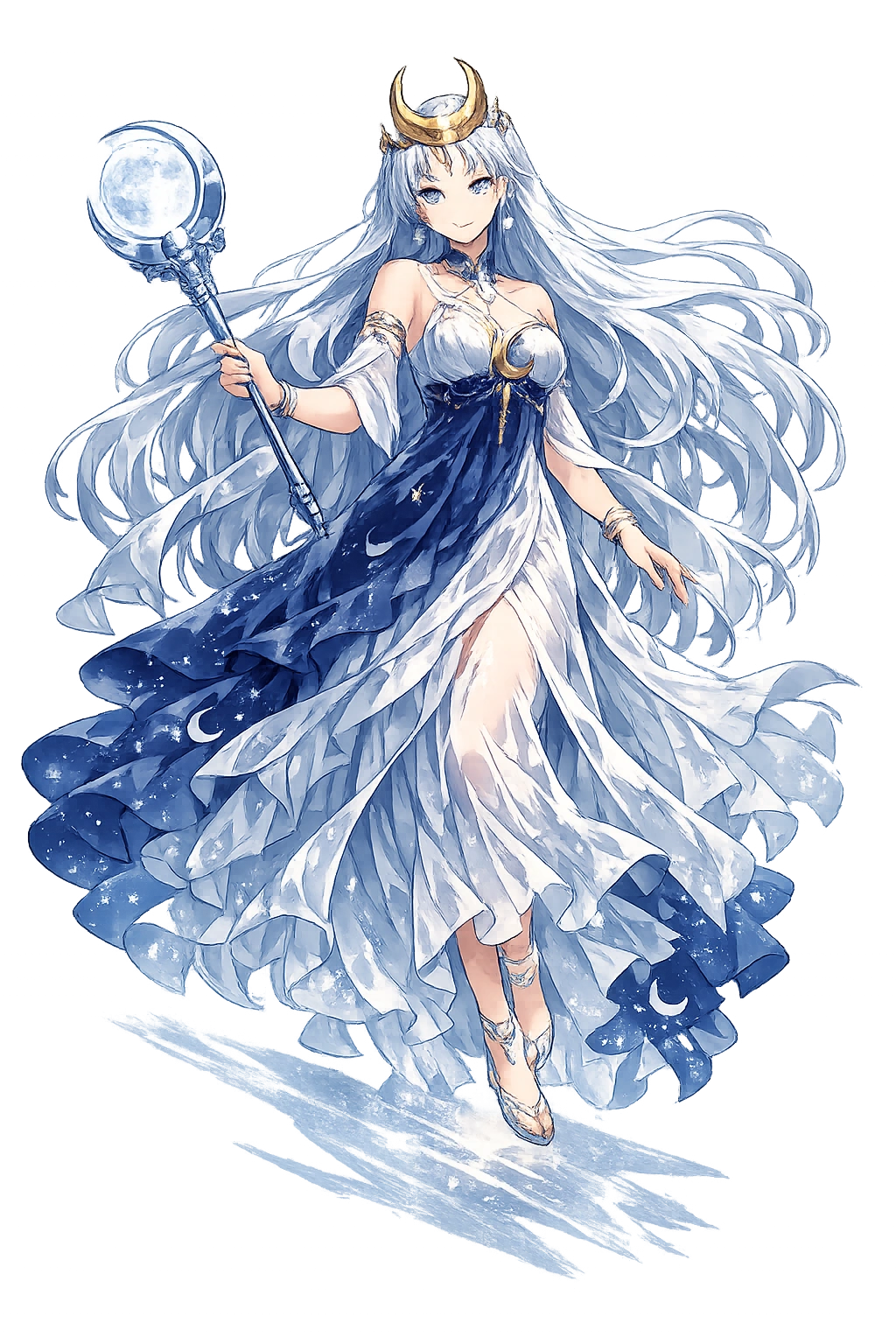
Selḗnē is the moon personified: a goddess who drives her silver chariot through the night, governs the menstrual cycle, and presides over dreams and magic. Where Hēlios reveals, Selḗnē conceals and transforms.
She crosses the night sky in a chariot drawn by oxen or horses, the counterpart to Hēlios's golden car.
The month is hers; she governs menstruation, tides, planting, and ritual calendars.
Hecate's ally; witches draw down the moon to work spells and send dreams.
She fell in love with the shepherd Endymion and put him to eternal sleep so he would not age.
Stories of Selēnē
Selḗnē's myths are fewer than Hēlios's because the night was less personified in Greek poetry. Her most famous story is a love affair with a mortal.
Selḗnē fell in love with Endymion, a beautiful shepherd or king, and asked Zeús to grant him eternal youth. Zeüs put him into eternal sleep in a cave on Mount Latmus in Caria. Each night Selḗnē visits him; some say their union produced fifty daughters. The myth turns the moon's monthly return into a romantic rendezvous and makes sleep the price of immortality.
Like Hēlios, Selḗnē drives a chariot across the sky. The Homeric Hymn to Selene (1–7) describes her as 'winged' and 'golden-crowned,' driving her chariot through the night while Hēlios rests. The moon's pale light is her garment; her crown marks her as a queen of heaven.
Selḗnē was sometimes said to drive oxen rather than horses, connecting her to agricultural time and the lunar calendar that governed planting. The white bull or ox became a lunar symbol across the ancient Mediterranean, linking her to both fertility and sacrifice.
In Greek magical papyri and later Neoplatonic theurgy, Selḗnē could be 'drawn down' by rituals to empower spells, especially those involving love, dreams, and transformation. The Thessalian witches of Roman literature were famous for pulling the moon from the sky. This magical Selḗnē merged with Hekátē and Artemis as a triple lunar goddess.
Selḗnē is the goddess of reflected light. She does not generate radiance; she transforms what Hēlios gives. This is her power and her limitation. The night reveals what the day hides: dreams, secrets, transformations. The moon governs the liminal hours when boundaries loosen.
Enter Extended Lore