
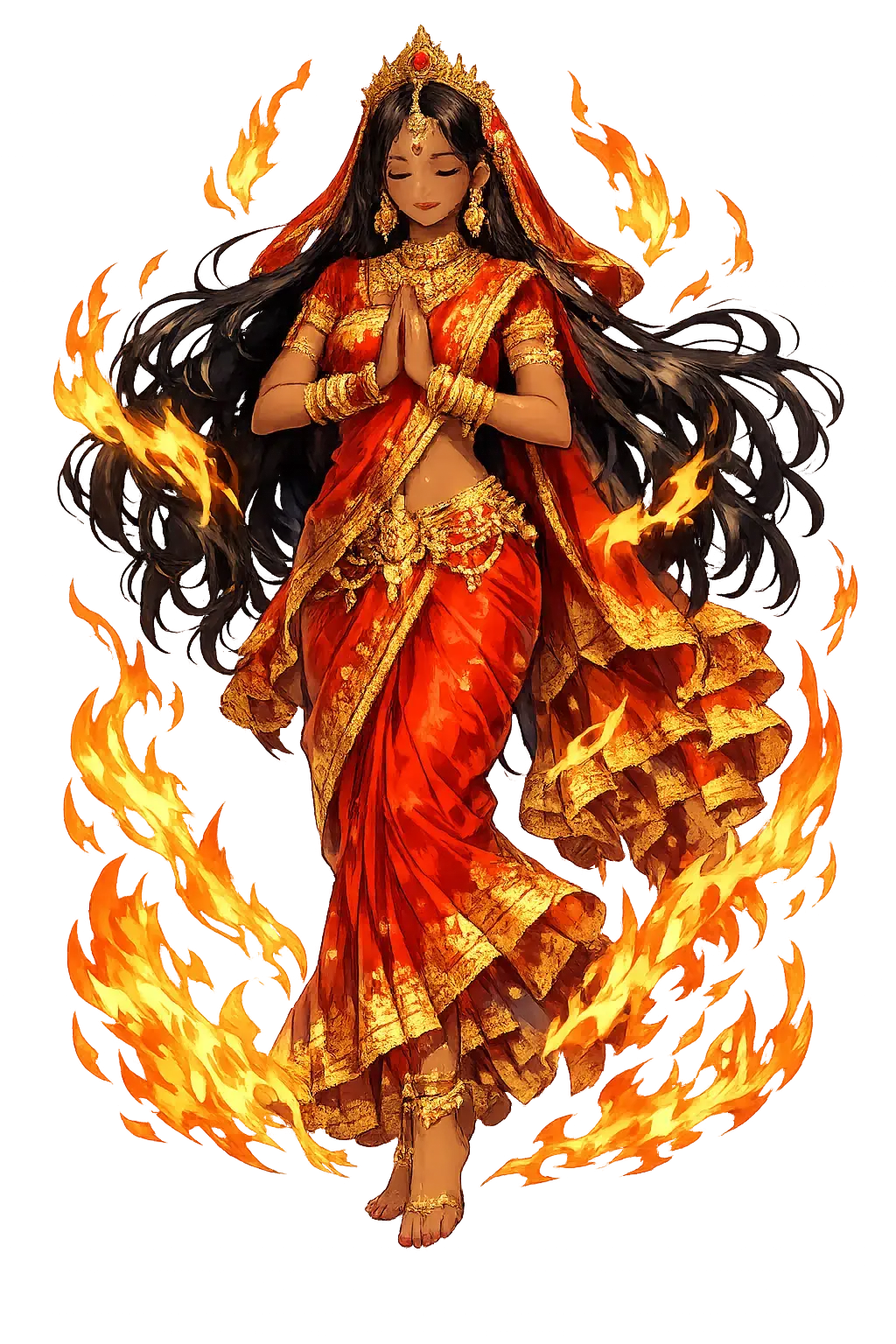
From Devanagari to Unicode: the journey of Satī
Long before it was a domain, this name traveled through scripts. Satī begins in Devanagari, passes through scholarly transliteration, and ends — for now — inside the punycode machinery of the global DNS. Each stage of that journey preserves some information and loses some, and the craft of restoration is knowing exactly which marks matter. This post follows the name stage by stage: the original script, the reconstructed pronunciation, the mythological record, the material evidence, and finally the Unicode form that carries all of it into the address bar. Think of it as a biography of a name, told through its spelling.
At a Glance
- Restored name: Satī
- ASCII form: sati
- Meaning: "of the goddess Durgā or Umā (sometimes described as Truth personified or as a daughter of Dakṣa and wife of Bhava [Śiva], and sometimes represented as putting an end to herself by"
- Domain of influence: Marital Fidelity, First Wife of Shiva
- Pantheon: Sanskrit
- Classification: Tier 1
- Original script: सती (Devanagari)
- Live domain: satī.com
Overview
Satī (Sanskrit सती; ASCII sati) is the daughter of the patriarch Dakṣa and the first wife of [[shiva|Śiva]], whose self-immolation at her father's sacrifice is the founding tragedy of the Śākta tradition. The Bhāgavata Purāṇa gives the classical account: excluded with her husband from Dakṣa's great sacrifice, she attends uninvited, suffers her father's public contempt of Śiva, and burns away her own body by yogic fire — an act that ends in the destruction of the sacrifice and, in later theology, in the scattering of her body across India as the Śakti-pīṭhas, the 'seats of the Goddess'.
Within the Sanskrit pantheon her domain is marital fidelity. Satī is the feminine of the present participle sat — 'being, true, good' — and denotes a true and virtuous wife; only secondarily does the goddess's proper name become, in the early modern period, the term for a widow who burns on her husband's pyre. After her death she is reborn as Pārvatī, the mountain-goddess who wins Śiva again, so that her story binds together marriage, honour, death, and return.
PuniCodex restores the name as Satī and serves its temple at satī.com. Exactly one historically valid Unicode restoration exists — the IAST form with the long final ī — which places the name in Tier 1. The plain ASCII sati is a modern convenience imposed by the early domain-name system, not an ancient spelling.
The Name
The name is attested in Devanagari as सती (satī). It is the feminine of sat, the present participle of √as, 'to be': satī means 'a being, true, virtuous woman', and Monier-Williams glosses the proper name as belonging to the goddess Durgā or Umā, described as a daughter of Dakṣa and wife of Bhava — that is, Śiva. The semantic slide from title to term is documented: the same word, applied to the widow who follows her husband in death, gave the colonial-era vocabulary its 'suttee'.
The ASCII form sati survives only because the early domain-name system could not carry diacritics; it is a technological compromise, not an ancient spelling. The Unicode restoration Satī recovers the long final vowel directly in the address bar: Sanskrit marks the feminine with dīrgha ī, and without the macron the goddess's name collapses into the ordinary practice-term. Exactly one historically valid Unicode restoration exists, which places the name in Tier 1; Sanskrit orthography marks quantity rather than stress, so the tiering here turns on vowel length alone.
The letter-by-letter transformation runs:
- s → S — Same, capitalized
- a → a — Same
- t → t — Same
- i → ī — Long vowel
Attested and derived spellings of the name:
- Sati — ASCII form: Plain ASCII form
The project holds the domain satī.com (xn--sat-wta.com) as the canonical home of this name.
The Original Script
The name is preserved in Devanagari as सती.
The scholarly transliteration is Satī.
The rendering proceeds step by step:
- Sanskrit Satī is written in Devanagari as सती
- IAST transliteration maps each Devanagari vowel and consonant to a Latin equivalent
- Macrons mark long vowels (ā, ī, ū); dots beneath consonants mark retroflex articulation (ṭ, ḍ, ṇ, ṣ)
The Sanskrit name is सती (Satī), written in Devanāgarī. The word derives from the root sat, meaning 'truth' or 'virtue'; a satī is a virtuous woman. The long final ī is marked by the dīrgha sign. PUNICODEX uses the IAST transliteration Satī with the macron, since Devanāgarī characters are not universally registrable and the macron preserves the Sanskrit vowel length that makes the form Tier 1.
Pronunciation
The reconstructed pronunciation of the name is /sɐ.tiː/ — Sanskrit Reconstruction.
Phoneme by phoneme:
- S- — Voiceless dental sibilant [s]; the initial of the participle sat
- -a- — Short open central vowel [ɐ]
- -t- — Voiceless unaspirated dental stop [t̪]; Sanskrit t is pronounced with the tongue at the teeth, and the retroflex series is a separate set (ṭ, ṭh, ḍ, ḍh, ṇ)
- -ī — Long close front vowel [iː], marked by the macron; the dīrgha ī of the feminine suffix
For the modern speaker, the closest approximation is: 'Suh-TEE' — keep the first vowel short and crisp, and lengthen the final 'ee'. In careful Sanskrit the t is dental, the tongue touching the teeth.
Kindred and historical forms of the name:
- Sanskrit — सती (Satī), feminine of sat, 'true, virtuous'
- Hindi/Urdu — Sati, the term later applied to the practice of widow immolation
- Rebirth — Pārvatī / Umā, the goddess into whom Satī is reborn
Satī is Tier 1: the macron on ī marks the long vowel of the Sanskrit feminine. The name is not merely a title but the proper name of Śiva's first wife and a goddess in her own right.
Mythology
Satī's story is told in the Śiva Purāṇa, the Skanda Purāṇa, and countless regional retellings. It is a drama of honour, love, and the catastrophic consequences of refusing a daughter's chosen god.
The Marriage of Satī and Śiva (Śiva Purāṇa, Satī Khaṇḍa)
Satī fell in love with Śiva, the ascetic god of destruction, and married him despite her father Dakṣa's contempt. Dakṣa considered Śiva uncouth, a dweller in cremation grounds, unfit for the company of respectable gods. Satī accepted exile from her father's house and lived with Śiva on Mount Kailāsa.
Dakṣa's Sacrifice (Bhāgavata Purāṇa 4.2–4)
Dakṣa held a great sacrifice and invited every god except Śiva. Satī went alone to confront him. Instead of welcoming her, Dakṣa publicly mocked her husband. Unable to bear the insult, Satī invoked her inner fire and burned her own body to ashes. Her death was both protest and transformation.
Śiva's Grief and Destruction (Bhāgavata Purāṇa 4.5; Skanda Purāṇa)
When Śiva learned of Satī's death, his grief turned to fury. He created Vīrabhadra and Bhadrakālī from his matted hair and sent them to destroy Dakṣa's sacrifice. Dakṣa was beheaded; the gods were humbled. Śiva then carried Satī's charred body across the cosmos, dancing the Tāṇḍava of destruction, until Viṣṇu cut her body into pieces with his discus. Where each part fell, a Śakti-pīṭha arose.
Symbols & Iconography
Satī has no fixed iconographic canon of her own — independent images of her are rare, and her visual presence lives through the goddesses of the Śakti-pīṭhas. Her symbolism therefore belongs to her myth, each attribute a compressed statement about the name:
- Sacred fire (agni) — The inner, yogic fire by which Satī immolates herself; in the Purāṇic accounts she burns by her own power, not on a lit pyre
- Trident (triśūla) — Śiva's weapon, symbol of the divine marriage she defends against her father's contempt
- Lotus — Purity and devotion, especially her steadfast love for Śiva
- Wedding garland — The marriage bond that Dakṣa's pride violates, and with it the order of sacrifice itself
Archaeology & Evidence
No temple of the historical period is dedicated to Satī under that name alone; her material cult is instead the network of Śakti-pīṭhas, the seats where the pieces of her dismembered body are said to have fallen. The classical lists vary — four, forty-two, fifty-one, fifty-two, and 108 pīṭhas are all attested in Tantric and Purāṇic texts — and the great shrines of that geography, above all Kāmākhyā on Nilācala hill near Guwahati and Kālīghāṭ at Kolkata, preserve continuous traditions of goddess worship on sites attested for centuries. A second, grimmer material record belongs to her name: the satī stones of Rajasthan and the Deccan, memorial slabs — often carved with a bent forearm or a husband-and-wife pair — erected where a widow burned on her husband's pyre; hundreds survive from the medieval and early modern periods.
Realm & Domain
Satī is the first consort of Śiva, the daughter of the proud Prajāpati Dakṣa. Her myth is the hinge on which the larger Śaiva narrative turns: an insult to her husband, an unbearable grief, and a self-immolation so total that it forces the god of destruction himself to destroy the sacrifice.
Divine Consort
She is Śiva's first wife, drawn to his ascetic power against her father's wishes.
Daughter of Dakṣa
Born to the patriarch Dakṣa, she embodies the conflict between household and hermitage.
Self-Immolation
She destroys her body by inner fire after Dakṣa insults Śiva.
Rebirth as Pārvatī
After death she is reborn as Pārvatī, who finally wins Śiva as her husband again.
Across Cultures
Satī is inseparable from Pārvatī and, by extension, from Durgā and Kālī. She is also the theological justification for the historical practice of sati, widow immolation, which colonial reformers and Hindu reform movements debated fiercely in the nineteenth century. Modern devotional traditions honour Satī as the supreme wife and the first Śakti, while critics see her myth as a dangerous idealisation of female self-sacrifice.
Within the Sanskrit tradition, closely related names in the corpus include [[durga|Durgā]], [[ganesha|Gaṇeśa]], [[kali|Kālī]], [[lakshmi|Lakṣmī]], [[nirmata|Nirmātā]], and [[om|Oṃ]].
Cultural Legacy
The story of Satī shaped Hindu ideals of wifely devotion and, through the Śakti-pīṭhas, the sacred geography of the subcontinent itself. Her name also became the term for widow immolation. Rammohun Roy's campaign against the practice persuaded Lord William Bentinck's government to prohibit it in the Bengal Presidency by Regulation XVII of 1829, and independent India criminalized even its glorification by the Commission of Sati (Prevention) Act of 1987, passed after the burning of Roop Kanwar at Deorala, Rajasthan, earlier that year. Temples to Satī — and above all the pīṭha shrines such as Kāmākhyā and Kālīghāṭ — remain living pilgrimage centres, while her myth continues to frame debates about gender, agency, and religious identity in South Asia.
The Scholarly Record
The account of Satī given in this edition rests on the witnesses and reference works listed below. The lexica secure the form and meaning of the name; the Purāṇas supply the narrative evidence; the modern studies document the pīṭha tradition and the colonial-era debate over the practice that took her name.
- Śiva Purāṇa, Satī Khaṇḍa.
- Skanda Purāṇa.
- Monier-Williams, Sanskrit-English Dictionary (satī).
- Doniger, Śiva: The Erotic Ascetic (the Dakṣa cycle).
- Hiltebeitel, The Cult of Draupadī.
- Hawley, ed., Sati, the Blessing and the Curse: The Burning of Wives in India.
- Sircar, The Śākta Pīṭhas.
A Meditation
Satī is the goddess who chooses her own end, and that choice has been read in opposite ways for centuries: as the ultimate devotion, or as the ultimate destruction of female agency. Both readings miss something. Satī's act is not about obedience; it is about the unbearability of a world in which her husband is publicly humiliated.
The violence that follows—Śiva's dance, the beheading of Dakṣa, the scattering of her body across India—shows that her death is not a quiet sacrifice but a cosmic rupture. Satī does not simply die; she rewrites the map of the sacred. In her rebirth as Pārvatī, she returns not as victim but as goddess, the Śakti without whom Śiva is incomplete.
The Unicode Restoration
Satī is classified as Tier 1: the original carries both stress and length, and only one valid Unicode restoration exists. The ASCII fallback sati still resolves everywhere, but it is the restored form that carries the name's full information. Across the 4 characters of the name, the restoration adjusts 1: 1 mark of length (ī). That is the whole thesis of this temple: the marks are the message.
Name Variations
The lexicon records 1 additional form of the name:
- Sati (ascii) — Plain ASCII form
The temple uses Satī as the primary form: it is the spelling that best balances philological accuracy with the practical limits of DNS.
Character by Character
The journey from sati to Satī, one character at a time:
- s → S — Same, capitalized
- a → a — Same
- t → t — Same
- i → ī — Long vowel
The Domain Name
The restored name is live as a working domain: satī.com, which the DNS carries in punycode form as xn--sat-wta.com — an ASCII-compatible encoding that lets a non-ASCII name travel the global network without breaking older infrastructure. The visitor sees Satī; the machines see the encoding. That duality is the engineering compromise on which the entire restoration rests, and it is why a name written the way its own tradition wrote it in Devanagari can now be typed into any browser on earth.
The Sanskrit Pantheon
Satī is one of 88 entries the PuniCodex lexicon catalogues under the Sanskrit pantheon. The Pantheon page gathers the tradition's major figures in one place, and the Lexicon lets you filter all 895 restorations by tradition, tier, or script — the fastest way to see where this name sits among its kin.
Frequently Asked Questions
What does Satī mean? The traditional gloss is "of the goddess Durgā or Umā (sometimes described as Truth personified or as a daughter of Dakṣa and wife of Bhava [Śiva], and sometimes represented as putting an end to herself by."
Which tradition does Satī belong to? Satī is catalogued in the Sanskrit pantheon of the PuniCodex lexicon.
Why is Satī classified as Tier 1? Because the original carries both stress and length, and only one valid Unicode restoration exists — and the marks in the restored spelling preserve exactly that evidence.
Is Satī a working domain? Yes — satī.com resolves today and routes to this temple.
What is the punycode for satī.com? The DNS encoding is xn--sat-wta.com; browsers perform the translation automatically, so visitors only ever see the restored name.
Typing Satī
You do not need a special keyboard to use this restoration. The PuniCodex Type Tool converts the ASCII form sati into Satī as you type, and the browser extension offers the same conversion inside any text field. Copy the restored form, paste it into the address bar, and the DNS does the rest.
Sister Temples
Other temples in the Sanskrit pantheon include Karma, Karṇa, and Kārtikeya — each with its own restoration story, its own scholarly record, and its own place in the lexicon.
Why This Restoration Matters
Every stage of the journey from Devanagari to Unicode was an act of care: the scribe who first wrote the name, the lexicographer who glossed it, the engineer who taught the DNS to carry it. The PuniCodex restoration is the latest stage, not the last word — the Scholarly Edition is revised as the evidence improves. What does not change is the principle: a name deserves to be written the way its own tradition wrote it. Satī in the address bar is that principle, made routable.
Explore Further
This post is one doorway into the temple. The home page carries the full character breakdown and the ambient canvas; the lore page tells the myths in long form; the Scholarly Edition preserves the sources, pronunciation data, and revision history; and the patron wall supports the restoration directly. For the wider map, browse the Lexicon, explore the Pantheon, or return to the PuniCodex blog.
Related Names
Sources
The full scholarly apparatus — every citation, revision, and review — lives in the Scholarly Edition. Key references for this post:
- Śiva Purāṇa, Satī Khaṇḍa.
- Bhāgavata Purāṇa 4.2–7 (Dakṣa's sacrifice and Satī's death).
- Monier-Williams, Sanskrit-English Dictionary (satī).
- Hawley, ed., Sati, the Blessing and the Curse: The Burning of Wives in India.
- Lexicon authorities for this entry: MW, Shiva Purana.