The Authentic Orthography
Mountains, Fertility, Devotion · of the god Śiva's wife (as daughter of Himavat, king of the snowy mountains), Up.; MBh.; Kāv.
Unicode restoration and ASCII comparison
पार्वती
The name in its original Sanskrit form. Pārvatī (पार्वती) is attested in the source tradition — “of the god Śiva's wife (as daughter of Himavat, king of the snowy mountains), Up.; MBh.; Kāv.”. Its macron-length vowels carry the full phonetic and orthographic weight of the source tradition.
parvati
Reduced to plain parvati, the name loses everything that made it specific: macron-length vowels. What remains is an ASCII string that machines can parse but that no longer speaks with its original voice.
Pārvatī
The Unicode restoration recovers what ASCII flattened. Pārvatī restores macron-length vowels, returning the name to its original written dignity. The domain encodes to Punycode, but the browser displays the truth.
Pārvatī.com → xn--prvat-fwa21a.com
The non-ASCII characters in Pārvatī are encoded while the ASCII remains visible. To the DNS, it is Punycode. To humanity, it is Pārvatī.
How Pārvatī travels from ancient script to the modern URL
Sanskrit Pārvatī; from parvata “mountain"; the daughter of the mountain and consort of Śiva.
Mountains, Fertility, Devotion
The IAST form Pārvatī uses registrable Latin diacritics; the Devanagari form is not supported in .com.
How Pārvatī was spoken
Mountains, Fertility, Devotion, and Sacred Marriage
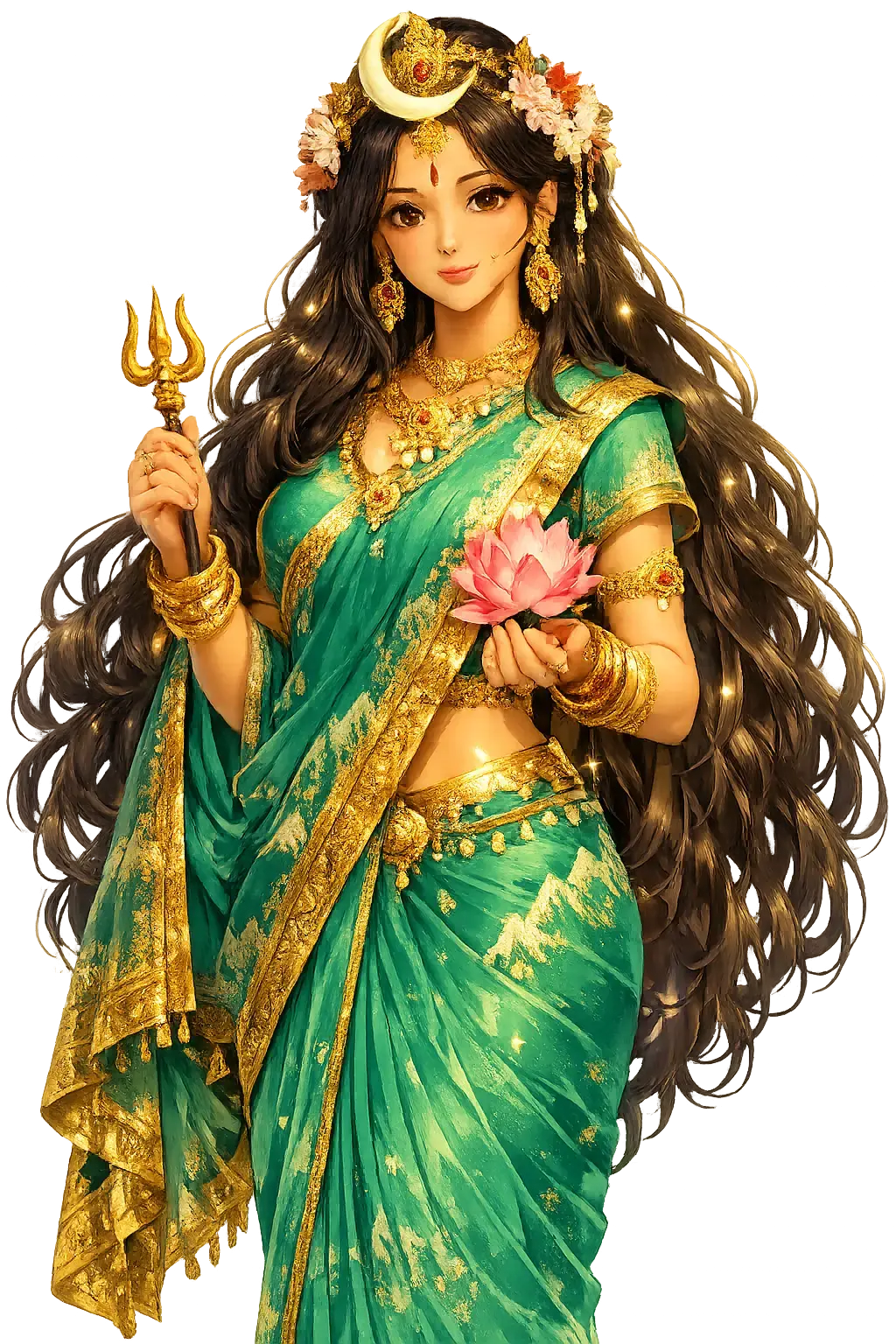
Pārvatī is the mountain goddess whose devotion transforms the absolute into a husband. Born as the daughter of Himavat, the personified Himalaya, she is Satī reborn, destined to marry Śiva and bridge the abyss between his fierce asceticism and the needs of the world. She is gentle, patient, and resolute — the feminine power (śakti) without whom the great yogin remains withdrawn from creation.
Her domain is the sacred marriage itself: the union of opposites that makes the cosmos fertile. Through her, the renouncer becomes householder, the destroyer becomes father, and the snow-capped peak becomes a bridal chamber.
She wins Śiva not by beauty alone but by the heat of her own ascetic discipline, matching his severity with hers.
As mother of Gaṇeśa and Skanda/Kārttikeya, she grounds the divine family in domestic love and protective power.
She is the active energy that complements Śiva's stillness; without her, he cannot move toward the world.
Her Himalayan birth links her to snow, purity, and the life-giving rivers that descend from the heights.
Stories of Pārvatī
Pārvatī's mythology is the story of a love that refuses to fail. From Satī's tragic death to Pārvatī's disciplined courtship, her narratives explore how devotion can soften even the most remote ascetic and how the feminine divine restores the world when the masculine principle withdraws too far.
After Satī immolated herself in protest against her father Dakṣa's insult to Śiva, the goddess was reborn as Pārvatī, daughter of the mountain king Himavat. From childhood she was drawn to Śiva, who sat motionless in meditation, clad in ash and serpents. While her parents worried, Pārvatī undertook severe tapas in the snowy forests, repeating his name until the earth trembled. Her ascetic power grew so great that the gods themselves grew alarmed and urged Śiva to accept her.
Kālidāsa's Kumārasambhava tells the courtship in exquisite verse. Śiva tests Pārvatī by appearing as a wandering ascetic who speaks against his own worth. Pārvatī's calm defense of the god reveals the depth of her understanding, and Śiva reveals himself. Their marriage is celebrated by the whole cosmos, and from their union is born Skanda, the commander of the gods' armies.
In one widely told story, Pārvatī creates Gaṇeśa from the turmeric paste of her own body to guard her door while she bathes. When Śiva returns and is stopped by the boy, he strikes off his head in anger. Stricken with remorse, Śiva restores the boy to life with the head of an elephant, and Gaṇeśa becomes the beloved son of Pārvatī and the remover of obstacles.
Pārvatī teaches that love can be a form of asceticism. She does not pursue Śiva through seduction or demand; she becomes so still, so focused, so burning with intention that the universe rearranges itself to bring them together. Her devotion is not submission but a discipline of matching power.
Enter Extended Lore