PuniCodex

Extended Lore

पार्वती Pārvatī

Etymology · Phonology · Orthography · Cultural Legacy · Primary Sources

Tier 1 Pārvatī.com
Pārvatī — Mountains, Fertility, Devotion
01

Quick Facts

Essential information about Pārvatī, Mountains, Fertility, Devotion

Original Scriptपार्वती
Unicode RestorationPārvatī
Reconstructed Pronunciation/ˈpaːr.ʋə.tiː/
PantheonSanskrit
DomainMountains, Fertility, Devotion
Meaningof the god Śiva's wife (as daughter of Himavat, king of the snowy mountains), Up.; MBh.; Kāv.
ClassificationTier 1
Primary DomainPārvatī.com
Sacred SymbolsLotus, Lion or tiger, Coral and gold ornaments, Two-armed and four-armed forms, The Himalaya
02

Etymology & Word Family

From original script to Unicode restoration

Original Script पार्वती Pārvatī — "of the god Śiva's wife (as daughter of Himavat, king of the snowy mountains), Up.; MBh.; Kāv."
Unicode Restoration Pārvatī Restored stress, length, and script
Modern ASCII parvati Plain-ASCII fallback

Pārvatī is Tier 1 because both the initial ā and final ī are long. The name is a transparent feminine derivative of parvata, 'mountain,' specifically the Himalaya.

03

Unicode Character Breakdown

Character-by-character philological analysis

CharacterUnicodeNameBlockPhonetic Role
PU+0050Latin Capital Letter PBasic LatinSame
āU+0101Latin Small Letter A with MacronLatin Extended-AMacron: long a
rU+0072Latin Small Letter RBasic LatinSame
vU+0076Latin Small Letter VBasic LatinSame
aU+0061Latin Small Letter ABasic LatinSame
tU+0074Latin Small Letter TBasic LatinSame
īU+012BLatin Small Letter I with MacronLatin Extended-AMacron: long i

The Tier 1 classification reflects which ancient features stress, length, or script are preserved in this restoration.

04

Cultural Significance

From ancient cult to modern Unicode

Ancient Domain

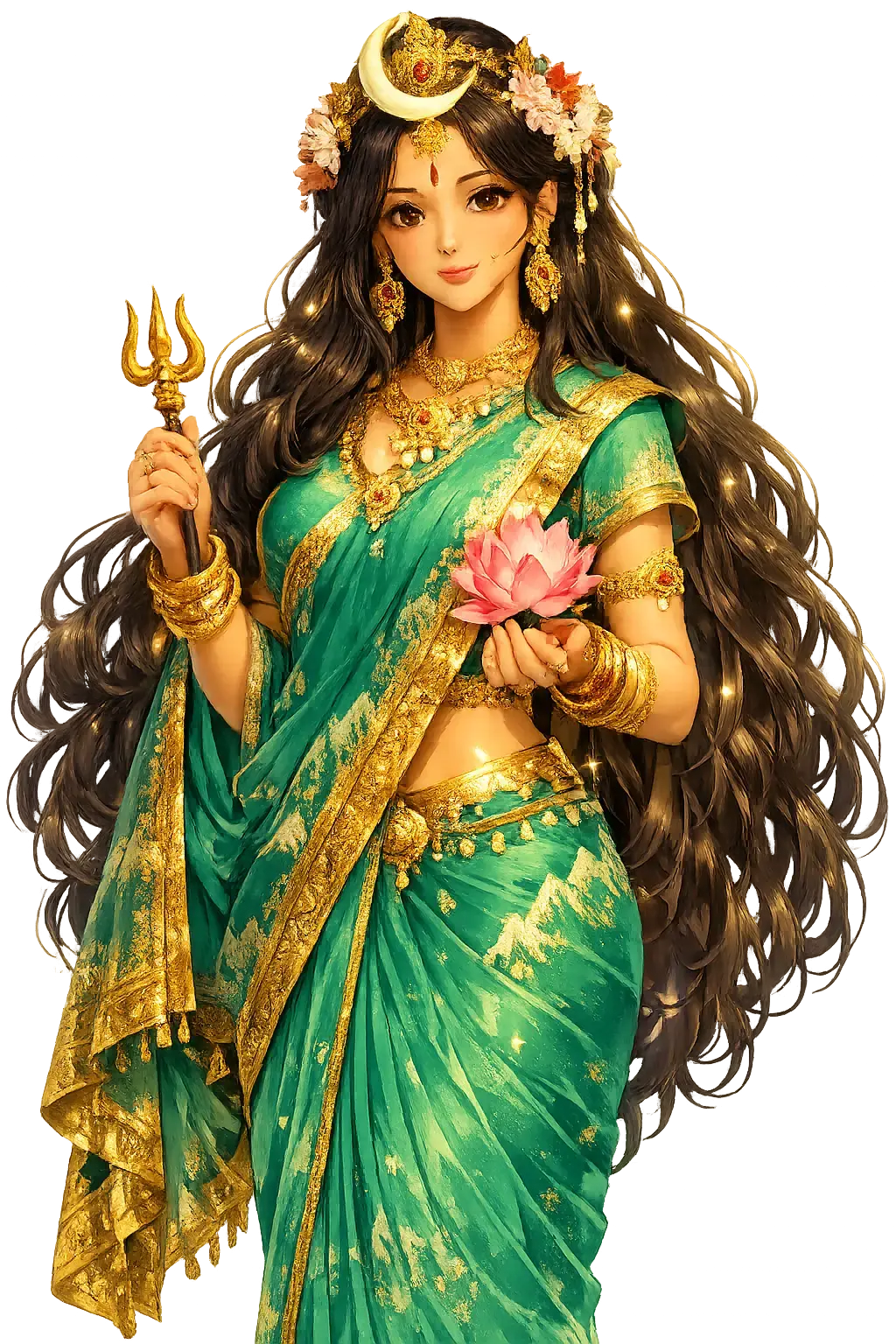
Pārvatī is the mountain goddess whose devotion transforms the absolute into a husband. Born as the daughter of Himavat, the personified Himalaya, she is Satī reborn, destined to marry Śiva and bridge the abyss between his fierce asceticism and the needs of the world. She is gentle, patient, and resolute — the feminine power (śakti) without whom the great yogin remains withdrawn from creation.

Her domain is the sacred marriage itself: the union of opposites that makes the cosmos fertile. Through her, the renouncer becomes householder, the destroyer becomes father, and the snow-capped peak becomes a bridal chamber.

Pārvatī in Later Traditions

Pārvatī is inseparable from the broader network of Śiva's consorts and energies. She is Satī reborn, Umā in the Vedas, Gaurī the fair one, and Caṇḍī or Durgā when wrathful. In South India she merges with the Tamil goddess Taṇṇammai; in Bengal and Assam she is identified with the mother goddess. Tantric traditions further multiply her forms, seeing her as the gentle face of the supreme śakti whose fierce aspect is Kālī. The mountain-goddess type has Indo-European echoes — the goddess born from or dwelling on the high peaks — but Pārvatī's specific identity as Śiva's wife and the mother of Gaṇeśa is distinctively Hindu.

Modern Legacy

Pārvatī remains a model of the devoted wife, the disciplined yoginī, and the protective mother in Hindu culture. Her marriage to Śiva is re-enacted in countless festivals, dance dramas, and domestic rituals; images of the divine couple (umāmaheśvara) grace temples and home shrines from Nepal to Tamil Nadu. In classical dance, especially Bharatanatyam and Odissi, her narratives are central. Feminist scholars have reclaimed her tapas as an assertion of female spiritual agency, while popular film and television continue to tell her stories to mass audiences. The name Pārvatī is also widely chosen for girls, embodying the ideal of strength cloaked in gentleness.

Unicode Restoration as Cultural Act

Restoring Pārvatī in a domain name is more than orthographic accuracy. It is a statement that the internet should recognize the full range of human writing — not only the ASCII keyboard.

05

Frequently Asked Questions

Common questions about Pārvatī, Mountains, Fertility, Devotion, and Unicode restoration

01How do you pronounce Pārvatī?

In reconstructed pronunciation, Pārvatī is /ˈpaːr.ʋə.tiː/ — approximately 'PAHR-vuh-tee' — hold the first 'pahr' and final 'tee' long; the 'v' is light, almost like a 'w'..

02What does Pārvatī mean?

Pārvatī means of the god Śiva's wife (as daughter of Himavat, king of the snowy mountains), Up.; MBh.; Kāv. in the sanskrit tradition.

03What are the symbols of Pārvatī?

Pārvatī is associated with Lotus (Purity and the unfolding of devotion; she often holds a blue lotus), Lion or tiger (Her vehicle, combining maternal gentleness with sovereign ferocity), Coral and gold ornaments (The beauty and auspiciousness of the married goddess), Two-armed and four-armed forms (The range of her iconography from modest wife to cosmic deity), The Himalaya (Her father and birthplace, the axis of the world and source of sacred rivers).

04Why restore Pārvatī in Unicode?

Plain ASCII parvati strips the stress, length, and script that make the name specific. Unicode restoration returns the name to its original written dignity.

05What is the most important myth about Pārvatī?

After Satī immolated herself in protest against her father Dakṣa's insult to Śiva, the goddess was reborn as Pārvatī, daughter of the mountain king Himavat. From childhood she was drawn to Śiva, who sat motionless in meditation, clad in ash and serpents. While her parents worried, Pārvatī undertook severe tapas in the snowy forests, repeating his name until the earth trembled. Her ascetic power grew so great that the gods themselves grew alarmed and urged Śiva to accept her.

06

Scholarly Sources

The philological foundations of this restoration

Every claim on this page is grounded in established scholarship. The orthographic restorations follow disciplinary convention. The etymological chain follows the best available reference works. This is not invention — it is resurrection through scholarship.

Lexicography & Philology

  • MW
  • KEWA

Primary Texts

  • Śiva Purāṇa, Satī Khaṇḍa and Pārvatī Khaṇḍa
  • Skanda Purāṇa (birth of Gaṇeśa)

Archaeology & Art History

  • Material evidence — iconography, inscriptions, and temple archaeology — for Pārvatī and related cults.
  • Images of Umā and Pārvatī appear from the Gupta period onward, often as part of the Umāmaheśvara motif showing Śiva in intimate embrace with his consort. Cave temples at Elephanta, Ellora, and Badami include major sculptural groups of the divine couple. Medieval temples across North and South India dedicated to Pārvatī, Gaurī, or the Goddess in her gentle form preserve her iconography as a beautiful, four-armed goddess seated on a lion or tiger. The annual festival of Gaurī/Gaurī Tṛtīyā and local celebrations of her marriage remain important in Maharashtra, Rajasthan, and South India.

Religious Studies

  • Kālidāsa, Kumārasambhava
  • Devībhāgavata Purāṇa
  • Monier-Williams, Sanskrit-English Dictionary (pārvatī)
  • Kinsley, Hindu Goddesses: Visions of the Divine Feminine
  • Handelman and Shulman, Śiva in the Forest of Pines
Return

The Surface Awaits

You have traced the name from its earliest attestation to its Unicode restoration. Now return to the myth. The story is where the name lives.

Back to Lore
Pārvatī mascot