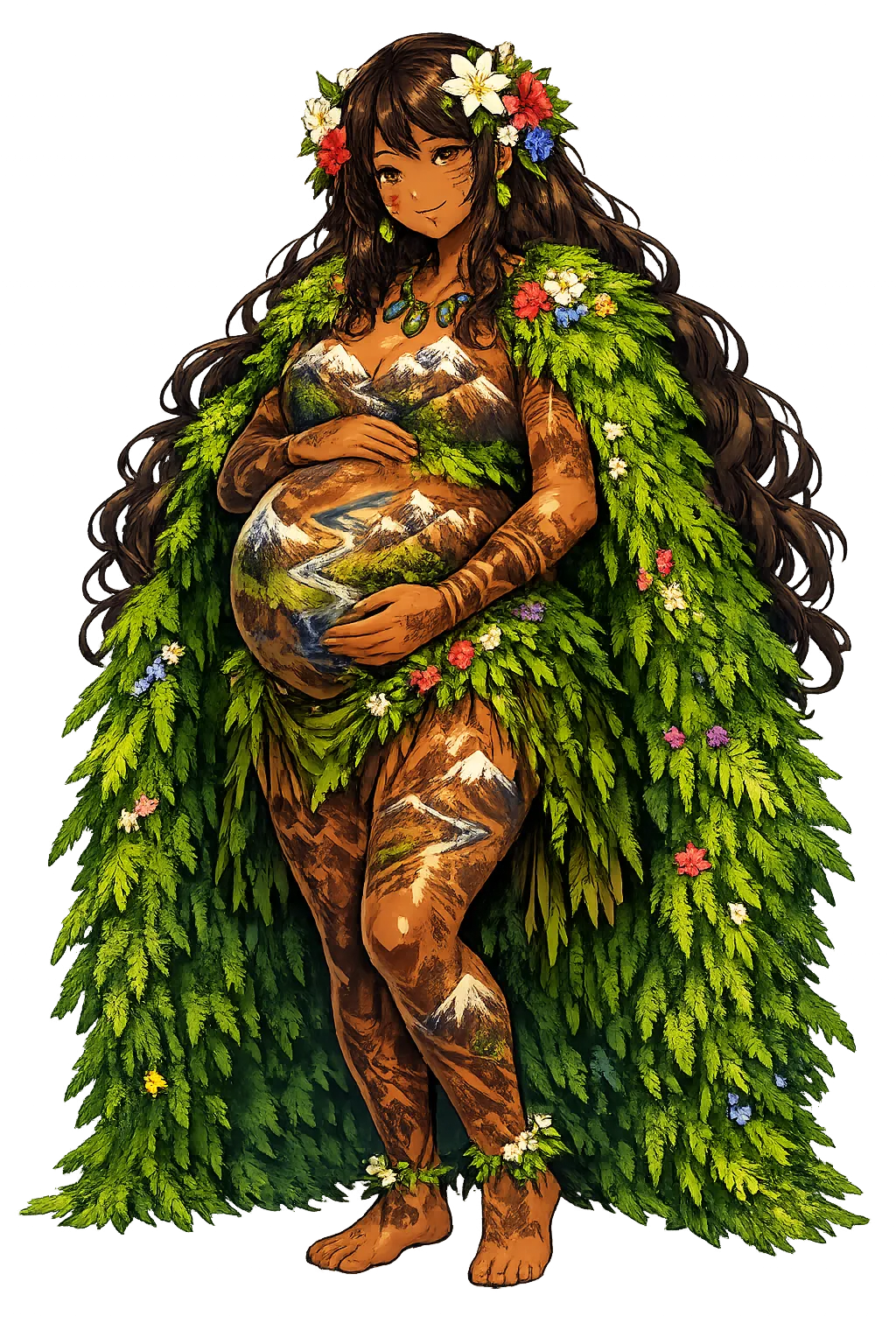
PuniCodex

Extended Lore

Papatūānuku

Etymology · Phonology · Orthography · Cultural Legacy · Primary Sources

Tier 2 Papatūānuku.com
Papatūānuku — Earth, Creation, Fertility
01

Quick Facts

Essential information about Papatūānuku, Earth, Creation, Fertility

Scholarly TransliterationPapatūānuku
Unicode RestorationPapatūānuku
Reconstructed Pronunciation/ˈpa.pa.tuːˈaː.nu.ku/
PantheonPolynesian
DomainEarth, Creation, Fertility
MeaningEarth Mother; the land that gives birth to all living things
ClassificationTier 2
Primary DomainPapatūānuku.com
Sacred SymbolsFlat, dark earth, Mountains and valleys, Caves, The kūmara and food plants
02

Etymology & Word Family

From original script to Unicode restoration

Proto-polynesian *papa earth, rock, foundation
Scholarly Transliteration Papatūānuku Papatūānuku — "Earth Mother; the land that gives birth to all living things"
Unicode Restoration Papatūānuku Restored stress, length, and script
Modern ASCII papatuanuku Plain-ASCII fallback

The name is a transparent Māori compound. Papa means 'earth, rock, foundation' and is found across Polynesia; tū means 'to stand'; ā is an emphatic particle; nuku means 'extended, far-reaching.' The macrons on ū and ā mark long vowels, the distinctive prosodic feature that makes this form Tier 2. Some dialects and orthographies write the short form Papa.

03

Unicode Character Breakdown

Character-by-character philological analysis

CharacterUnicodeNameBlockPhonetic Role
PU+0050Latin Capital Letter PBasic LatinSame, capitalized
aU+0061Latin Small Letter ABasic LatinSame
pU+0070Latin Small Letter PBasic LatinSame
aU+0061Latin Small Letter ABasic LatinSame
tU+0074Latin Small Letter TBasic LatinSame
ūU+016BLatin Small Letter U with MacronLatin Extended-AMacron: long u
āU+0101Latin Small Letter A with MacronLatin Extended-AMacron: long a
nU+006ELatin Small Letter NBasic LatinSame
uU+0075Latin Small Letter UBasic LatinSame
kU+006BLatin Small Letter KBasic LatinSame
uU+0075Latin Small Letter UBasic LatinSame

The Tier 2 classification reflects which ancient features stress, length, or script are preserved in this restoration.

04

Cultural Significance

From ancient cult to modern Unicode

Ancient Domain

Papatūānuku is the broad earth lying beneath the sky, the mother from whose body all living things spring. In Māori cosmology she and Ranginui, the Sky Father, were once locked in an embrace so tight that their children lived in darkness between them. Their separation by Tāne brought light and space into the world — and a wound of separation that still marks every creature's relation to earth and sky.

Papatūānuku in Later Traditions

Papatūānuku is cognate with the Hawaiian earth mother Papa and with earth-deity figures across eastern Polynesia. In Māoridom today she is often paired with Ranginui in prayers, environmental discourse, and artistic representations of the creation story. Some Christian Māori theologians have drawn parallels between Papatūānuku and the created earth praised in biblical psalms, while contemporary environmental movements invoke her as the personification of ecological responsibility and land rights.

Modern Legacy

Papatūānuku has become a central figure in modern Māori cultural identity and in Aotearoa New Zealand's environmental and educational vocabulary. Schools, health services, and land-restoration projects invoke her name. The phrase 'kaitiaki of Papatūānuku' expresses an ethic of guardianship over the land. Internationally, she is one of the most widely recognized Polynesian deities, a symbol of indigenous earth-relationship in an era of climate crisis.

Unicode Restoration as Cultural Act

Restoring Papatūānuku in a domain name is more than orthographic accuracy. It is a statement that the internet should recognize the full range of human writing — not only the ASCII keyboard.

05

Frequently Asked Questions

Common questions about Papatūānuku, Earth, Creation, Fertility, and Unicode restoration

01How do you pronounce Papatūānuku?

In reconstructed pronunciation, Papatūānuku is /ˈpa.pa.tuːˈaː.nu.ku/ — approximately 'PAH-pah-too-AH-noo-koo' — keep the p's gentle and unaspirated, hold the ū and ā long, and give each vowel its own syllable..

02What does Papatūānuku mean?

Papatūānuku means Earth Mother; the land that gives birth to all living things in the polynesian tradition.

03What are the symbols of Papatūānuku?

Papatūānuku is associated with Flat, dark earth (Her body is the soil itself, often figured as lying prone beneath the sky), Mountains and valleys (The folds and ridges of her body, the places where her children still touch her), Caves (Openings into her body, places of birth, burial, and communication with the dead), The kūmara and food plants (Crops grown from her body, especially the sweet potato brought from Hawaiki).

04What is the difference between Papatūānuku.com?

Each is a historically defensible restoration. Papa-tū-ā-nuku.com is the alt form: Hyphenated analytical spelling emphasizing the components.

05Why restore Papatūānuku in Unicode?

Plain ASCII papatuanuku strips the stress, length, and script that make the name specific. Unicode restoration returns the name to its original written dignity.

06What is the most important myth about Papatūānuku?

In the beginning Ranginui, the Sky, and Papatūānuku, the Earth, clung together in a close embrace. Their children — Tāne, Tāwhirimātea, Tangaroa, Tū, Rongo, and Haumia-tiketike — were born into the cramped darkness between their parents' bodies. Tired of confinement, the brothers debated how to escape. Tū wanted to kill the parents, but Tāne proposed separating them instead. He lay on his back and pushed upward with his legs until Ranginui rose into the sky and light streamed into the world. Papatūānuku remained below, mourning her husband, while Ranginui wept tears of rain upon her. (Grey, Polynesian Mythology; Best, Māori Religion and Mythology.)

06

Scholarly Sources

The philological foundations of this restoration

Every claim on this page is grounded in established scholarship. The orthographic restorations follow disciplinary convention. The etymological chain follows the best available reference works. This is not invention — it is resurrection through scholarship.

Lexicography & Philology

  • Tregear
  • Grey
  • Best

Primary Texts

  • Primary sources in the polynesian tradition for Papatūānuku.

Archaeology & Art History

  • Material evidence — iconography, inscriptions, and temple archaeology — for Papatūānuku and related cults.
  • There are no monumental temple sculptures of Papatūānuku comparable to those of Aztec or Greek deities; Māori sacred expression was primarily oral, architectural, and environmental. Marae and carved meeting houses (wharenui) encode genealogical narratives linking the living community to Papatūānuku and Ranginui. Rock art, greenstone ornaments, and burial practices reflect the cosmology of return to the earth. Nineteenth-century written records by Grey, Best, and Smith preserve the oral mythology in detail.

Religious Studies

  • Grey, Polynesian Mythology
  • Tregear, The Maori-Polynesian Comparative Dictionary
  • Best, Maori Religion and Mythology
  • Smith, The Lore of the Whare-wananga
  • Buck (Te Rangi Hiroa), The Coming of the Maori
  • Orbell, The Illustrated Encyclopedia of Maori Myth and Legend
  • Māori Marsden, The Woven Universe
Return

The Surface Awaits

You have traced the name from its earliest attestation to its Unicode restoration. Now return to the myth. The story is where the name lives.

Back to Lore
Papatūānuku mascot