
Ancient Domain
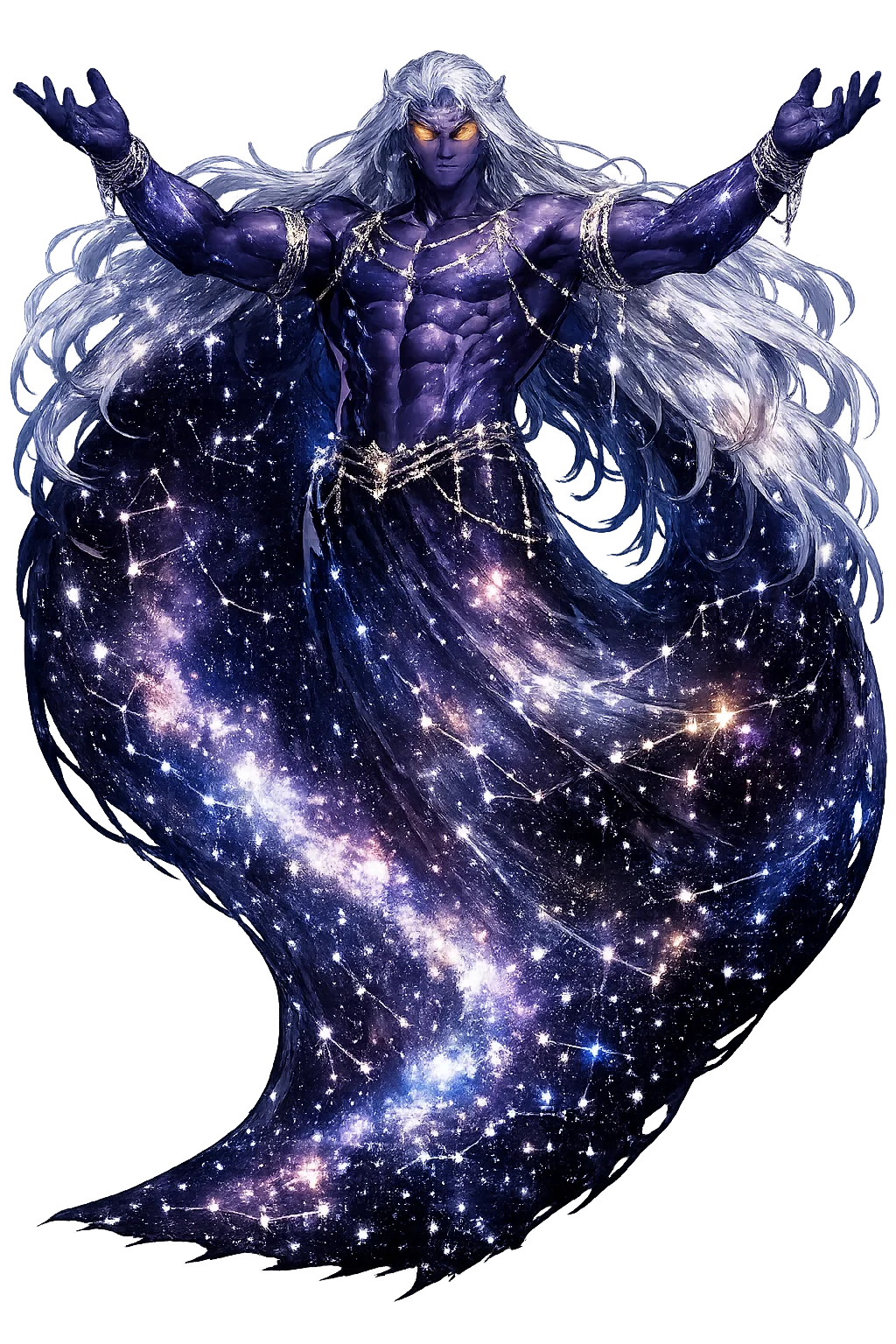
Ouranós is the personification of the sky, the primordial father whose body forms the vault of heaven. Born from Gē without a mate, he became her consort and the first ruler of the cosmos — until his son overthrew him.
Extended Lore
Etymology · Phonology · Orthography · Cultural Legacy · Primary Sources
Essential information about Ouranós, Sky
From original script to Unicode restoration
Ouranós is Tier 1 because the Greek Οὐρανός contains both length (the diphthong ου in the first syllable) and stress (acute on the final ό). The name is the standard Greek word for sky or heaven.
Character-by-character philological analysis
| Character | Unicode | Name | Block | Phonetic Role |
|---|---|---|---|---|
| O | U+004F | Latin Capital Letter O | Basic Latin | O uppercase |
| u | U+0075 | Latin Small Letter U | Basic Latin | u same |
| r | U+0072 | Latin Small Letter R | Basic Latin | r same |
| a | U+0061 | Latin Small Letter A | Basic Latin | a same |
| n | U+006E | Latin Small Letter N | Basic Latin | n same |
| ó | U+00F3 | Latin Small Letter O with Acute | Latin-1 Supplement | Acute on o |
| s | U+0073 | Latin Small Letter S | Basic Latin | s same |
The Tier 1 classification reflects which ancient features stress, length, or script are preserved in this restoration.
From ancient cult to modern Unicode
Ouranós is the personification of the sky, the primordial father whose body forms the vault of heaven. Born from Gē without a mate, he became her consort and the first ruler of the cosmos — until his son overthrew him.
Ouranós had no independent Roman cult; the Romans used caelum for sky and identified the cosmic father with Caelus in philosophical contexts. In later Platonism and Renaissance cosmology he became the outermost sphere of the fixed stars. The name survives in modern astronomy (Uranus, the seventh planet) and in the prefix 'urano-' for sky and heaven.
Ouranós is the ancestor of every 'heaven' in Western thought. The word gave name to the planet Uranus and to concepts of the celestial sphere. His myth of generational violence influenced Freud's theories of the father-son conflict. In modern Greek, ouranós still means 'sky.'
Restoring Ouranós in a domain name is more than orthographic accuracy. It is a statement that the internet should recognize the full range of human writing — not only the ASCII keyboard.
Common questions about Ouranós, Sky, and Unicode restoration
In reconstructed pronunciation, Ouranós is /oː.ra.nós/ — approximately 'oo-rah-NOSS' — the first syllable is long and rounded, the final syllable pitched high..
Ouranós means Heaven, sky in the greek tradition.
Ouranós is associated with Starry sky (His body and realm; the visible heavens), Adamantine sickle (The weapon of his castration, forged by Gē), Mountains (The points where earth and sky were once joined), Aphrodite born from foam (The goddess who arose from the severed genitals thrown into the sea).
Plain ASCII ouranos strips the stress, length, and script that make the name specific. Unicode restoration returns the name to its original written dignity.
After Chaos and Gē came Ouranós, 'starry' and equal to her in size. He covered Gē on every side and became the secure seat of the blessed gods. With her he fathered the Titans, the Cyclopes, and the Hundred-Handers.
The philological foundations of this restoration
Every claim on this page is grounded in established scholarship. The orthographic restorations follow disciplinary convention. The etymological chain follows the best available reference works. This is not invention — it is resurrection through scholarship.
You have traced the name from its earliest attestation to its Unicode restoration. Now return to the myth. The story is where the name lives.
Back to Lore