
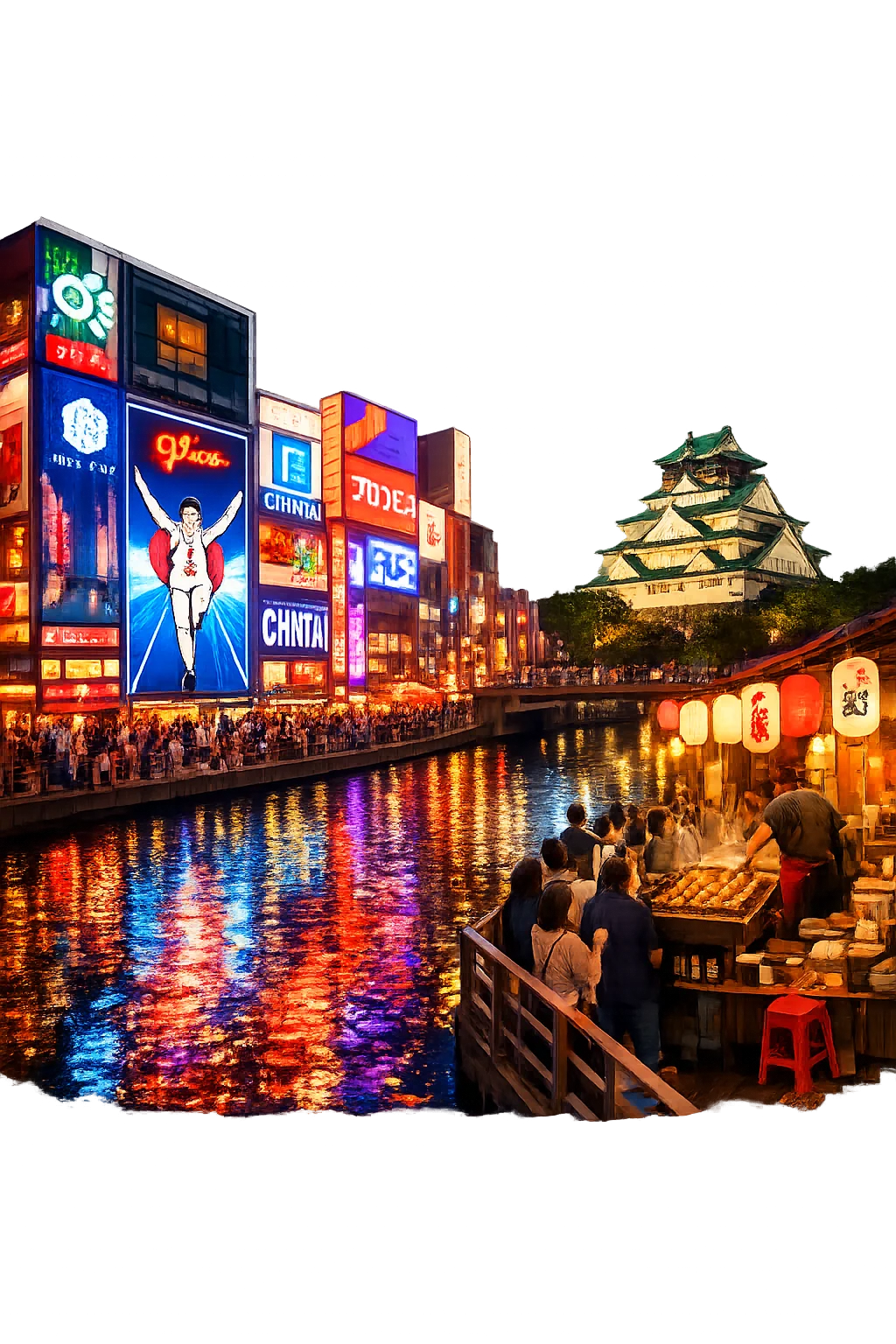
Pronouncing Ōsaka: a guide for the curious
Saying Ōsaka aloud is harder than reading it on a screen, and more rewarding. The restored spelling is a compressed pronunciation guide: every accent and macron is an instruction. This post unpacks those instructions — the reconstructed sound, the phoneme-by-phoneme record, the kindred forms in neighboring languages — and then zooms out to the full record around the name: its Japanese characters writing, its mythology, its cult, and its modern life as a Unicode domain. Whether you arrive as a linguist, a reader of myth, or a domainer, you will leave able to say the name the way the evidence suggests it was said — and able to type it the way it was written.
At a Glance
- Restored name: Ōsaka
- ASCII form: osaka
- Meaning: "Large hill or slope"
- Domain of influence: Merchant City, Kansai
- Pantheon: Japanese
- Classification: Tier 1
- Original script: 大阪 (Japanese characters)
- Live domain: ōsaka.com
Overview
Ōsaka (osaka) — Large hill or slope — belongs to the Japanese tradition, where it is catalogued under the domain "Merchant City, Kansai". The name means "Large hill or slope".
Ōsaka began as the ancient port of Naniwa, briefly an imperial capital, and grew into the merchant city par excellence of early modern Japan. Where Kyōto was aristocratic and Edo samurai, Ōsaka was the place where money, rice, and popular culture flowed together.
PuniCodex restores the name as Ōsaka and serves its temple at ōsaka.com. The original carries both stress and vowel length, and exactly one historically valid Unicode restoration exists, which places the name in Tier 1. The plain ASCII form osaka survives as a modern convenience imposed by the early domain-name system; the restoration, not the fallback, is the form the project defends as philologically complete.
The Name
The name is attested in Japanese characters as 大阪. Etymologically it means "Large hill or slope".
The reconstructed proto-form is 大阪 (proto-sino-tibetan, "large + slope, hill"). From Japanese 大阪 "large hill"; ancient commercial capital.
The ASCII form osaka survives only because the early domain-name system could not carry diacritics; it is a technological compromise, not an ancient spelling. The Unicode restoration Ōsaka recovers the vowel length of the original directly in the address bar. The original carries both stress and vowel length, and exactly one historically valid Unicode restoration exists, which places the name in Tier 1.
The letter-by-letter transformation runs:
- o → Ō — Macron: long vowel
- s → s — Same
- a → a — Same
- k → k — Same
- a → a — Same
The project holds the domain ōsaka.com (xn--saka-k3a.com) as the canonical home of this name.
Etymology & Roots
The recorded derivation reads: From Japanese 大阪 "large hill"; ancient commercial capital.
The reconstructed proto-form is 大阪 (proto-sino-tibetan), glossed as "large + slope, hill".
The reconstruction is classed as attested.
The Original Script
The name is preserved in Japanese characters as 大阪 — Kanji (Sino-Japanese logographs), attested Heian – present, in Japan. The script is written left-to-right; traditional top-to-bottom.
The scholarly transliteration is Ōsaka (Hepburn romanisation with macron), giving the normalized reading /oːsaka/.
The rendering proceeds step by step:
- The name is written with the kanji 大阪.
- Each kanji carries both a semantic meaning and Sino-Japanese (on'yomi) and native Japanese (kun'yomi) readings.
- Hepburn romanisation with macron marks long vowels, which the ASCII form loses.
- The Unicode restoration Ōsaka is used for DNS because the kanji form is not supported in the .com IDN table.
Pronunciation
The reconstructed pronunciation of the name is /oːsaka/ — Hepburn Japanese Reconstruction.
Phoneme by phoneme:
- Ō- — Long open back vowel [oː], marked by the macron; the two-mora length makes the name Tier 1.
- -sa- — Voiceless alveolar fricative [s] plus short open front vowel [a], the middle syllable of the old name Naniwa.
- -ka — Voiceless velar stop [k] plus short open front vowel [a], a common place-name ending meaning 'place, slope'.
For the modern speaker, the closest approximation is: 'OH-sah-kah' — the first vowel is long; the following syllables are short and level in pitch.
Kindred and historical forms of the name:
- Old Japanese — Naniwa (難波), the ancient port and first imperial capital on the site of modern Ōsaka
- Japanese — 大阪 (ō-saka), 'large hill' or 'large slope', the name that replaced Naniwa in the medieval period
- Japanese — 天下の台所 (tenka no daidokoro), 'the nation's kitchen', the Edo-period nickname for the merchant city
Ōsaka is Tier 1 because the Hepburn restoration preserves the long initial vowel ō. As with other Japanese entries, the macron records length rather than pitch accent, which is not registrable at the DNS root.
Mythology
Ōsaka began as the ancient port of Naniwa, gateway to the Asian continent and briefly an imperial capital. It later became the merchant city par excellence — the 'kitchen of the nation' — and the fortress from which Toyotomi Hideyoshi sought to rule a unified Japan.
Naniwa, the First Imperial Port (Origins)
Long before it was called Ōsaka, the area was known as Naniwa. The Nihon Shoki records that Emperor Nintoku's great tomb rose on the Osaka plain, and in 645 Emperor Kōtoku moved the capital to Naniwa Nagara Toyosaki-no-miya, making it Japan's first official capital. The city of Ōsaka notes that Naniwazu port served as the arrival point for envoys, Buddhism, ceramics, and metallurgy from Korea and China, technologies that then spread across the archipelago.
Shitennō-ji and Prince Shōtoku (Religion)
In 593 Prince Shōtoku founded Shitennō-ji, one of Japan's oldest Buddhist temples, in what is now Ōsaka. The temple was both a religious centre and a diplomatic statement: it marked the region's role as a point of contact with the continental mainland. Shitennō-ji's pagoda and gate still stand, a reminder that Ōsaka's identity was shaped by international exchange as much as by trade.
Hideyoshi's Castle Town (Unification)
In 1583 Toyotomi Hideyoshi, who had completed the military unification of Japan, began construction of Ōsaka Castle on the site of the former Ishiyama Hongan-ji fortress. He intended the castle to be the centre of a new political order. After his death the Toyotomi were destroyed by Tokugawa Ieyasu in the sieges of 1614–1615, but the castle kept its symbolic place as the heart of the Kansai merchant capital.
The Nation's Kitchen (Commerce)
During the Edo period (1603–1868) Ōsaka became Japan's principal distribution centre for rice, sake, and luxury goods. The city's network of canals earned it the nickname tenka no daidokoro, 'the nation's kitchen'. Merchant culture flourished here: bunraku puppet theatre, kabuki, and the money markets of Dōjima made Ōsaka an urban culture distinct from the aristocracy of Kyōto and the samurai of Edo.
Symbols & Iconography
The iconography associated with Ōsaka concentrates in a small set of recurring attributes, each a compressed statement about the name:
- Castle tower — The five-storey donjon of Ōsaka Castle is a 1931 ferroconcrete reconstruction on the Tokugawa-period stone base; beneath it, excavation has uncovered the granite walls of Hideyoshi's original fortress, buried when the Tokugawa rebuilt the castle after the sieges of 1614–1615.
- Bunraku puppet — The articulated puppet of ningyō jōruri, the narrative puppet theatre perfected in Ōsaka around the playwright Chikamatsu Monzaemon, whose domestic tragedies turned merchant lives into high drama; the tradition continues at the National Bunraku Theatre.
- Merchant's scale — The balance of the Dōjima rice exchange, licensed by the shogunate in 1730, where rice bills were traded as forward contracts and Ōsaka brokers ran what is often described as the world's first organised futures market.
Archaeology & Evidence
The Ōsaka plain holds three capitals in its soil. At the Naniwa Palace site, a National Historic Site, foundation stones and pillar bases mark the two palaces of the chronicles — Emperor Kōtoku's reform capital of 645 and the eighth-century Naniwa-kyō — with excavated remains displayed in the basement of the Osaka Museum of History, which stands on the site's edge. To the south, the Mozu-Furuichi Kofun Group, inscribed as a UNESCO World Heritage property in 2019, preserves forty-nine keyhole, round, and square tombs of the fourth to sixth centuries, among them the Daisenryō Kofun attributed to Emperor Nintoku: some 486 metres long, it is the largest tomb mound in Japan and among the largest in the world. Beneath Ōsaka Castle, excavation has exposed the granite walls of Toyotomi Hideyoshi's 1583 fortress, buried under the Tokugawa rebuilding, and at Shitennō-ji the Asuka-period temple layout of 593 still fixes the ground plan.
Realm & Domain
Ōsaka began as the ancient port of Naniwa, briefly an imperial capital, and grew into the merchant city par excellence of early modern Japan. Where Kyōto was aristocratic and Edo samurai, Ōsaka was the place where money, rice, and popular culture flowed together.
Ōsaka Castle
Hideyoshi's fortress rose on the ruins of the Ishiyama Hongan-ji and became the symbol of Toyotomi ambition.
Port of Naniwa
The ancient harbour received envoys, Buddhism, and trade from Korea and China before the city was called Ōsaka.
Bunraku and Kabuki
Merchant patronage made Ōsaka a cradle of popular theatre, especially the puppet art of bunraku.
Merchant Culture
The Dōjima rice exchange and canal-side warehouses turned Ōsaka into Japan's financial and distribution hub.
Across Cultures
Ōsaka's identity was forged by mixing sacred and commercial cultures.
Prince Shōtoku's Shitennō-ji, founded in 593, made the plain one of Japan's earliest Buddhist centres, while the port of Naniwa received continental technologies, Chinese learning, and Korean crafts. In the Edo period the city became a meeting ground for samurai, merchants, and entertainers; its theatre, food, and festivals borrowed from Kyōto, Edo, and the immigrant communities of districts such as Tsuruhashi. Modern Ōsaka remains Japan's most openly mercantile major city, proud of its dialect, its food, and its history of making deals across boundaries.
Within the Japanese tradition, closely related names in the corpus include [[fujin|Fūjin]], [[jizo|Jizō]], [[kobe|Kōbe]], [[kyoto|Kyōto]], and [[nikko|Nikkō]].
Cultural Legacy
Ōsaka is the city that taught Japan to laugh, eat, and trade.
Its merchant culture produced bunraku and kabuki patronage, the manzai comedy that still dominates Japanese entertainment, and a cuisine summed up in the local watchword kuidaore — 'eat yourself bankrupt' — and celebrated in takoyaki, okonomiyaki, and kushi-katsu. The Dōjima rice exchange pioneered futures trading, and the city's canals and warehouses shaped the physical landscape of Kansai. In 1970 Ōsaka hosted Asia's first world's fair, Expo '70, whose symbol, the Tower of the Sun, still stands on the former fairgrounds; in 2025 the city hosted the exposition a second time, on the artificial island of Yumeshima. Ōsaka represents the Japan of merchants and migrants as much as the Japan of emperors and samurai.
The Scholarly Record
The account of Ōsaka given in this edition rests on the witnesses and reference works listed below. The chronicles secure the Naniwa centuries; the poetry anthologies, the temple and shrine registers, and the economic historiography carry the city from imperial port to merchant capital.
- Nihon Shoki (Chronicles of Japan), 720; trans. W. G. Aston. Full text
- Kojiki (Records of Ancient Matters), 712; trans. D. L. Philippi. Full text
- Man'yōshū (Collection of Ten Thousand Leaves), ca. 759, poems of Naniwa.
- Engishiki (Procedures of the Engi Era), 927, Jinmyōchō register of Settsu province shrines (Sumiyoshi as myojin taisha).
- UNESCO World Heritage Centre, Mozu-Furuichi Kofun Group: Mounded Tombs of Ancient Japan, inscribed 2019. Listing
- Hauser, William B., Economic Institutional Change in Tokugawa Japan: Ōsaka and the Kinai Cotton Trade (Cambridge University Press, 1974).
- McMullin, Neil, Buddhism and the State in Sixteenth-Century Japan (Princeton University Press, 1984).
- Keene, Donald, Bunraku: The Art of the Japanese Puppet Theatre (Kodansha International, 1965).
A Meditation
Ōsaka's name is a slope — ō-saka, the 'large hill' on which the city climbed from the sea. For centuries the name on the maps was Naniwa, the harbour where the chronicles seat emperors and receive embassies, and where the Nihon Shoki has Emperor Nintoku, seeing no cooking-smoke rise from the roofs of his capital, remit his people's taxes for three years rather than rule over their poverty.
To contemplate Ōsaka is to inherit that gaze from the hill. The city below has always measured itself in the smoke of kitchens — the hearths of Naniwa, the rice warehouses of the 'nation's kitchen', the takoyaki grills of the modern arcades. A name that began as a slope became a vantage point: whoever stands on it must keep watching whether the people below are fed.
The Unicode Restoration
Ōsaka is classified as Tier 1: the original carries both stress and length, and only one valid Unicode restoration exists. The ASCII fallback osaka still resolves everywhere, but it is the restored form that carries the name's full information. Across the 5 characters of the name, the restoration adjusts 1: 1 mark of length (Ō). That is the whole thesis of this temple: the marks are the message.
Character by Character
The journey from osaka to Ōsaka, one character at a time:
- o → Ō — Macron: long vowel
- s → s — Same
- a → a — Same
- k → k — Same
- a → a — Same
The Domain Name
The restored name is live as a working domain: ōsaka.com, which the DNS carries in punycode form as xn--saka-k3a.com — an ASCII-compatible encoding that lets a non-ASCII name travel the global network without breaking older infrastructure. The visitor sees Ōsaka; the machines see the encoding. That duality is the engineering compromise on which the entire restoration rests, and it is why a name written the way its own tradition wrote it in Japanese characters can now be typed into any browser on earth.
The Japanese Pantheon
Ōsaka is one of 43 entries the PuniCodex lexicon catalogues under the Japanese pantheon. The Pantheon page gathers the tradition's major figures in one place, and the Lexicon lets you filter all 895 restorations by tradition, tier, or script — the fastest way to see where this name sits among its kin.
Frequently Asked Questions
What does Ōsaka mean? The traditional gloss is "Large hill or slope."
Which tradition does Ōsaka belong to? Ōsaka is catalogued in the Japanese pantheon of the PuniCodex lexicon.
Why is Ōsaka classified as Tier 1? Because the original carries both stress and length, and only one valid Unicode restoration exists — and the marks in the restored spelling preserve exactly that evidence.
Is Ōsaka a working domain? Yes — ōsaka.com resolves today and routes to this temple.
What is the punycode for ōsaka.com? The DNS encoding is xn--saka-k3a.com; browsers perform the translation automatically, so visitors only ever see the restored name.
Typing Ōsaka
You do not need a special keyboard to use this restoration. The PuniCodex Type Tool converts the ASCII form osaka into Ōsaka as you type, and the browser extension offers the same conversion inside any text field. Copy the restored form, paste it into the address bar, and the DNS does the rest.
Why This Restoration Matters
Pronunciation turns out to be the heart of the matter. The marks in Ōsaka are instructions for the voice, and a web that strips them is a web that mispronounces the past at scale. The restoration hands the instructions back: say it as the evidence suggests, type it as the tradition wrote it, and let the punycode machinery do the quiet translation in between. That is all the PuniCodex project asks of the infrastructure — and everything it asks of you, the reader, is to use the whole name.
Explore Further
This post is one doorway into the temple. The home page carries the full character breakdown and the ambient canvas; the lore page tells the myths in long form; the Scholarly Edition preserves the sources, pronunciation data, and revision history; and the patron wall supports the restoration directly. For the wider map, browse the Lexicon, explore the Pantheon, or return to the PuniCodex blog.
Related Names
Sources
The full scholarly apparatus — every citation, revision, and review — lives in the Scholarly Edition. Key references for this post:
- Nihon Shoki (Chronicles of Japan), 720; trans. W. G. Aston.
- UNESCO World Heritage Centre, Mozu-Furuichi Kofun Group: Mounded Tombs of Ancient Japan, inscribed 2019.
- Kojiki (Records of Ancient Matters), 712; trans. D. L. Philippi.
- Kojiki (Records of Ancient Matters), Translated by Basil Hall Chamberlain, 712.
- Ōsaka City official historical overview.
- Nihon Shoki (Chronicles of Japan).
- Osaka Museum of History.
- Osaka Museum of History (Ōsaka Castle and Naniwa Palace exhibits).
- Lexicon authorities for this entry: Hepburn, Kojiki.