
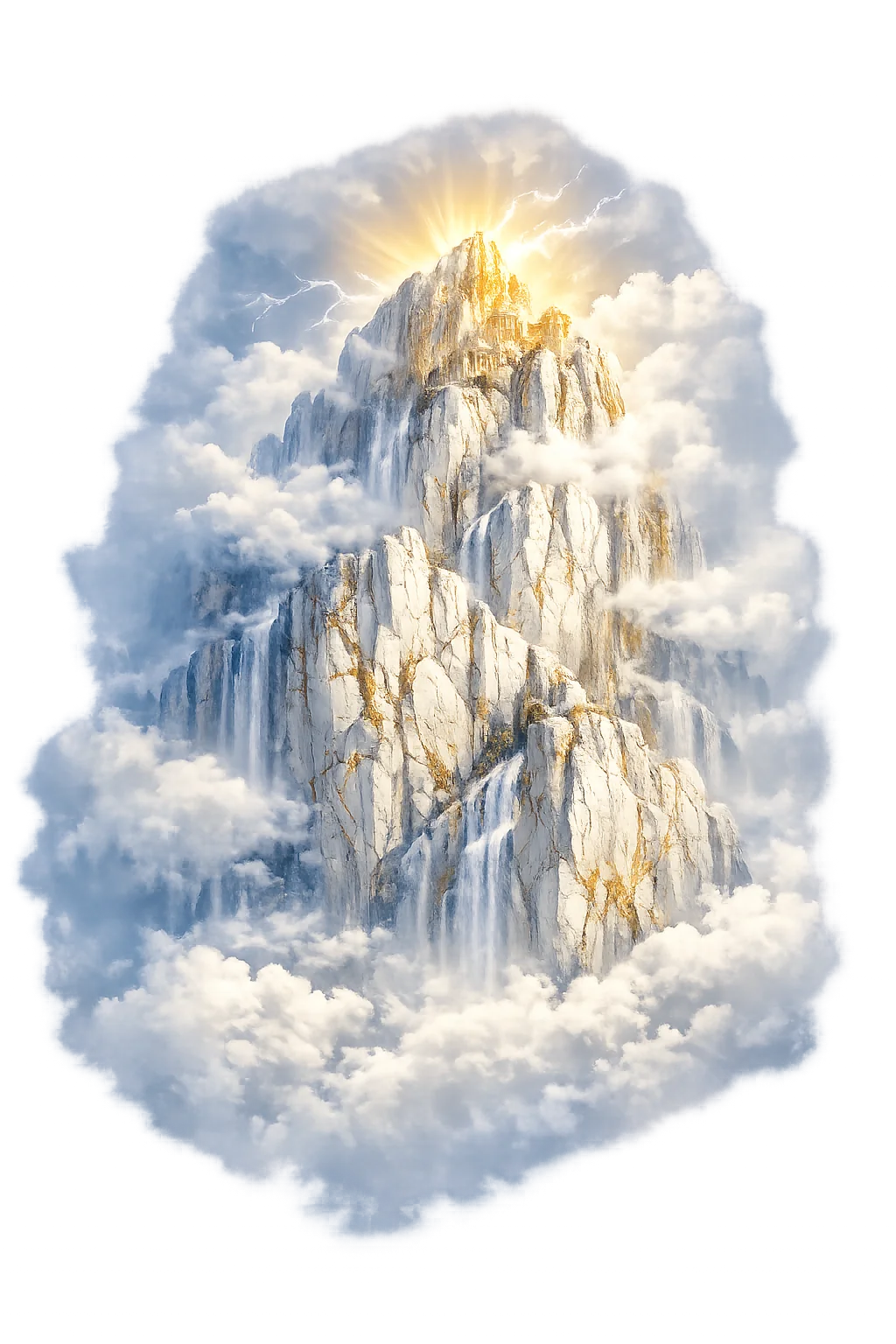
From Greek to Unicode: the journey of Ólympos
Long before it was a domain, this name traveled through scripts. Ólympos begins in Greek, passes through scholarly transliteration, and ends — for now — inside the punycode machinery of the global DNS. Each stage of that journey preserves some information and loses some, and the craft of restoration is knowing exactly which marks matter. This post follows the name stage by stage: the original script, the reconstructed pronunciation, the mythological record, the material evidence, and finally the Unicode form that carries all of it into the address bar. Think of it as a biography of a name, told through its spelling.
At a Glance
- Restored name: Ólympos
- ASCII form: olympos
- Meaning: "Bright, shining mountain"
- Domain of influence: Mountain of the Gods
- Pantheon: Greek Location
- Classification: Tier 2
- Original script: Ὄλυμπος (Greek)
- Live domain: ólympos.com
Overview
Ólympos (olympos) — a Pre-Greek name of unexplained etymology — is the massif on the border of Thessaly and Macedonia, the highest mountain in Greece (Mytikas, 2,918 m), and in Greek thought the seat of the gods: the one fixed address in the divine world.
Homer makes it the court of Zeus, where the gods feast, quarrel, and hold assembly above the clouds; the Odyssey places its summit beyond wind, rain, and snow altogether. Ancient geography knew many mountains of the name — in Mysia, Lycia, Cyprus, Elis, and elsewhere — but the Thessalian massif became canonical, and to be 'Olympian' became the mark of belonging to Zeus's ruling order.
PuniCodex restores the name as Ólympos and serves its temple at ólympos.com. The original preserves one prosodic feature — the acute accent on the first omicron — rather than both stress and vowel length, which places the name in Tier 2. The plain ASCII form olympos survives as a modern convenience imposed by the early domain-name system; the restoration, not the fallback, is the form the project defends as philologically complete.
The Name
The name is attested in Greek as Ὄλυμπος. Etymologically it is glossed as "Bright, shining mountain" — a traditional rendering, not a secure derivation.
The lexicon's proposed proto-form ol-um- (proto-indo-european, "sky, luminous") is speculative, and the connection sometimes drawn to λύμη fails, since λύμη means 'outrage', not 'light'. Modern lexica treat Ὄλυμπος as a Pre-Greek place-name: Beekes assigns it to the Pre-Greek substrate, comparing the characteristic suffix -υμπ-.
The ASCII form olympos survives only because the early domain-name system could not carry diacritics; it is a technological compromise, not an ancient spelling. The Unicode restoration Ólympos recovers the stress accent of the original directly in the address bar. The original preserves one prosodic feature — stress or vowel length — rather than both, which places the name in Tier 2.
The letter-by-letter transformation runs:
- o → Ó — Acute on omicron
- l → l — Lambda
- y → y — Upsilon
- m → m — Mu
- p → p — Pi
- o → o — Short omicron
- s → s — Sigma
The project holds the domain ólympos.com (xn--lympos-9wa.com) as the canonical home of this name.
Etymology & Roots
The recorded derivation reads: Possibly from λύμη "light" or pre-Greek. The mountain of the gods.
The reconstructed proto-form is *ol-um- (proto-indo-european), glossed as "sky, luminous".
The reconstruction is classed as speculative.
The Original Script
The name is preserved in Greek as Ὄλυμπος — Greek alphabet (Classical / Attic), attested Ancient Greek, c. 8th century BCE – present, in Greece and the Greek-speaking Mediterranean. The script is written left-to-right.
The scholarly transliteration is Ólympos (Greek alphabet with polytonic accents), giving the normalized reading /ˈo.lym.pos/.
The rendering proceeds step by step:
- The Greek form Ὄλυμπος is written in the Classical Greek alphabet.
- Letters with acute, grave, or circumflex accents preserve the pitch accent of Ancient Greek.
- Macrons and omegas (η, ω) mark long vowels, a feature lost in the plain ASCII form.
- The Unicode restoration Ólympos encodes the scholarly spelling as a registrable domain name.
Pronunciation
The reconstructed pronunciation of the name is /ˈo.lyn.pos/ — Ancient Greek Reconstruction.
Phoneme by phoneme:
- O- — Short close-mid back [o], the Greek omicron; the acute marks stress on this first syllable
- -ly- — Voiced alveolar lateral [l] plus front rounded [y], the Greek upsilon sound
- -mpos — Bilabial nasal [m] plus voiceless stop [p] and voiceless fricative [s]; the final cluster is -mps
For the modern speaker, the closest approximation is: 'OH-lu-poss' — the first syllable is short and stressed, the 'y' is rounded like French u, and the name ends in a crisp 'poss'.
Kindred and historical forms of the name:
- Greek — Ὄλυμπος (Ólympos), the Thessalian mountain and the heavenly abode of the gods
- Latin — Olympus, the Roman form borrowed into Western languages
- Modern Greek — Όλυμπος (Ólympos), preserving the ancient stress and cluster
Ólympos is accent-preserving Tier 2: the acute on the first omicron marks stress, but the word contains no long vowel. The name may be pre-Greek; its etymology from *ol-um- 'luminous' is speculative, so the pronunciation follows the attested Greek form rather than a reconstructed prototype.
Mythology
Ólympos is the mountain that became a palace, the palace that became a government, and the government that became a symbol of ultimate authority. Homer places the gods on its snowy summit, where they feast on ambrosia and listen to the Muses sing. To be 'Olympian' is to belong to the ruling order of Zeus; to fall from Olympus is to be cast out of divine society altogether.
Ancient Greeks recognized several peaks named Ólympos, but the northern Thessalian mountain — the tallest in Greece — gradually became canonical. Poets nonetheless treated Olympus as a celestial rather than strictly geographic place: Pindar calls it the bright seat of the gods, and the Homeric Hymns locate it above storm and cloud. This ambiguity allowed later cities to claim Olympic connections while philosophers debated whether the gods literally dwelt on a specific summit. The gods' Olympus was identified with real mountains in Thessaly, Macedonia, Mysia, Cyprus, and elsewhere, each peak a local claim to divine presence. Roman poets and Renaissance artists later fixed Olympus in the Western imagination as the archetypal home of the gods.
The Palace of the Gods (Cosmology)
Homer's Olympus is not merely a high mountain in Thessaly but the fixed abode of the Olympian gods, hidden from mortal sight by unbroken clouds. There Zeus has his bronze-floored hall, and Hephaestus has built each god a dwelling of his own. The gods gather in council on its summit, debate the fates of cities, and receive the prayers of mortals through rising sacrificial smoke.
The mountain is therefore both a real place and a cosmic location. Pilgrims might look toward the actual Mount Olympus from the plains of Thessaly, but poets located the divine court just above its peak, in a realm where snow never melts and the light is always clear. This double existence made Olympus the perfect symbol of transcendent power rooted in recognizable geography.
The Fall of the Titans (Titanomachy)
After Zeus and his siblings defeated the Titans, Olympus became the seat of the new regime. The defeated Titans were cast into Tartarus, while the victorious gods divided the cosmos by lot: Zeus received the sky, Poseidon the sea, and Hades the misty darkness, while earth and high Olympus remained common to all three. The mountain thus marks the boundary between the ordered present and the defeated chaos of the older gods.
Hesiod describes Olympus as the place from which the Olympians marched to war and to which they returned in triumph. In the Iliad its cloud-gates are kept by the Horai, who open and close the way for the gods' chariots. To dwell on Olympus is to belong to the victorious order.
Hephaestus Thrown from Heaven (Olympian Conflicts)
Olympus is also the scene of divine discord. In the Iliad, Zeus recalls hanging Hera from the sky with anvils at her feet; Ares, wounded by Diomedes, howls and flees back to Olympus; and Hephaestus, cast down from heaven by Zeus for defending Hera, falls for a day and lands on Lemnos. These stories show that Olympus is a court as well as a sanctuary, subject to the same passions and rivalries that trouble mortal houses.
Yet the gods always return to Olympus. Even when they intervene in human wars or descend to the underworld, the mountain remains their home and the seat of their immortality. It is the fixed point around which the changing world turns.
Symbols & Iconography
Ólympos has no temple iconography of its own; its symbolic furniture is literary, drawn from the Homeric picture of the gods' court. The Iliad gives Zeus a bronze-floored house and has Hephaestus build each god a separate dwelling, while the cloud-gates of the summit are kept by the Horai, who open and close them for the gods' chariots. Ambrosia and nectar, served at the divine feast, are the summit's signature fare, and the eagle of Zeus patrols the upper air below which mortals may not climb.
- Cloud-throne of Zeus — The peak where the king of gods sits enthroned above the weather
- Golden house of the gods — The luminous dwellings built by Hephaestus on the mountain
- Aegis and thunderbolt — The weapons of Zeus, stored and wielded from the Olympian summit
- Ambrosia and nectar — The divine foods that confirm Olympian immortality
- Eagle of Zeus — The bird that bears his thunderbolts and serves as his messenger
Archaeology & Evidence
The summit of Ólympos has no sanctuary and no excavation: the gods' mountain was never a cult site, and its material record is that of a natural monument — a national park since 1938, first climbed only in 1913. Cult clustered instead at the mountain's foot. The chief site is Dion in Pieria, the sanctuary of Olympian Zeus where Alexander held games and sacrificed before crossing to Asia; excavated since 1928, it is now an archaeological park with theaters, baths, and sanctuaries. Also on the eastern flank lay Leivithra, where local tradition placed the death and tomb of Orpheus, torn apart by the Maenads and mourned by the Muses of Pieria.
Realm & Domain
Ólympos functions in Greek tradition less as a place of cult than as the seat of divine government: the gods hold assembly there, feast on ambrosia, watch mortal wars from its ridges, and retire at nightfall to the houses Hephaestus built for them. Hesiod makes possession of the heights the stake of the Titanomachy — Zeus fights from Olympus, the Titans from Othrys — and after the victory the three sons of Kronos divide the cosmos by lot, while earth and high Olympus remain common to all.
Palace of the Gods
Zeus's bronze-floored hall, Hera's golden throne, and Hephaestus's forges crown the mountain above the clouds.
Omphalos
The navel stone at Delphi, not Olympus itself, marked the earth's center, but Olympus was its celestial counterpart.
Throne of the Olympians
After the Titanomachy, Olympus became the seat of the victorious gods who divided the cosmos by lot.
Pindar's Bright Seat
Poets placed Olympus above storm and cloud, a luminous court accessible only to the deathless gods.
Across Cultures
Rome naturalized the name. Ovid stages Jupiter's council on the summit and calls the sky itself 'the Palatine of high heaven,' fixing Olympus as the Latin court of the gods; through Vergil and Ovid the word passed into every European vernacular, until 'Olympian' became the ordinary adjective for remote, unruffled superiority. The Thessalian massif must be distinguished from Olympia in Elis, the sanctuary of Olympian Zeus where the games were held from 776 BCE: the modern Olympic movement descends from the Peloponnesian festival, not from the mountain, though the shared epithet keeps the association alive. In the twentieth century the name left the planet: Olympus Mons, the tallest volcano on Mars, was named for the classical mount of the gods, while the massif itself became Greece's first national park in 1938.
Kindred places in the corpus include [[olympia|Olympía]], [[delphoi|Delphoí]], [[athenai|Athēnai]], [[delos|Dēlos]], [[elysion|Ēlysion]], and [[atlantis|Atlantís]].
Cultural Legacy
The mountain's deepest legacy is grammatical: the adjective 'Olympian' — remote, superior, above the fray — preserves exactly the Homeric picture of gods who feast while Troy burns below. The modern Olympic Games, though named for Olympia in Elis, inherit the aura of the divine mountain, and the name has been borrowed by airlines, camera makers, and mountaineering expeditions; Olympus Mons on Mars extends it to another world. The massif itself was made Greece's first national park in 1938 and a UNESCO biosphere reserve in 1981, so the gods' mountain is now a protected natural monument rather than a sanctuary. Restoring Ólympos in Unicode keeps the acute on the first syllable, distinguishing the Greek name from the Latinized 'Olympus' that the modern uses all assume.
The Scholarly Record
The account of Ólympos given in this edition rests on the witnesses and reference works listed below. Lexica and etymological dictionaries secure the form and meaning of the name; the literary and religious texts supply the narrative evidence.
- Beekes, R. S. P., Etymological Dictionary of Greek. Leiden: Brill, 2010, s.v. Ὄλυμπος.
- Homer, Iliad (the Olympian assemblies, esp. Books 1, 15; the gates of the Horai, 5.749-751).
- Homer, Odyssey 6.42-46 (the weatherless Olympus).
- Hesiod, Theogony (the Titanomachy: Olympus against Othrys). Full text
- Pape-Benseler, Wörterbuch der griechischen Eigennamen, 3rd ed., 1863, s.v. Ὄλυμπος. Full text
- Pindar, Olympian Odes.
- Pandermalis, D., Dion: The Archaeological Site and the Museum (the cult at the mountain's foot).
A Meditation
Ólympos is where the Greeks put everything they could not control: weather, justice, death. The gods on the summit feast, quarrel, and nap while cities burn below, and that detachment is the point — the mountain names the distance between what mortals suffer and what the world intends. Hesiod's cosmos is governed from its heights; Homer's heroes die within sight of them.
Homer insists the summit knows no wind, rain, or snow: an unearthly calm balanced on the highest point in Greece. To restore Ólympos in Unicode is to keep that paradox legible — a real massif with a weatherless heaven standing on its peak.
The Unicode Restoration
Ólympos is classified as Tier 2: the original preserves at least one philological feature that ASCII cannot encode. The ASCII fallback olympos still resolves everywhere, but it is the restored form that carries the name's full information. Across the 7 characters of the name, the restoration adjusts 1: 1 mark of stress (Ó). That is the whole thesis of this temple: the marks are the message.
Character by Character
The journey from olympos to Ólympos, one character at a time:
- o → Ó — Acute on omicron
- l → l — Lambda
- y → y — Upsilon
- m → m — Mu
- p → p — Pi
- o → o — Short omicron
- s → s — Sigma
The Domain Name
The restored name is live as a working domain: ólympos.com, which the DNS carries in punycode form as xn--lympos-9wa.com — an ASCII-compatible encoding that lets a non-ASCII name travel the global network without breaking older infrastructure. The visitor sees Ólympos; the machines see the encoding. That duality is the engineering compromise on which the entire restoration rests, and it is why a name written the way its own tradition wrote it in Greek can now be typed into any browser on earth.
Why This Restoration Matters
Every stage of the journey from Greek to Unicode was an act of care: the scribe who first wrote the name, the lexicographer who glossed it, the engineer who taught the DNS to carry it. The PuniCodex restoration is the latest stage, not the last word — the Scholarly Edition is revised as the evidence improves. What does not change is the principle: a name deserves to be written the way its own tradition wrote it. Ólympos in the address bar is that principle, made routable.
Explore Further
This post is one doorway into the temple. The home page carries the full character breakdown and the ambient canvas; the lore page tells the myths in long form; the Scholarly Edition preserves the sources, pronunciation data, and revision history; and the patron wall supports the restoration directly. For the wider map, browse the Lexicon, explore the Pantheon, or return to the PuniCodex blog.
Related Names
Sources
The full scholarly apparatus — every citation, revision, and review — lives in the Scholarly Edition. Key references for this post:
- Pape-Benseler, Wörterbuch der griechischen Eigennamen, 3rd ed., 1863, s.v. Ὄλυμπος.
- Hesiod, Theogony (the Titanomachy: Olympus against Othrys).
- Beekes, R. S. P., Etymological Dictionary of Greek. Leiden: Brill, 2010, s.v. Ὄλυμπος (a Pre-Greek name).
- Homer, Odyssey 6.42-46 (the weatherless Olympus).
- Beekes, R. S. P., Etymological Dictionary of Greek. Leiden: Brill, 2010, s.v. Ὄλυμπος.
- Beekes, R. S. P. Etymological Dictionary of Greek. Leiden: Brill, 2010.
- Lexicon authorities for this entry: Pape-Benseler, Barrington.