PuniCodex

The Authentic Orthography

Ὠκεανός Ōkeanós

Ocean, Fresh Water · The great river encircling the world
Tier 1 Ōkeanós.com
Ōkeanós — Ocean, Fresh Water
01

The Authentic Name

Unicode restoration and ASCII comparison

Original Script

Ὠκεανός

The name in its original Greek form. Ōkeanós (Ὠκεανός) is attested in the source tradition — “The great river encircling the world”. Its acute accents carry the full phonetic and orthographic weight of the source tradition.

ASCII Constraint

okeanos

Reduced to plain okeanos, the name loses everything that made it specific: acute accents. What remains is an ASCII string that machines can parse but that no longer speaks with its original voice.

Unicode Restoration

Ōkeanós

The Unicode restoration recovers what ASCII flattened. Ōkeanós restores acute accents, returning the name to its original written dignity. The domain encodes to Punycode, but the browser displays the truth.

Punycode Encoding
Ōkeanós.com → xn--keans-3ta93d.com

The non-ASCII characters in Ōkeanós are encoded while the ASCII remains visible. To the DNS, it is Punycode. To humanity, it is Ōkeanós.

02

Original Script & Provenance

How Ōkeanós travels from ancient script to the modern URL

Ὠκεανός
Greek
Ōkeanós
Reading: /ɔː.ke.aˈnós/
Reconstruction: /ɔː.ke.aˈnós/
Greek alphabet (Classical / Attic) · left-to-right · Ancient Greek, c. 8th century BCE – present · Greece and the Greek-speaking Mediterranean
Greek letter Ὠ
Letter
Greek letter with its classical phonetic value; accents mark pitch and length.
κ
Greek letter κ
κ
Letter
Greek letter with its classical phonetic value; accents mark pitch and length.
ε
Greek letter ε
ε
Letter
Greek letter with its classical phonetic value; accents mark pitch and length.
α
Greek letter α
α
Letter
Greek letter with its classical phonetic value; accents mark pitch and length.
ν
Greek letter ν
ν
Letter
Greek letter with its classical phonetic value; accents mark pitch and length.
ό
Greek letter ό
ό
Letter
Greek letter with its classical phonetic value; accents mark pitch and length.
ς
Greek letter ς
ς
Letter
Greek letter with its classical phonetic value; accents mark pitch and length.
Original Script
Ὠκεανός
Indigenous writing
Transliteration
Ōkeanós
Scholarly reading
Unicode Restoration
Ōkeanós
Registrable form
Punycode
xn--keans-3ta23d.com
DNS encoding
ASCII Fallback
okeanos
Flattened spelling

Etymology

Greek Ὠκεανός; the great river encircling the world; probably from a pre-Greek substrate.

Meaning

Ocean, Fresh Water

From original to transliteration

  1. The Greek form Ὠκεανός is written in the Classical Greek alphabet.
  2. Letters with acute, grave, or circumflex accents preserve the pitch accent of Ancient Greek.
  3. Macrons and omegas (η, ω) mark long vowels, a feature lost in the plain ASCII form.
  4. The Unicode restoration Ōkeanós encodes the scholarly spelling as a registrable domain name.
  • Ὠκεανός Original script
  • Ōkeanós Unicode restoration
  • okeanos ASCII fallback
  • Hesiod, Theogony
    c. 700 BCE Greece Hesiod, Theogony 116–125
  • Homeric Hymns
    c. 700–500 BCE Greece Homeric Hymns, selected hymns
  • Homer, Iliad and Odyssey
    c. 750–650 BCE Greece Homer, Iliad and Odyssey, selected passages
Beekes, Etymological Dictionary of GreekTier 1
Chantraine, Dictionnaire étymologique de la langue grecqueTier 2
Hesiod, TheogonyTier 2
Liddell-Scott-Jones (LSJ)Tier 1

DNS / IDN note

The Unicode restoration Ōkeanós preserves Greek stress and length; the ASCII form okeanos loses these features.

  • !The exact phonetic realization of pitch accent in Classical Greek is reconstructed.
  • !Some letters (e.g., ζ) had dialectal pronunciations that remain debated.
  • !Classical Greek accents originally marked pitch, not stress; the later Byzantine stress pronunciation is conventional today.
  • !Some names may be pre-Greek loans, making purely Greek etymologies uncertain.
03

Pronunciation

How Ōkeanós was spoken

/o.ke.a.nós/ Attic Greek Reconstruction
O- Short omicron — the name begins with the round sound of water.
-ke- Kappa plus short epsilon — the compact middle.
-a- Short alpha — the open central vowel.
-nós Nu plus acute on short omicron — the stressed peak that names the encircling river.
04

The Encircling River

The Ocean, Fresh Water, and the Edge of the World

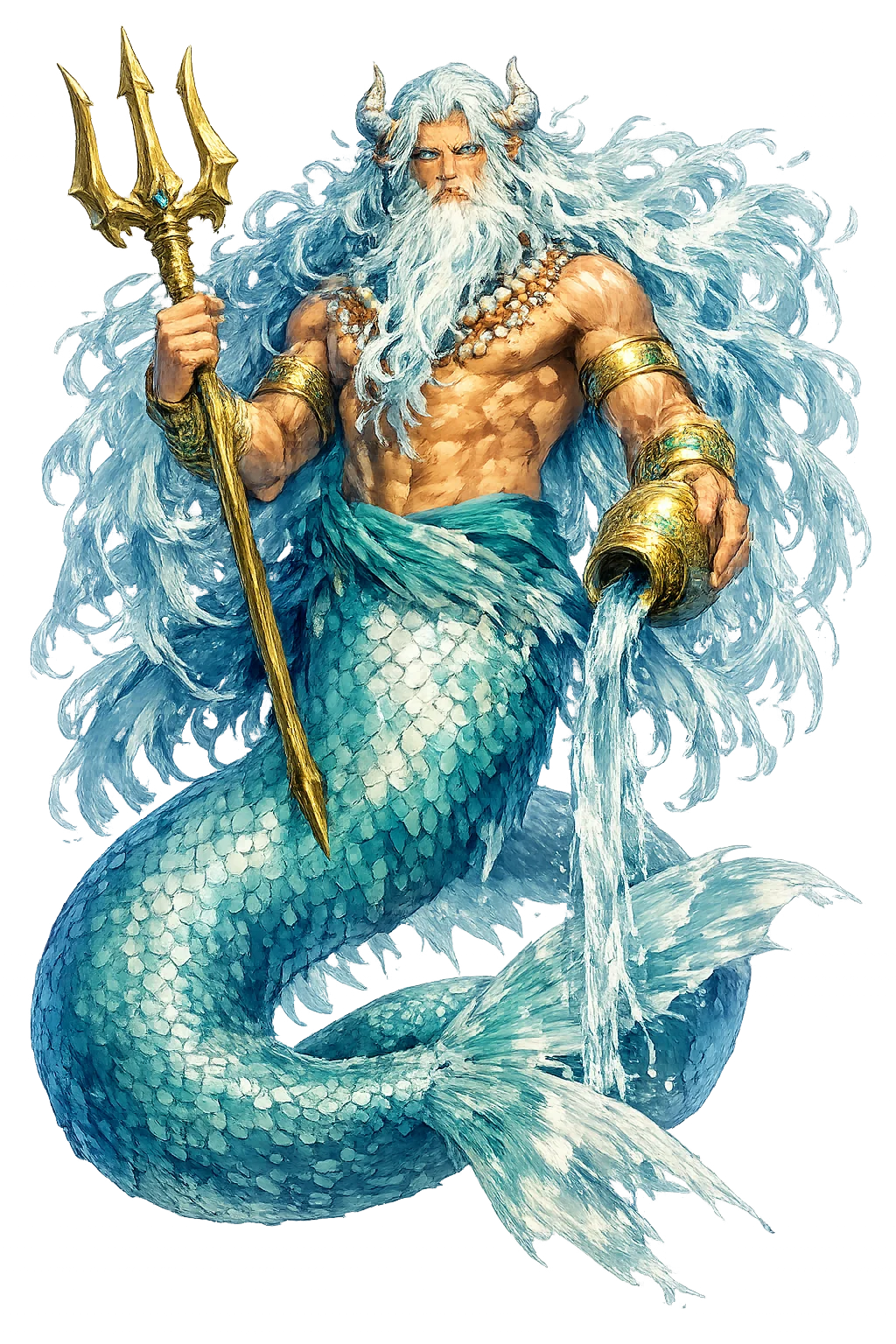
Ōkeanos is the great river that flows around the edge of the world. He is not salt sea but fresh water, the source of all rivers, springs, and clouds. Where Pontos is the sea within the world, Ōkeanos is the water at its rim.

The World-Encircling River

He flows around the flat earth like a ring, beyond the known seas.

Source of Fresh Water

All rivers, springs, and rain descend from him; he is the origin of the world's drinkable water.

Father of the Oceanids

His three thousand daughters and sons are the springs, rivers, and clouds.

The Western Boundary

The sun rises from and sets into Ōkeanos; his waters mark the edge of day.

Sacred Symbols

Encircling river The ring of water around the world
Bull's horn The horn-shaped curve of the river
Fish The life within his waters
Serpent or dragon The winding, boundary-guarding form of the river
Urn The vessel from which rivers pour
Setting sun The sun's daily return to his waters
05

Mythology

Stories of Ōkeanós

Ōkeanos is a Titan who did not fight the Olympians. He remains at the edge of the world, neutral and self-contained, the source from which all waters flow.

The Birth

Eldest of the Titans

In Hesiod's Theogony (133–138), Ōkeanos and Tethys are the eldest children of Ouranos and Gaia. While his brothers and sisters were imprisoned in Tartaros, Ōkeanos remained free, circling the earth with his waters. His neutrality is cosmic: he does not take sides because he contains all sides.

The Iliad

The Source of the Gods

In Iliad 14.200–210, Hēra says she is going to visit Ōkeanos and Tethys, 'the source of all the gods.' The line suggests that even the Olympians trace their origins to the primordial waters. When Thetis needs help for Achilles, she goes to Ōkeanos's house at the edge of the world.

The Oceanids

Three Thousand Daughters

Ōkeanos and Tethys bore three thousand Oceanids, nymphs of springs and streams, and as many river-gods. Every named river — from the Nile to the Styx — was their son. This genealogy makes Ōkeanos the literal father of all fresh water on earth.

The Edge

The Pillars of Herakles

For the Greeks, the Strait of Gibraltar — the Pillars of Heraklēs — marked the boundary between the Mediterranean and the vast Ōkeanos beyond. To sail past the pillars was to leave the known world. The ocean thus defined the limits of Greek geographical knowledge and the beginning of myth.

Go Deeper

Extended Lore

Ōkeanos is the water at the edge of the map. For the Greeks, he was both boundary and source: the river you could not cross, yet from which all rivers came. This double nature — limit and origin — makes him one of the most philosophically rich figures in the pantheon.

Enter Extended Lore
Ōkeanós mascot