
How Ọṣọọsì got its dots back
The dots come first. Under the Ọ, under the ṣ, under the second ọ — three small points below the line, with a grave over the final ì — lies the difference between a name and a noise. The ASCII form ochosi is how the hunter orisha travels through systems that cannot carry those marks; Ọṣọọsì is how he is actually known. What follows is the record behind it: the dot-below vowels, the Atlantic crossing as Ochosi and Oxóssi, the myths of the single arrow and the false accusation, and the logic that returns the spelled-out name to the address bar. The marks were never decoration. They are the name.
At a Glance
- Restored name: Ọṣọọsì
- ASCII form: ochosi
- Meaning: "The hunter"
- Domain of influence: Hunting, Forest, Justice
- Pantheon: Yoruba
- Classification: Tier 1
- Original script: Ọ̀ṣọ́ọ̀sì (Yoruba modern Latin orthography)
- Live domain: ọṣọọsì.com
Overview
Ọṣọọsì (ochosi) — Hunting, Forest, Justice · The hunter — belongs to the Yoruba tradition, catalogued under the domain "Hunting, Forest, Justice". The name means "The hunter": the orisha of the hunt, the forest, and deliberate strategy.
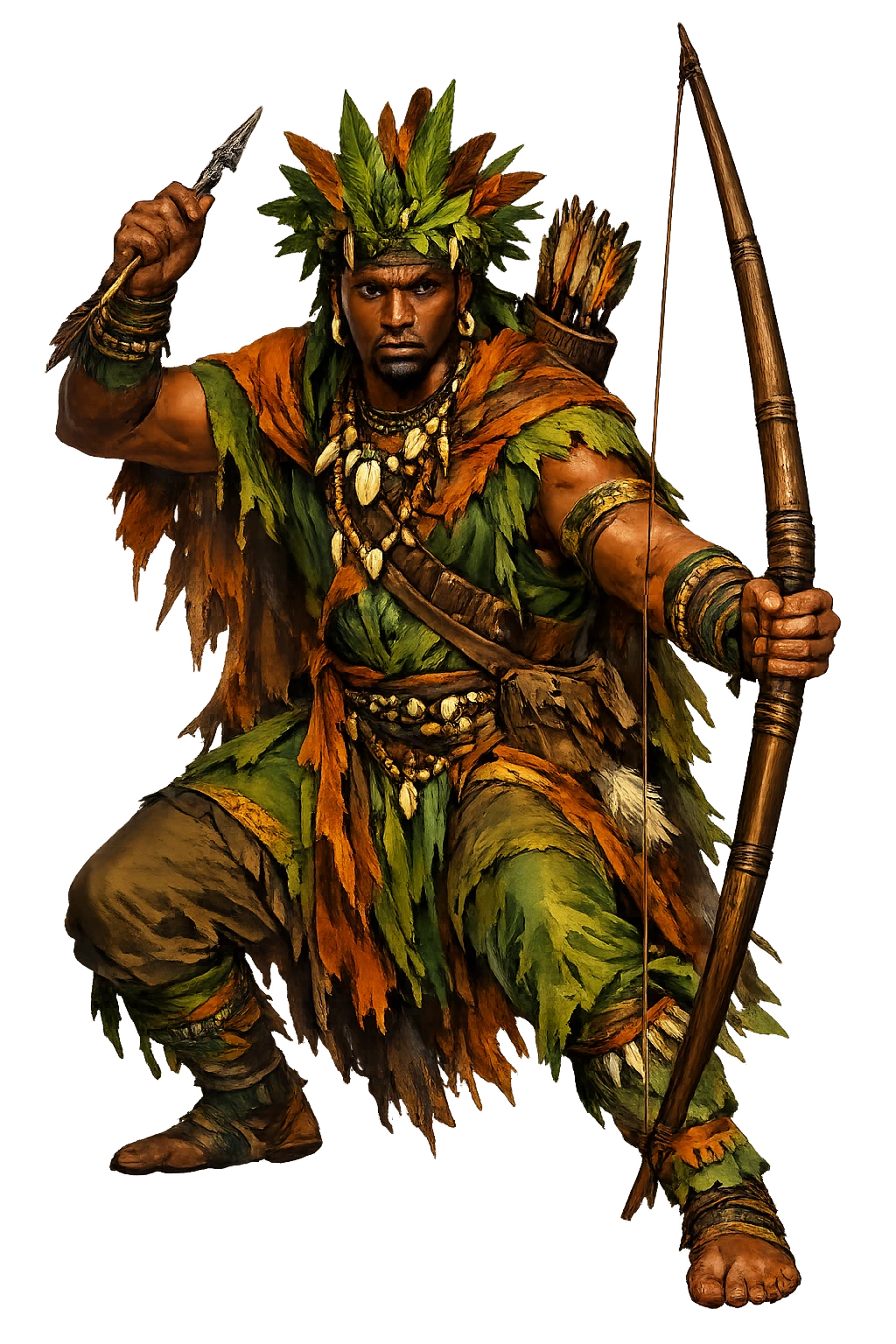
He is the archer of the orisha: the hunter whose single arrow never misses because it is never loosed in haste, the lord of the forest who provides the game, and — after the false accusation he answered with silence — the patron of justice and the voiceless. His temple's tagline: The Single Arrow · Lord of the Forest Hunt.
PuniCodex restores the name as Ọṣọọsì and serves its temple at ọṣọọsì.com. The restoration preserves distinctive features the ASCII form loses — three dotted vowels, the dotted ṣ, and the final low tone — which places the name in Tier 1; the plain ochosi is a convenience of the early domain-name system, not the form the project defends.
The Name
The name traveled, and each shore spelled it differently. In Yorubaland the standard orthography writes Ọ̀ṣọ́ọ̀sì, every tone marked: low-high-low-low, the melody made visible. The diaspora kept its own solutions — Cuban Santería writes Ochosi, with ch standing in for the Yoruba ṣ; Brazilian Candomblé writes Oxóssi, with x for the same sound. All three are the same hunter.
The dot below writes what the mouth does: ọ is the open vowel /ɔ/, the aw of English law, and ṣ is the hush /ʃ/, English sh. Without the dots, ochosi closes three open vowels and hardens the hush. ASCII is a technological compromise, not a spelling anyone chose for the orisha; the Unicode restoration Ọṣọọsì recovers the dotted letters directly in the address bar.
The letter-by-letter transformation runs:
- o → Ọ — O with dot below: open /ɔ/
- c → ṣ — S with dot below: /ʃ/ (Santería ch = Yoruba ṣ)
- h → ọ — O with dot below: open /ɔ/
- o → ọ — O with dot below: open /ɔ/
- s → s — Same
- i → ì — Grave: low tone
The project holds the domain ọṣọọsì.com (xn--s-hga147tdmaba.com) as the canonical home of this name.
The Original Script
Yoruba civilization is historically oral: its theology lived for centuries in memory — in oríkì praise-poems, in Ifá divination verses, in patakí stories — long before it lived on paper. Today the language is written in a Latin-based orthography that marks vowel quality with the dot below and tone with accents, one of Africa's most carefully engineered writing conventions. In that standard the name is Ọ̀ṣọ́ọ̀sì, fully tone-marked. The written standard is the measure of the restoration: Ọṣọọsì keeps its dotted vowels and its ṣ, and carries the final low tone on the ì. No mark is decorative.
Pronunciation
The pronunciation of the name is /ɔ̀.ʃɔ́.ɔ̀.sì/ — Standard Yoruba.
For the modern speaker, the closest approximation is: aw-shAW-aw-see — four syllables, the melody falling low-high-low-low.
Kindred and historical forms of the name:
- Standard Yoruba — Ọ̀ṣọ́ọ̀sì
- Cuban Santería — Ochosi
- Brazilian Candomblé — Oxóssi
- Owned form — Ọṣọọsì
Every vowel is the open ɔ of English law, which is why the dot appears three times: the open vowels are the dotted ones. The ṣ is not s but the hush ʃ, exactly English sh; Cuban ch and Brazilian x are the diaspora's two spellings of that consonant. And the tones are phonemic: low-high-low-low is the name's melody, so the grave on the final ì is part of the word itself. Say it once — aw-shAW-aw-see — and you have greeted the hunter by his own name.
Mythology
The myths of Ọṣọọsì turn on restraint: the arrow held until the shot is certain, and the word withheld until the truth can speak for itself.
The Single Arrow (The Deliberate Shot)
His emblem is the bow and one arrow. Where Ògún's cutlass clears by force, Ọṣọọsì hunts by patience: he studies the trail, waits for the one true moment, and never wastes a shot. The single arrow is a whole ethic compressed — deliberation over force, economy over display, the strategy of a hunter who knows the forest so well that one arrow is enough. The missed shot, his devotees say, was a rushed shot.
The Three Warriors (The Guardians of the Road)
With Èṣù Ẹlẹ́gbára, the messenger who opens every road, and Ògún, the iron-worker who cuts it, Ọṣọọsì forms the triad of the road — the warriors who open the path and guard the traveler on it. In Cuban practice the three are received together as los guerreros, among the first consecrations a devotee undertakes: Èṣù at the door, Ògún at the forge, Ọṣọọsì at the forest's edge. Details vary by house and nation, but the logic is constant — the road needs its opener, its clearer, and its provider.
The False Accusation (The Silence)
The best-known patakí of the hunter is a courtroom story. Accused of a crime he did not commit, Ọṣọọsì kept his silence. He would not protest or plead; he let the truth surface in its own time, and his name was cleared. From that story comes his deepest office: orisha of justice, patron of the wrongly accused, refuge of those who cannot speak for themselves — the voiceless before power. The hunter who waits for his shot is the defendant who waits for his vindication.
King of the Forest (The Provider)
Before he is judge, he is lord of the igbo — the deep forest where the farms end and the game begins. He knows its paths, its dangers, and its generosity, and provides the meat that feeds the village when the fields cannot. In Brazilian Candomblé this kingship is explicit: Oxóssi is hailed as king of the Ketu nation, the forest-lord whose feast turns whole terreiros green. Rank and regalia vary between houses — Cuba and Brazil remember him differently — but everywhere he is the wild place made gracious.
Symbols & Iconography
- The bow and single arrow — One shot, perfectly chosen — deliberation over force
- The green cloth — The deep forest worn as ceremony, from Ketu terreiros to Cuban shrines
- The forest itself — The igbo, the green country that feeds those who respect it
His image is the hunter's kit: in Brazilian houses the green cloth and the bow announce Oxóssi before any name is spoken, and in Cuban practice the small iron arrow among the warriors' implements marks his presence. The forest remains the portrait everything else copies.
Archaeology & Evidence
A hunter raises no temple stones, and an oral archive leaves no inscriptions — the evidence for Ọṣọọsì is the living record. His oríkì praise-poems are still chanted by hunters in Yorubaland; the Ifá corpus preserves his verses, documented in print by William Bascom; and E. Bolaji Idowu's classic study records his place among the orisha. Across the Atlantic the record is equally alive: Cuba and Brazil kept his altars, his green cloth, and his patakí in unbroken practice, so the excavation of this god is conducted in terreiros and ilés, not in trenches.
Realm & Domain
The Hunt
The hunt is his first office: the tracking, the waiting, the single arrow. He is the patron of hunters and of everyone whose work is patience rewarded — the long preparation behind the one decisive act.
The Forest
The igbo is his town: the deep, unfarmed green where the game lives and the paths are known only to him. Provider of meat and master of the wild, he makes the dangerous country generous.
The Just Cause
Falsely accused, and silent until the truth emerged, he became the orisha of justice: patron of the wrongly accused, of prisoners, and of all who cannot speak for themselves.
Across Cultures
The Atlantic crossing changed his spelling more than his nature. In Cuban Santería he is Ochosi, syncretized in many houses with San Sebastián — the arrow-pierced soldier-saint — and in some with San Norberto. In Brazilian Candomblé he is Oxóssi, identified in the Ketu nation with São Sebastião, patron saint of Rio de Janeiro, while in Bahia many houses syncretize him with São Jorge. These pairings are local decisions, not doctrine: they vary by nation, city, and house.
Cultural Legacy
His legacy is the green one. In Brazil, Oxóssi's day — the feast of São Sebastião on 20 January — is a public festival in Rio de Janeiro, his green and his arrows crowding the streets. In Cuba and the wider diaspora, the warriors' shrine keeps his iron arrow by the door of countless homes. In Yorubaland the hunters still chant his oríkì at the forest's edge, and the patakí of the false accusation remains the tradition's standing parable for the wrongly accused. The deliberate hunter travels well, because patience travels well.
The Scholarly Record
The account of Ọṣọọsì given in this edition rests on the witnesses and reference works listed below. R. C. Abraham's Dictionary of Modern Yoruba secures the name's form — the dotted letters and the tone melody. William Bascom's fieldwork on Ifá divination records the verses and their keepers, the babaláwo. E. Bolaji Idowu's Olódùmarè remains the standard study of the orisha in Yoruba belief. The lexica fix the spelling; the ethnographies supply the narrative evidence.
A Meditation
One arrow. That is the whole teaching. The forest does not reward the hunter who shoots the most; it feeds the one who waits the longest. And the courtroom, his second forest, works the same way: truth, like game, comes to the one who can be still. Ọṣọọsì asks the question every restless age resists: what would you hit, if you only ever loosed one arrow — and what would be proved about you, if you let silence speak first?
The Unicode Restoration
Ọṣọọsì is classified as Tier 1: the restoration preserves distinctive features that ASCII cannot encode. Three are the dotted vowels — ọ at the head and twice in the root — marking the open /ɔ/ that plain o mispronounces. The fourth is ṣ, the dotted s carrying the hush /ʃ/ that Cuban ch and Brazilian x both stand in for. The fifth is the grave on ì, the final low tone of the name's low-high-low-low melody. Strip the marks and ochosi loses the vowels, the hush, and the tune at once.
Character by Character
The journey from ochosi to Ọṣọọsì, one character at a time:
- o → Ọ — O with dot below: open /ɔ/
- c → ṣ — S with dot below: /ʃ/ (Santería ch = Yoruba ṣ)
- h → ọ — O with dot below: open /ɔ/
- o → ọ — O with dot below: open /ɔ/
- s → s — Same
- i → ì — Grave: low tone
The Domain Name
The restored name is live as a working domain: ọṣọọsì.com, which the DNS carries in punycode form as xn--s-hga147tdmaba.com — an ASCII-compatible encoding that lets a non-ASCII name travel the global network without breaking older infrastructure. The visitor sees Ọṣọọsì; the machines see the encoding. That duality is the engineering compromise on which the entire restoration rests, and it is why a name written as its own tradition writes it can now be typed into any browser on earth.
The Yoruba Pantheon
Ọṣọọsì is one of 32 entries the PuniCodex lexicon catalogues under the Yoruba pantheon. The Pantheon page gathers the tradition's major figures in one place, and the Lexicon lets you filter all 927 restorations across 24 pantheons by tradition, tier, or script — the fastest way to see where this name sits among its kin.
Frequently Asked Questions
What does Ọṣọọsì mean? The traditional gloss is "The hunter" — orisha of the hunt, the forest, and deliberate strategy.
Which tradition does Ọṣọọsì belong to? Ọṣọọsì is catalogued in the Yoruba pantheon of the PuniCodex lexicon.
Why is Ọṣọọsì classified as Tier 1? Because the restoration preserves features ASCII loses — three dotted vowels (ọ), the dotted ṣ (/ʃ/), and the final low tone on ì.
Is ọṣọọsì.com a working domain? Yes — ọṣọọsì.com resolves today and routes to this temple.
What is the punycode for ọṣọọsì.com? The DNS encoding is xn--s-hga147tdmaba.com; browsers perform the translation automatically, so visitors only ever see the restored name.
Typing Ọṣọọsì
You do not need a special keyboard to use this restoration. The PuniCodex Type Tool converts the ASCII form ochosi into Ọṣọọsì as you type, and the browser extension offers the same conversion inside any text field. Copy the restored form, paste it into the address bar, and the DNS does the rest.
Sister Temples
His companions of the road have temples of their own: Ògún, the iron that clears the way; Ẹlẹ́gbára (Èṣù), the messenger who opens it; and Ṣàngó, the thunder that judges — each with its own restoration story.
Why This Restoration Matters
A name carried across an ocean in a slave ship's hold, then kept for centuries in song and shrine, deserves better than a web that cannot spell it. Every time ochosi is typed where Ọṣọọsì is meant, the record flattens: the open vowels close, the hush hardens, the tone falls silent. This temple keeps the restored form in circulation — as a domain, a dataset entry, and a scholarly argument — so the machinery of the web learns the name as its own tradition writes it. Dot by dot, the hunter gets his marks back.
Explore Further
This post is one doorway into the temple. The home page carries the full character breakdown and the ambient canvas; the lore page tells the myths in long form; the Scholarly Edition preserves the sources, pronunciation data, and revision history; and the patron wall supports the restoration directly. For the wider map, browse the Lexicon, explore the Pantheon, or return to the PuniCodex blog.
Related Names
Sources
The full scholarly apparatus — every citation, revision, and review — lives in the Scholarly Edition. Key references for this post:
- R. C. Abraham, Dictionary of Modern Yoruba, University of London Press, 1958.
- William Bascom, Ifa Divination: Communication Between Gods and Men in West Africa, Indiana University Press, 1969.
- E. Bolaji Idowu, Olódùmarè: God in Yoruba Belief, Longmans, Green & Co., 1962.
- Lexicon authorities for this entry: Abraham, Bascom, Idowu.