
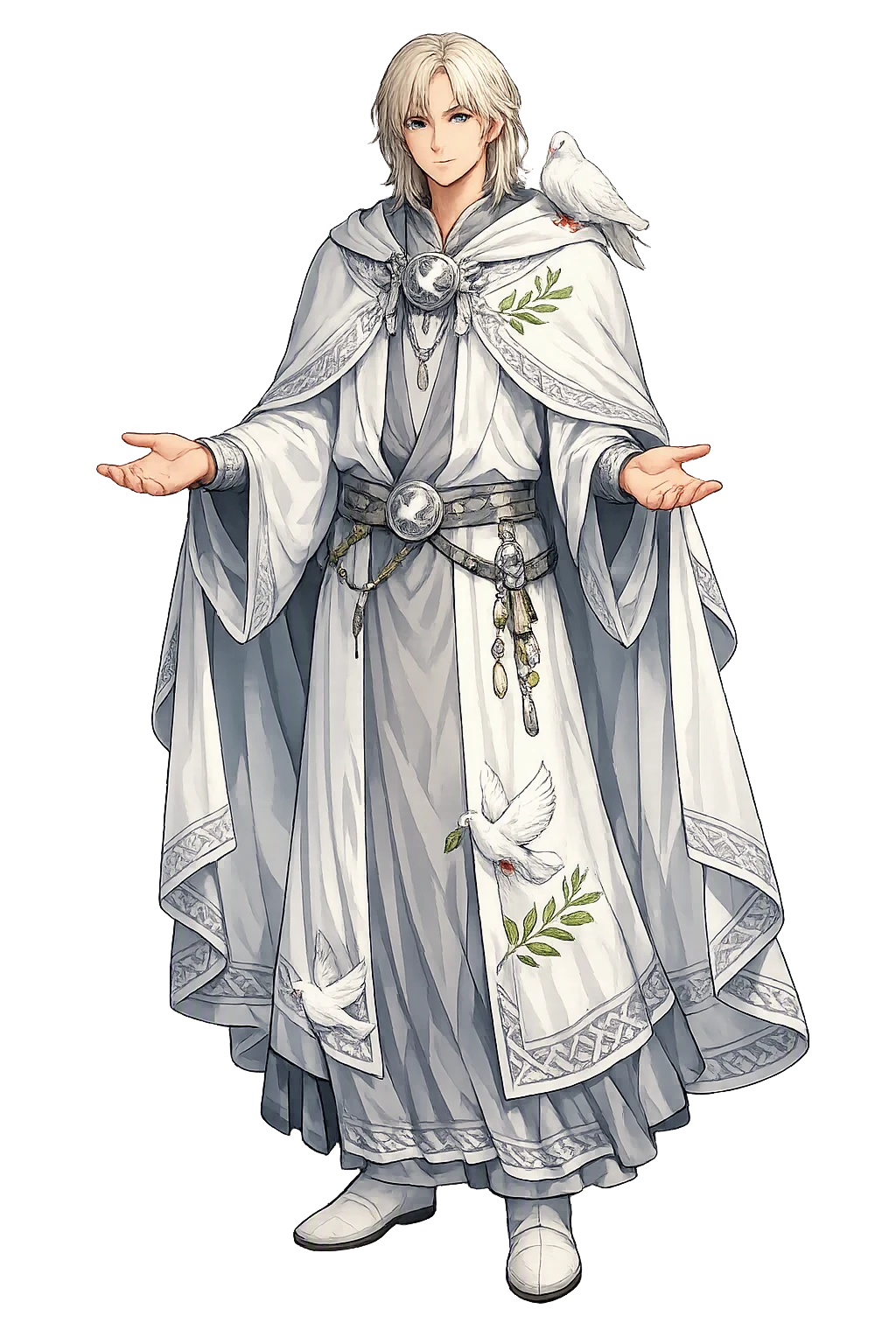
The provenance file on Nisien
Catalogue entry — Nisien. Every claim below carries its chain of custody.
Provenance
1. The attestation. —, from the tradition's own record. On record: Branwen ferch Llŷr (the Second Branch of the Mabinogi), trans. Sioned Davies, The Mabinogion (Oxford, 2007) — the paired character note; the mutilation of Matholwch's horses; the war and the cauldron, Williams, Ifor, ed., Pedeir Keinc y Mabinogi (Cardiff: University of Wales Press, 1930) — the standard Welsh text, Guest, Lady Charlotte, trans., The Mabinogion (1838–49) — the first English translation, Mac Cana, Proinsias, The Mabinogi, 2nd ed. (Cardiff: University of Wales Press, 1992) — the twins as personified antithesis.
2. The narrative record. The Two Sons of Euroswydd — The Second Branch introduces the twins in a single balanced construction, the most quoted sentence either brother ever gets. Nisien, the tale says, was a good man: he would bring about peace between two armies when they were at the height of their fury. The Horses at Aberffraw — When Brân consents to give Branwen in marriage to Matholwch, king of Ireland, and the wedding is held at Aberffraw, it is Efnysien — insulted that the match was made without his leave — who takes revenge on the groom's horses: he cuts off their lips to the teeth, their ears to their heads, their tails to their backs, and the eyelids to the bone. The outrage becomes the war's first cause, patched over with reparation and the gift of the Cauldron of Rebirth, and reopened in Ireland when Branwen is made a scullion and struck daily in the kitchen.
3. The physical record. Nisien is a purely textual figure: no inscription, votive deposit, or cult site names him, and the early inscribed stones of Wales — the Latin and ogham memorials of roughly the fifth to seventh centuries — record personal names in funerary formulae, not theonyms or tale-figures. His evidence is manuscript evidence. The Four Branches survive complete in the White Book of Rhydderch (Aberystwyth, NLW Peniarth MSS 4–5, c. 1350) and the Red Book of Hergest (Oxford, Jesus College MS 111, c. 1382–1410), with earlier fragments in Peniarth 6; the tales' date of composition is argued rather than documented, with current scholarship generally holding a range around 1060–1120. The geography of his branch is real: Aberffraw, where the wedding and the outrage are set, was the historic principal seat of the kings and later princes of Gwynedd on Anglesey, and the Alaw, where Branwen dies of her broken heart, is an Anglesey river. The giant who wades the sea and the cauldron of revival belong to the tale's mythic furniture; the courts and the crossings are drawn from the Welsh world the redactor knew.
4. The current holding. The temple at /sites/nisien/, classified Tier 2. Tier-2 here means one preserved truth — not less important, just singular. The temple shows it and names it.
5. The documented resonances. Legal, Justice & Compliance, History, Archives & Records, Leadership, Governance & Public Administration — seats argued and weighted in the pattern atlas, read through the myths in this temple's Resonance File.
6. The continuing record. Nisien's afterlife is as quiet as his dossier. Lady Charlotte Guest's translation of the Mabinogion (1838–49) carried the twins into English, and every retelling of Branwen since has kept the paired sentence — it is the one line of the Second Branch that anthologies quote whole.
At a Glance
- Restored name: Nisien
- ASCII form: nisien
- Meaning: "Peaceful one"
- Domain of influence: Peace, Brother of Efnysien
- Pantheon: Celtic
- Classification: Tier 2
- Original script: —
- Series: The Restoration Files, No. 250 of 397
The File Continues
Read the founding dispatch for the name's full story, the Resonance File for the archetype at work — or the whole archive in one sitting.
Continue the series — previous file: Nirmātā (read it here) · next file: Njǫrðr (read it here).
The Restoration Files are written from the same canonical record as the temples themselves: the lexicon, the lore catalog, the pattern atlas, and the cited scholarly sources. If a file ever disagrees with its temple, the temple is right — tell us, and the file will be corrected.