
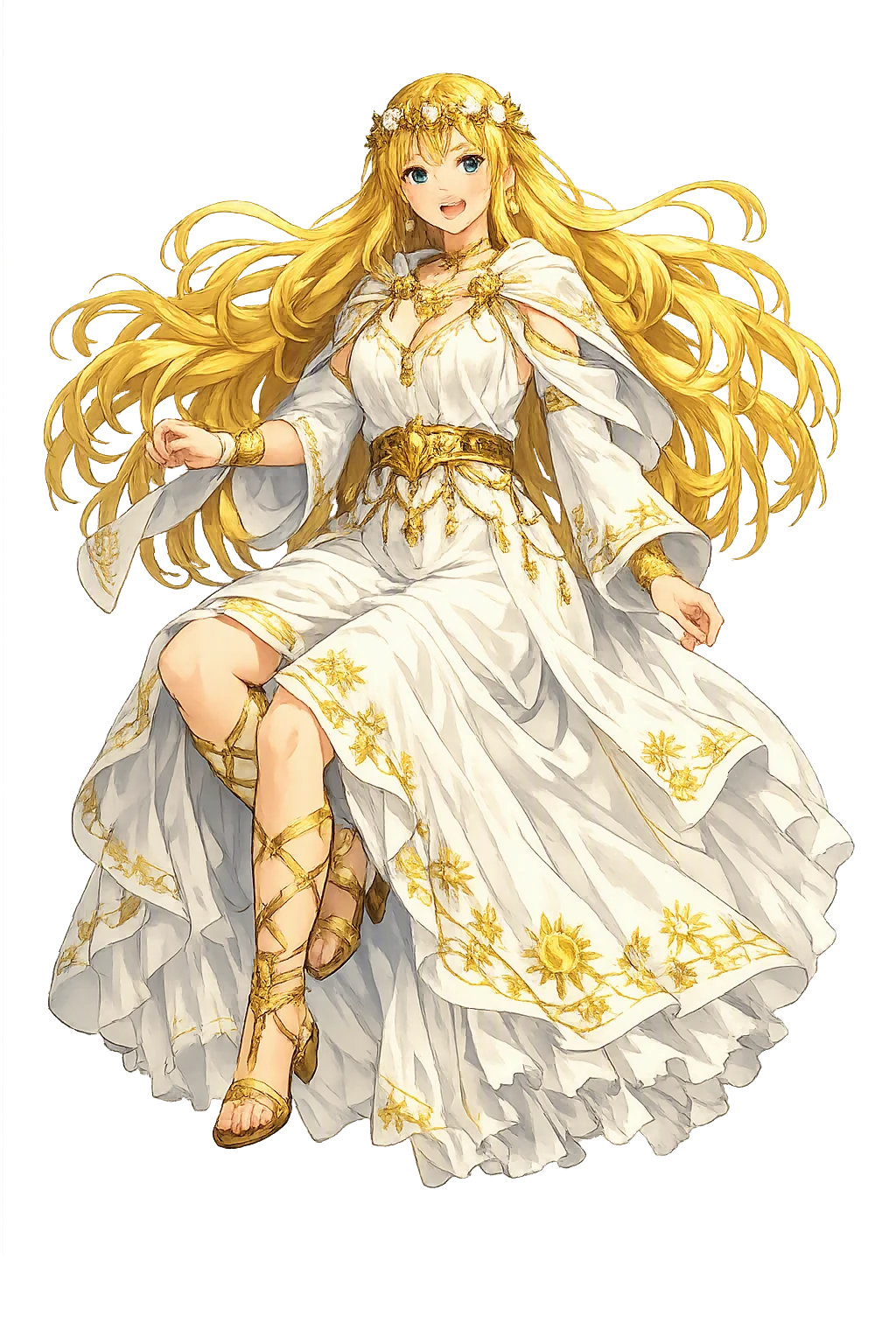
How Niamh was rebuilt, mark by mark
Bench notes, Niamh: what we found, what we rejected, and what we finally set down. Kept in the open, because a restoration you cannot audit is just a spelling with confidence.
What We Found
The attestation runs through the tradition's own sources: —. Meaning: "Bright, radiant".
The figure behind the name: Niamh's story survives as one tale told one way: the lay Laoi Oisín ar Thír na nÓg, 'The Lay of Oisín in the Land of Youth', ascribed to the eighteenth-century poet Mícheál Coimín and first printed with an English translation by the Ossianic Society in 1859.
What the Name Carried In
The Summons from over the Sea. Oisín, son of Fionn mac Cumhaill and last great poet of the Fianna, is with his people when a maiden none of them knows rides out of the west on a white horse. She names herself: Niamh Chinn Óir, Niamh of the Golden Hair, daughter of the king of Tír na nÓg.
The Wonders on the Wave. The white horse rides the sea as if it were a road, and the crossing is the lay's strangest passage. Marvels pass them on the wave: a fawn coursed by a white hound with red ears; a maiden riding with a golden apple in her hand; a young rider in a crimson cloak hard behind her, a gold-hilted sword at his side.
A spelling that has to carry stories like these is not a label. It is equipment.
Where It Stood Before Us
Niamh is an entirely textual figure: no ogham stone names her, no votive deposit invokes her, and Irish paganism generally left literature rather than dedications. Her tale has an exact documentary trail: the Laoi Oisín ar Thír na nÓg, ascribed to the eighteenth-century Clare poet Mícheál Coimín, survives in the Irish paper-manuscript tradition and reached print in the Transactions of the Ossianic Society (vol. 4, 1859), the learned society that did for the Fenian lays what Grimm did for the folktale. The medieval frame into which the lay fits its ending — Oisín and Caílte reciting Ireland to St. Patrick — is preserved in the Acallam na Senórach, whose great witness is the fifteenth-century Book of Lismore, with Laud Misc. 610 among its sister codices. Her Otherworld has no fixed address, and that is its nature: unlike the Dagda's Brú na Bóinne, where Newgrange gives myth a monument, Tír na nÓg was never mapped onto any real island — the material record of Niamh is the manuscript tradition itself, and the unbroken popularity of her name. The bench inherits all of it — the web temple is the newest site, not the first.
What We Rejected
Any form invented for availability. The rule on the bench: if the evidence does not carry it, the domain does not get it — whatever the registrar has in stock.
What We Set Down
Niamh — One decisive feature survives — a single, honest mark — which places the restoration in Tier-2: exact, and exactly labeled.
For the voice: 'NEE-uv' (Munster) or 'NEEV' (standard) — the weight on the long 'ee', the final mh a soft v; never 'nee-AM' and never an English h.
The temple stands at /sites/niamh/ — the notes above are public in its Scholarly Edition, sources and all.
At a Glance
- Restored name: Niamh
- ASCII form: niamh
- Meaning: "Bright, radiant"
- Domain of influence: Beauty, Otherworld
- Pantheon: Celtic
- Classification: Tier 2
- Original script: —
- Series: The Restoration Files, No. 245 of 397
The File Continues
The temple's founding dispatch tells the name's story; its Resonance File reads the myths into the industries; the blog index holds the whole archive.
Continue the series — previous file: Nḫt (read it here) · next file: Niflheimr (read it here).
The Restoration Files are written from the same canonical record as the temples themselves: the lexicon, the lore catalog, the pattern atlas, and the cited scholarly sources. If a file ever disagrees with its temple, the temple is right — tell us, and the file will be corrected.