
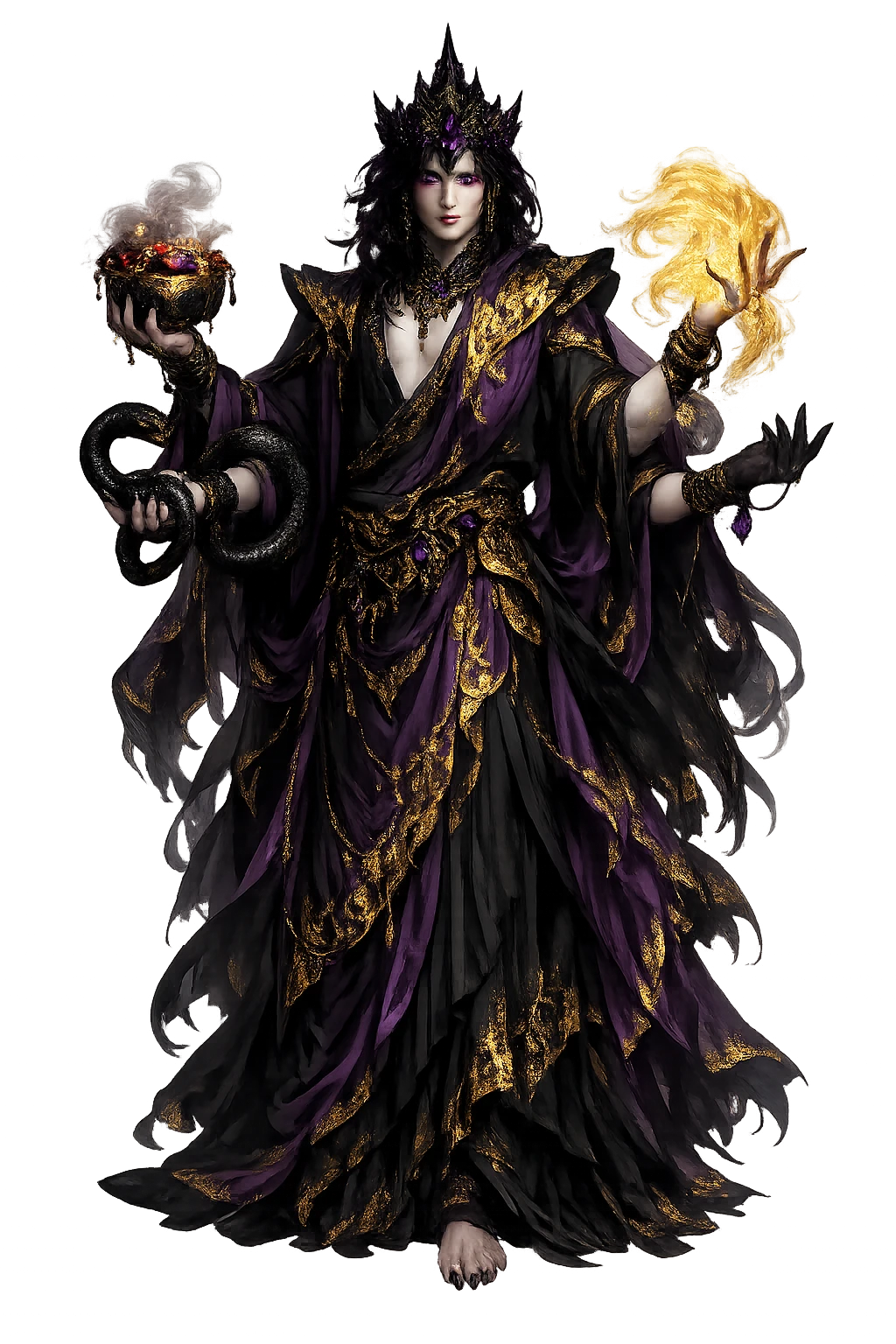
The hidden history behind Māra
One stroke of the pen separates the tempter of the Bodhi tree from a girl's name in a kindergarten register. That stroke is the macron — the short horizontal line over the first vowel that turns mara, a common given name carried across Europe and the Americas, into Māra, the Buddhist personification of death and desire. Sanskrit length is meaning: māra, from √mṛ 'to die', names the killer; mara names nothing in particular. What follows is the full scholarly picture — name, script, sound, myth, and legacy — and the engineering compromise that lets the restored spelling live at a real address. The adversary who once marshalled an army against the Buddha now marshals a punycode string.
At a Glance
- Restored name: Māra
- ASCII form: mara
- Meaning: "death, the killer"
- Domain of influence: Death, Temptation, Illusion
- Pantheon: Buddhist
- Classification: Tier 1
- Original script: मार (Devanagari)
- Live domain: māra.com
Overview
Māra (mara) — Death, Temptation, Illusion · death, the killer — belongs to the Buddhist tradition, where he stands as the adversary of awakening itself: the lord of the desire realm who assailed Siddhārtha beneath the Bodhi tree and who returns wherever a mind turns toward release.
His essence is a paradox the tradition insists on: the tempter is also the killer, because desire and death are one movement — what binds beings to the wheel makes it turn. The Pāli canon calls him Namuci, 'the non-releaser'.
PuniCodex restores the name as Māra and serves its temple at māra.com. The restoration preserves the long initial ā of the Sanskrit — the one distinctive feature the ASCII form loses — and exactly one historically valid restoration exists, which places the name in Tier 1.
The Name
The name derives from the Sanskrit root √mṛ, 'to die'. From it the agent noun māra is formed: 'death', and by extension 'the killer', 'the one who slays'. Monier-Williams glosses the word as death and the tempter in one — the personification of death and desire who assailed the Buddha under the Bodhi tree. Pāli Māra is the same word, inherited unchanged; the Buddhist tradition made it a proper name and gave its bearer an office: lord of the desire realm, whose rule ends where awakening begins.
The macron is the whole restoration. Everything else in the ASCII spelling is already correct; only the length of the first vowel, lost when the name was pressed into unaccented type, needs returning. That single stroke carries the etymology: māra, with long ā, is the killer; mara is just a name.
The letter-by-letter transformation runs:
- m → M — Same, capitalized
- a → ā — Macron: long /aː/
- r → r — Same
- a → a — Same
The Original Script
The name is written in Devanagari as मार. The script encodes the long vowel directly: the syllable मा carries the inherent 'a' of म lengthened by the vertical stroke ा, so that a reader of the original cannot miss what the ASCII form discards — the length that makes the word mean 'death'.
Against this written form both the ASCII fallback mara and the PuniCodex restoration Māra are measured. The restoration preserves, in the Roman alphabet, exactly what the Devanagari preserves in its own: the long ā. A reader typing the modern address speaks the ancient word whole, not a shortened shadow of it.
Pronunciation
The reconstructed pronunciation of the name is /ˈmaː.ɾə/ — Reconstructed Sanskrit.
For the modern speaker, the closest approximation is: MAH-ruh — two syllables, the first held twice as long as the second, the 'r' a light tap of the tongue.
Kindred and historical forms of the name:
- Devanagari — मार
- Pāli — Māra
- Epithet — Namuci, 'the non-releaser'
- Owned form — Māra
The Pāli form matters: the canon that tells the assault at Bodh Gayā speaks the name with the same long ā the Sanskrit does. The restoration keeps that length in the address bar — the long first syllable, the full weight of the word, exactly where the tradition placed it.
Mythology
Māra's myths are the shadow side of the awakening story: wherever the light advances, he is the shape of what resists it.
The Assault at Bodh Gayā
As Siddhārtha sat beneath the Bodhi tree, resolved not to rise until he had seen through birth and death, Māra came with his armies. The Padhāna Sutta names them, and the names are an anatomy of the mind: sensual desire, discontent, hunger and thirst, craving, sloth and torpor, fear, doubt, hypocrisy and obstinacy. These are not demons from outside; the armies are the forces within every practitioner, marshalled by the one who profits from their bondage. Riding his elephant, dark banner streaming, Māra hurled them against the seated one — and the seated one did not move.
The Three Daughters
When the armies failed, Māra sent his daughters: Taṇhā, Craving; Aratī, Discontent; and Rāgā, Desire. They danced before the seated one, the last and subtlest assault — not terror but allure. They found no purchase. Where a mind had clung, there was no longer anything to cling to; the dance that had shaken kingdoms passed over the stillness like wind over water. The daughters are named as precisely as the armies: craving, discontent, and desire are his children because they do his work.
The Earth's Witness
Then Māra advanced his final claim: the seat of awakening belonged to him, and his host bore witness to it. Siddhārtha had no host. He reached down his right hand and touched the earth — and the earth itself roared its testimony to the aeons of generosity that earned it. Māra's elephant knelt; the host scattered; the dark banner fell. The gesture, bhūmisparśa, 'the earth-touching', became the most copied image in Buddhist art: the Buddha seated, right hand down, calling the one witness no adversary can suborn.
The Persistent Adversary
Māra did not retire at Bodh Gayā. He returned across the Buddha's life — tempting Ānanda, urging the master toward parinibbāna, the final passing; and the Buddha, his work done, allowed that his time had come. Even the killer's last victory was negotiated, not won. Later systematizers folded the figure into doctrine, counting four māras: skandha-māra, the aggregates that compose the person; kleśa-māra, the defilements; mṛtyu-māra, death itself; and devaputra-māra, the god of the desire realm — the mythic figure, now one item on a list of the ways bondage works.
Symbols & Iconography
Māra's iconography concentrates in a few recurring attributes, each a compressed statement about the adversary:
- The demon host — grotesque, animal-headed, armed, hurling weapons that fall as flowers
- The riding elephant — his mount in the assault, kneeling at the earth-touching
- The three daughters — Taṇhā, Aratī, Rāgā, dancing the last temptation
- The dark banner — the standard of the desire realm, fallen at the witness of the earth
He is rarely shown alone. Buddhist art prefers him in defeat: the crowded assault scenes where the still seated figure at the center is the whole point, and the churn of the host only measures the stillness. In later Himalayan painting he grips the wheel of life as its skeletal lord.
Archaeology & Evidence
The assault at Bodh Gayā is among the earliest great subjects of Buddhist art. Reliefs at Bodh Gayā itself, and across the early schools at Bhārhut, Sāñcī, and Gandhāra, carve the scene again and again: the meditator beneath the tree, right hand down, and around him the churning host — riders, archers, beasts, the elephant mid-kneel. The Gandhāran workshops gave Māra's army its most crowded and inventive forms, demon faces and brandished weapons pressed to the edge of the stone. The material record confirms the texts: the tradition read the assault not as an episode but as the hinge of the whole story, worth carving wherever the story was told.
Realm & Domain
The Tempter
As tempter, Māra rules the kāma-dhātu, the desire realm — the ordinary world as ordinarily experienced, where wanting runs the show. His daughters dance; his armies whisper. The temptation is rarely to evil; it is to comfort, to the next small thing.
The Killer
As killer, he is death plain: mṛtyu-māra, the end that makes all wanting temporary. The tradition holds the two faces together — desire and death are one lord because desire is how death keeps its subjects.
The Illusion
As illusion, he is the misreading of the world: the conviction that what passes is permanent, that the self is a citadel, that the dance is the point. Awakening is, definitionally, the seeing-through of Māra.
Across Cultures
The adversary-tempter is one of the oldest patterns in comparative mythology, and Māra's parallels are instructive precisely because they are parallels, not borrowings. In Egypt, Apep assaults the sun barque night after night and is nightly repelled. In the Gospel accounts the tempter meets the fasting one in the desert with offers of bread, power, and proof, and is refused. Each tradition found its own way to the same discovery: the decisive battle is fought not against an army outside but against the force that makes a mind cling. Māra is the Buddhist name for that force.
Cultural Legacy
Māra's afterlife runs through every culture Buddhism touched. In Thai temple murals his host storms the Bodhi tree in gold and vermilion; in the literature of Japan he survives as Maō, the demon king of the sixth heaven. The deepest legacy is quieter: the fourfold analysis that turned a mythic adversary into a diagnostic of the mind. When a teacher says 'your māra' for the shape of one's own resistance, the god of the desire realm has completed his transformation from deity to mirror.
The Scholarly Record
The record for the name is old and stable. Monier-Williams' Sanskrit-English Dictionary records māra from √mṛ, 'death, the tempter'. The Pāli Text Society's editions preserve the Māra Saṃyutta, an entire chapter of the Saṃyutta Nikāya given to his encounters with the Buddha and his disciples; the Padhāna Sutta of the Sutta Nipāta names his armies. Later scholarship has treated the figure as the tradition's own psychology of resistance, and the philology has never been seriously disputed: the word means death, and always did.
A Meditation
The tradition does not ask you to hate Māra; it asks you to notice him. His armies wear no armor because they are your own habits, and his daughters are beautiful because they are your own wants. The seated figure at the center of every assault scene is not fighting. He is only touching the earth — calling the one witness that cannot be suborned. The killer keeps his kingdom only where no one looks at him directly. Looked at, he kneels like the elephant, and the banner falls of its own weight.
The Unicode Restoration
The restoration of Māra is the smallest one in the lexicon: a single macron, one stroke over one vowel. But few restorations separate more. Mara, unmarked, is a given name carried by thousands of living people. Māra, marked, is the lord of death and desire at the foot of the Bodhi tree. The macron is the difference between a person and a personification. Because the restoration preserves the one distinctive feature the ASCII form loses — the long ā — and because exactly one historically valid restoration exists, the name classifies as Tier 1: mechanically verifiable, philologically complete.
Character by Character
- m → M — Same, capitalized
- a → ā — Macron: long /aː/
- r → r — Same
- a → a — Same
The Domain Name
The temple lives at māra.com, and it resolves: type the restored name into a browser and the page answers. Behind the address bar the machinery is less elegant — browsers speak ASCII, so the name travels as xn--mra-1oa.com, the punycode encoding of the Unicode string. The encoding is deterministic: māra compresses to mra, and the suffix -1oa encodes where the ā belongs. PuniCodex holds the domain as the canonical home of the name — the one address where the long vowel is load-bearing.
The Buddhist Pantheon
Māra is one of 23 entries the PuniCodex lexicon catalogues under the Buddhist pantheon — buddhas and bodhisattvas, protectors and adversaries. The Pantheon page gathers the tradition in one view; the Lexicon lets you filter all 927 restorations by tradition, tier, or script.
Frequently Asked Questions
What does the name Māra mean?
'Death, the killer' — from the Sanskrit root √mṛ, 'to die'; in Buddhist usage, the tempter who assailed the Buddha, desire and death in one lord.
Which tradition does Māra belong to?
The Buddhist tradition. He appears across the Pāli canon and the Sanskrit, Chinese, and Tibetan recensions as the adversary of awakening, lord of the desire realm.
Why is Māra classified as Tier 1?
Because the restoration preserves the distinctive feature ASCII loses — the long ā — and exactly one historically valid restoration exists. Tier 1 is mechanical, not editorial.
Is māra.com a working domain?
Yes. The domain is live and serves this temple; the restored spelling resolves directly in modern browsers.
What is the punycode for māra.com?
xn--mra-1oa.com — the ASCII encoding browsers use behind the address bar.
Typing Māra
The PuniCodex Type Tool types Māra as it should be typed: enter the ASCII mara and the tool offers the restored Māra with its macron, ready to copy anywhere. A browser extension brings the same restoration into any text field on the web — no character maps, no Unicode tables, just the name, whole.
Sister Temples
Other Buddhist temples in the collection: Mahākāla, the great protector; Tārā, the savioress; and Maitreya, the Buddha yet to come.
Why This Restoration Matters
Of all the names in the lexicon, Māra makes the sharpest case for the project. Without the macron, the adversary of the Bodhi tree is indistinguishable from a common given name — the killer dissolves into the crowd. The restoration costs almost nothing: one stroke, one small difference in the punycode. What it buys is the tradition's whole semantic weight — the long vowel that says 'death', the line between a girl named Mara and the lord of the desire realm. If a single macron can carry that much meaning, the case for carrying the rest of the world's marks is already made.
Explore Further
Continue through the temple: the home page, the lore page, the Scholarly Edition with its reviewed apparatus, and the patron wall. Beyond the temple, browse the Lexicon, the Pantheon, and the PuniCodex blog.
Related Names
- Śākyamuni — the sage of the Śākya clan, the Buddha who faced Māra beneath the tree
- Sarnath — the deer park where the wheel was first turned
- Mañjuśrī — the bodhisattva of wisdom, whose sword cuts what Māra binds
Sources
The full scholarly apparatus — every citation, revision, and review — lives in the Scholarly Edition. Key references for this post:
- Monier-Williams Sanskrit-English Dictionary, Oxford, 1899.
- Buddhist canonical and commentarial literature (Pāli, Sanskrit, Chinese, and Tibetan recensions).
- Māra Saṃyutta (Saṃyutta Nikāya 4); Padhāna Sutta (Sutta Nipāta 3.2).
- Lexicon authorities for this entry: MW, Buddhist texts.