
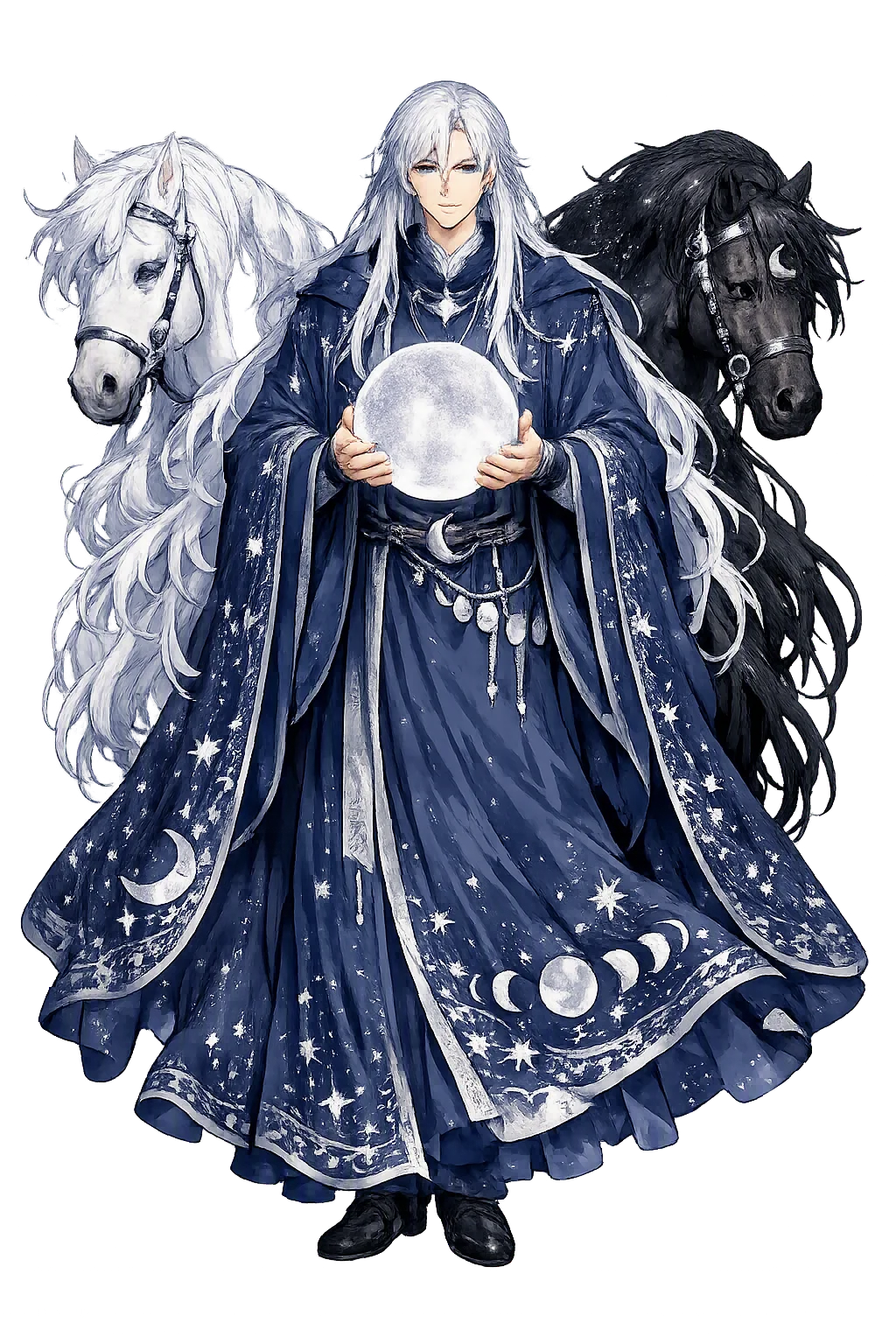
How Máni was rebuilt, mark by mark
From the restoration bench — the working notes on Máni, kept because the process is the proof.
What We Found
The attestation runs through the tradition's own sources: —. Meaning: "Moon (the personified moon, brother of Sól)".
The figure behind the name: Máni's mythology is brief but exact: he has no hammer-duels and no disguises, only a course to keep and a hunter behind him.
What the Name Carried In
Mundilfari's Boast. In the Vafþrúðnismál, the giant Vafþrúðnir tells Óðinn that Mundilfari is the father of Máni and of Sól alike. Snorri, in Gylfaginning, gives the story its edge: Mundilfari's two children were so fair that he named his son Máni, 'Moon', and his daughter Sól, 'Sun', and married Sól to a man named Glenr.
The Wolf at the Moon's Heels. The moon does not drift; it flees. Snorri explains its speed by its hunter: two wolves run with the lights of heaven, and Hati Hróðvitnisson is the one who runs before the moon and means to take it — 'and so it will come to pass.
A spelling that has to carry stories like these is not a label. It is equipment.
Where It Stood Before Us
Máni has no secure iconography: no picture stone, runestone, or amulet has been convincingly identified as his image, and his attestation is essentially textual. The Poetic Edda poems that name him — Vafþrúðnismál, Grímnismál, and Vǫluspá — survive chiefly in the Codex Regius (GKS 2365 4to, c. 1270), with Vǫluspá also in the Hauksbók; Snorri's account in Gylfaginning is transmitted by the main Snorra Edda manuscripts (GKS 2367 4to, Codex Upsaliensis, Codex Wormianus). The older strata of Scandinavian sky-religion are, however, material: the Bronze Age Trundholm sun chariot (c. 1400 BC) proves a native tradition of a heavenly body drawn by horse across the sky, and wheel- and disc-marked Gotland picture stones show the sun and moon as enduring cultic signs. The runic record knows the common noun máni and the month-names descended from it, but no runic inscription names the god directly. The bench inherits all of it — the web temple is the newest site, not the first.
What We Kept
The evidence, mark by mark — 1 feature the keyboard form mani cannot hold:
- a → á — Acute on a. Kept.
What We Rejected
mani as the primary form. It survives as the convenience it is; it does not get to lead. The hierarchy is full restoration first, and this name can afford to stand at the top of it.
What We Set Down
Máni — What survives here cannot be shown in ASCII: a feature of the original that the fallback alphabet flattens. That is the Tier-1 test, and this name passes it without argument.
For the voice: 'MAH-nee' — hold the first vowel long and open, as in 'father', with the weight squarely on the first syllable and a quick, light '-nee' to close.
The temple stands at /sites/mani/ — the notes above are public in its Scholarly Edition, sources and all.
At a Glance
- Restored name: Máni
- ASCII form: mani
- Meaning: "Moon (the personified moon, brother of Sól)"
- Domain of influence: Moon, Night, Time
- Pantheon: Norse
- Classification: Tier 1
- Original script: —
- Series: The Restoration Files, No. 157 of 293
The File Continues
The temple's founding dispatch tells the name's story; its Resonance File reads the myths into the industries; the blog index holds the whole archive.
Continue the series — previous file: Manannán (read it here) · next file: Mañjuśrī (read it here).
The Restoration Files are written from the same canonical record as the temples themselves: the lexicon, the lore catalog, the pattern atlas, and the cited scholarly sources. If a file ever disagrees with its temple, the temple is right — tell us, and the file will be corrected.