
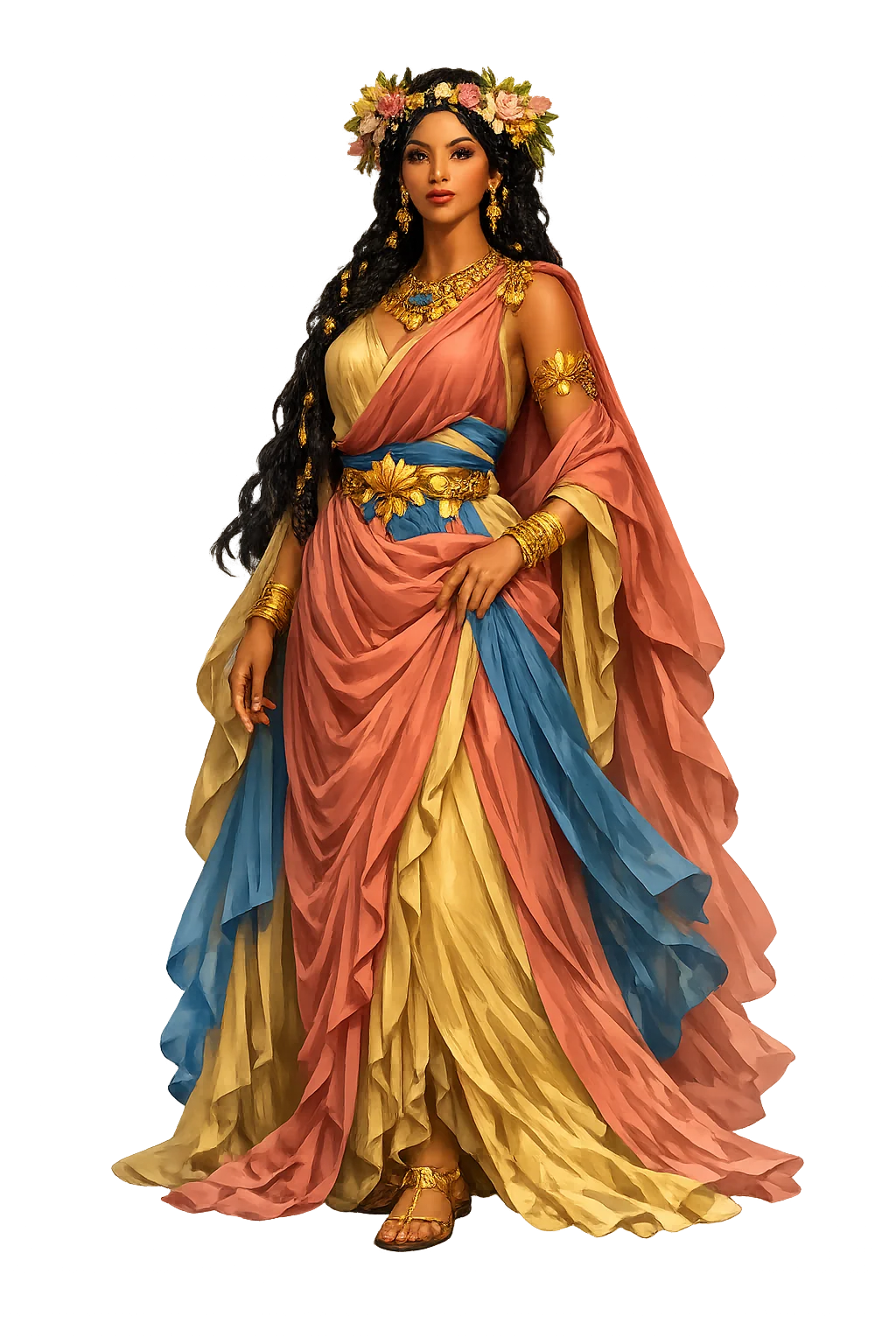
Pronouncing Libyē: a guide for the curious
Saying Libyē aloud is harder than reading it on a screen, and more rewarding. The restored spelling is a compressed pronunciation guide: every accent and macron is an instruction. This post unpacks those instructions — the reconstructed sound, the phoneme-by-phoneme record, the kindred forms in neighboring languages — and then zooms out to the full record around the name: its Greek writing, its mythology, its cult, and its modern life as a Unicode domain. Whether you arrive as a linguist, a reader of myth, or a domainer, you will leave able to say the name the way the evidence suggests it was said — and able to type it the way it was written.
At a Glance
- Restored name: Libyē
- ASCII form: libye
- Meaning: "The African continent (etymology uncertain)"
- Domain of influence: Personified Continent of Africa
- Pantheon: Greek Location
- Classification: Tier 1
- Original script: Λιβύη (Greek)
- Live domain: libyē.com
Overview
Libyē (libye) is the Greek name of Africa west of Egypt, personified as the daughter of Epaphus and Memphis — and so the granddaughter of the wandering Io. By Poseidon she bore Agenor and Belus, the eponymous founders of the Phoenician and Egyptian dynasties, binding three shores of the Mediterranean into one family tree.
The etymology is uncertain; the word is usually connected with the Libu — the rbw of Egyptian texts — a people of the western desert. To the geographers, Libyē was the third part of the world beside Europe and Asia, from the green shelf of Cyrene to the unmapped Sahara.
PuniCodex restores the name as Libyē and serves its temple at libyē.com. The original carries both stress and vowel length, and exactly one historically valid Unicode restoration exists, which places the name in Tier 1. The plain ASCII form libye survives as a modern convenience imposed by the early domain-name system; the restoration, not the fallback, is the form the project defends as philologically complete.
The Name
The name is attested in Greek as Λιβύη. Etymologically it means "The African continent (etymology uncertain)".
The reconstructed proto-form is lebu (proto-afro-asiatic, "Libyan, western"). From Greek Λιβύη, name for North Africa west of Egypt.
The ASCII form libye survives only because the early domain-name system could not carry diacritics; it is a technological compromise, not an ancient spelling. The Unicode restoration Libyē recovers the vowel length of the original directly in the address bar. The original carries both stress and vowel length, and exactly one historically valid Unicode restoration exists, which places the name in Tier 1.
The letter-by-letter transformation runs:
- l → L — Lambda
- i → i — Iota
- b → b — Beta
- y → y — Upsilon
- e → ē — Eta: long vowel
The project holds the domain libyē.com (xn--liby-eva.com) as the canonical home of this name.
Etymology & Roots
The recorded derivation reads: From Greek Λιβύη, name for North Africa west of Egypt.
The reconstructed proto-form is *lebu (proto-afro-asiatic), glossed as "Libyan, western".
The reconstruction is classed as attested.
The Original Script
The name is preserved in Greek as Λιβύη — Greek alphabet (Classical / Attic), attested Ancient Greek, c. 8th century BCE – present, in Greece and the Greek-speaking Mediterranean. The script is written left-to-right.
The scholarly transliteration is Libyē (Greek alphabet with polytonic accents), giving the normalized reading /liˈbyːɛː/.
The rendering proceeds step by step:
- The Greek form Λιβύη is written in the Classical Greek alphabet.
- Letters with acute, grave, or circumflex accents preserve the pitch accent of Ancient Greek.
- Macrons and omegas (η, ω) mark long vowels, a feature lost in the plain ASCII form.
- The Unicode restoration Libyē encodes the scholarly spelling as a registrable domain name.
Pronunciation
The reconstructed pronunciation of the name is /li.býː/ — Ancient Greek Reconstruction.
Phoneme by phoneme:
- Li- — Voiced alveolar lateral [l] plus short close front [i]; the first syllable is unstressed
- -by- — Voiced bilabial stop [b] plus front rounded [y], the Greek upsilon sound before a front vowel
- -ē — Long close-mid front [ɛː], the Greek eta; the macron marks length, giving the word its Tier-1 status
For the modern speaker, the closest approximation is: 'lee-BOO-ay' — the middle vowel is tight and rounded like French u, and the final 'ay' is held long.
Kindred and historical forms of the name:
- Egyptian — rbw / Libu, the name of a Libyan people recorded in Pharaonic texts
- Latin — Libya, the Roman continent name derived from Greek Libyē
- Greek — Λίβυς (Líbys), 'a Libyan', the masculine ethnikon from which the place-name is formed
Libyē is Tier 1 because the final eta is long. Greek had no acute on this form in our restoration, but the length mark is the scholarly feature being preserved. The name originally designated North Africa west of Egypt and only later narrowed to the modern state.
Mythology
Libyē is the Greek name for Africa west of Egypt, personified as a daughter of Epaphus and Memphis. Her myth places her at the intersection of Egypt and the Greek colonial world, the ancestress of the Libyan peoples and the mother of Belus and Agenor, founders of the great Near Eastern dynasties. Through her, the African continent enters Greek genealogy as a sister of Asia and Europe, equally ancient and equally consequential. Libye's mythic daughters spread across North Africa and the Aegean, their genealogies encoding Greek attempts to explain Phoenician, Egyptian, and native Libyan interactions. The name later designated the Roman province of Africa and, in modern usage, the nation-state on the Mediterranean coast. Through every transformation, it retained its association with the vast Sahara and the cultures that edge it.
Daughter of Io and Epaphus (Genealogy)
Libya's father was Epaphus, the son born to Io after her wanderings from Argos to Egypt. Io, transformed into a heifer by Hera and driven across Europe and Asia, finally found rest in Egypt and there gave birth to Epaphus. Epaphus in turn married Memphis, the eponym of the Egyptian capital, and their daughter Libya became the namesake of the African land west of the Nile.
This genealogy makes Libya the granddaughter of the Argive princess Io, linking the African continent to the same mythic network that produced Europa and Asia. The Greeks thus imagined Libya not as an alien south but as a branch of a single divine family tree rooted in Argos, Egypt, and Phoenicia.
Mother of Belus and Agenor (Eponym)
By Poseidon, Libya bore twin sons Belus and Agenor, who became the eponymous founders of the dynasties of Egypt and Phoenicia. Belus remained in Egypt and fathered Danaus and Aegyptus, whose quarrel produced the story of the Danaïds; Agenor traveled to Phoenicia and fathered Cadmus, Europa, and Phoenix, whose descendants founded Thebes and shaped the mythic history of Crete.
Through these sons, Libya becomes the mythic source of the migrations and conflicts that bind Egypt, Phoenicia, and Greece together. The African continent is not a peripheral zone but a generatrix of the very dynasties whose stories dominate Greek heroic legend.
Libya and the Peoples of Africa (Ethnography)
Herodotus devotes a long digression in Book 4 to the peoples, animals, and customs of Libya, from the seafaring lotus-eaters to the girdle-wearing Garamantes and the gold-trading Carthaginians. He reports strange creatures — the dog-headed men, the headless Blemmyes, the wild cattle whose horns point backward — and records the story that the Libyans were the first to practice the four-horse chariot.
For Greek writers, Libya was a land of extremes: burning deserts, miraculous springs, and the garden of the Hesperides at its western edge. The continent personified thus embodied both the harshness and the wonder of the African interior, the threshold beyond which the known world dissolved into fable.
The Western Garden of the Hesperides (Genealogy)
Greek writers placed the Garden of the Hesperides at Libya's western extremity, where the sun sinks into the Ocean and the known world yields to marvel. There golden apples of immortality grew under the care of nymphs, daughters of Atlas or of Night, and were guarded by the ever-watchful serpent Ladon. Herakles' eleventh labor brought him to this Libyan margin, making the continent not merely a geographical name but the threshold between mortal travel and the wonders that lie beyond the setting sun. Libya thus frames both the genealogical origin and the fantastical limit of the Greek imagination.
Symbols & Iconography
The iconography associated with Libyē concentrates in a small set of recurring attributes, each a compressed statement about the name:
- Saharan lion — The North-African lion that emblematised the wilds beyond Greek settlement
- Lotus-eater's island — The dreamy shore visited by Odysseus, placed by Homer in Libyan waters
- Silphium plant — The extinct North-African medicinal herb worth its weight in silver
- Oracle of Ammon — The Siwa oasis sanctuary where Zeus Ammon spoke, the Libyan Delphi
- Gorgon's head — The Libyan-born Medusa, whose petrifying visage belongs to the continent's mythic west
Archaeology & Evidence
The personified Libyē had no cult; the name's archaeology is the Greek archaeology of North Africa. Cyrene preserves the sanctuaries of the Battiad city — the sanctuary of Apollo, the agora, and the colossal temple of Zeus, one of the largest Greek temples ever built — excavated in long Italian and international campaigns since the early twentieth century. Far south, the oasis of Siwa keeps the ruined temple of the oracle of Ammon at Aghurmi, where the god's processional shrine stood; the site's ram iconography matches the horned Zeus Ammon of Cyrene's coins. Between these poles the desert interior that Herodotus filled with nomads keeps its own archive in the rock art of the Akakus and Tadrart massifs.
Realm & Domain
Libyē names both the continent west of Egypt and the princess of the Io genealogy whose sons founded the Phoenician and Egyptian royal lines; the aspects below hold both senses at once.
Daughter of Io
Libyē is the daughter of Epaphus and Memphis, granddaughter of the Argive princess Io who wandered to Egypt.
Mother of Belus and Agenor
By Poseidon she bore the eponymous founders of the Egyptian and Phoenician dynasties.
Garden of Hesperides
Greeks placed the golden garden at Libya's western edge, where the sun sank and wonder began.
Sahara and the Garamantes
Herodotus mapped Libya's interior peoples, from lotus-eaters to desert traders, defining the African frontier.
Across Cultures
Greek religion in Libya was translation under new skies. The supreme case is Zeus Ammon: the ram-horned Theban Amun, whom Herodotus equates outright with Zeus, spoke from the oasis of Siwa, and Greeks made the 'Libyan Delphi' their own — Cyrene struck his horned profile on its coinage, and Alexander forced the desert crossing in 331 BCE to hear the god address him as son of Ammon. The founding of Cyrene was itself a graft: Pindar sings how Apollo carried the Thessalian nymph Cyrene across the sea to make her queen of the rich Libyan land, a poetic charter for Greek roots in African soil. Even the genealogy made Libyē a sister of Europe and Asia within one Argive family, binding the continent to the mythic kinship of Eurṓpē and Asía.
Cultural Legacy
Libyē narrowed as it travelled: the Greek name for a whole continent west of Egypt became the Italian colony's title in 1934 and finally the modern nation-state. The mythic princess provided a genealogical bridge between Greek, Egyptian, and indigenous Libyan identities, and Greek literature kept the land's double register — danger and allure — from the lotus-eaters of the Odyssey to Pindar's golden Cyrene. Restoring the long eta preserves the vowel Greek speakers stretched across two and a half millennia of maps — the difference between a modern state label and the name Herodotus gave his whole African book.
The Scholarly Record
The account of Libyē given in this edition rests on the witnesses and reference works listed below. Lexica and etymological dictionaries secure the form and meaning of the name; the literary and religious texts supply the narrative evidence.
- Beekes, R. S. P. Etymological Dictionary of Greek. Leiden: Brill, 2010.
- Herodotus, Histories Book 4 (the Libyan logos).
- Homer, Iliad.
- Homer, Odyssey.
- Hesiod, Theogony, Loeb Classical Library No. 57, 700 BCE. Full text
- Pindar, Pythian Odes.
- Pausanias, Description of Greece.
A Meditation
Libyē holds the Greek south in a single word: the green shelf of Cyrene, the oracular sands of Siwa, the unmapped desert beyond. Granddaughter of Io, she is also the knot that ties three continents into one genealogy — daughter, mother, and namesake of lands. The long eta of the restored form is a small monument: Greek speakers stretched that final vowel for a thousand years of maps, and the restoration lets it be heard again. To contemplate Libyē is to remember that the Greeks mapped their south not by conquest but by kinship, folding a continent into the family of a wandering cow-girl from Argos.
The Unicode Restoration
Libyē is classified as Tier 1: the original carries both stress and length, and only one valid Unicode restoration exists. The ASCII fallback libye still resolves everywhere, but it is the restored form that carries the name's full information. Across the 5 characters of the name, the restoration adjusts 1: 1 mark of length (ē). That is the whole thesis of this temple: the marks are the message.
Character by Character
The journey from libye to Libyē, one character at a time:
- l → L — Lambda
- i → i — Iota
- b → b — Beta
- y → y — Upsilon
- e → ē — Eta: long vowel
The Domain Name
The restored name is live as a working domain: libyē.com, which the DNS carries in punycode form as xn--liby-eva.com — an ASCII-compatible encoding that lets a non-ASCII name travel the global network without breaking older infrastructure. The visitor sees Libyē; the machines see the encoding. That duality is the engineering compromise on which the entire restoration rests, and it is why a name written the way its own tradition wrote it in Greek can now be typed into any browser on earth.
The Greek Location Pantheon
Libyē is one of 24 entries the PuniCodex lexicon catalogues under the Greek Location pantheon. The Pantheon page gathers the tradition's major figures in one place, and the Lexicon lets you filter all 895 restorations by tradition, tier, or script — the fastest way to see where this name sits among its kin.
Frequently Asked Questions
What does Libyē mean? The traditional gloss is "The African continent (etymology uncertain)."
Which tradition does Libyē belong to? Libyē is catalogued in the Greek Location pantheon of the PuniCodex lexicon.
Why is Libyē classified as Tier 1? Because the original carries both stress and length, and only one valid Unicode restoration exists — and the marks in the restored spelling preserve exactly that evidence.
Is Libyē a working domain? Yes — libyē.com resolves today and routes to this temple.
What is the punycode for libyē.com? The DNS encoding is xn--liby-eva.com; browsers perform the translation automatically, so visitors only ever see the restored name.
Typing Libyē
You do not need a special keyboard to use this restoration. The PuniCodex Type Tool converts the ASCII form libye into Libyē as you type, and the browser extension offers the same conversion inside any text field. Copy the restored form, paste it into the address bar, and the DNS does the rest.
Why This Restoration Matters
Pronunciation turns out to be the heart of the matter. The marks in Libyē are instructions for the voice, and a web that strips them is a web that mispronounces the past at scale. The restoration hands the instructions back: say it as the evidence suggests, type it as the tradition wrote it, and let the punycode machinery do the quiet translation in between. That is all the PuniCodex project asks of the infrastructure — and everything it asks of you, the reader, is to use the whole name.
Explore Further
This post is one doorway into the temple. The home page carries the full character breakdown and the ambient canvas; the lore page tells the myths in long form; the Scholarly Edition preserves the sources, pronunciation data, and revision history; and the patron wall supports the restoration directly. For the wider map, browse the Lexicon, explore the Pantheon, or return to the PuniCodex blog.
Related Names
Sources
The full scholarly apparatus — every citation, revision, and review — lives in the Scholarly Edition. Key references for this post:
- Apollodorus, Bibliotheca 2.1.3-4 (Libye, daughter of Epaphus, mother of Agenor and Belus).
- Herodotus, Histories Book 4 (the Libyan logos).
- Hesiod, Theogony, Loeb Classical Library No. 57, 700 BCE.
- Histories, Loeb Classical Library, 440 BCE.
- Beekes, R. S. P. Etymological Dictionary of Greek, s.v. Λιβύη. Leiden: Brill, 2010.
- Beekes, R. S. P. Etymological Dictionary of Greek. Leiden: Brill, 2010.
- Material evidence from the Greek world — inscriptions, sanctuaries, votive deposits, and literary papyri — anchors the name in historical cult.
- Apollodorus, Bibliotheca 2.1.3-4; Herodotus, Histories Book 4.
- Lexicon authorities for this entry: LSJ, Herodotus.