
The hidden history behind Kꜣ
Behind the modern ASCII form ka hides a much longer story. Kꜣ reaches back through manuscripts, inscriptions, and oral tradition long before it ever touched a keyboard, and every mark in the restored spelling is a receipt from that journey. In what follows we trace the name from its Hieroglyphs attestations through its mythology, its cult, its symbols, and its afterlife in other cultures — and we show how the PuniCodex project turned that philological record into a Unicode domain that resolves today. The history was never lost. It was only waiting for the infrastructure to catch up.
At a Glance
- Restored name: Kꜣ
- ASCII form: ka
- Meaning: "The vital essence, life force, or double of a person. Created at birth and surviving death."
- Domain of influence: Vital Essence, Life Force
- Pantheon: Egyptian
- Classification: Tier 2
- Original script: 𓂓𓏤 (Hieroglyphs)
- Live domain: kꜣ.com
Overview
Kꜣ (ka) — The vital essence, life force, or double — belongs to the Egyptian tradition, where it is catalogued under the domain "Vital Essence, Life Force". The name means "The vital essence, life force, or double of a person. Created at birth and surviving death.".
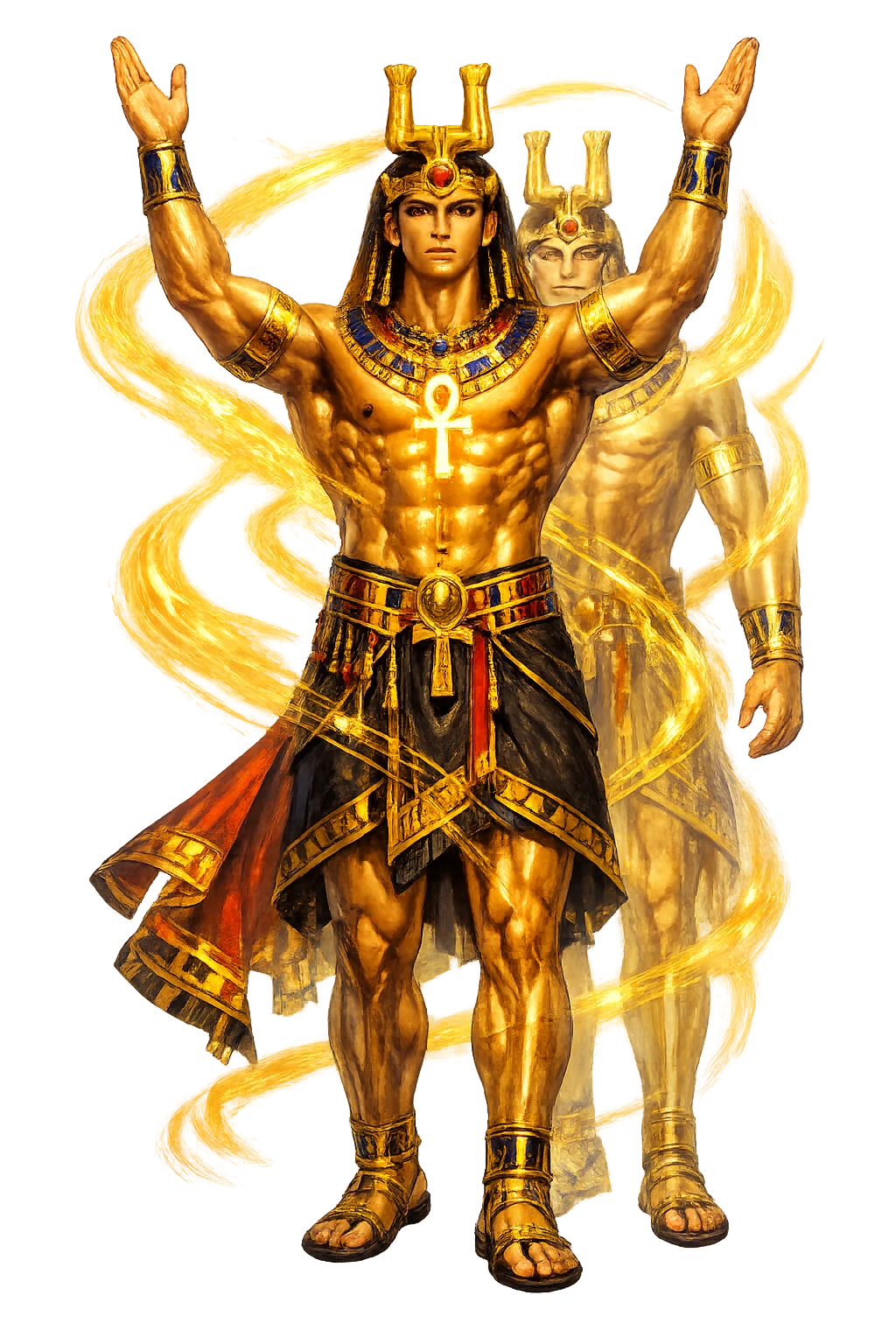
The Egyptian kꜣ is the life-force that makes a person alive, the vital double created at birth and sustained by offerings. Where the ba is the mobile personality, the ka remains tethered to the body and the tomb, consuming the spiritual essence of bread, beer, and meat.
PuniCodex restores the name as Kꜣ and serves its temple at kꜣ.com. The original preserves one prosodic feature — stress or vowel length — rather than both, which places the name in Tier 2. The plain ASCII form ka survives as a modern convenience imposed by the early domain-name system; the restoration, not the fallback, is the form the project defends as philologically complete.
The Name
The name is attested in Hieroglyphs as 𓂓𓏤. Etymologically it means "The vital essence, life force, or double of a person. Created at birth and surviving death.".
From Egyptian kꜣ, a term for the life-force or 'double' created with a person; the hieroglyphic spelling records consonants only.
The ASCII form ka survives only because the early domain-name system could not carry diacritics; it is a technological compromise, not an ancient spelling. The Unicode restoration Kꜣ recovers the full diacritic detail of the scholarly transliteration directly in the address bar. The original preserves one prosodic feature — stress or vowel length — rather than both, which places the name in Tier 2.
The letter-by-letter transformation runs:
- k → K — Same, capitalized
- a → ꜣ — Egyptological aleph — glottal stop or specific vocalic quality
The project holds the domain kꜣ.com (xn--k-yw3e.com) as the canonical home of this name.
Etymology & Roots
The recorded derivation reads: From Egyptian kꜣ, a term for the life-force or 'double' created with a person; the hieroglyphic spelling records consonants only.
The root gloss is "vital essence, double."
The reconstruction is classed as attested.
The Original Script
The name is preserved in Hieroglyphs as 𓂓𓏤 — Egyptian hieroglyphic, attested Old Kingdom – Late Antiquity, c. 2600 BCE – 400 CE, in Egypt. The script is written right-to-left / top-to-bottom.
The scholarly transliteration is Kꜣ (Egyptological conventional), giving the normalized reading Original vocalisation unknown; Egyptological /kaːʕ/..
The rendering proceeds step by step:
- The Egyptian name is written 𓂓𓏤 in hieroglyphs.
- Hieroglyphs combine logograms, phonograms, and determinatives; the exact function of each sign depends on context.
- Egyptian writing does not record vowels; the vocalised form is a modern convention reconstructed from Coptic and Greek evidence.
- The Unicode restoration Kꜣ uses Egyptological alef/ayin and other registrable characters; the hieroglyphic form is not registrable in .com.
Pronunciation
The reconstructed pronunciation of the name is /kaːʔ/ — Egyptological Reconstruction.
Phoneme by phoneme:
- K- — Voiceless velar stop [k], the initial consonant of the life-force.
- -aː- — Long open vowel [aː], inferred from Coptic and from the word's prosodic weight.
- -ꜣ — Final Egyptological aleph [ʔ], a glottal catch that leaves the root open like a breath.
For the modern speaker, the closest approximation is: 'KAH-ah' — say a firm ka, hold the vowel, then close with a soft glottal catch.
Kindred and historical forms of the name:
- Egyptian — kꜣ, 'vital essence, double, life-force', created with the person at birth
- Egyptian — bꜣ, the mobile personality or ba, paired with the ka in Egyptian anthropology
- Egyptian — ꜥnḫ, 'life', the outcome that the ka sustains
The ka is Tier 2 because the restoration preserves the long vowel and final Egyptological aleph (ꜣ) as distinctive features, without a Greek-style stress mark. Egyptian vowels are not written in hieroglyphs and must be reconstructed.
Mythology
The Egyptian ka is the vital double, the life-force that makes a person alive and that continues after death. Born with the body, shaped by the creator god, and sustained by offerings, the ka links the living, the dead, and the divine.
The Ka Created at Birth (Creation)
In Egyptian theology, the god Khnum shapes the infant body and its ka together on the potter's wheel — the royal birth scenes at Deir el-Bahari and Luxor show the double fashioned as a twin of the child. The ka is not a separate soul in the modern sense but the living energy that accompanies the body. To have a ka is to be alive; to lose it is to die.
The Ka After Death (Afterlife)
After death the ka leaves the body but remains tethered to it, returning to the corpse or to a statue made in the deceased's likeness. Tombs were therefore called 'houses of the ka', and statues were provided so the ka had a form to inhabit. Without a preserved body or substitute image, the ka could not receive offerings and would starve.
The Ka and the Gods (Theology)
Kings possess multiple kas, divine doubles that extend their presence into cult and cosmos. The god Amun is called 'Amun, his ka', and the ka of Ptah is invoked in Memphis. In this way the ka is not only personal but theological: it is the principle by which a god's power can be present in many places at once.
Feeding the Ka (Ritual)
Every tomb inscription asks for offerings 'for the ka of' the deceased. The formula 'May the king give an offering to Ptah-Sokar-Osiris' ensures that bread, beer, oxen, and fowl are magically provided. Relatives placed real food in the tomb chapel, but the ka was believed to consume the spiritual essence while the material food remained for the living.
Symbols & Iconography
The ka's iconography begins in the script itself: the word is written with the sign of two upraised arms (Gardiner D28), the embracing gesture made visible, and that sign doubles as the concept's emblem on stelae and amulets.
- Ka-arms (D28) — two arms raised in embrace: the hieroglyph of the life-force, also worn as an amulet
- Offering table — the material focus of ka-sustenance, heaped with bread, beer, and meat
- Ka-statue — a substitute body for the life-force, set in the tomb's sealed serdab
- False door — the stone threshold through which the ka passed to take its offerings
- Ankh — the breath of life the ka receives and perpetuates
Archaeology & Evidence
The ka's material footprint covers the whole Egyptian necropolis. Old Kingdom mastabas at Giza and Saqqara were built as 'houses of the ka': the Fourth Dynasty reserve heads and the ka-statues sealed in serdabs — most famously the seated statue of Djoser from his Step Pyramid serdab — supplied the life-force with bodies should the corpse fail. False doors of stone channelled offerings to the ka of the owner, and the great chapels of Ti and Mereruka at Saqqara cover their walls with offering-bearers approaching him. The acknowledged masterpiece of the genre is the life-size wooden ka-statue of King Awibre Hor from Dahshur (Dynasty 13), whose figure is crowned by the ka-arms themselves.
Realm & Domain
The Egyptian kꜣ is the life-force that makes a person alive, the vital double created at birth and sustained by offerings. Where the ba is the mobile personality, the ka remains tethered to the body and the tomb, consuming the spiritual essence of bread, beer, and meat.
Created at Birth
Khnum shapes the infant and its ka on the potter's wheel; Heka animates it.
Sustained by Offerings
Tombs are 'houses of the ka'; offerings feed the life-force after death.
Statue Body
A ka-statue provides a form for the ka if the body perishes.
Divine Ka
Kings possess multiple kas; gods extend their presence through ka-doubles.
Across Cultures
The ka has no direct counterpart in Greek or Roman religion, but related ideas circulated.
Greek authors sometimes interpreted Egyptian ka-statues as 'doubles' or 'guardian spirits,' and the Roman genius and Juno concepts may have faintly echoed the idea of a personal life-force. In Coptic Christianity, the old vocabulary of ka and ba was largely replaced by Greek pneuma and psychē, though the practice of offering food at tombs survived in modified forms. Modern Theosophy and Hermeticism revived the ka as the 'etheric double,' an energetic body that sustains the physical form. In Kemetic reconstruction, the ka remains a central concept: the life-force that must be fed, remembered, and honored.
Within the Egyptian tradition, closely related names in the corpus include [[ab|Ꜣb]], [[akh|Ꜣḫ]], [[amun|Ꜣmun]], [[ankh|ꜥnḫ]], [[apep|Ꜥpp]], and [[ba|Bꜣ]].
Cultural Legacy
The ka survives wherever people speak of a life-force or energy body.
From Theosophical 'etheric doubles' to New Age 'auras,' from Chinese qi to Hindu prāṇa, modern seekers have repeatedly rediscovered the Egyptian intuition that physical life depends on an invisible sustaining power. The ka's need for offerings has been reinterpreted as the need for attention, memory, and ritual care. In museums, ka-statues stand as reminders that the Egyptians imagined survival as a social act: the dead continue only if the living continue to feed them. The ka is thus ancestor to every modern practice that treats the dead as ongoing participants in family life.
The Scholarly Record
The account of Kꜣ given in this edition rests on the witnesses and reference works listed below. Lexica and etymological dictionaries secure the form and meaning of the name; the literary and religious texts supply the narrative evidence.
- Pyramid Texts (the offering utterances addressed to the king's ka).
- Faulkner, R. O. The Ancient Egyptian Pyramid Texts. Oxford: Clarendon, 1969.
- Faulkner, R. O. The Ancient Egyptian Coffin Texts. Warminster: Aris & Phillips, 1973–1978.
- Erman, A. & Grapow, H. Wörterbuch der ägyptischen Sprache, s.v. kꜣ.
- Book of the Dead, Spell 105 (for satisfying the ka in the realm of the dead).
- Book of the Dead, Spell 110 (the Field of Reeds).
- Book of the Dead, Spell 30B ('you are my ka which was in my body').
- Bell, L. 'Luxor Temple and the Cult of the Royal Ka,' JNES 44 (1985): 251–294.
- Bolshakov, A. Man and His Double in Egyptian Ideology of the Old Kingdom (ÄAT 37). Wiesbaden: Harrassowitz, 1997.
A Meditation
The ka proposes an economics of survival: life is a flow that must be fed. The Egyptians built their whole funerary practice on that premise — tombs as houses, priests as caterers, statues as reserve bodies — because the double lives only as long as it eats. It is a theology of dependence, and therefore of community: the dead persist through the fidelity of the living, and the offering formula makes every passer-by a potential feeder of someone's ka.
The sign says it before any text does: two arms raised in embrace. The life-force is pictured as a holding — of child, of offering, of self. To restore the aleph in Kꜣ is a small act of the same kind: keeping the name fed with its full form.
The Unicode Restoration
Kꜣ is classified as Tier 2: the original preserves at least one philological feature that ASCII cannot encode. The ASCII fallback ka still resolves everywhere, but it is the restored form that carries the name's full information. Across the 2 characters of the name, the restoration adjusts 1: 1 further adjustment (ꜣ). That is the whole thesis of this temple: the marks are the message.
Character by Character
The journey from ka to Kꜣ, one character at a time:
- k → K — Same, capitalized
- a → ꜣ — Egyptological aleph — glottal stop or specific vocalic quality
The Domain Name
The restored name is live as a working domain: kꜣ.com, which the DNS carries in punycode form as xn--k-yw3e.com — an ASCII-compatible encoding that lets a non-ASCII name travel the global network without breaking older infrastructure. The visitor sees Kꜣ; the machines see the encoding. That duality is the engineering compromise on which the entire restoration rests, and it is why a name written the way its own tradition wrote it in Hieroglyphs can now be typed into any browser on earth.
The Egyptian Pantheon
Kꜣ is one of 66 entries the PuniCodex lexicon catalogues under the Egyptian pantheon. The Pantheon page gathers the tradition's major figures in one place, and the Lexicon lets you filter all 895 restorations by tradition, tier, or script — the fastest way to see where this name sits among its kin.
Frequently Asked Questions
What does Kꜣ mean? The traditional gloss is "The vital essence, life force, or double of a person. Created at birth and surviving death.."
Which tradition does Kꜣ belong to? Kꜣ is catalogued in the Egyptian pantheon of the PuniCodex lexicon.
Why is Kꜣ classified as Tier 2? Because the original preserves at least one philological feature that ASCII cannot encode — and the marks in the restored spelling preserve exactly that evidence.
Is Kꜣ a working domain? Yes — kꜣ.com resolves today and routes to this temple.
What is the punycode for kꜣ.com? The DNS encoding is xn--k-yw3e.com; browsers perform the translation automatically, so visitors only ever see the restored name.
Typing Kꜣ
You do not need a special keyboard to use this restoration. The PuniCodex Type Tool converts the ASCII form ka into Kꜣ as you type, and the browser extension offers the same conversion inside any text field. Copy the restored form, paste it into the address bar, and the DNS does the rest.
Sister Temples
Other temples in the Egyptian pantheon include Mnw, Nḫt, and Pꜣḫt — each with its own restoration story, its own scholarly record, and its own place in the lexicon.
Why This Restoration Matters
The story of Kꜣ did not end in antiquity; it changed medium. Names that survive for millennia do so because each generation finds a new carrier for them — clay, papyrus, print, and now DNS. The PuniCodex restoration simply makes the carrier honest: the spelling that resolves is the spelling the evidence supports. If this post showed anything, it is that ka and Kꜣ are not the same name with different styling. They are a summary and the text it summarizes. The web can now serve the text.
Explore Further
This post is one doorway into the temple. The home page carries the full character breakdown and the ambient canvas; the lore page tells the myths in long form; the Scholarly Edition preserves the sources, pronunciation data, and revision history; and the patron wall supports the restoration directly. For the wider map, browse the Lexicon, explore the Pantheon, or return to the PuniCodex blog.
Related Names
Sources
The full scholarly apparatus — every citation, revision, and review — lives in the Scholarly Edition. Key references for this post:
- James P. Allen, Middle Egyptian: An Introduction to the Language and Culture of Hieroglyphs, Cambridge University Press, 2000.
- Pyramid Texts.
- Book of the Dead.
- Faulkner, The Ancient Egyptian Pyramid Texts.
- Gardiner, A. Egyptian Grammar, 3rd ed., sign-list D28. Oxford: Griffith Institute, 1957.
- Lexicon authorities for this entry: Faulkner, Gardiner, Allen.