
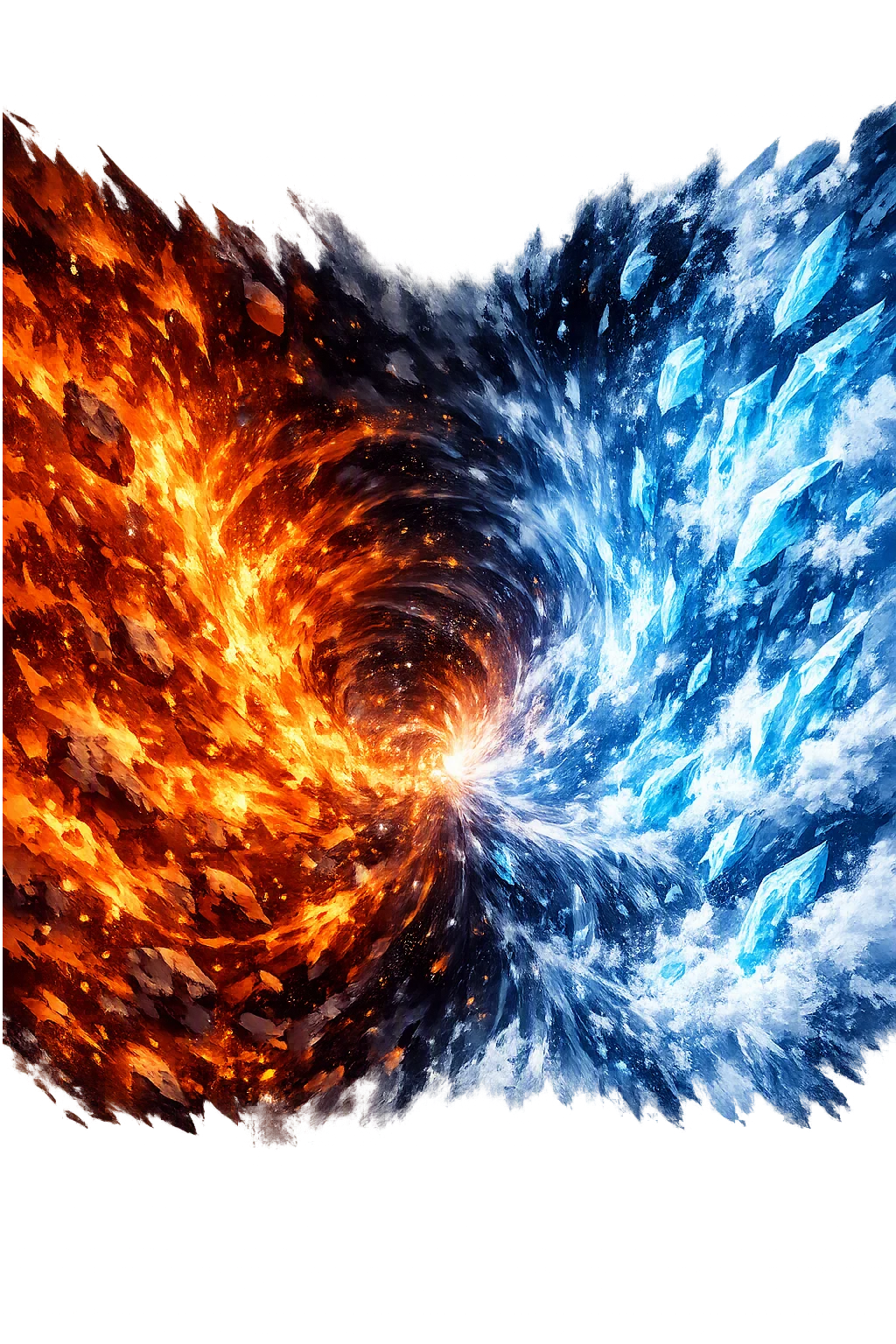
How Ginnungagap was rebuilt, mark by mark
From the restoration bench — the working notes on Ginnungagap, kept because the process is the proof.
What We Found
The attestation runs through the tradition's own sources: ᚴᛁᚾᚾᚢᚾᚴᛅᚴᛅᛒ. Meaning: "Magic-gaping-void".
The figure behind the name: Ginnungagap has no adventures, because it is not a character but a place — or rather the condition of there being places at all.
What the Name Carried In
The Gap of Ginnungs. The seeress reaches back before memory: 'Early in time, when Ymir made his settlement — there was no sand nor sea nor cool waves; earth was found nowhere, nor the sky above; a gap of ginnungs there was, but grass nowhere. ' That is the entire notice the oldest poem gives, and everything Snorri builds hangs on its two words, gap ginnunga.
Fog in the North, Fire in the South. Asked what was before the earth, Hár tells Gylfi that Niflheimr was made many ages before the world: a dark world of mist with the spring Hvergelmir at its heart, from which run the rivers called the Élivágar — Svǫl, Gunnþrá, Fjǫrm, Fimbulþul, Slíðr and Hríð, Sylgr and Ylgr, Víð, Leiptr, and Gjǫll, which flows nearest the gate of Hel. Far from that spring the rivers hardened like the slag that runs from a forge, turned to ice, and spread rime and freezing fog northward.
A spelling that has to carry stories like these is not a label. It is equipment.
Where It Stood Before Us
A void can leave no votives: Ginnungagap's evidence is entirely manuscript evidence, and unusually good of its kind. Völuspá, Vafþrúðnismál, and Grímnismál survive in the Codex Regius of the Poetic Edda (GKS 2365 4to, c. 1270), the great Reykjavík codex that preserves nearly the whole mythological corpus; Snorri's Gylfaginning, with its systematic account of the gap, is transmitted in the Codex Regius of the Prose Edda (GKS 2367 4to, early 14th c.), the Codex Wormianus, and the Codex Upsaliensis, the last sometimes held to preserve an earlier redaction. No runic inscription names the compound — a silence it shares with every other item of cosmological furniture — and no picture stone can be securely read as the meeting of rime and fire, though scholars have occasionally proposed cosmic scenes among the Gotlandic imagery. The archaeology of Ginnungagap is thus the archaeology of the bookhand: a phrase in a thirteenth-century Icelandic codex, preserving the first sentence of the northern world. The bench inherits all of it — the web temple is the newest site, not the first.
What We Rejected
ginnungagap as the primary form. It survives as the convenience it is; it does not get to lead. The hierarchy is full restoration first, and this name can afford to stand at the top of it.
What We Set Down
Ginnungagap — Tier-2 here means one preserved truth — not less important, just singular. The temple shows it and names it.
For the voice: 'GIN-noong-ahp' — stress the first syllable, hold the double n long, keep the u of -ng- short as in 'put', and end with a hard g and a clipped final p.
The temple stands at /sites/ginnungagap/ — the notes above are public in its Scholarly Edition, sources and all.
At a Glance
- Restored name: Ginnungagap
- ASCII form: ginnungagap
- Meaning: "Magic-gaping-void"
- Domain of influence: Primordial Void
- Pantheon: Norse
- Classification: Tier 2
- Original script: ᚴᛁᚾᚾᚢᚾᚴᛅᚴᛅᛒ
- Series: The Restoration Files, No. 137 of 397
The File Continues
The temple's founding dispatch tells the name's story; its Resonance File reads the myths into the industries; the blog index holds the whole archive.
Continue the series — previous file: Gilgameš (read it here) · next file: Guāndì (read it here).
The Restoration Files are written from the same canonical record as the temples themselves: the lexicon, the lore catalog, the pattern atlas, and the cited scholarly sources. If a file ever disagrees with its temple, the temple is right — tell us, and the file will be corrected.