The Authentic Orthography
Phonological Reconstruction, Wind, Air, Storms, Kingship · Reconstruction node for the Sumerian/Akkadian deity Enlil: the macron marks a discussable vowel length, not a canonical spelling claim.
Unicode restoration and ASCII comparison
𒀭𒂗𒆤
The name in its original Mesopotamian form. Enlīl (𒀭𒂗𒆤) is attested in the source tradition — “Reconstruction node for the Sumerian/Akkadian deity Enlil: the macron marks a discussable vowel length, not a canonical spelling claim.”. Its macron-length vowels carry the full phonetic and orthographic weight of the source tradition.
enlil
Reduced to plain enlil, the name loses everything that made it specific: macron-length vowels. What remains is an ASCII string that machines can parse but that no longer speaks with its original voice.
Enlīl
The Unicode restoration recovers what ASCII flattened. Enlīl restores macron-length vowels, returning the name to its original written dignity. The domain encodes to Punycode, but the browser displays the truth.
Enlīl.com → xn--enll-sya.com
The non-ASCII characters in Enlīl are encoded while the ASCII remains visible. To the DNS, it is Punycode. To humanity, it is Enlīl.
How Enlīl travels from ancient script to the modern URL
Sumerian EN 'lord' + LÍL 'wind, air, spirit'; hence 'Lord of the Air/Wind'.
Chief deity of the Sumerian pantheon, god of air, storms, and destiny.
The Unicode restoration Enlīl uses a macron to preserve length; the ASCII form Enlil loses the vowel-length marker. The cuneiform form is not registrable in .com.
How Enlīl was spoken
Wind, Storm, Kingship
The name is written 𒂗𒇸. Standard Assyriology transliterates it as Enlil. But in the phonological grammar of Sumerian and Akkadian, the length of the second vowel remains an open question — and it is here, in the space between the written sign and the spoken sound, that this temple operates. This node of PuniCodex is dedicated to the phonological reconstruction and didactic grammar of the ancient Near East. We mark vowel length not because it is certain, but because it is discussable. The macron is a question mark made visible.
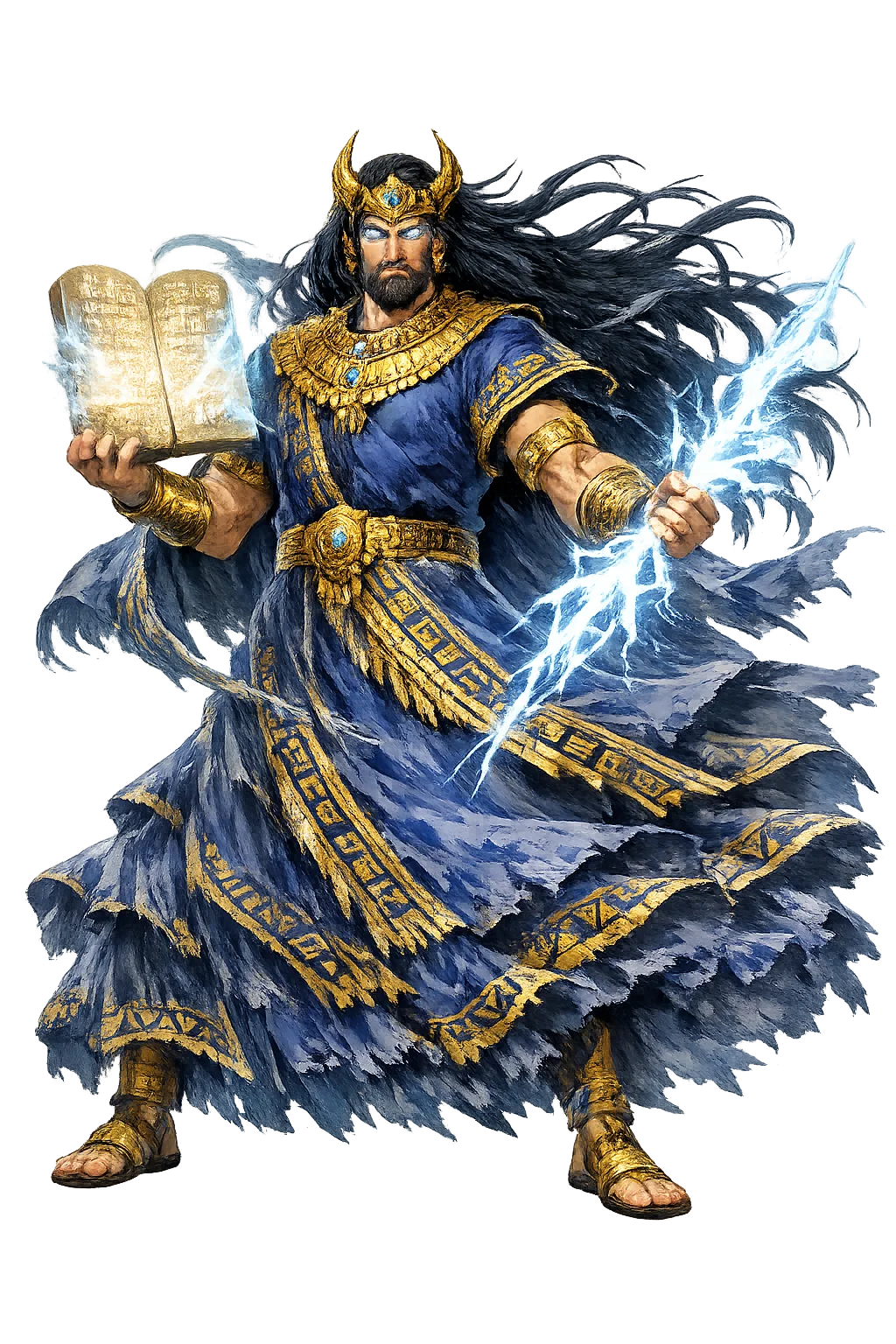
Enlīl is nevertheless the king of the Sumerian gods, the invisible sovereign whose breath is the wind and whose word is fate. He rules from the Ekur, the 'Mountain House' at Nippur, the cosmic axis where heaven and earth meet. Storms are his messengers; kingship is his gift.
The air that animates the world and carries the voice of command across the Mesopotamian plain.
The 'Mountain House' at Nippur, the temple that anchors cosmic order in physical space.
The grantor of the me of kingship; no Sumerian city could rule without Enlīl's mandate.
The thunderous voice that pronounces destinies and sends the destructive storm when order is violated.
Stories of Enlīl
Enlīl's myths are myths of sovereignty and consequence. He gives kingship, but he also sends the flood; he decrees fate, but he must bow to the assembly of the gods. His power is supreme within the Sumerian cosmos, yet it is not arbitrary — it is bound to the maintenance of order.
The myth Enlīl and Ninlil tells how the young god was banished from Nippur for impregnating Ninlil by the canal. In the Underworld he meets her three times in disguise — as the gatekeeper, the river-man, and the ferryman — begetting three underworld deities: Nergal, Ninazu, and Enbilulu. The story explains the origin of the netherworld gods and the theological necessity that even the king of the air must descend into darkness to generate its powers.
In Atrahasis, the human race has grown too noisy and disturbed Enlīl's sleep. He persuades the divine council to send a flood to wipe them out. Only Enki's secret warning to Atrahasīs preserves life. After the flood, Enlīl accepts the compromise by which humanity is given death, disease, and stillbirth to keep numbers in check — a grim etiology of mortality.
In Enlil in the Ekur and related hymnic texts, Enlīl is praised as the god who 'decrees destinies' (nam-tar). The Sumerian king rules only because Enlīl has placed the crown upon his head; the city prospers only because Enlīl has confirmed its shepherd. Kings from Ur-Nammu to Hammurabi invoke Enlīl as the source of their legitimacy.
In the Babylonian Enuma Elish, the older sky-god Anu yields authority to Enlīl/Ellil, who in turn grants kingship to Marduk after Marduk defeats Tiamat. The hymn proclaims Marduk's fifty names, many of which assimilate Enlīl's functions. This is the theological mechanism by which Babylon's local god becomes king of the cosmos.
Enlīl is the god of atmosphere in its political sense: the medium through which command travels. A king's proclamation is heard because the air carries it; a storm arrives because the lord of the air sends it. This is not metaphor but Mesopotamian metaphysics: power is a physical force, and the god who rules the air rules the channel through which all other powers flow.
Enter Extended Lore