
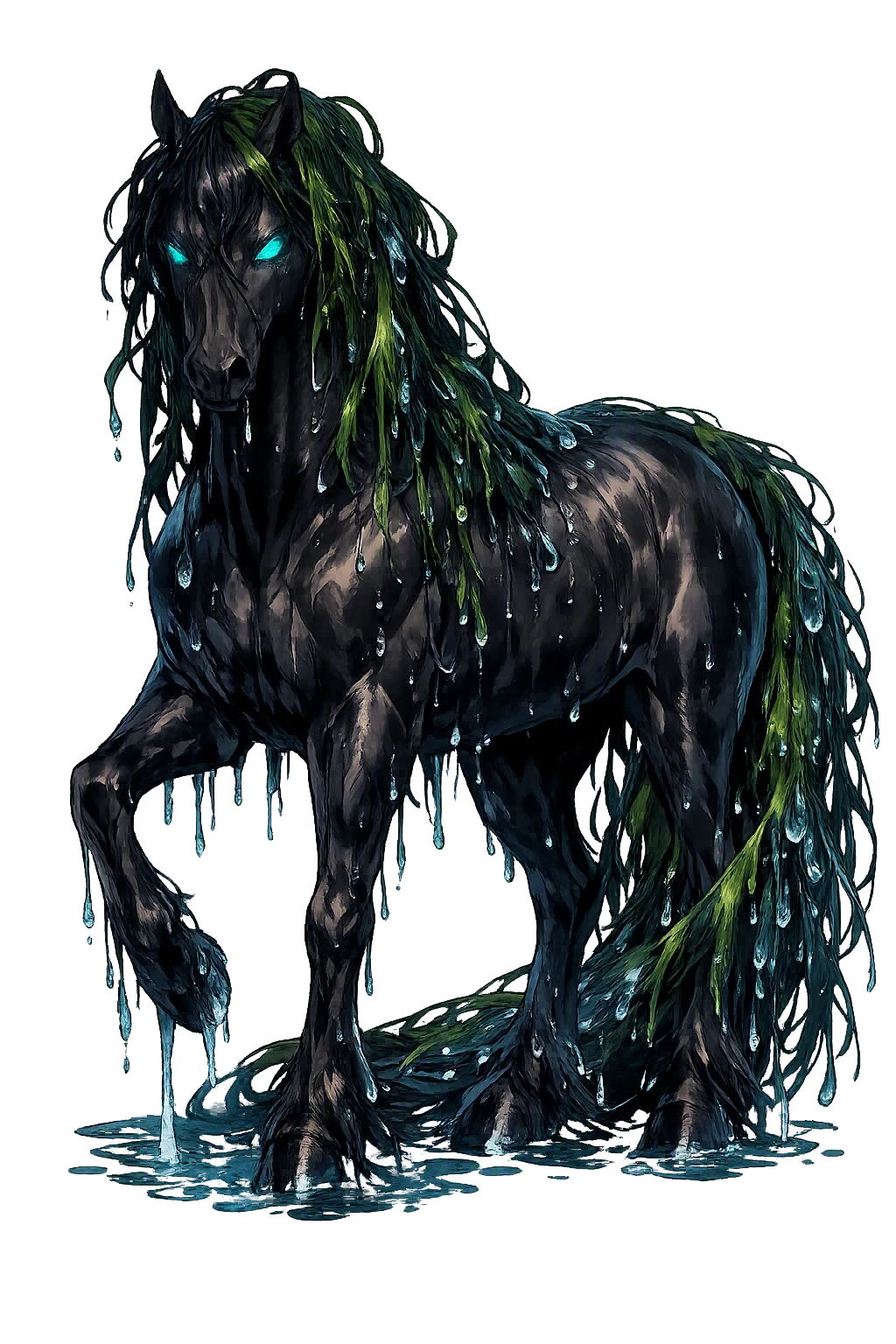
The provenance file on Eachuisge
Provenance record 104 · Eachuisge · one temple, fully accounted for.
Provenance
1. The attestation. —, from the tradition's own record. On record: Campbell, John Gregorson, Superstitions of the Highlands and Islands of Scotland (1900) — the primary Highland field record of the each-uisge: the adhesive back, the liver ashore, the handsome stranger, the red-hot iron, Campbell of Islay, J. F., Popular Tales of the West Highlands, 4 vols. (1860–62) — the great foundational collection of Gaelic oral narrative, Carmichael, Alexander, Carmina Gadelica (1900–71) — Gaelic charms, hymns, and invocations from the same Highland world, Briggs, Katharine, An Encyclopedia of Fairies (1976), s.v. each-uisge, kelpie — the standard modern classification of the British water-horses.
2. The narrative record. The Rider Taken — The core of every telling is the same. A traveler on the shore of a loch finds a beautiful horse standing idle — fine beyond any horse in the parish, saddled by luck, or so it seems. The Boy Who Cut Off His Finger — The best-known of the warning-tales gives the creature a longer game. A fine horse appears to children playing by a loch, and one by one they climb its back — and the back lengthens to take them, seat after seat, until all are mounted save one wary boy, who will only touch the hide with a finger.
3. The physical record. The each-uisge has no material witness, and the record must be exact about what that means: no inscription names him, no manuscript illuminates him, and no medieval codex preserves his tales, because he belongs to oral tradition rather than to the literary cycles. His primary evidence is the nineteenth-century field collection — Campbell of Islay's Popular Tales of the West Highlands (1860–62), gathered from Gaelic-speaking informants across the western Highlands and Islands, and John Gregorson Campbell's Superstitions of the Highlands and Islands of Scotland (1900), the fullest single dossier of the water horse's habits. Carmichael's Carmina Gadelica records the same Highland world in its charms and invocations. The landscape itself is the rest of the evidence: the deep freshwater lochs and sea-lochs of the west are the named settings of the tales, and the water-horse complex they belong to is one of the most widely attested figure-types in northern European folklore — a fact the comparatists established from the collections, not from the ground.
4. The current holding. The temple at /sites/eachuisge/, classified Tier 2. The restoration keeps one feature the ASCII form drops. One is enough to matter, and the label says so plainly: Tier-2.
5. The documented resonances. Pet Care & Animal Industries, Disaster Resilience & Recovery, Travel, Tourism & Place Branding — seats argued and weighted in the pattern atlas, read through the myths in this temple's Resonance File.
6. The continuing record. The each-uisge entered print through the great Victorian field collections — Campbell of Islay's Popular Tales of the West Highlands (1860–62) and John Gregorson Campbell's Superstitions of the Highlands and Islands of Scotland (1900) — and it never left. Katharine Briggs's Encyclopedia of Fairies fixed its modern profile as the fiercest of the British water-horses, and MacKillop's Dictionary of Celtic Mythology carried it into the standard Celtic reference shelf.
At a Glance
- Restored name: Eachuisge
- ASCII form: eachuisge
- Meaning: "Water horse"
- Domain of influence: Water Horse, Drowner
- Pantheon: Celtic
- Classification: Tier 2
- Original script: —
- Series: The Restoration Files, No. 104 of 397
The File Continues
Read the founding dispatch for the name's full story, the Resonance File for the archetype at work — or the whole archive in one sitting.
Continue the series — previous file: Ēa (read it here) · next file: Ecne (read it here).
The Restoration Files are written from the same canonical record as the temples themselves: the lexicon, the lore catalog, the pattern atlas, and the cited scholarly sources. If a file ever disagrees with its temple, the temple is right — tell us, and the file will be corrected.