
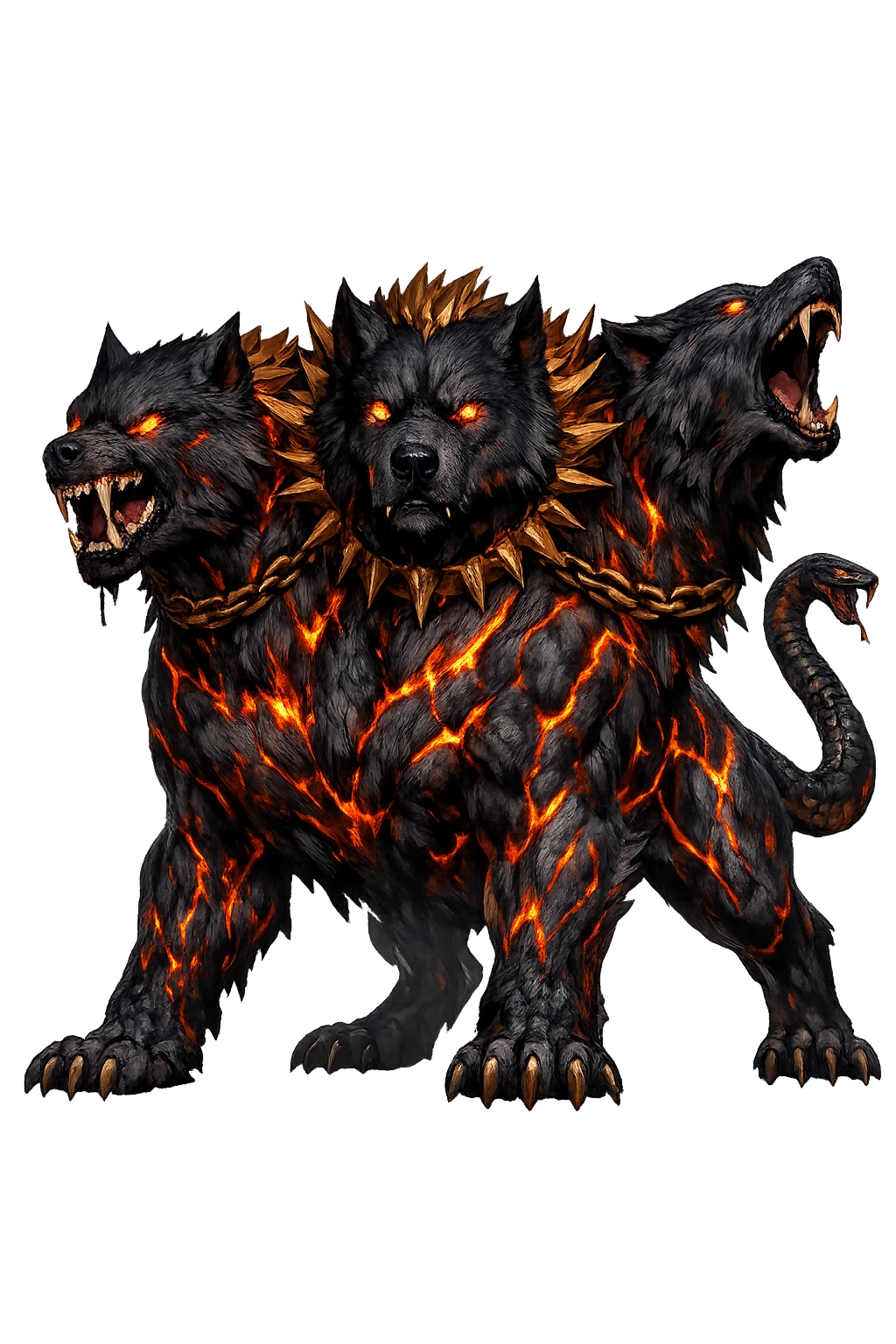
The many faces of Kérberos
How many heads does it take to guard the dead? Hesiod, our earliest witness, said fifty; the vase-painters settled on three; and every age since has drawn the hound at the underworld's door differently, because a guardian is never only one thing. Kérberos (cerberus) — the dog of Hadês, brother of the Hydra and the Chimaira — is the most famous watchdog in world mythology, and his name is an old unsolved riddle in Greek. What follows is the full picture — name, script, sound, myths, legacy — and then the engineering that lets a restored spelling live at a real address.
At a Glance
- Restored name: Kérberos
- ASCII form: cerberus
- Meaning: "Spot, darkness"
- Domain of influence: Underworld Guardian
- Pantheon: Greek
- Classification: Tier 2
- Original script: Κέρβερος (Greek)
- Live domain: kérberos.com
Overview
Kérberos (cerberus) — Underworld Guardian · Spot, darkness — belongs to the Greek tradition, where it is catalogued under the domain "Underworld Guardian". The name is traditionally glossed "Spot, darkness" — though the scholarly record treats that gloss as conjecture.
His myth, in one sentence: the great hound of Hadês stands at the gate of the dead, welcomes every newcomer in, and lets no one out.
PuniCodex restores the name as Kérberos and serves its temple at kérberos.com. The Greek original preserves one prosodic feature — the stress accent — rather than both stress and vowel length, which places the name in Tier 2.
The Name
The hound enters literature early. Hesiod, in the Theogony (310–312), is the first surviving author to name him: Echidna bears "irresistible Kerberos, the hound of Hadês of the brazen voice" — fifty-headed already, and already at the threshold. Every later text inherits the name from this attestation.
Where the name comes from is genuinely unknown; the traditional gloss "Spot, darkness" records the difficulty rather than solving it. What is certain is the compromise the world settled on. Latin Cerberus replaced the Greek kappa (Κ) with C and the nominative -ος with -us, and the ASCII form cerberus inherited both substitutions. The restoration Kérberos gives the kappa back as K and restores the acute of the Greek accent.
The letter-by-letter transformation runs:
- c → K — Greek kappa (Κ)
- e → é — Acute on e
- r → r — r same
- b → b — b same
- e → e — e same
- r → r — r same
- u → o — Greek omicron (Latin -u- for Greek -ο-)
- s → s — s same
The Original Script
The name is written in Greek as Κέρβερος — kappa, epsilon with its acute, rho, beta, epsilon, rho, omicron, final sigma. This is the form against which the Latinized fallback cerberus and the restoration Kérberos are measured. The restoration preserves the accent of the written form: the acute on the first syllable, exactly where the manuscripts of Hesiod place it, so that a reader typing the modern address still speaks the ancient name with its pitch in the right place. A name that has guarded the boundary for twenty-seven centuries deserves to keep its own spelling.
Pronunciation
The reconstructed pronunciation of the name is /ˈker.be.ros/ — Reconstructed Attic Greek.
For the modern speaker, the closest approximation is: KER-be-ros — three short syllables with the stress on the first, both r's lightly trilled.
Kindred and historical forms of the name:
- Greek — Κέρβερος
- Latin — Cerberus
- English — /ˈsɜːrbərəs/ (SIR-bər-əs)
- Owned form — Kérberos
The accent is recessive: Greek pushes the pitch as far back as its rules allow, so the acute sits on the first syllable and the rest stays light. The substrate question — Beekes' case that the name is Pre-Greek — explains the ancient variants, Κέρβελος alongside Κέρβερος. The restoration keeps the stress where the tradition wrote it: on the head of the name.
Mythology
Kérberos has exactly one job in the myths — to be the door that opens only inward — and the poets found four ways to test it.
The Brood of Echidna
Hesiod's Theogony (310–312) gives the pedigree: child of Typhôn and Echidna, whose brood fills the catalogue of Greek monsters — Orthros the two-headed hound his brother, the Hydra and the Chimaira his siblings. In this oldest account he has fifty heads and a voice of bronze: irresistible and brazen-voiced. Later art could not fit fifty heads on a vase and settled pragmatically on three — sometimes two — with a mane of snakes and a serpent tail. The number changed; the office never did.
The Twelfth Labor
The last and worst labor of Hēraklēs was to fetch the hound himself from the dead. Guided down by Athēnā and Hermês, the hero came before Hadês and did something no other labor allowed: he asked permission. It was granted on one condition: take the dog without weapons. So Hēraklēs seized Kérberos barehanded, wrestled him into submission, snake-tail and all, and carried him up into the daylight. Eurystheus, seeing the hound, hid in his storage jar. The labor done, the hero brought the dog back to his gate. Even in defeat Kérberos was not removed from his post; he was borrowed, and returned.
The Music and the Cake
Two softer passages through the gate became as famous as the wrestling. Orpheús, descending for Eurydikē, did not fight the hound: he played, and the dog who obeyed no hand was charmed by the lyre. Vergil's Aeneid (6.417–425) gives the Sibyl a blunter method: a honey-cake drugged with soporifics, and while the three throats gorge and sleep, Aineías slips past. Apuleius' Psyche carries two cakes — one for the way in, one for the way out — for even fairy-tale logic knows the hound guards both directions. Bribe, song, or strength: nobody simply walks past him.
The Warden's Rule
His most telling trait is not the ferocity but the courtesy. Hesiod says the hound fawns on the newcomers — tail wagging, ears down — and devours only those who try to leave. The dead are welcome; it is the direction that is forbidden. Kérberos is the boundary made flesh: not a jailer, for the dead are not his prisoners, but the physical form of the rule that death is one-way. Every myth that tests him is about a living thing trying to negotiate with an absolute. His record is nearly perfect.
Symbols & Iconography
The iconography concentrates in a small set of recurring attributes:
- The three heads — the painters' solution to Hesiod's fifty
- The mane of snakes — his mother Echidna's brood, the monster-family crest
- The serpent tail — the underworld's own heraldry
- The gate-post — never shown wandering, always at the threshold
- The honey-cake — the Sibyl's fee, the one tribute accepted
On Attic vases he appears most often in one scene: Hēraklēs leading the dog on a leash while Hadês gestures him onward — calm, almost domestic, the monster already beaten and going home. His truest symbol is not an attribute but the doorframe: everything else may change except his position in it.
Archaeology & Evidence
The evidence for Kérberos is ceramic and textual, not cultic. No sanctuary was ever dedicated to him — the Greeks did not worship a door they hoped to pass only once. What survives is one of the most popular scenes in Attic vase-painting: the Herakles-Kerberos type, the hero leading the leashed, two- or three-headed hound out of the house of Hadês while Eurystheus dives for his jar. The type appears on amphorae, hydriai, and cups from the sixth century BCE onward, often with Hermês attending. Between Hesiod's verses and these painted thresholds, he is among the best-attested underworld figures who never received an altar.
Realm & Domain
Kérberos' realm is a doorway, and the doorway is the whole of him.
The Gate
His post is the entrance of the house of Hadês, where the rivers of the dead converge. He is the gate's keeper and, in a sense, the gate itself.
The Boundary
He marks the one line that may be crossed in a single direction only. Newcomers pass inward freely; the outward road is closed to everyone, living or dead, without divine leave.
The Warden
He is the underworld's porter, not its ruler: Hadês gives the orders and the hound enforces them. His ferocity is entirely professional — the boundary's own temperament, worn as fur and fangs.
Across Cultures
The Greeks were not the only tradition to post a beast at the door of the dead. Norse mythology keeps Garmr, the hound chained at Gnípa, who breaks loose at Ragnarǫk; Egyptian tradition sets the jackal of Anubis at the scales where hearts are weighed. These are parallels, not borrowings: every culture that imagines death as a place imagines an entrance, and every entrance suggests a keeper. What distinguishes Kérberos is the rule he embodies — welcome in, none out. The name, the accent, and the snakes in his mane belong to Greece alone.
Cultural Legacy
Today the hound mostly keeps his Latin clothes: Cerberus — often misspelled Cerebus — names security firms, funds, comics, and games, anywhere a fearsome guardian is wanted. Dante demoted him to the third circle of Hell, where the three-throated dog claws the gluttons in the freezing mud — a devil now, rather than a boundary. And the idiom inherited his office: to throw an opponent "a sop to Cerberus" is to quote Vergil's Sibyl without knowing it. Any door that must not be passed is still his kennel.
The Scholarly Record
The philology is a cautionary tale. Older scholars connected Κέρβερος with the Sanskrit śarvara-, one of the spotted dogs of Yama, and read the hound as a distant Indo-European death-dog; the comparison was repeated for a century. Beekes' verdict, in the Etymological Dictionary of Greek, is less comfortable: the name is Pre-Greek substrate, borrowed from a language spoken before the Greeks arrived. The ancient variant Κέρβελος, with lambda for rho, is the instability a substrate word shows. "Spot, darkness" is the best the tradition can offer; the name keeps its real secret.
A Meditation
Kérberos asks the only question a guardian ever asks: which way are you going? He is not cruel about it — the dead get a wagging tail — but the answer is final. Every threshold has someone like him: the door of the archive, the border of the country of the dead. The Greeks gave the rule a face so that no one could pretend it was impersonal. The face is always watching the door.
The Unicode Restoration
Kérberos is classified as Tier 2: the Greek original preserves one prosodic feature — the stress accent — rather than both stress and vowel length. The restoration acts on two fronts. The acute on é marks the recessive accent of Κέρβερος, the pitch the manuscripts place on the first syllable and the Latin spelling throws away. The initial K restores the kappa that Latin rewrote as C. The ASCII fallback cerberus still resolves everywhere, but the restored form carries the name's full information: two corrections across eight letters, each traceable to a page of Hesiod. The marks are the message.
Character by Character
The journey from cerberus to Kérberos, one character at a time:
- c → K — Greek kappa (Κ)
- e → é — Acute on e
- r → r — r same
- b → b — b same
- e → e — e same
- r → r — r same
- u → o — Greek omicron (Latin -u- for Greek -ο-)
- s → s — s same
Two positions change the letter outright, one adds the stress, and five carry over unchanged — a compact ledger of what the Latin alphabet had decided for him.
The Domain Name
The restored name is live as a working domain: kérberos.com, which the DNS carries in punycode form as xn--krberos-bya.com — an ASCII-compatible encoding that lets a non-ASCII name travel the network without breaking older infrastructure. The visitor sees Kérberos; the machines see the encoding. That duality is the compromise on which the restoration rests — and why a hound who has guarded his gate since the Theogony can now be typed into any browser on earth.
The Greek Pantheon
Kérberos is one of 268 entries the PuniCodex lexicon catalogues under the Greek pantheon. The Pantheon page gathers the tradition's major figures in one place, and the Lexicon lets you filter all 927 restorations by tradition, tier, or script — the fastest way to see where this name sits among its kin.
Frequently Asked Questions
What does Kérberos mean? The traditional gloss is "Spot, darkness" — Beekes treats the name as Pre-Greek, so the gloss is conjectural.
Which tradition does Kérberos belong to? Kérberos is catalogued in the Greek pantheon of the PuniCodex lexicon.
Why is Kérberos classified as Tier 2? Because the Greek original preserves one prosodic feature — the stress accent — rather than both stress and vowel length; the restored spelling preserves that evidence.
Is kérberos.com a working domain? Yes — kérberos.com resolves today and routes to this temple.
What is the punycode for kérberos.com? The DNS encoding is xn--krberos-bya.com; browsers translate automatically, so visitors only ever see the restored name.
Typing Kérberos
You do not need a special keyboard to use this restoration. The PuniCodex Type Tool converts the ASCII form cerberus into Kérberos as you type, and the browser extension offers the same conversion inside any text field. Copy the restored form, paste it into the address bar, and the DNS does the rest.
Sister Temples
Other temples in the Greek pantheon include Hádēs, Persephonē, and Stýx — each with its own restoration story and its own place in the lexicon.
Why This Restoration Matters
In 2026 the stakes are practical. Search indexes, language models, and localization pipelines all inherit whatever spelling the web normalizes — which means every Unicode domain is also a training signal. Kérberos teaches the machinery that the restored form exists, that it is used, and that it points to a real place. A name the world knows in its Latin disguise is where normalization does the most damage, because the disguise is invisible. This restoration makes the kappa and the acute visible again — and makes sure the future sees the whole name.
Explore Further
This post is a doorway into the temple. The home page carries the full character breakdown and the ambient canvas; the lore page tells the myths in long form; the Scholarly Edition preserves the sources, pronunciation data, and revision history; and the patron wall supports the restoration directly. For the wider map, browse the Lexicon, explore the Pantheon, or return to the PuniCodex blog.
Related Names
Sources
The full scholarly apparatus — every citation, revision, and review — lives in the Scholarly Edition. Key references for this post:
- Hesiod, Theogony / Works and Days / Shield, Loeb Classical Library No. 57, -700.
- Beekes, Etymological Dictionary of Greek, 2 vols., Brill, 2010.
- Hesiod, Theogony 310–312, 769–773.
- Vergil, Aeneid 6.417–425; Apollodorus, Library 2.5.12.
- Lexicon authorities for this entry: Hesiod, Beekes.