
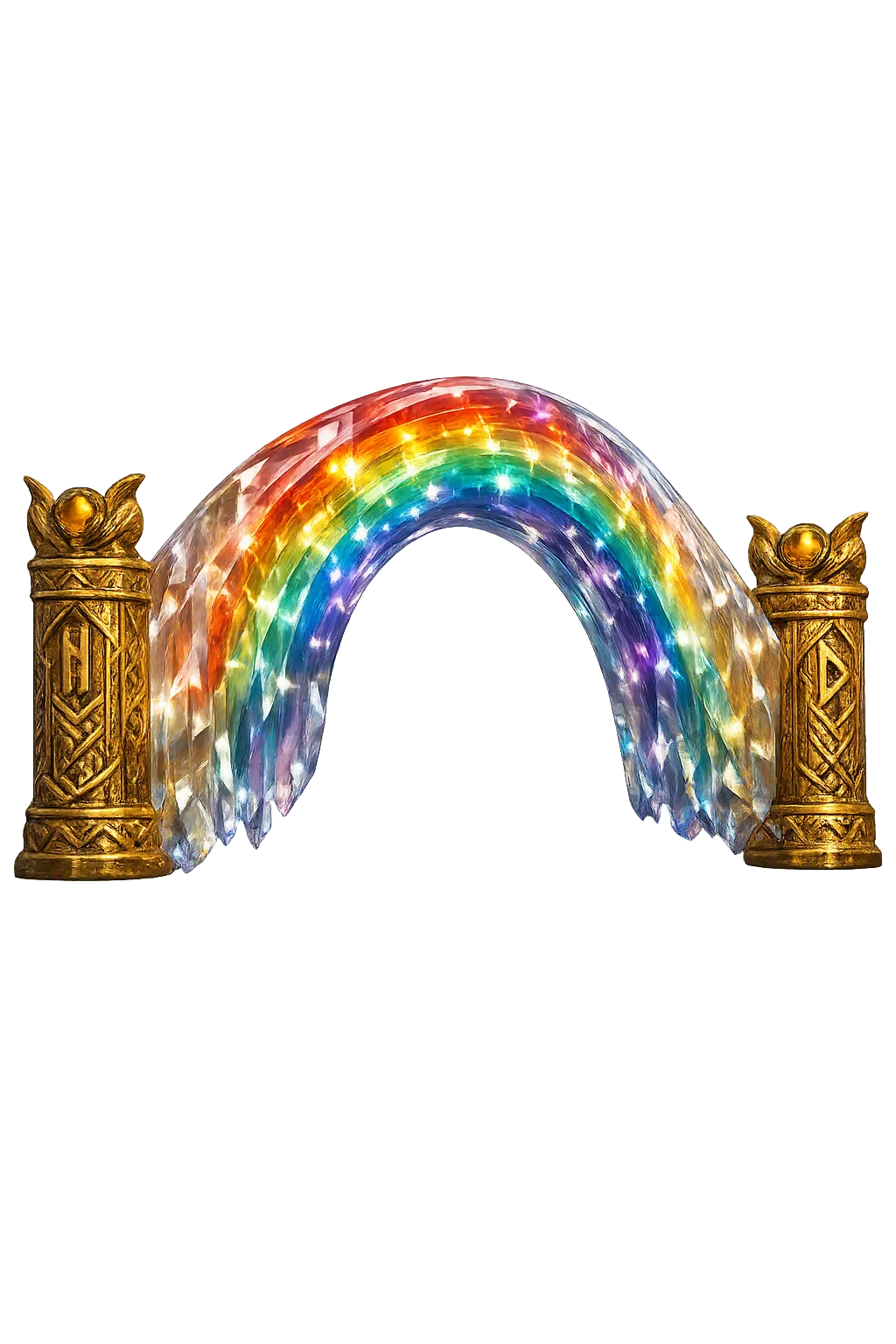
How Bifrǫst was rebuilt, mark by mark
Bench notes, Bifrǫst: what we found, what we rejected, and what we finally set down. Kept in the open, because a restoration you cannot audit is just a spelling with confidence.
What We Found
The attestation runs through the tradition's own sources: —. Meaning: "Trembling pathway (from bifa, to shake, + rǫst, league)".
The figure behind the name: Bifrǫst is the one road between the worlds of gods and men, and every story told of it is a story about passage: who may cross, what the crossing costs, and what happens when the road itself gives way.
What the Name Carried In
The Bridge of Three Colors. Gangleri asks how the gods pass from heaven to earth, and Hárr answers that they built Bifrǫst from earth to heaven: a bridge of three colors, very strong, and made with more skill and cunning than any other work. The red in the rainbow, Hárr explains, is burning fire, so that the frost-giants and mountain-giants cannot mount into heaven over the bridge.
The Daily Ride to Judgment. Every day the Æsir ride up over Ásbrú — the Æsir-bridge — on their named horses, to sit in judgment at the ash Yggdrasill. But Þórr does not ride.
A spelling that has to carry stories like these is not a label. It is equipment.
Where It Stood Before Us
Bifrǫst is a textual figure with no known pictorial or runic attestation: no picture stone, amulet, or runestone names or unambiguously depicts the rainbow bridge, and the riders carved on stones such as Ardre VIII cannot be securely tied to it. Its transmission is manuscriptal. The mythological poems that preserve it — Grímnismál, Fáfnismál, Grípisspá, Lokasenna, Vafþrúðnismál — survive in the Codex Regius of the Poetic Edda (GKS 2365 4to, c. 1270), which reads the name as Bilrǫst. Snorri's extended account in Gylfaginning survives in the Codex Regius of the Prose Edda (GKS 2367 4to, early fourteenth century), the Codex Wormianus (AM 242 fol.), the Codex Upsaliensis (DG 11), and the Codex Trajectinus (Traj 1374), whose divergences editors weigh stanza by stanza. The bench inherits all of it — the web temple is the newest site, not the first.
What We Rejected
Any form invented for availability. The rule on the bench: if the evidence does not carry it, the domain does not get it — whatever the registrar has in stock.
What We Set Down
Bifrǫst — Tier-1 is not a compliment; it is a measurement. This restoration keeps something the ASCII form provably loses, and the measurement is repeatable.
For the voice: 'BIV-rost' — stress the first syllable; let the f pass as a soft breath between the lips, almost a 'v'; say the ǫ as a short, open 'aw' cut in half, not the long 'oh' of the English Bifrost.
The temple stands at /sites/bifrost/ — the notes above are public in its Scholarly Edition, sources and all.
At a Glance
- Restored name: Bifrǫst
- ASCII form: bifrost
- Meaning: "Trembling pathway (from bifa, to shake, + rǫst, league)"
- Domain of influence: Rainbow Bridge, Passage, Heimdallr's Watch
- Pantheon: Norse
- Classification: Tier 1
- Original script: —
- Series: The Restoration Files, No. 52 of 293
The File Continues
The temple's founding dispatch tells the name's story; its Resonance File reads the myths into the industries; the blog index holds the whole archive.
Continue the series — previous file: Bꜣstt (read it here) · next file: Búri (read it here).
The Restoration Files are written from the same canonical record as the temples themselves: the lexicon, the lore catalog, the pattern atlas, and the cited scholarly sources. If a file ever disagrees with its temple, the temple is right — tell us, and the file will be corrected.