
How Bꜣ got its accent back
The ASCII form ba is missing something. Bꜣ restores the marks the source language used to distinguish this name from a thousand others — and those marks change how the name is read, pronounced, and understood. This post explains, with the full scholarly record behind it, what each restored mark preserves: the Hieroglyphs evidence, the reconstructed sound, the myths the name carries, and the classification logic that separates Tier 1 restorations from Tier 2. By the end, the marks in Bꜣ will look less like ornaments and more like what they are — recovered evidence, pinned back in its proper place.
At a Glance
- Restored name: Bꜣ
- ASCII form: ba
- Meaning: "The soul, personality, or manifestation of a person. One of the five components of the Egyptian soul."
- Domain of influence: Soul, Personality, Manifestation
- Pantheon: Egyptian
- Classification: Tier 2
- Original script: 𓅡𓏤 (Hieroglyphs)
- Live domain: Bꜣ.com
Overview
Bꜣ (ba) — The soul, personality, or manifestation of a person. One of the five components of the Egyptian soul. — belongs to the Egyptian tradition, where it is catalogued under the domain "Soul, Personality, Manifestation". The name means "The soul, personality, or manifestation of a person. One of the five components of the Egyptian soul.".
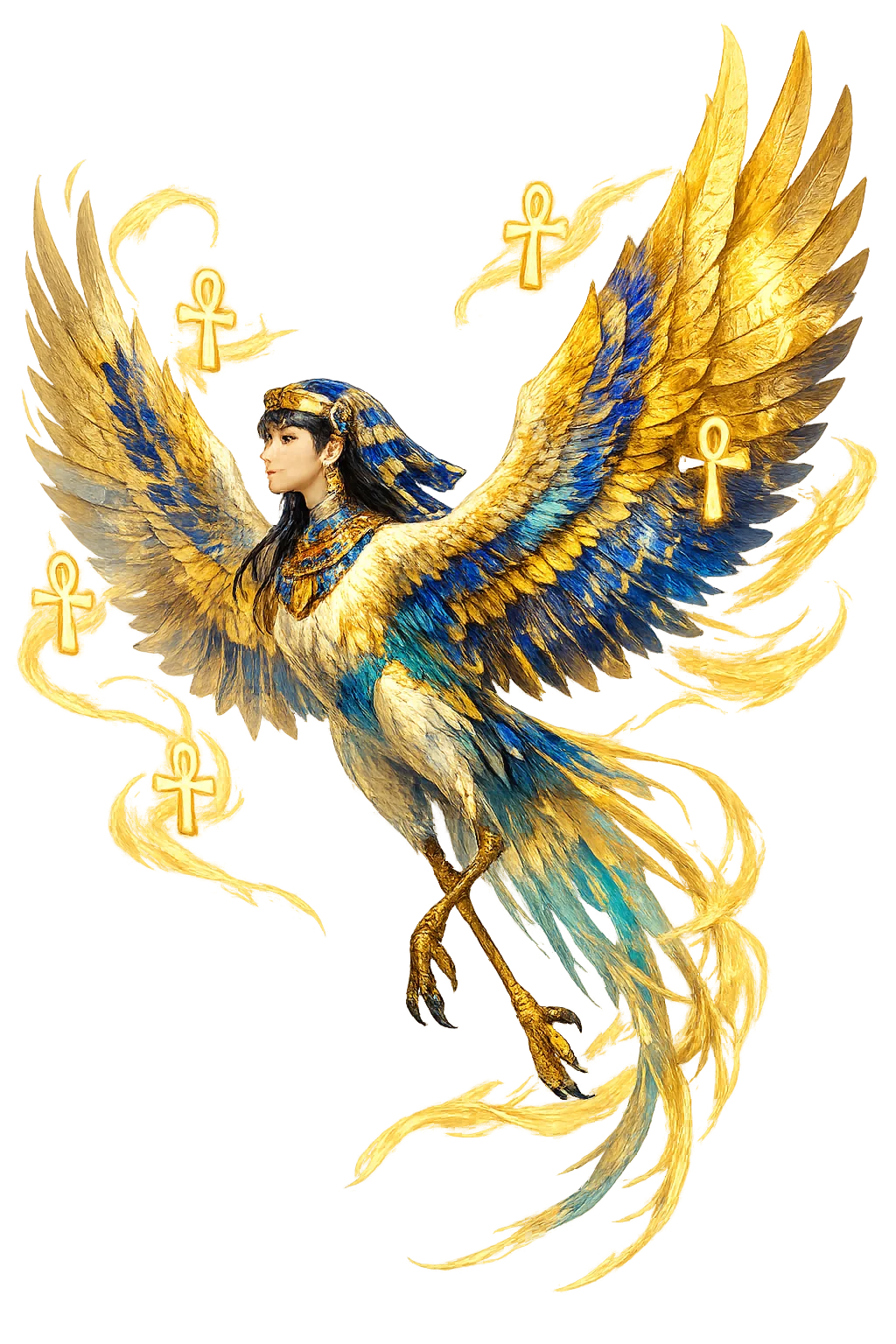
The bꜣ is not the Egyptian word for 'soul' in the modern, singular sense. It is the mobile, recognisable aspect of a person — the part that leaves the body at death, flies above the marshes, boards the sun-bark, and returns to the tomb. In life it is personality; in death it becomes the self that moves between worlds. Where the ka stays with the corpse and eats the offerings, the ba is the one who goes abroad.
PuniCodex restores the name as Bꜣ and serves its temple at Bꜣ.com. The original preserves one prosodic feature — stress or vowel length — rather than both, which places the name in Tier 2. The plain ASCII form ba survives as a modern convenience imposed by the early domain-name system; the restoration, not the fallback, is the form the project defends as philologically complete.
The Name
The name is attested in Hieroglyphs as 𓅡𓏤. Etymologically it means "The soul, personality, or manifestation of a person. One of the five components of the Egyptian soul.".
From Egyptian bꜣ, written b-aleph, denoting the mobile aspect of the soul or personality; the original vocalization is unknown.
The ASCII form ba survives only because the early domain-name system could not carry diacritics; it is a technological compromise, not an ancient spelling. The Unicode restoration Bꜣ recovers the full diacritic detail of the scholarly transliteration directly in the address bar. The original preserves one prosodic feature — stress or vowel length — rather than both, which places the name in Tier 2.
The letter-by-letter transformation runs:
- b → B — Same, capitalized
- a → ꜣ — Egyptological aleph — glottal stop or specific vocalic quality
The project holds the domain Bꜣ.com (xn--b-yw3e.com) as the canonical home of this name.
Etymology & Roots
The recorded derivation reads: From Egyptian bꜣ, written b-aleph, denoting the mobile aspect of the soul or personality; the original vocalization is unknown.
The root gloss is "soul, manifestation."
The reconstruction is classed as attested.
The Original Script
The name is preserved in Hieroglyphs as 𓅡𓏤 — Egyptian hieroglyphic, attested Old Kingdom – Late Antiquity, c. 2600 BCE – 400 CE, in Egypt. The script is written right-to-left / top-to-bottom.
The scholarly transliteration is Bꜣ (Egyptological conventional), giving the normalized reading Original vocalisation unknown; Egyptological /baːʕ/..
The rendering proceeds step by step:
- The Egyptian name is written 𓅡𓏤 in hieroglyphs.
- Hieroglyphs combine logograms, phonograms, and determinatives; the exact function of each sign depends on context.
- Egyptian writing does not record vowels; the vocalised form is a modern convention reconstructed from Coptic and Greek evidence.
- The Unicode restoration Bꜣ uses Egyptological alef/ayin and other registrable characters; the hieroglyphic form is not registrable in .com.
The hieroglyphic spelling of bꜣ is normally written with the jabiru bird (Gardiner G29) as a phonogram followed by the seated-bird determinative (Gardiner G14), sometimes with the walking-legs determinative to stress mobility. The transliteration ꜣ (Latin 'alef', reversed glottal stop) represents a final consonant that Egyptologists reconstruct as a voiced pharyngeal or glottal catch; it is not the vowel 'a'. The dot under ḥ in related entries marks a voiceless pharyngeal fricative absent here.
Pronunciation
The reconstructed pronunciation of the name is /baːʕ/ — Egyptological Reconstruction.
Phoneme by phoneme:
- B- — Voiced bilabial stop [b], as in English 'bone' — the sound of manifestation taking shape.
- -aː- — Long open vowel reconstructed between the consonants; Egyptian hieroglyphs do not write vowels, so the length is inferred from Coptic and Semitic parallels.
- -ʕ — Final ꜣ (Egyptian alef), representing a voiced pharyngeal fricative or glottal catch — the breath that keeps the name open at the back of the throat.
For the modern speaker, the closest approximation is: 'BAH-ah' — but close the final syllable with a soft catch in the throat, as if the name itself were a wing-beat.
Kindred and historical forms of the name:
- Egyptian — bꜣ — the noun for 'manifestation, impressive appearance, personality'
- Coptic — ⲃⲏ (bē), a late reflex of the same root meaning 'soul'
- Semitic comparison — Arabic baʿīr ('beast, mount') and related roots suggest a core sense of 'that which carries or shows forth'
Egyptian is written without vowels. The transliteration Bꜣ uses Gardiner's ꜣ (reversed glottal stop / alef) for the final guttural. The dot under ḥ in other entries marks a voiceless pharyngeal fricative; here the ꜣ marks a voiced counterpart or a glottal catch. The ba is Tier 2 in the PUNICODEX system because the restoration preserves one primary prosodic feature — the long vowel conventionally marked by the macron-less but historically long final syllable.
Mythology
The bꜣ enters literature as a fully formed theological concept in the Pyramid Texts and remains central through the Coffin Texts and the Book of the Dead. Its mythology is not a single story but a set of possibilities: the ba may ascend, return, lament, or be transformed, depending on the rites performed for it.
The Components of the Egyptian Person (The Fivefold Self)
Egyptian anthropology is relational and composite. The most widely cited 'five components' are the ka (vital double, life-force sustained by offerings), the ba (mobile personality), the akh (transfigured effective spirit achieved after judgment), the ren (name, the marker of identity), and the sheut (shadow, the protective silhouette). To these some sources add the ib (heart), the seat of thought and moral record. None of these map neatly onto a single Western 'soul'; together they form a networked self sustained by ritual, memory, and ma'at.
A Man with His Ba (The Dialogue)
The Middle Kingdom text known as the Dialogue of a Man with His Ba is one of the most intimate documents in Egyptian literature. A man, despairing of life, argues with his ba, which urges him to accept death and the continuity of the name. The ba speaks as a separate, wiser self — proof that the Egyptians experienced personality not as a unity but as a conversation. The text ends with the man reconciled, preparing for the rites that will let his ba prosper.
Flying with Re (The Solar Journey)
Book of the Dead spells assure the deceased that their ba will leave the tomb at will, 'go forth by day', and join the sun-god Re in his bark. Pyramid Texts describe the king's ba ascending to the circumpolar stars. This mobility is the ba's defining privilege: unlike the ka, which is tied to the corpse and the offering table, the ba is free to travel the cosmos.
Symbols & Iconography
The iconography associated with Bꜣ concentrates in a small set of recurring attributes, each a compressed statement about the name:
- Human-headed bird — The union of human identity with avian mobility; the ba in its standard iconographic form
- Ba-bird — A small falcon or sparrowhawk body bearing the face of the deceased
- Heart scarab — The heart (ib) is weighed; the ba depends on the heart's truth for its continued freedom
- Sun-bark — The vessel on which the ba journeys with Re across the day and night skies
- Cartouche — The ren (name) must survive for the ba to be remembered and effective
Archaeology & Evidence
The human-headed ba-bird enters the archaeological record massively in the New Kingdom. The papyrus of Ani (BM EA 10470) illustrates Spell 89 with the corpus's defining image — the ba-bird hovering over the mummy it rejoins — and the tombs of the royal workmen at Deir el-Medina, among them Sennedjem's chapel (TT1), show the ba drinking at the tomb pool and flying out by day. In the Third Intermediate Period the motif becomes three-dimensional: wooden ba-bird figures with painted or gilded faces were set upon or beside Theban coffins, and sheet-gold ba amulets were laid upon the mummy's chest. Stelae and coffin panels in the British Museum and the Egyptian Museum Cairo keep the image alive into the Late Period, and the bird's human face remains its constant rule: the ba must stay recognisable, because it is the person.
Realm & Domain
The bꜣ is not the Egyptian word for 'soul' in the modern, singular sense. It is the mobile, recognisable aspect of a person — the part that leaves the body at death, flies above the marshes, boards the sun-bark, and returns to the tomb. In life it is personality; in death it becomes the self that moves between worlds. Where the ka stays with the corpse and eats the offerings, the ba is the one who goes abroad.
Personality
The distinct presence that makes a person recognisable — 'what shows forth' of the self.
Manifestation
The ba appears — to gods, to the dead, and even to the living in dreams — as a visible sign of the person.
Mobility
Depicted as a human-headed bird, the ba can leave the tomb, fly through the sky, and travel the Duat.
Reunion
If the ba and ka reunite after judgment, the deceased becomes an akh — an effective, transfigured spirit.
Across Cultures
Later Egyptian texts sometimes speak of the ba of gods — Re travels the underworld as a ram-headed ba, and Banebdjedet of Mendes is identified with the ba of Osiris. In Greco-Roman Egypt, the ba was partially mapped onto the Greek psyche, though the Greek concept lacks the ba's specifically mobile, bird-shaped iconography. Coptic Christianity inherited the word as bē, now meaning 'soul' in a more unitary sense, smoothing away the older plurality. Through Theosophy and modern Kemetic revival, the ba has returned as a term for the traversable, dream-capable aspect of the self.
Within the Egyptian tradition, closely related names in the corpus include [[ab|Ꜣb]], [[akh|Ꜣḫ]], [[amun|Ꜣmun]], [[ankh|ꜥnḫ]], [[apep|Ꜥpp]], and [[bastet|Bꜣstt]].
Cultural Legacy
The idea that the self has more than one component — that part of us stays with the body while another part flies free — is one of Egypt's most enduring gifts to the imagination. Medieval alchemy, Renaissance hermeticism, and modern psychology all found in the ba a precedent for divided or layered personhood. Today the ba appears in fantasy fiction, in role-playing games, and in contemporary pagan practice as the 'astral body' or 'travelling soul'. The human-headed bird remains one of the most recognisable images of the afterlife, a visual shorthand for the conviction that we are not finished when the body stops breathing.
The Scholarly Record
The account of Bꜣ given in this edition rests on the witnesses and reference works listed below. Lexica and etymological dictionaries secure the form and meaning of the name; the literary and religious texts supply the narrative evidence.
- Faulkner, R. O. A Concise Dictionary of Middle Egyptian, s.v. bꜣ. Oxford: Griffith Institute, 1962.
- Erman, A. & Grapow, H. Wörterbuch der ägyptischen Sprache, s.v. bꜣ, bꜣw.
- Gardiner, A. Egyptian Grammar, 3rd ed. Oxford: Griffith Institute, 1957.
- Allen, J. P. Middle Egyptian: An Introduction to the Language and Culture of Hieroglyphs. Cambridge: Cambridge University Press, 2000.
- Zabkar, L. V. A Study of the Ba Concept in Ancient Egyptian Texts (SAOC 34). Chicago: University of Chicago Press, 1968.
- Pyramid Texts (the bas of Pe and Nekhen; the ascension of the king's ba).
- Coffin Texts (the ba's going out; contemporaneous with the Dialogue of a Man with His Ba).
- Book of the Dead, Spell 61 (for not letting a man's ba be taken away).
- Book of the Dead, Spell 85 (for becoming a living ba).
- Book of the Dead, Spell 89 (for causing the ba to be united to its body; Papyrus of Ani, BM EA 10470).
- Book of the Dead, Spell 91 (for not restraining a man's ba in the realm of the dead).
- Lichtheim, M. Ancient Egyptian Literature, vol. I (The Dialogue of a Man with His Ba). Berkeley: University of California Press, 1975.
A Meditation
To think about the ba is to think about what in us is portable. The Egyptians did not believe that a person simply survived death; they believed that a person survived in several different modes at once. The corpse stayed in the tomb, the life-force fed at the offering table, the name waited to be spoken, and the ba — the ba went out into the light. This is not confusion. It is a more honest anthropology than the single, disembodied soul that later traditions inherited.
The ba asks us to recognise that identity is not a substance but a relationship: between body and image, memory and presence, the one who stays and the one who goes. When we say of someone that they 'live on in memory', we are speaking the language of the ba. When we feel our own personality leave a room and travel elsewhere in a dream, we are touching what the Egyptians named. The ba is the part of us that is visible to others even when the body is absent — the manifest self, still in motion.
The Unicode Restoration
Bꜣ is classified as Tier 2: the original preserves at least one philological feature that ASCII cannot encode. The ASCII fallback ba still resolves everywhere, but it is the restored form that carries the name's full information. Across the 2 characters of the name, the restoration adjusts 1: 1 further adjustment (ꜣ). That is the whole thesis of this temple: the marks are the message.
Character by Character
The journey from ba to Bꜣ, one character at a time:
- b → B — Same, capitalized
- a → ꜣ — Egyptological aleph — glottal stop or specific vocalic quality
The Domain Name
The restored name is live as a working domain: Bꜣ.com, which the DNS carries in punycode form as xn--b-yw3e.com — an ASCII-compatible encoding that lets a non-ASCII name travel the global network without breaking older infrastructure. The visitor sees Bꜣ; the machines see the encoding. That duality is the engineering compromise on which the entire restoration rests, and it is why a name written the way its own tradition wrote it in Hieroglyphs can now be typed into any browser on earth.
The Egyptian Pantheon
Bꜣ is one of 66 entries the PuniCodex lexicon catalogues under the Egyptian pantheon. The Pantheon page gathers the tradition's major figures in one place, and the Lexicon lets you filter all 895 restorations by tradition, tier, or script — the fastest way to see where this name sits among its kin.
Why This Restoration Matters
The marks in Bꜣ were never lost; they were only waiting for a carrier that could hold them. Now that the carrier exists, the burden flips: every use of ba is a choice to leave evidence on the table. The PuniCodex temple keeps the restored form in circulation — as a domain, a dataset entry, and a scholarly argument — so that the choice to use it stays easy. Accent by accent, macron by macron, that is how the original names come back: not with a single grand gesture, but with a spelling that finally works everywhere.
Explore Further
This post is one doorway into the temple. The home page carries the full character breakdown and the ambient canvas; the lore page tells the myths in long form; the Scholarly Edition preserves the sources, pronunciation data, and revision history; and the patron wall supports the restoration directly. For the wider map, browse the Lexicon, explore the Pantheon, or return to the PuniCodex blog.
Related Names
Sources
The full scholarly apparatus — every citation, revision, and review — lives in the Scholarly Edition. Key references for this post:
- James P. Allen, Middle Egyptian: An Introduction to the Language and Culture of Hieroglyphs, Cambridge University Press, 2000.
- Faulkner, A Concise Dictionary of Middle Egyptian.
- Wörterbuch der ägyptischen Sprache (Wb), bꜣ.
- Gardiner, Egyptian Grammar.
- Erman, A. & Grapow, H. Wörterbuch der ägyptischen Sprache, s.v. bꜣ.
- Lexicon authorities for this entry: Faulkner, Gardiner, Allen.