
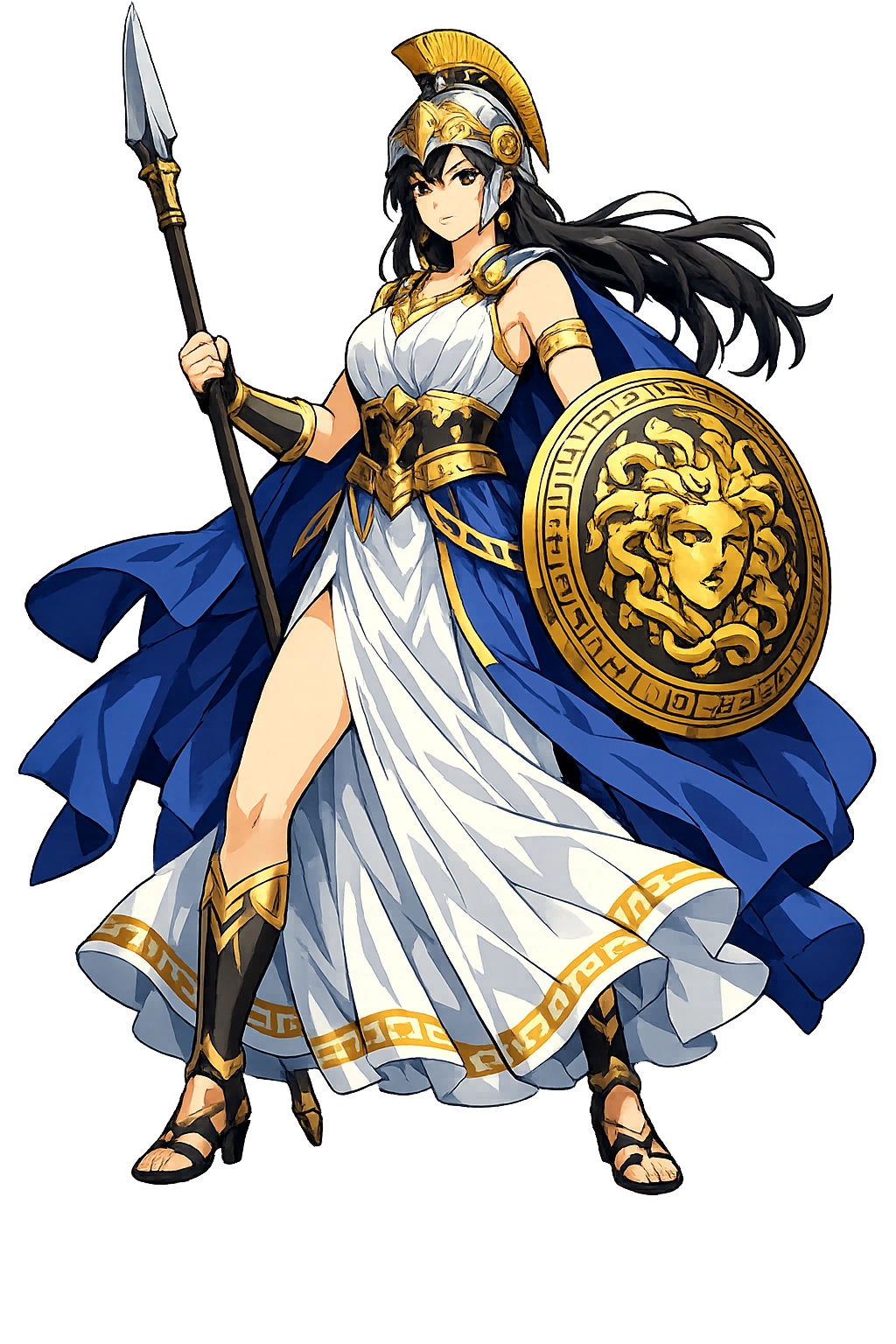
Pronouncing Athénā: a guide for the curious
Saying Athénā aloud is harder than reading it on a screen, and more rewarding. The restored spelling is a compressed pronunciation guide: every accent and macron is an instruction. This post unpacks those instructions — the reconstructed sound, the phoneme-by-phoneme record, the kindred forms in neighboring languages — and then zooms out to the full record around the name: its Greek writing, its mythology, its cult, and its modern life as a Unicode domain. Whether you arrive as a linguist, a reader of myth, or a domainer, you will leave able to say the name the way the evidence suggests it was said — and able to type it the way it was written.
At a Glance
- Restored name: Athénā
- ASCII form: athena
- Meaning: "Unknown; possibly pre-Greek"
- Domain of influence: Wisdom, War Strategy, Crafts
- Pantheon: Greek
- Classification: Tier 1
- Original script: Ἀθήνᾶ (Greek)
- Live domain: athénā.com
Overview
Athénā (athena) — The Grey-Eyed Strategist · Patron of Athens — belongs to the Greek tradition, where it is catalogued under the domain "Wisdom, War Strategy, Crafts". The name means "Unknown; possibly pre-Greek".
Athénā is unique among the Olympians: a warrior who fights only for just causes, a virgin goddess who needs no consort to validate her power, and the patron of the practical arts that make city life possible. She is intelligence made divine.
PuniCodex restores the name as Athénā and serves its temple at athénā.com. The original carries both stress and vowel length, and exactly one historically valid Unicode restoration exists, which places the name in Tier 1. The plain ASCII form athena survives as a modern convenience imposed by the early domain-name system; the restoration, not the fallback, is the form the project defends as philologically complete.
The Name
The name is attested in Greek as Ἀθήνᾶ. Etymologically it means "Unknown; possibly pre-Greek".
The reconstructed proto-form is h₂erǵ- (proto-indo-european, "to shine, white, silver"). Pre-Greek or from Ἀθήνη; possibly from *h₂erǵ- "shining" or Luwian deity. The owl goddess.
Cognate forms across related languages:
- Attarsiya (luwian) — Luwian theophoric name
The ASCII form athena survives only because the early domain-name system could not carry diacritics; it is a technological compromise, not an ancient spelling. The Unicode restoration Athénā recovers both the stress accent and the vowel length of the original directly in the address bar. The original carries both stress and vowel length, and exactly one historically valid Unicode restoration exists, which places the name in Tier 1.
The letter-by-letter transformation runs:
- a → A — Alpha
- t → t — Tau
- h → h — Theta
- e → é — Acute on epsilon
- n → n — Nu
- a → ā — Long alpha with iota subscript
Attested and derived spellings of the name:
- Athēnā — macron-only form: LSJ convention: length only, no acute on epsilon
The project holds the domain athénā.com (xn--athn-dpa9l.com) as the canonical home of this name.
Etymology & Roots
The recorded derivation reads: Pre-Greek or from Ἀθήνη; possibly from *h₂erǵ- "shining" or Luwian deity. The owl goddess.
The reconstructed proto-form is *h₂erǵ- (proto-indo-european), glossed as "to shine, white, silver".
The reconstruction is classed as disputed.
Kindred forms recorded in the lexicon:
- Attarsiya (luwian) — Luwian theophoric name
The Original Script
The name is preserved in Greek as Ἀθήνᾶ — Greek alphabet (Classical / Attic), attested Ancient Greek, c. 8th century BCE – present, in Greece and the Greek-speaking Mediterranean. The script is written left-to-right.
The scholarly transliteration is Athénā (Greek alphabet with polytonic accents), giving the normalized reading /atʰɛːˈnaː/.
The rendering proceeds step by step:
- The Greek form Ἀθήνᾶ is written in the Classical Greek alphabet.
- Letters with acute, grave, or circumflex accents preserve the pitch accent of Ancient Greek.
- Macrons and omegas (η, ω) mark long vowels, a feature lost in the plain ASCII form.
- The Unicode restoration Athénā encodes the scholarly spelling as a registrable domain name.
Pronunciation
The reconstructed pronunciation of the name is /a.tʰɛː́.naː/ — Attic Greek Reconstruction.
Phoneme by phoneme:
- A- — Short alpha with smooth breathing — the name opens clearly, without roughness.
- -th- — Aspirated theta [tʰ], the sound of intellect: precise, sharp, clean.
- -ḗ- — Long eta with acute pitch — the stressed peak of the name, holding authority.
- -nā — Long alpha with iota subscript, the old nominative ending that gives the name its archaic dignity.
For the modern speaker, the closest approximation is: 'ah-THAY-na' — the second syllable is pitched higher and drawn out; the final 'a' is long and pure.
Kindred and historical forms of the name:
- Greek — Ἀθήνη (Athḗnē), the older form; the long final alpha reflects the original stem
- Luwian — Attarsiya, a theophoric name in Bronze Age Anatolia, possibly related
- PIE — no secure etymology; Beekes treats the name as Pre-Greek
Athénā is Tier 1 because the Greek Ἀθήνᾶ contains both stress (acute on the long η) and length (η plus long alpha with iota subscript). The restoration Athénā preserves the acute stress; Athēnā is the macron-only variant. The form Athēnē changes the final letter and is therefore used only when the domain requires it.
Mythology
Athénā's myths center on intelligence overcoming force. She is born from Zeús's head, defeats Poseidôn by gift rather than combat, and guides the heroes who win by cunning.
Born from the Head of Zeús (The Birth)
Zeús swallowed his pregnant first wife Mêtis, who was destined to bear first a daughter and then a son of overmastering power who would be king of gods and men; the Theogony makes the swallowing Zeús's way of keeping Mêtis's counsel within himself. When the time came, Athénā sprang from Zeús's head fully armed — Pindar adds Hēphaistos's axe that split the skull — with a war-cry that made heaven and earth tremble. She is therefore the only Olympian whose parent is purely paternal: intelligence born directly from sovereignty.
Athena and Poseidôn for Athens (The Contest)
The two gods competed to become patron of Athens. Poseidôn struck the Acropolis with his trident and produced a salt spring; Athénā planted the first olive tree. The judges — Cecrops and the Athenian people — chose the olive, because it gives food, oil, and wood. Poseidôn flooded the Thriasian plain in anger, but Athénā's city endured. The myth makes civilization superior to maritime power.
Arachnê Transformed (The Weaver)
The mortal weaver Arachnê boasted that her skill surpassed the goddess's. Athénā wove a tapestry of the gods' majesty; Arachnê wove their scandals — flawless work, but impious. Athénā destroyed it and struck the girl; when Arachnê hanged herself, the goddess lifted the rope and transformed her into the first spider. Ovid's is the only full telling that survives, and it is a warning that skill without reverence is hubris.
Odysseus and the Return (The Hero's Guide)
Athénā's favorite mortal is Odysseus, the man of many wiles. She protects him through his wanderings, disguises him on Ithaca, and stands with him against the suitors. Their bond is the closest thing in Greek myth to a partnership between human intelligence and divine wisdom.
Symbols & Iconography
The iconography associated with Athénā concentrates in a small set of recurring attributes, each a compressed statement about the name:
- Owl — Wisdom, night-vision, and the bird sacred to Athens
- Olive tree — Her gift to Athens, defeat of Poseidôn in the contest for the city
- Aegis — The goat-skin fringed with serpents; worn by Zeús and Athena, it inspires terror
- Helmet and spear — Warrior identity, but always disciplined and defensive
- Gorgoneion — The severed head of Medousa on her breastplate, turning enemies to stone
- Spindle and loom — Weaving as the emblem of ordered, intelligent labor
Athénā is among the most recognizable figures in ancient art because her attributes never vary: crested helmet, spear, shield, the snaky-fringed aegis with the Gorgoneion, and the owl. She alone among goddesses is always armed.
The defining cult image was Pheidias's Athena Parthenos (438 BCE), a gold-and-ivory colossus holding a Nike, its base carved with the birth of Pandora; the type survives in Roman copies such as the Varvakeion statuette and in Pausanias's description. Athens put her owl on the reverse of its silver tetradrachms and her striding, spear-brandishing Promachos pose on the prize amphorae of the Panathenaic games.
Vase painters favored her birth — springing from Zeús's head as Hēphaistos steps back with the axe — and her duels with the Giants; red-figure adds quieter scenes of the helmeted goddess among her heroes.
Epithets & Cult Titles
Her titles run from archaic poetic formulae to the civic cult names of the Acropolis.
- Γλαυκῶπις (glaukōpis) — 'grey-eyed' or 'owl-eyed,' her most frequent Homeric epithet.
- Παλλὰς (Pallas) — of uncertain meaning, perhaps 'maiden' or from pallō, 'brandish'; attached to her name since Homer.
- Τριτογένεια (Tritogeneia) — 'Trito-born,' an old epic title in Homer and Hesiod, linked since antiquity — inconclusively — with Libyan Lake Tritonis.
- Πολιάς (Polias) — 'of the city,' her title as guardian of Athens, whose ancient olive-wood image was kept in the Erechtheion.
- Παρθένος (Parthenos) — 'the Maiden,' the title of Pheidias's gold-and-ivory statue and of the Parthenon itself.
- Ἐργάνη (Ergānē) — 'the Worker,' patroness of craftspeople, worshipped with Hēphaistos above the Athenian Agora.
The Homeric Hymns
No long narrative hymn to Athénā survives; her two hymns are short. Hymn 11 (five lines) hails 'Pallas Athena, protectress of cities,' who with Árēs delights in the works of war and the sack of towns and who guards armies as they march out and return — the martial polis goddess in miniature.
Hymn 28 (eighteen lines) is grander: it tells how she sprang from the holy head of Zeús in full armor while the gods trembled, Olympus reeled, the sea surged, and the sun checked his horses — 'until maiden Pallas Athena stripped the heavenly armor from her immortal shoulders, and Zeús the counselor rejoiced.'
Hesiod gives the fuller frame: Zeús swallowed the pregnant Mêtis so that her counsel would become his own (Theogony 886–900); Pindar adds the axe of Hēphaistos (Olympian 7).
Oracle Sites & Sanctuaries
Athénā kept no prophetic seat; her guidance came through the owl's flight, sacrificial omens, and the dreams she sends her heroes in epic. Her sanctuaries are civic, not oracular.
- Athens (Acropolis) — the Erechtheion held the xoanon of Athena Polias, said to have fallen from heaven; the Parthenon housed the Parthenos; the Nike bastion her wingless Victory.
- Tegea (Arcadia) — the sanctuary of Athena Alea, among the most venerable in the Peloponnese, where the tusks of the Calydonian boar were displayed.
- Lindos (Rhodes) — the hilltop temple of Athena Lindia, whose chronicle recorded dedications back to mythical donors.
- Alalkomenai (Boeotia) — her ancient sanctuary beside the village that claimed her birth, source of the epic title Alalkomenēis.
- Sparta — Athena Chalkioikos, 'of the Bronze House,' guardian of the Spartan acropolis.
Archaeology & Evidence
The Akropolis of Athens is her archaeology. The Parthenon (447–432 BCE) housed Pheidias's gold-and-ivory Athénā Parthénos and a sculptural program showing her birth on the east pediment and her contest with Poseidôn on the west. The Erechtheion (421–406 BCE) sheltered within one building the ancient olive-wood image of Athénā Polias, her olive tree, and Poseidôn's salt well. The temple of Athénā Níkē (c. 427–424 BCE) crowned the entrance bastion. Pausanias saw all three, together with the colossal bronze Athénā Prómachos, whose spear-point and helmet-crest sailors sighted from Sounion. Beyond Athens: the temple of Athénā Aléa at Tegea, whose architect was Skopas, ranked among the most venerated in the Peloponnese and displayed the tusks of the Kalydonian boar. The hilltop sanctuary of Athénā Líndia on Rhodes kept an inscribed chronicle of dedications reaching back to mythical donors. At Priene, the temple of Athénā Polias — designed by Pytheos, who wrote its commentary, and dedicated by Alexander the Great — set the canon for Ionic temple design.
Realm & Domain
Athénā is unique among the Olympians: a warrior who fights only for just causes, a virgin goddess who needs no consort to validate her power, and the patron of the practical arts that make city life possible. She is intelligence made divine.
Strategic Warfare
She favors counsel, discipline, and defensive battle over the berserk fury of Árēs; heroes like Odysseus and Diomedes fight under her sign.
Wisdom and Counsel
The mind that sees all sides; her advice is practical, ethical, and far-sighted.
Weaving and Crafts
Patron of weaving, pottery, carpentry, and olive cultivation — the technologies that sustain the polis.
Guardian of Cities
Polias and Poliouchos: the goddess who protects the citadel and whose olive tree marks the land.
Across Cultures
The Romans identified Athénā with Minerva, a goddess already associated with crafts and strategy, so the equation was unusually smooth. In Egypt she was equated with Neith, the warrior-weaver goddess of Sais, and Hellenistic Jews identified her with Sophia, divine Wisdom. During the Renaissance she became the emblem of rational virtue; in modern Athens she remains the namesake and symbol of the city, her helmeted head on coins and official seals. The Parthenon, her temple, is the canonical image of Classical Greece.
Kindred figures in the PuniCodex cross-tradition index include [[ahuramazda|AhuraMazdā]] (wisdom / knowledge), [[anat|ꜥAnat]] (war / battle), [[ares|Árēs]] (war / battle), [[ashur|Aššur]] (war / battle), [[durga|Durgā]] (war / battle), and [[ganesha|Gaṇeśa]] (wisdom / knowledge).
Cultural Legacy
Athénā's civic afterlife is unmatched. The Panathēnaia, her birthday festival, was the greatest celebration of the Athenian year: a new peplos woven for her ancient image, a procession up the Akropolis, and games whose prize amphorae — filled with oil from her sacred olives — carried her striding figure across the Mediterranean. Athenian silver put her helmeted head on the obverse and her owl on the reverse of the tetradrachms that became the first international trade coinage, and 'bringing owls to Athens' entered the language as the proverb for a pointless gift.
The city itself bears her name, and the aetiological myth of the contest with Poseidôn made the naming her victory prize. The Parthenon, her temple, became the canonical image of Classical Greece and of the democracy that built it. Through Minerva she passed to Rome as goddess of crafts and strategic war, and from there onto the seals of academies and universities. Restoring Athénā preserves the name under which the world's first democracy invoked its guiding intelligence.
The Scholarly Record
The account of Athénā given in this edition rests on the witnesses and reference works listed below. Lexica and etymological dictionaries secure the form and meaning of the name; the literary and religious texts supply the narrative evidence.
- Liddell-Scott-Jones Greek-English Lexicon, 9th ed. with 1996 supplement, 1843. Full text
- Etymological Dictionary of Greek, 2 vols., Brill, 2010. Full text
- Wörterbuch der griechischen Eigennamen, 3rd ed., 1863. Full text
- Homer, Iliad and Odyssey.
- Hesiod, Theogony, Loeb Classical Library No. 57, 700 BCE. Full text
- Aeschylus, Eumenides.
- Pausanias, Description of Greece.
A Meditation
Athénā is the goddess of the well-aimed blow — not merely in war, but in speech, craft, and thought. She does not rage; she calculates. She does not seduce; she advises. Her virginity is not a lack but a statement: her power is complete in itself, needing no alliance with masculinity to be effective.
In an age that often confuses intelligence with cleverness and power with dominance, Athénā offers a different model. She is strong because she is skilled, just because she is wise, and feared because she is right. The restoration of her name in Unicode is a small act of recognition: that wisdom, no less than beauty or wrath, deserves its original voice.
The Unicode Restoration
Athénā is classified as Tier 1: the original carries both stress and length, and only one valid Unicode restoration exists. The ASCII fallback athena still resolves everywhere, but it is the restored form that carries the name's full information. Across the 6 characters of the name, the restoration adjusts 2: 1 mark of stress (é); 1 mark of length (ā). That is the whole thesis of this temple: the marks are the message.
The Domain Name
The restored name is live as a working domain: athénā.com, which the DNS carries in punycode form as xn--athn-dpa9l.com — an ASCII-compatible encoding that lets a non-ASCII name travel the global network without breaking older infrastructure. The visitor sees Athénā; the machines see the encoding. That duality is the engineering compromise on which the entire restoration rests, and it is why a name written the way its own tradition wrote it in Greek can now be typed into any browser on earth.
Why This Restoration Matters
Pronunciation turns out to be the heart of the matter. The marks in Athénā are instructions for the voice, and a web that strips them is a web that mispronounces the past at scale. The restoration hands the instructions back: say it as the evidence suggests, type it as the tradition wrote it, and let the punycode machinery do the quiet translation in between. That is all the PuniCodex project asks of the infrastructure — and everything it asks of you, the reader, is to use the whole name.
Explore Further
This post is one doorway into the temple. The home page carries the full character breakdown and the ambient canvas; the lore page tells the myths in long form; the Scholarly Edition preserves the sources, pronunciation data, and revision history; and the patron wall supports the restoration directly. For the wider map, browse the Lexicon, explore the Pantheon, or return to the PuniCodex blog.
Related Names
Sources
The full scholarly apparatus — every citation, revision, and review — lives in the Scholarly Edition. Key references for this post:
- Liddell-Scott-Jones Greek-English Lexicon, 9th ed. with 1996 supplement, 1843.
- Etymological Dictionary of Greek, 2 vols., Brill, 2010.
- Wörterbuch der griechischen Eigennamen, 3rd ed., 1863.
- Hesiod, Theogony 886–900 and 924–929.
- Ovid, Metamorphoses 6.1–145 (Arachne).
- Homer, Odyssey (Athena and Odysseus).
- Pindar, Olympian 7.35–38; Homeric Hymn 28, To Athena.
- Apollodorus, Bibliotheca 3.14.1 (the contest for Athens).
- J. Neils, Goddess and Polis: The Panathenaic Festival in Ancient Athens (1992).
- Aristophanes, Birds 301 (the proverb); C. M. Kraay, Archaic and Classical Greek Coins (1976).
- Lexicon authorities for this entry: LSJ, Pape-Benseler, Beekes.