
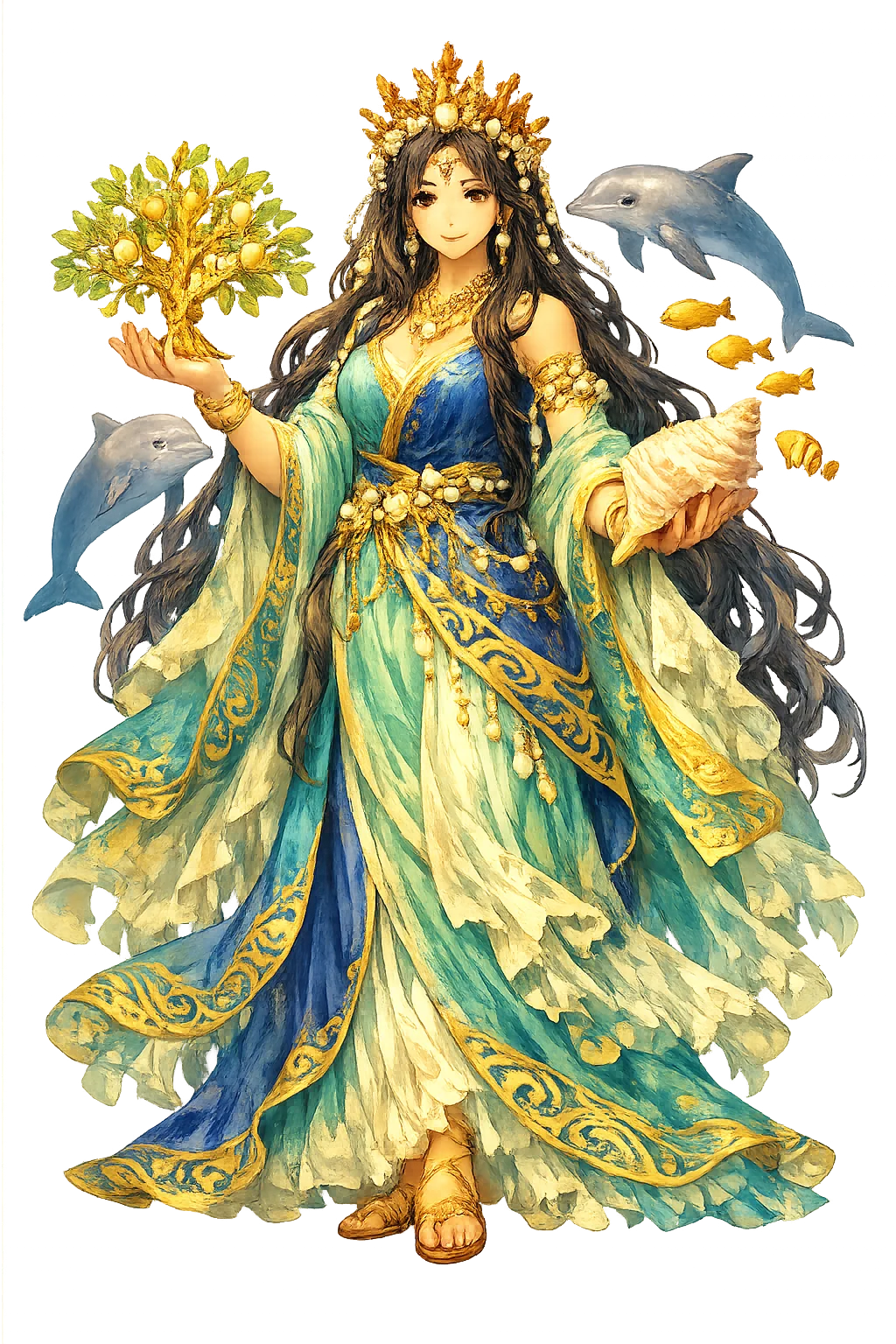
The name ꜥAsherah and the world it opens
A name is a door. ꜥAsherah opens onto an entire world: the domain of mother goddess, lady of the sea, a Canaanite tradition, and centuries of storytelling, worship, and scholarship. This post walks through that world room by room — the name and its roots, the original script, the sound of it, the myths, the symbols, the sites, the afterlife across cultures — and ends at the newest room of all: a Unicode domain that makes the whole structure addressable. asherah gets you to the same building, but only the restored form tells you why it was built.
At a Glance
- Restored name: ꜥAsherah
- ASCII form: asherah
- Meaning: "Canaanite mother goddess, consort of Ēl and patroness of childbirth"
- Domain of influence: Mother Goddess, Lady of the Sea
- Pantheon: Canaanite
- Classification: Tier 2
- Original script: 𐎀𐎘𐎗𐎚 (Ugaritic)
- Live domain: ꜥasherah.com
Overview
ꜥAsherah (asherah) — She Who Treads the Sea · Mother of the Gods — is the Canaanite mother goddess, consort of [[el|Ēl]] and matriarch of the divine assembly, catalogued in this edition under the domain "Mother Goddess, Lady of the Sea." At Ugarit she bears the fixed title rbt ʾaṯrt ym, "Lady Asherah of the Sea."
ꜥAsherah is the great mother of the Canaanite pantheon, the consort of Ēl and the goddess whose very treading calms the sea. Unlike the fierce maiden ꜥAnat, she moves through the myths as queen mother, intercessor, and source of divine legitimacy. Where Ēl is the distant father, Asherah is the active power broker who knows how to approach him.
PuniCodex restores the name as ꜥAsherah and serves its temple at ꜥasherah.com. The restoration writes the disputed initial consonant of the Ugaritic spelling 𐎀𐎘𐎗𐎚 with the Egyptological Ain (ꜥ, U+A724) — a registrable stand-in chosen where scholarship itself hesitates between glottal ʾaleph and pharyngeal ʿayin; this single orthographic mark, without stress or length notation, places the name in Tier 2. The ASCII asherah erases the question entirely.
The Name
The name is attested in Ugaritic as 𐎀𐎘𐎗𐎚. Etymologically it means "Canaanite mother goddess, consort of Ēl and patroness of childbirth".
The reconstructed proto-form is ʾaṯiratu / ʿaṯiratu* (proto-afro-asiatic, "she who treads/crosses, Lady of the Sea"). From Ugaritic ʾaṯrt; the initial consonant is rendered with Egyptian Ain (ꜥ) as the only registrable Unicode substitute
Cognate forms across related languages:
- אֲשֵׁרָה (ʾĂšērāh) (Hebrew)
- 𐤀𐤔𐤓𐤕 (ʾšrt) (Phoenician)
- أَثِيرَة (ʾaṯīrah) (Arabic)
The ASCII form asherah survives only because the early domain-name system could not carry diacritics; it is a technological compromise, not an ancient spelling. The Unicode restoration ꜥAsherah recovers the full diacritic detail of the scholarly transliteration directly in the address bar. The original preserves one prosodic feature — stress or vowel length — rather than both, which places the name in Tier 2.
The letter-by-letter transformation runs:
- a → ꜥA — Egyptian Ain (ꜥ) stands in for Semitic ʿayin at the start of the name, followed by the capital alpha present in the Unicode restoration
- s → s — Same
- h → h — Same
- e → e — Same
- r → r — Same
- a → a — Same
- h → h — Same
Attested and derived spellings of the name:
- ʿAsherah — ideal form: Semitic ʿayin (ʿ) is ideal but not registrable at the DNS root
- ꜥasherah — owned form: Lowercase owned form
The project holds the domain ꜥasherah.com (xn--asherah-dv2z.com) as the canonical home of this name.
Etymology & Roots
The recorded derivation reads: From Ugaritic ʾaṯrt; the initial consonant is rendered with Egyptian Ain (ꜥ) as the only registrable Unicode substitute
The reconstructed proto-form is *ʾaṯiratu / ʿaṯiratu* (proto-afro-asiatic), glossed as "she who treads/crosses, Lady of the Sea".
The reconstruction is classed as disputed.
Kindred forms recorded in the lexicon:
- אֲשֵׁרָה (ʾĂšērāh) (Hebrew) — cognate
- 𐤀𐤔𐤓𐤕 (ʾšrt) (Phoenician) — cognate
- أَثِيرَة (ʾaṯīrah) (Arabic) — uncertain
The Original Script
The name is preserved in Ugaritic as 𐎀𐎘𐎗𐎚 — Northwest Semitic cuneiform alphabet, attested Late Bronze Age, c. 1400–1200 BCE, in Ugarit (modern Ras Shamra, Syria). The script is written left-to-right.
The scholarly transliteration is ꜥAsherah (Ugaritic alphabetic cuneiform), giving the normalized reading /ʔaʃeˈraː/.
The rendering proceeds step by step:
- The name is written 𐎀𐎘𐎗𐎚 in the Ugaritic cuneiform alphabet.
- Ugaritic ʿayin is rendered with Egyptological Ain (ꜥ) for DNS registrability.
- Long vowels are reconstructed from Hebrew and Akkadian cognates and marked with macrons.
- The Unicode restoration ꜥAsherah is registrable in .com; the Ugaritic cuneiform form is not supported in the .com IDN table.
Ugaritic writes her name 𐎀𐎘𐎗𐎚 (ʾ-a-ṯ-r-t). The third sign, ṯ (transliterated š in later Semitic), represents a sound like English 'sh'. The initial consonant may be glottal stop (ʾ) or pharyngeal (ʿ); the Egyptological Ain (ꜥ) is used here as a registrable stand-in. The macron over ē marks the long vowel inferred from Hebrew אֲשֵׁרָה.
Pronunciation
The reconstructed pronunciation of the name is /ʔa.ʃeː.ra/ — Ugaritic/Phoenician Reconstruction.
Phoneme by phoneme:
- ʔa- — Glottal stop [ʔ] followed by open [a]; in some reconstructions the initial consonant is a pharyngeal ʿ rather than a glottal stop. The Egyptological Ain (ꜥ) marks this debated point.
- -šē- — Voiceless postalveolar fricative [ʃ] plus long [eː], marked by macron; the length is inferred from Hebrew and Aramaic reflexes.
- -ra — Tapped or trilled [r] plus final [a], a feminine ending.
For the modern speaker, the closest approximation is: 'ah-SHAY-rah' — start with a slight catch in the throat, then a long 'shay' and a soft 'rah'.
Kindred and historical forms of the name:
- Ugaritic — 𐎀𐎘𐎗𐎚 (ʾaṯrt), written ʾ-a-ṯ-r-t; her full title is rbt ʾaṯrt ym, 'Lady Asherah of the Sea'
- Hebrew — אֲשֵׁרָה (ʾĂšērāh), the goddess and her cult object; also 'Queen of Heaven' in Jeremiah
- Phoenician — 𐤀𐤔𐤓𐤕 (ʾšrt), attested in inscriptions and personal names
The initial consonant of the Ugaritic name is disputed: some read it as a glottal stop (ʾ), others as a pharyngeal (ʿ). We follow the lexicon's use of Egyptian Ain (ꜥ) as the registrable compromise. The long ē is marked with a macron to preserve the length implied by Hebrew and Aramaic cognates; stress falls on the long middle syllable.
Mythology
ꜥAsherah does not star in the great combat myths; she rules by relationship. Her appearances in the Baꜥal Cycle show a goddess who can approach the high god, sway his decisions, and guarantee the succession of kings. She is the still center around which the violent younger gods revolve.
The Queen Mother's Journey (The Baal Cycle)
In KTU 1.4, Baꜥal longs for a palace but cannot win Ēl's approval directly. He turns to Asherah. She prepares herself with care, harnesses her donkey, and travels to the source of the divine rivers. There she prostrates before Ēl, flatters his wisdom, and asks that Baꜥal be granted a house 'like the gods'. Ēl laughs, welcomes her, and consents. Without her diplomacy, Baꜥal would remain homeless.
Creatress of the Gods (The Baal Cycle)
Asherah is repeatedly called qnyt ʾilm, 'Creatress/Creatrix of the Gods' (KTU 1.3 v 25–26; 1.4 i 23; iii 26). The seventy sons of Asherah (KTU 1.4 vi 46) are the divine council itself; when Baꜥal disappears into Mot's realm, it is she who is asked to choose a successor from among her sons.
Nurse of the Divine (Myth of the Gracious Gods)
In KTU 1.23, the 'Birth of the Gracious Gods,' Asherah appears in the background of a sacred-marriage and birth narrative, associated with suckling and nourishment. The newborn gods drink from her breasts, a motif that links her to royal legitimation: kings may be called her nurslings.
The Lady and the Sea (Iconography)
Her epithet 'Lady Asherah of the Sea' (rbt ʾaṯrt ym) has been interpreted as 'she who treads on sea.' Whether the sea is the Mediterranean that fed Ugarit's economy, the cosmic watery chaos, or both, the title makes Asherah a boundary-goddess: she walks where land and water meet and brings the wild under domestic sovereignty.
Symbols & Iconography
ꜥAsherah's attributes move between the domestic and the cosmic:
- Spindle — The one implement the Ugaritic texts place in her hands: Athirat is the goddess portrayed with a spindle, the emblem of ordered women's labor raised to divine rank.
- Sea — Her title rbt ʾaṯrt ym, "Lady Asherah of the Sea," ties her to the waters that fed and threatened coastal Ugarit; her attendant Qōdesh-wa-Amrūr is styled her fisherman.
- Stylized tree or pole — The biblical ʾăšērāh was a wooden cult object, a stylized tree or trunk planted beside altars (Deuteronomy 16:21); the Taanach cult stand shows a sacred tree flanked by ibexes beneath a lioness.
- Donkey — The beast she saddles for the journey to Ēl's tent in KTU 1.4 iv, when she rides to win Baꜥal his palace — the queen mother's unwarlike mount.
- Sea — The waters she treads and tames, source of fertility and commerce for coastal Ugarit
Archaeology & Evidence
ꜥAsherah's dossier splits between the Late Bronze Age texts of Ugarit and the Iron Age artifacts of Israel and Judah. The Ras Shamra tablets (KTU 1.3–1.4; 1.23) name her rbt ʾaṯrt ym, "Lady Asherah of the Sea," and qnyt ʾilm, "Creatress of the Gods," and the god lists (KTU 1.47; 1.118) rank her among the city's chief deities.
The Iron Age evidence is artifactual and contested. The painted pithoi of Kuntillet ꜥAjrud (c. 800 BCE) carry blessings "by YHWH of Samaria/Teman and by his asherah"; the Khirbet el-Qom tomb inscription (8th century BCE) blesses Uriyahu by YHWH "and by his asherah." Iconography supplies the rest: the Taanach cult stand's tree flanked by ibexes, the Lachish ewer's stylized tree, and the Judean pillar figurines are routinely read as her imagery — none names her, and each identification is debated.
Realm & Domain
ꜥAsherah is the great mother of the Canaanite pantheon, the consort of Ēl and the goddess whose very treading calms the sea. Unlike the fierce maiden ꜥAnat, she moves through the myths as queen mother, intercessor, and source of divine legitimacy. Where Ēl is the distant father, Asherah is the active power broker who knows how to approach him.
Mother of the Gods
Called qnyt ʾilm, 'Creatress of the Gods'; the seventy sons of Asherah populate the divine court.
Lady of the Sea
Her epithet rbt ʾaṯrt ym links her to the Mediterranean, to fishing, and to the cosmic waters tamed by her presence.
Royal Intercessor
It is Asherah who petitions Ēl on Baꜥal's behalf, securing permission for the storm-god's palace.
Domestic Sovereignty
Spindle, weaving, and nursing imagery mark her as the divine model of women's work raised to cosmic scale.
Across Cultures
ꜥAsherah's influence spread far beyond Ugarit. In Hittite treaties she appears as Ašertu, the consort of Elkunirša. In Egypt she was identified with Hathor and venerated under the name Qudshu, 'Holiness.' In Israel and Judah she became the most controversial divine figure of the Bible: the Queen of Heaven, consort of Yahweh in some inscriptions and folk religion, condemned by prophets and reformers. She was later flattened into a mere wooden pole (the ʾăšērâ) by Deuteronomistic polemic. Modern archaeology — especially the Kuntillet ʿAjrud inscriptions — has reopened the question of whether Israelite religion once knew her as God's wife.
Within the Canaanite tradition, closely related names in the corpus include [[abel|Hāḇel]], [[anat|ꜥAnat]], [[baal|Baꜥal]], [[cain|Qāyīn]], [[david|Dāwîḏ]], and [[el|Ēl]].
Cultural Legacy
ꜥAsherah is the hidden goddess of the Hebrew Bible. Wherever the prophets rage against "the Asherah" or the women of Jerusalem bake cakes for the Queen of Heaven (Jeremiah 7:18; 44:17–19), they testify to her persistent hold on popular devotion: Deuteronomistic polemic reduced a goddess to a piece of lumber, and the ferocity of the reduction measures the cult it fought. Modern finds forced the question back open — the Kuntillet ꜥAjrud blessings "by YHWH... and by his asherah" made her the center of a sustained scholarly debate over whether ancient Israel knew a divine consort, a controversy carried to a wide public by Dever's Did God Have a Wife? Today she is reclaimed by feminist theologians as the divine feminine edited out of the Western canon — and, on the evidence of the inscriptions, not without reason.
The Scholarly Record
The account of ꜥAsherah given in this edition rests on the witnesses and reference works listed below. Lexica and etymological dictionaries secure the form and meaning of the name; the literary and religious texts supply the narrative evidence.
- KTU (Ugaritic texts).
- Coogan, Stories from Ancient Canaan.
- Smith, The Origins of Biblical Monotheism.
- Day, Yahweh and the Gods and Goddesses of Canaan.
- Hadley, The Cult of Asherah in Ancient Israel and Judah.
- Wiggins, A Reassessment of Asherah.
- KTU 1.4 (Baal Cycle: Asherah intercedes with El).
- Hebrew Bible, Deuteronomy 16:21; Judges 6:25–26 (asherah poles).
- Hebrew Bible, 1 Kings 18:19; 2 Kings 21:7; 23:4–7 (prophets and Josianic reform).
- Kuntillet ʿAjrud inscriptions (KH1–KH3: 'Yahweh and his Asherah').
A Meditation
ꜥAsherah teaches a theology of mediation. She is not the storm on the mountain; she is the one who persuades the high god to let the storm have a house. Her power is relational, domestic, and therefore easy to overlook — yet without it, the cosmos loses its cohesion.
In an age that often mistakes loudness for authority, Asherah reminds us that influence can be quiet, patient, and rooted in care. She is the queen mother, the wet nurse of gods, the one who walks between sea and shore. To remember her is to remember that the divine feminine was never absent from the ancient Near East; it was edited out later, and what has been edited out can be read back in.
The Unicode Restoration
ꜥAsherah is classified as Tier 2: the original preserves at least one philological feature that ASCII cannot encode. The ASCII fallback asherah still resolves everywhere, but it is the restored form that carries the name's full information. Across the 7 characters of the name, the restoration adjusts 1: 1 further adjustment (ꜥA). That is the whole thesis of this temple: the marks are the message.
Name Variations
The lexicon records 2 additional forms of the name:
- ʿAsherah (ideal) — Semitic ʿayin (ʿ) is ideal but not registrable at the DNS root
- ꜥasherah (owned) — Lowercase owned form
The temple uses ꜥAsherah as the primary form: it is the spelling that best balances philological accuracy with the practical limits of DNS.
Character by Character
The journey from asherah to ꜥAsherah, one character at a time:
- a → ꜥA — Egyptian Ain (ꜥ) stands in for Semitic ʿayin at the start of the name, followed by the capital alpha present in the Unicode restoration
- s → s — Same
- h → h — Same
- e → e — Same
- r → r — Same
- a → a — Same
- h → h — Same
The Domain Name
The restored name is live as a working domain: ꜥasherah.com, which the DNS carries in punycode form as xn--asherah-dv2z.com — an ASCII-compatible encoding that lets a non-ASCII name travel the global network without breaking older infrastructure. The visitor sees ꜥAsherah; the machines see the encoding. That duality is the engineering compromise on which the entire restoration rests, and it is why a name written the way its own tradition wrote it in Ugaritic can now be typed into any browser on earth.
The Canaanite Pantheon
ꜥAsherah is one of 12 entries the PuniCodex lexicon catalogues under the Canaanite pantheon. The Pantheon page gathers the tradition's major figures in one place, and the Lexicon lets you filter all 895 restorations by tradition, tier, or script — the fastest way to see where this name sits among its kin.
Why This Restoration Matters
A door only matters if people walk through it. ꜥasherah.com is open, and everything behind it — the myths, the scholarship, the canvas, the patrons — hangs on the restored spelling. The PuniCodex project bets that the web will make room for names as they were actually written, and ꜥAsherah is one of its standing proofs. Visit, share, cite, type it yourself: each use is a small rehearsal for a web where no name has to hide its marks to be found.
Explore Further
This post is one doorway into the temple. The home page carries the full character breakdown and the ambient canvas; the lore page tells the myths in long form; the Scholarly Edition preserves the sources, pronunciation data, and revision history; and the patron wall supports the restoration directly. For the wider map, browse the Lexicon, explore the Pantheon, or return to the PuniCodex blog.
Related Names
Sources
The full scholarly apparatus — every citation, revision, and review — lives in the Scholarly Edition. Key references for this post:
- Corpus Inscriptionum Semiticarum, Académie des Inscriptions et Belles-Lettres, Paris, 1881.
- Dietrich, Loretz & Sanmartín (eds.), The Cuneiform Alphabetic Texts from Ugarit (KTU), 3rd enlarged ed., Ugarit-Verlag, 2013.
- Coogan & Smith, Stories from Ancient Canaan, 2nd ed., Westminster John Knox, 2012.
- Wiggins, A Reassessment of Asherah: With Further Considerations of the Goddess, Gorgias Press, 2007.
- KTU (Ugaritic texts).
- Lexicon authorities for this entry: KTU, Coogan, Smith, Day.