
Ancient Domain
Ašavahišta is the Amesha Spenta of Aša — "Best Righteousness": the Bounteous Immortal who is cosmic order itself, the truth the universe is built to run on, and the sacred fire that tests every soul and every word against it.
Extended Lore
Etymology · Phonology · Orthography · Cultural Legacy · Primary Sources
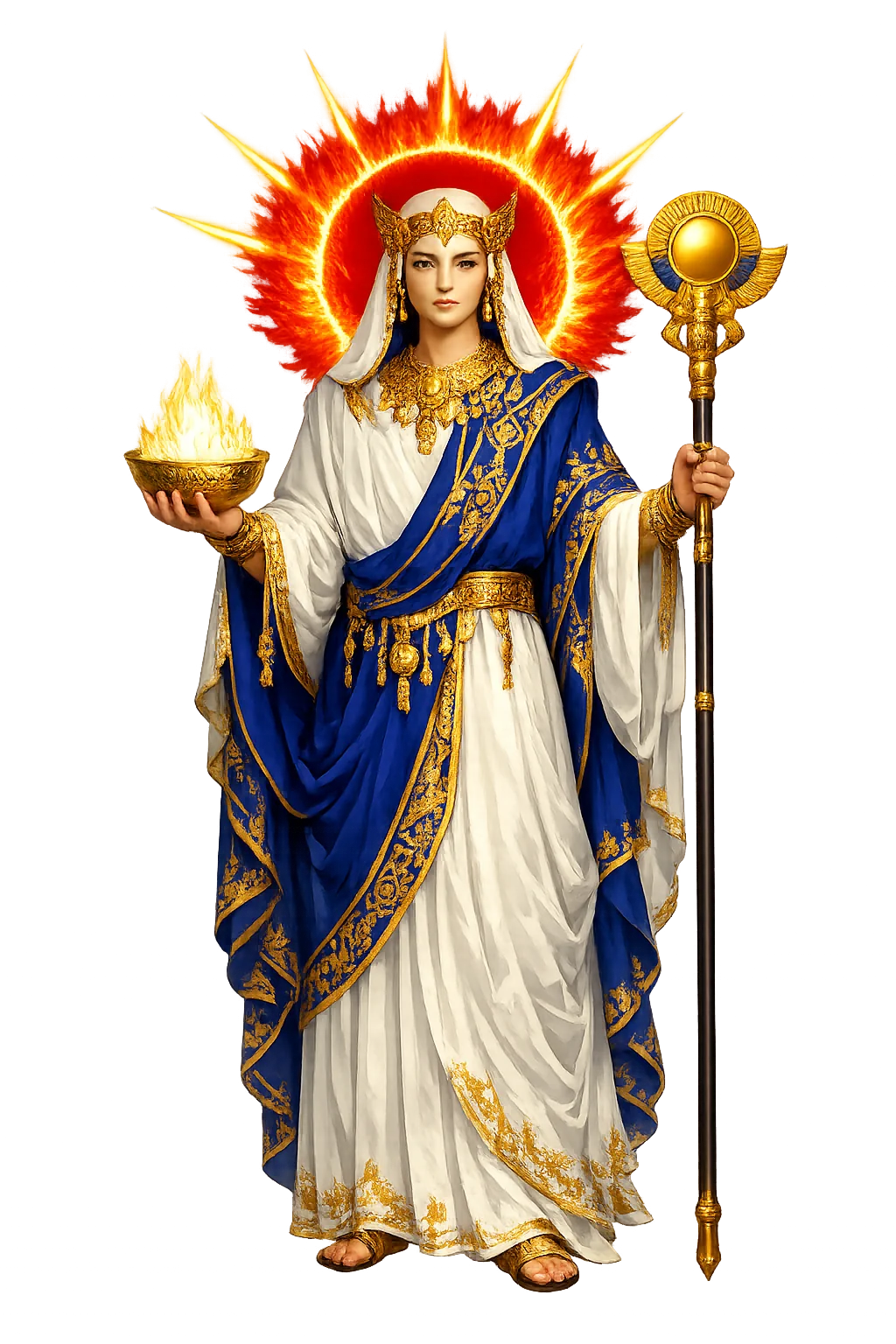
Essential information about Ašavahišta, Truth, Righteousness, Fire
From original script to Unicode restoration
Avestan aša vahišta — "Best Truth/Righteousness" — is written in the scholarly transliteration with the palatal š of the Avestan alphabet, twice: Ašavahišta. The restoration keeps both sibilants exactly where the Gathas put them; English "Asha Vahishta" softens what the Avesta writes sharp.
Character-by-character philological analysis
| Character | Unicode | Name | Block | Phonetic Role |
|---|---|---|---|---|
| A | U+0041 | Latin Capital Letter A | Basic Latin | Same, capitalized |
| š | U+0161 | Latin Small Letter S with Caron | Latin Extended-A | Sibilant š (palatal s) |
| — | N/A | Dropped character | Zoroastrian orthography | Fuses with s into š |
| a | U+0061 | Latin Small Letter A | Basic Latin | Same |
| v | U+0076 | Latin Small Letter V | Basic Latin | Same |
| a | U+0061 | Latin Small Letter A | Basic Latin | Same |
| h | U+0068 | Latin Small Letter H | Basic Latin | Same |
| i | U+0069 | Latin Small Letter I | Basic Latin | Same |
| š | U+0161 | Latin Small Letter S with Caron | Latin Extended-A | Sibilant š (palatal s) |
| t | U+0074 | Latin Small Letter T | Basic Latin | Same |
| a | U+0061 | Latin Small Letter A | Basic Latin | Same |
The Tier 1 classification reflects how much of the original phonology this restoration preserves — stress and vowel length for Greek names, distinctive letters and diacritics for every other tradition.
From ancient cult to modern Unicode
Ašavahišta is the Amesha Spenta of Aša — "Best Righteousness": the Bounteous Immortal who is cosmic order itself, the truth the universe is built to run on, and the sacred fire that tests every soul and every word against it.
His cognate is the Vedic ṛta and its guardian: scholars pair Aša with the Vedic order-principle and note the shared Indo-Iranian root (*rtá/aša). In the Sasanian era his fire became state cult — the great fire-temples of Adur Gušnasp and Adur Farnbag bore his element as national shrines; and the Yasna's ašem-vohū verse ("aša is the best, it is happiness") remains the most-recited line of the living faith. He survives wherever the fire is kept: Yazd's perpetual flame is, by every account, still his.
He is the reason "truth" has a temple: the Zoroastrian moral tradition — good thought, good word, good deed — is his liturgy, and the fire-temples of Yazd and the diaspora are his addresses. The word "Asha" lives in modern Persian and in a million names (Ashton? no — Asha, common across South Asia). Scholars read him as the hinge on which the Abrahamic heaven-and-judgment traditions later turned: the first theology of a universe audited for truth.
Restoring Ašavahišta in a domain name is more than orthographic accuracy. It is a statement that the internet should recognize the full range of human writing — not only the ASCII keyboard.
Common questions about Ašavahišta, Truth, Righteousness, Fire, and Unicode restoration
In reconstructed pronunciation, Ašavahišta is /a.ʃaː.va.hiʃ.taː/ — approximately ah-shah-vah-HISH-tah — two sharp š sibilants, even vowels..
Ašavahišta means "Best Truth" — the Amesha Spenta of cosmic order (Aša), guardian of the sacred fire and the moral law in the zoroastrian tradition.
Ašavahišta is associated with The altar flame (The fire of the Avesta — his presence in every Zoroastrian temple), The ašem-vohū verse (The oldest prayer in the faith: "aša is the best, it is happiness"), The winged sun (The fravašis' symbol he shares with the whole order).
Plain ASCII ashavahista strips the stress, length, and script that make the name specific. Unicode restoration returns the name to its original written dignity.
The Avesta's great hymn-names them: Vohu Manah (Good Mind), Aša Vahišta (Best Truth), Xšathra Vairya (Chosen Power), Spenta Ārmaiti (Holy Devotion), Haurvatāt (Wholeness), Amərətāt (Immortality) — the Amesha Spentas, the Bounteous Immortals who are at once Ahura Mazda's powers and persons. Ašavahišta is the second: the Truth the Good Mind thinks, and the Fire that proves it. In the Gathas, Zaraθuštra meets each as a presence, not a principle.
The philological foundations of this restoration
Every claim on this page is grounded in established scholarship. The orthographic restorations follow disciplinary convention. The etymological chain follows the best available reference works. This is not invention — it is resurrection through scholarship.
You have traced the name from its earliest attestation to its Unicode restoration. Now return to the myth. The story is where the name lives.
Back to Lore