The Authentic Orthography
Light, Music, Prophecy · Possibly 'destroyer' or 'purifier' (from ἀπόλλυμι)
Unicode restoration and ASCII comparison
Ἀπόλλων
The name in its original Greek form. Apóllōn (Ἀπόλλων) is attested in the source tradition — “Possibly 'destroyer' or 'purifier' (from ἀπόλλυμι)”. Its long vowels and acute accents carry the full phonetic and orthographic weight of the source tradition.
apollon
Reduced to plain apollon, the name loses everything that made it specific: long vowels and acute accents. What remains is an ASCII string that machines can parse but that no longer speaks with its original voice.
Apóllōn
The Unicode restoration recovers what ASCII flattened. Apóllōn restores long vowels and acute accents, returning the name to its original written dignity. The domain encodes to Punycode, but the browser displays the truth.
Apóllōn.com → xn--aplln-1ta64d.com
The non-ASCII characters in Apóllōn are encoded while the ASCII remains visible. To the DNS, it is Punycode. To humanity, it is Apóllōn.
How Apóllōn travels from ancient script to the modern URL
Greek Ἀπόλλων; etymology debated; folk-etymologies connect it with ἀπόλλυμι “to destroy" or ἀπολούω “to wash"; probably pre-Greek.
Light, Music, Prophecy
The Unicode restoration Apóllōn preserves Greek stress and length; the ASCII form apollon loses these features.
How Apóllōn was spoken
Light, Music, Prophecy, and Healing
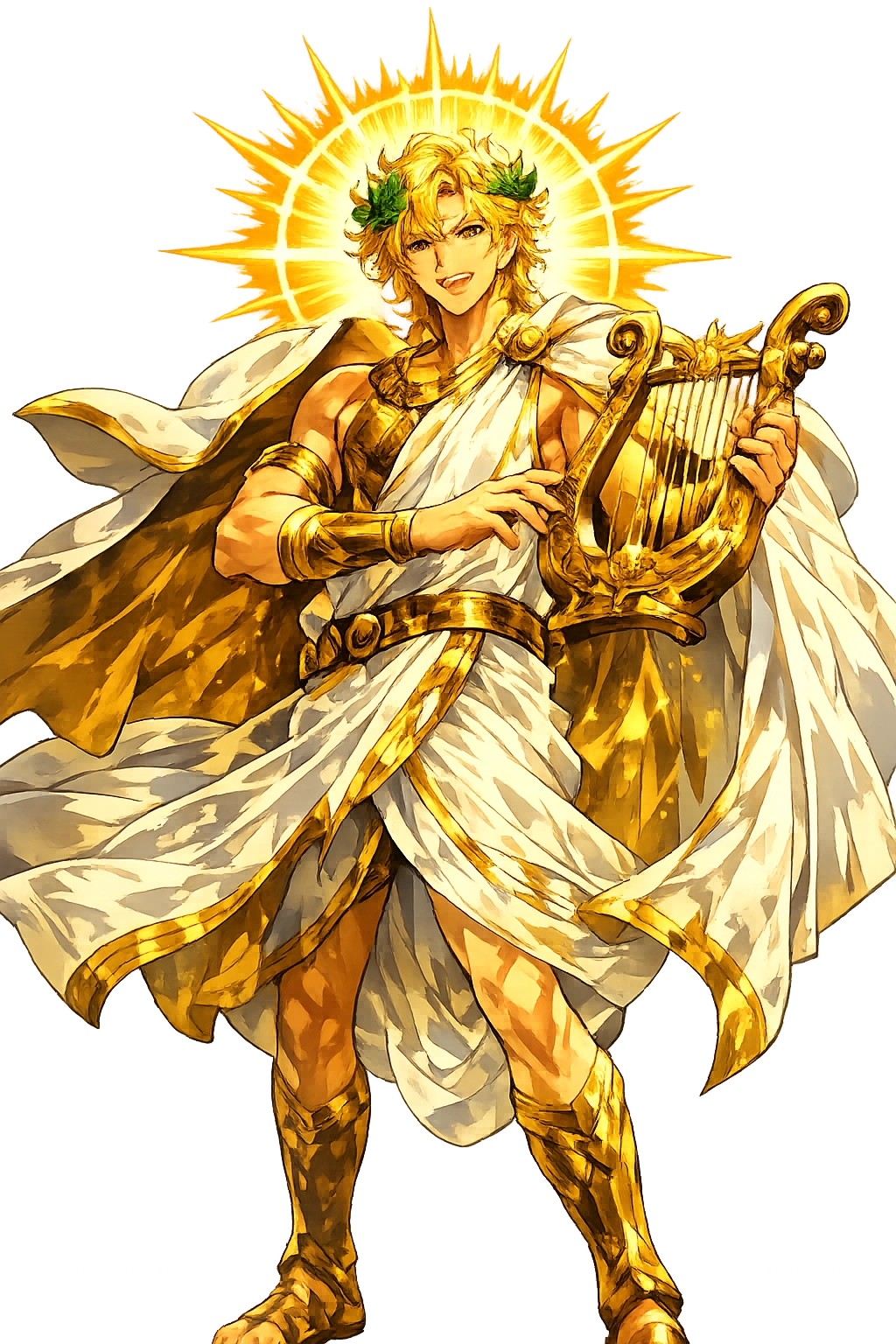
Apóllōn is the most Greek of the gods: not a chthonic power or a primal element, but the embodiment of measured excellence. He is the archer whose arrows strike from unseen distance, the musician whose lyre imposes order on chaos, the prophet who speaks only what Zeus permits, and the healer whose touch can lift plague as surely as his arrows bring it.
The eye that sees all and the fire that nourishes; Apóllōn's chariot drives the sun across the sky, though Helios increasingly takes over this role in later poetry.
His lyre, won from Hermês, orders emotion itself; music, mathematics, and cosmic proportion fall under his patronage.
At Delphoí, through the Pythia, he speaks in enigmatic verse; prophecy is not fortune-telling but the disciplined interpretation of divine will.
The same bow that sends plague can avert it; his epithets Alexikakos and Paiôn mark him as protector from evil and god of healing.
Stories of Apóllōn
Apóllōn's myths are unusually coherent because they consistently dramatize the same theme: the distance between divine perfection and mortal limitation. He is never ridiculous, but he is often terrifying.
Hêra, in jealousy, cursed Lētô so that no land fixed to the earth could give her shelter. All islands refused her — until Dêlos, a floating rock, offered itself. There Lētô clung to a palm tree and bore Apóllōn and his twin sister Artemis. Swans circled the island seven times, and light flooded the Aegean. Dêlos became fixed forever — the weight of divinity anchors what chaos cannot hold.
Apóllōn seized Delphoí by killing the she-dragon Pythôn who guarded the site. From her corpse the oracle took its name: Pythia. The Homeric Hymn to Apollo describes his journey from Delos to Delphi as a triumphal procession; every place he passes becomes Greek through recognition of his power.
The satyr Marsyas found the aulos that Athena had discarded and challenged Apóllōn to a musical contest. The god won and flayed Marsyas alive for his presumption. The myth is brutal, but its logic is consistent: no mortal art can rival divine order, and to claim equality with a god is to invite destruction.
Pursued by Apóllōn, the nymph Daphnê prayed to her father the river-god Peneus and was transformed into a laurel tree. Apóllōn made the laurel his sacred plant, and it became the crown of poets, athletes, and conquerors. The myth turns loss into symbol: what cannot be possessed becomes the sign of achievement.
Apóllōn is the god who makes distance felt. His arrows come from far away; his oracle speaks in riddles; his music imposes pattern on emotion from above. He is not the warm sun but the clear, hard light that reveals every flaw. That is why he is both healer and destroyer: the same clarity that diagnoses disease also pronounces sentence.
Enter Extended Lore