
The hidden history behind Ꜥpp
Behind the modern ASCII form apep hides a much longer story. Ꜥpp reaches back through manuscripts, inscriptions, and oral tradition long before it ever touched a keyboard, and every mark in the restored spelling is a receipt from that journey. In what follows we trace the name from its Hieroglyphs attestations through its mythology, its cult, its symbols, and its afterlife in other cultures — and we show how the PuniCodex project turned that philological record into a Unicode domain that resolves today. The history was never lost. It was only waiting for the infrastructure to catch up.
At a Glance
- Restored name: Ꜥpp
- ASCII form: apep
- Meaning: "He who was spat out"
- Domain of influence: Chaos, Darkness, Serpent
- Pantheon: Egyptian
- Classification: Tier 2
- Original script: 𓂝𓊪𓊪𓆓 (Hieroglyphs)
- Live domain: ꜥpp.com
Overview
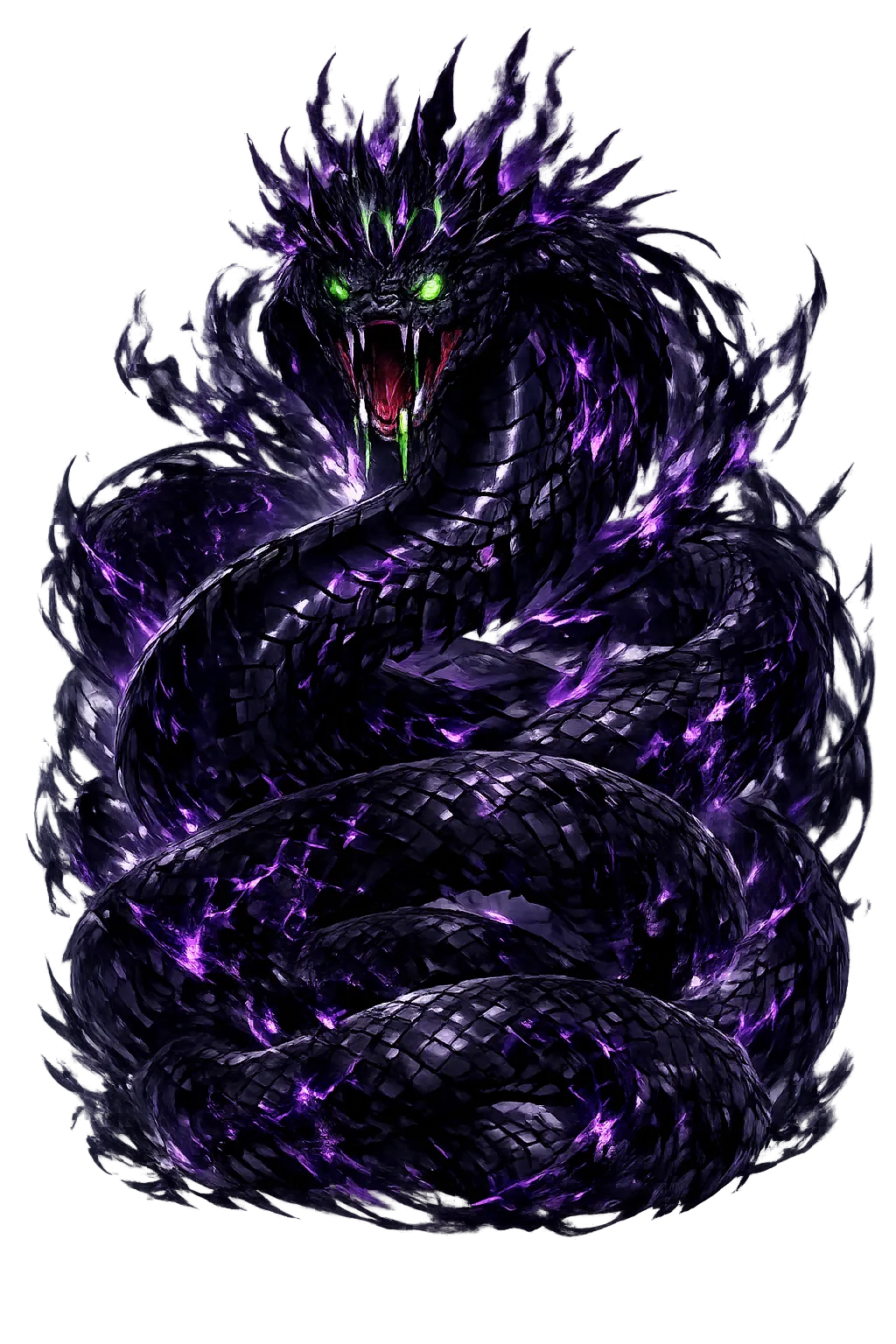
Ꜥpp (apep) — Greek Ἄποφις, Apophis — is the one being in Egyptian religion who exists only to be destroyed. A giant serpent of primordial chaos, he personifies isfet, the disorder that opposes [[maat|Mꜣꜥt]], and each night he lies in wait in the waters of the Duat to swallow the solar barque and prevent the dawn. His defeat is therefore not an event but a practice: renewed nightly in the underworld books, daily in the temple liturgy of the Book of Overthrowing Apophis, and personally by every justified dead who joins the solar crew. The arch-serpent steps onto the stage under his own name only in the Middle Kingdom — the Coffin Texts know him, the Pyramid Texts know only hostile snakes — and scribes write his name with a serpent determinative they deliberately mutilate, a graphic assault on the being it names.
PuniCodex restores the name as Ꜥpp and serves its temple at ꜥpp.com: the Egyptological ayin (Ꜥ, U+A724) preserves the pharyngeal onset that the ASCII fallback apep erases — a Tier 2 restoration of the consonantal skeleton ꜥ-p-p.
The Name
The name is attested in Hieroglyphs as 𓂝𓊪𓊪𓆓 — the ayin arm, two stool signs, and a serpent determinative — and is traditionally glossed 'he who was spat out'; a fuller form ꜥꜣpp is also attested. Egyptian scribes treated the writing of the name as an opportunity to wound it: from the Middle Kingdom onward the serpent determinative is shown pierced by knives, decapitated, or replaced by the bound-enemy sign, and in execration contexts the name itself may be deliberately mutilated.
The ASCII form apep is a technological compromise imposed by the early domain-name system, not an ancient spelling. The Unicode restoration Ꜥpp preserves the Egyptological ayin (Ꜥ, U+A724) that marks the lost pharyngeal onset, carried directly in the address bar as a Tier 2 form.
The letter-by-letter transformation runs:
- a → Ꜥ — Alef
- p → p — Same
- e → — — Vowel not written
- p → p — Same
The project holds the domain ꜥpp.com (xn--pp-xq8h.com) as the canonical home of this name.
The Original Script
The name is preserved in Hieroglyphs as 𓂝𓊪𓊪𓆓 — Egyptian hieroglyphic, attested c. 3200 BCE – 4th century CE in the Nile Valley; the script runs right-to-left, top-to-bottom, or multidirectionally.
The scholarly transliteration is Ꜥpp (Egyptological). The original vocalisation is unrecorded; conventional reading gives an approximate /ˈɑː.pɛp/.
The rendering proceeds step by step:
- Hieroglyphic spelling 𓂝𓊪𓊪𓆓, from the Manuel de Codage string a-p-p-I10
- Read in scholarly transliteration as Ꜥpp; a fuller form ꜥꜣpp is also attested
- The serpent sign (Gardiner I10) serves as determinative — and in hostile contexts is written pierced by knives or mutilated
- The traditional gloss runs 'he who was spat out'
Greek sources render the name Ἄποφις (Apophis). PuniCodex registers Ꜥpp as a Tier 2 restoration that preserves the Egyptological ayin (Ꜥ, U+A724); the hieroglyphic form itself lies outside the .com IDN table.
Pronunciation
The reconstructed pronunciation of the name is /ʔaˈpeːp/ — Egyptological Reconstruction.
Phoneme by phoneme:
- Ꜥ — Egyptological ayin, a voiced pharyngeal fricative [ʕ] or glottal stop; the initial consonant of Ꜥpp
- p — Voiceless bilabial plosive [p], doubled in the root Ꜥpp
- p — The doubled final p reinforces the serpent's coiling, repeated attack
For the modern speaker, the closest approximation is: ah-PAYP — start with a slight throaty catch, then a sharp double-p closure like the pop of a striking snake.
Kindred and historical forms of the name:
- Egyptian hieroglyphs — 𓄪𓂋𓄫 (Ꜥpp), the coiled serpent determinative that names chaos itself
- Greek — Ἄποφις (Apophis), the Hellenized name by which he is best known in modern Egyptology
- Coptic — Ⲁⲡⲱⲫ (Apōph), the late form preserved in Christian-period texts
Ꜥpp is a Tier-2 consonantal restoration. The doubled p is written but the vowels are supplied by convention; the Greek form Apophis preserves the final -is suffix but the Egyptian root is simply Ꜥpp. The initial Ꜥ marks a pharyngeal or glottal onset now lost.
Mythology
Apophis has no temple, no cult, no hymns of praise. He exists to be defeated. Yet his role is essential: he is the adversary against whom the gods and the justified dead must fight each night. The mythology of Apophis is therefore a mythology of cosmic maintenance, in which order is not given but won again and again.
The Nocturnal Battle in the Duat (Books of the Underworld)
In the Amduat, the Book of Gates, and other New Kingdom underworld books, Ra's barque sails through twelve hours of night. In the seventh hour Apophis waits, a vast serpent coiled in the river of the Duat. Seth stands at the prow, spear in hand, while the other gods bind and knife the monster. The sun passes only because chaos is ritually held at bay.
The Book of Overthrowing Apophis (Ritual Text)
Preserved on papyri and temple walls, this liturgical text instructs priests to make wax images of Apophis, pierce them with knives, burn them, trample them, and recite spells that sever his vertebrae and scatter his body. The ritual was performed daily in major temples to ensure that the sun would rise. It is one of the most elaborate examples of Egyptian execration magic.
The Eye of Ra and the Distant Goddess (Solar Myth)
In some variants, the chaos serpent threatens not only Ra but the returning Eye of the sun, embodied as Mehit or Tefnut. Her safe return from the southern desert is a victory over Apophis's allies, and her restoration as the uraeus on Ra's brow is a reaffirmation of ordered light against encircling dark.
Symbols & Iconography
The iconography associated with Ꜥpp concentrates in a small set of recurring attributes, each a compressed statement about the serpent and his defeat:
- Giant coiled serpent — Chaos as undifferentiated mass; in the underworld books he stretches across the waters of the seventh hour of night, the one obstacle the sun cannot sail around.
- Solar barque under attack — The nightly struggle in which Seth stands at the prow with spear raised while the gods of the entourage bind and knife the monster.
- Knife and flames — The weapons of the temple ritual: wax images of the serpent pierced with knives, spat upon, trampled, and burned, so that his body and his name perish together.
- Dark water and eclipse — The media of his threat: the black river of the Duat, and the eclipses and storms that were read as moments when the swallowing nearly succeeds.
- Dark water or eclipse — The moments when order seems closest to collapse
Archaeology & Evidence
Apophis has no temples, so his archaeology is the archaeology of his enemies. In the Valley of the Kings he is painted into the royal underworld programs — the Amduat first attested complete in the tomb of Thutmose III (KV 34), and the decorated tombs of Seti I (KV 17) and Ramesses VI (KV 9), where the seventh hour of night shows the serpent repelled from the barque. The fullest copy of his ritual destruction is Papyrus Bremner-Rhind (British Museum EA 10188), a Theban compilation of the fourth century BCE containing the 'Book of Overthrowing Apophis' with its prescriptions for wax images, knifing, trampling, and burning. The same family of magic is documented in the Middle Kingdom execration deposits — inscribed vessels and bound-captive figurines, most famously from the Nubian fortress of Mirgissa — in which the enemies of order are named and ritually annihilated.
Realm & Domain
Ꜥpp is not a god to be worshipped; he is the force that must be destroyed so that the sun can rise. A giant serpent of primordial chaos, he lies in the depths of the Duat and each night attempts to swallow the solar barque. His defeat is not a one-time event but a daily ritual, renewed in temple liturgy and in the Books of the Underworld. Without Ꜥpp there is no drama of cosmic order; without his defeat there is no dawn.
Swallower of the Sun
Each night Apophis coils around the solar barque; eclipses are moments when he nearly succeeds.
Enemy of Order
He personifies isfet, the chaos that opposes mꜣꜥt; his defeat is the daily re-creation of the cosmos.
Ritual Binding
Priests performed 'The Book of Overthrowing Apophis' to magically knife, burn, and bind him each day.
The Underworld River
He haunts the waters of the Duat, the dark mirror of the Nile through which Ra must pass.
Across Cultures
Apophis has no positive syncretisms; he is the anti-god against whom all order defines itself. Later Gnostic and Christian traditions sometimes compared him to Satan or the Leviathan, though the Egyptian figure is more cosmic and less personal than the Christian devil. In modern pop culture, Apophis appears as a serpentine world-destroyer, but his ancient significance is more precise: he is the entropy that must be ritually opposed for life to continue.
Kindred figures in the PuniCodex cross-tradition index include [[chaos|Cháos]], [[jormungandr|Jǫrmungandr]], [[leviathan|Liwyāṯān]], [[tiamat|Tiāmat]], [[typhon|Typhōn]], and [[yam|Yām]], each linked through chaos / primordial / world serpent.
Cultural Legacy
The name Apophis survives in Egyptology as the archetype of the chaos serpent, and it has escaped the journals twice over. The near-Earth asteroid 99942 Apophis (provisional designation 2004 MN4), discovered in June 2004 at Kitt Peak by Tucker, Tholen, and Bernardi, received its name in 2005 — the Greek form of Apep, chosen by discoverers reportedly fond of the television series Stargate SG-1, whose principal villain was himself named for the Egyptian serpent. When early orbit solutions gave the asteroid a real chance of striking Earth in 2029, it briefly reached level 4 on the Torino impact-hazard scale — the highest rating ever assigned — before further observations ruled an impact out; its close approach of 13 April 2029 will instead pass inside the altitude of geostationary satellites. In fantasy literature, games, and comics he persists as the dragon-like antagonist, and for scholars he remains the sharpest symbol of the Egyptian conviction that order is a daily achievement, not a given.
The Scholarly Record
The account of Ꜥpp given in this edition rests on the witnesses and reference works listed below. Lexica and etymological dictionaries secure the form and meaning of the name; the literary and religious texts supply the narrative evidence.
- Book of Overthrowing Apophis (papyrus Bremner-Rhind and temple parallels).
- Amduat (Book of the Hidden Chamber).
- Book of Gates.
- Faulkner, A Concise Dictionary of Middle Egyptian.
- Wb, Ꜥpp (Erman & Grapow).
- Hornung, The Ancient Egyptian Books of the Afterlife.
- Pinch, Egyptian Mythology: A Guide to the Gods, Goddesses, and Traditions of Ancient Egypt.
- Ritner, The Mechanics of Ancient Egyptian Magical Practice.
- Faulkner, The Ancient Egyptian Coffin Texts, 3 vols (1973–78).
- NASA/JPL Small-Body Database, 99942 Apophis (2004 MN4).
A Meditation
Apophis is the serpent who teaches that entropy never sleeps. Every morning the sun rises because someone — the gods, the priests, the cosmos itself — has done the work of pushing chaos back. The Egyptian answer was never despair but repetition: the liturgy of the overthrowing was performed daily, precisely because the enemy returns daily. In our own time, climate change, political disorder, and personal despair all wear Apophis's face. To remember him is to remember that order is a practice, not a possession, and that dawn arrives only for those who refuse to let the dark swallow the light.
The Unicode Restoration
Ꜥpp is classified as Tier 2: the original preserves at least one philological feature that ASCII cannot encode. The ASCII fallback apep still resolves everywhere, but it is the restored form that carries the name's full information. Across the 4 characters of the name, the restoration adjusts 2: 2 further adjustments (Ꜥ, e). That is the whole thesis of this temple: the marks are the message.
Character by Character
The journey from apep to Ꜥpp, one character at a time:
- a → Ꜥ — Alef
- p → p — Same
- e → e — Vowel not written
- p → p — Same
The Domain Name
The restored name is live as a working domain: ꜥpp.com, which the DNS carries in punycode form as xn--pp-xq8h.com — an ASCII-compatible encoding that lets a non-ASCII name travel the global network without breaking older infrastructure. The visitor sees Ꜥpp; the machines see the encoding. That duality is the engineering compromise on which the entire restoration rests, and it is why a name written the way its own tradition wrote it in Hieroglyphs can now be typed into any browser on earth.
The Egyptian Pantheon
Ꜥpp is one of 66 entries the PuniCodex lexicon catalogues under the Egyptian pantheon. The Pantheon page gathers the tradition's major figures in one place, and the Lexicon lets you filter all 895 restorations by tradition, tier, or script — the fastest way to see where this name sits among its kin.
Frequently Asked Questions
What does Ꜥpp mean? The traditional gloss is "He who was spat out."
Which tradition does Ꜥpp belong to? Ꜥpp is catalogued in the Egyptian pantheon of the PuniCodex lexicon.
Why is Ꜥpp classified as Tier 2? Because the original preserves at least one philological feature that ASCII cannot encode — and the marks in the restored spelling preserve exactly that evidence.
Is Ꜥpp a working domain? Yes — ꜥpp.com resolves today and routes to this temple.
What is the punycode for ꜥpp.com? The DNS encoding is xn--pp-xq8h.com; browsers perform the translation automatically, so visitors only ever see the restored name.
Typing Ꜥpp
You do not need a special keyboard to use this restoration. The PuniCodex Type Tool converts the ASCII form apep into Ꜥpp as you type, and the browser extension offers the same conversion inside any text field. Copy the restored form, paste it into the address bar, and the DNS does the rest.
Sister Temples
Other temples in the Egyptian pantheon include sꜥ, and Wꜣḏyt — each with its own restoration story, its own scholarly record, and its own place in the lexicon.
Why This Restoration Matters
The story of Ꜥpp did not end in antiquity; it changed medium. Names that survive for millennia do so because each generation finds a new carrier for them — clay, papyrus, print, and now DNS. The PuniCodex restoration simply makes the carrier honest: the spelling that resolves is the spelling the evidence supports. If this post showed anything, it is that apep and Ꜥpp are not the same name with different styling. They are a summary and the text it summarizes. The web can now serve the text.
Explore Further
This post is one doorway into the temple. The home page carries the full character breakdown and the ambient canvas; the lore page tells the myths in long form; the Scholarly Edition preserves the sources, pronunciation data, and revision history; and the patron wall supports the restoration directly. For the wider map, browse the Lexicon, explore the Pantheon, or return to the PuniCodex blog.
Related Names
Sources
The full scholarly apparatus — every citation, revision, and review — lives in the Scholarly Edition. Key references for this post:
- NASA/JPL Small-Body Database, 99942 Apophis (2004 MN4).
- James P. Allen, Middle Egyptian: An Introduction to the Language and Culture of Hieroglyphs, Cambridge University Press, 2000.
- Hornung, The Ancient Egyptian Books of the Afterlife (1999).
- Book of Overthrowing Apophis (papyrus Bremner-Rhind and temple parallels).
- Ritner, The Mechanics of Ancient Egyptian Magical Practice (1993).
- Wb, Ꜥpp (Erman & Grapow).
- Lexicon authorities for this entry: Faulkner, Wb.